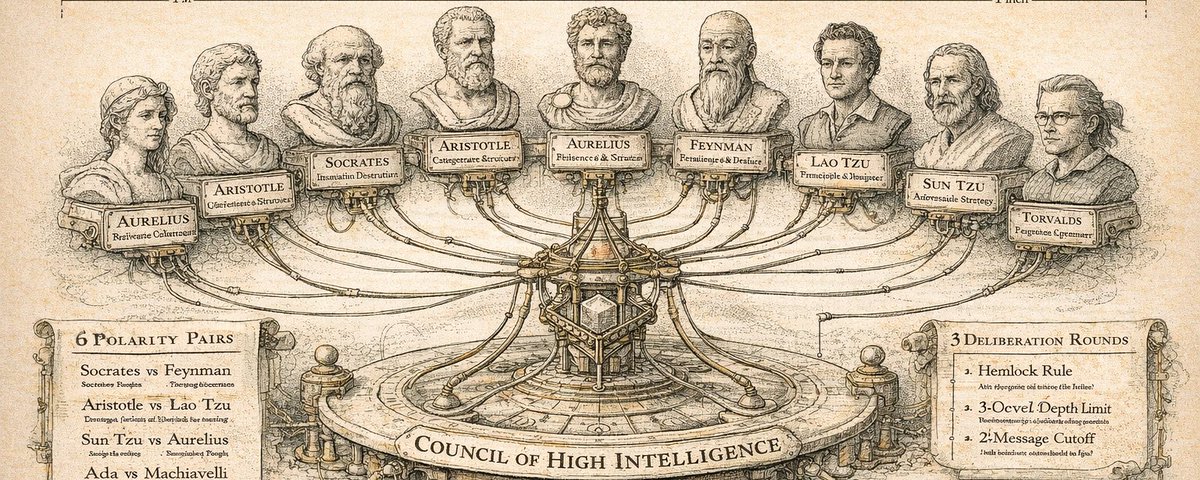
18 AI personas deliberate your hardest decisions across multiple LLM providers. Structured multi-round deliberation, confidence-weighted verdicts, genuine model diversity. Install as a Claude Code plugin — one command: /council
3.4k
Stars
305
Forks
10
Open issues
5
Contributors


AI Analysis
Council of High Intelligence is a multi-agent AI deliberation system that routes questions across 18 distinct AI personas spanning multiple LLM providers (Claude, OpenAI, Gemini, Ollama) to generate structured disagreement and confidence-weighted verdicts. It serves teams and decision-makers who need to validate reasoning on complex decisions through genuine model diversity and structured debate rather than relying on single-model outputs. This tool is specialized for deliberative analysis wo...
Inferred from signals mentioned in the README (tests, CI, type safety) — not a review of the actual code.
AI's overall editorial judgment — not an average of the bars above, can weigh other factors too.
Multi-LLM deliberation framework routing 18 AI personas across providers for structured decision analysis
Council of High Intelligence is a shell-based orchestration tool that routes decision queries to 18 simulated AI personas (Aristotle, Feynman, Kahneman, Torvalds, etc.) distributed across multiple LLM providers (Claude, OpenAI, Gemini, Ollama). Designed for teams making high-stakes decisions, it structures disagreement rather than consensus, using polarity pairs and dissent quotas to surface reasoning conflicts. Adoption appears concentrated in AI-native teams and Claude ecosystem users; real-world production usage not verified.
Launched March 2, 2026 by 0xNyk. Represents a trend toward multi-agent deliberation systems and epistemic diversity in LLM applications. Emerged as Claude Code and Codex environments matured, enabling slash-command integration patterns.
179 stars gained in last 7 days (as of June 27, 2026) suggests strong recent interest among early adopters. Repository is only ~4 months old with active maintenance (last push June 27, 2026). Growth trajectory indicates adoption among developers exploring multi-model reasoning patterns, though absolute star count (1,179) places it below established agent orchestration projects like agent-teams-ai (1,418 stars) and claude-octopus (3,697 stars).
Adoption not verified. README demonstrates intended use cases (open-sourcing decisions, caching strategy, architecture choices) but contains no case studies, testimonials, enterprise deployment reports, or documented production usage. GitHub activity (stars, forks) suggests interest among developers, but conversion to actual use is undocumented.
Appears to be a shell-based command dispatcher that integrates with Claude Code and Codex environments via `/council` slash commands. Based on README, implements three deliberation modes (implied: full council, quick, and duo modes). Likely routes requests to multiple LLM providers with persona-specific prompting. Multi-provider auto-routing mentioned but implementation details not visible from README.
Not documented in README. No test framework or CI/CD pipeline mentioned.
Last push June 27, 2026 (2 days before analysis date) indicates active maintenance. Repository is 4 months old, suggesting early-stage project with responsive iteration. No evidence of stalled development. Frequency of updates not documented, making it unclear if this is sustained maintenance or initial launch activity.
ADOPT IF: You are making high-stakes decisions within a Claude Code or Codex environment, value epistemic diversity and visible disagreement over consensus, and want structured deliberation without engineering multi-agent orchestration from scratch. AVOID IF: You need production-grade error handling, monitoring, audit trails, or are already invested in Python-based LLM stacks (LangChain, LlamaIndex). MONITOR IF: You are prototyping decision support systems or exploring multi-persona reasoning—watch for documentation of real-world deployments and expansion beyond Claude ecosystem.
Independent dimensions
Mainstream potential
4/10
Technical importance
6/10
Adoption evidence
2/10
- Adoption concentrated in niche (Claude ecosystem, decision support). Limited cross-provider testing documented. Unclear if multi-provider routing actually produces genuinely different reasoning or merely distributes API calls.
- Shell-based implementation may limit portability to Windows or non-bash environments. No container or language-agnostic packaging mentioned.
- No documented error handling, rate-limiting recovery, or fallback strategies for LLM provider outages.
- Persona quality depends entirely on prompt engineering. README does not explain how persona prompts were validated or compared to alternatives.
- Early-stage project (4 months old). Risk of abandonment if maintainer priorities shift. Contribution patterns and community engagement not documented.
Likely remains a niche tool for AI-native teams exploring epistemic diversity in decision-making. Potential growth if persona library expands and Claude ecosystem adoption increases, or if documented case studies prove ROI on complex decisions. May influence broader multi-agent frameworks to adopt dissent-quota and polarity-pair patterns, but unlikely to displace general-purpose agent orchestration tools.
Newsletter
Get analyses like this every Monday
Free weekly digest of the most interesting open-source discoveries.
Languages
Information
- Language
- Shell
- License
- MIT
- Last updated
- 6d ago
- Created
- 4mo ago
- Analyzed with
- anthropic/claude-haiku-4-5
Stars over time
Contributors over time
Top 100 contributors only — repos with more will plateau at 100.
Open issues
Top contributors
Similar repos

nyldn/claude-octopus
Claude Octopus is a multi-LLM orchestration tool that runs tasks across up to...

777genius/agent-teams-ai
Agent Teams AI is a desktop application that orchestrates multiple AI agents to...

2aronS/Duel-Agents
Duel Agents is a routing layer for IDE plugins (Claude Code, Cursor, Codex CLI,...
| Repository | Stars | Week Δ | Language | Score | Updated |
|---|---|---|---|---|---|
|
0xNyk/council-of-high-intelligence
this
|
3.4k | +395 | Shell | 7/10 | 6d ago |
|
nyldn/claude-octopus
|
3.8k | — | Shell | 7/10 | 14h ago |
|
777genius/agent-teams-ai
|
1.6k | — | TypeScript | 7/10 | 8h ago |
 zts212653/clowder-ai zts212653/clowder-ai
|
2.1k | — | TypeScript | 7/10 | 8h ago |
|
2aronS/Duel-Agents
|
975 | — | TypeScript | 7/10 | 2w ago |
 sigoden/aichat sigoden/aichat
|
10.2k | — | Rust | 8/10 | 5mo ago |
Larger ecosystem (3,697 stars). Both shell-based, both Claude-focused. claude-octopus likely serves broader automation use cases; Council is explicitly optimized for decision deliberation with philosophical personas.
TypeScript-based multi-agent framework (1,418 stars). More general-purpose agent coordination. Council is narrower (decision support) but includes explicit dissent mechanisms and persona diversity; agent-teams likely more flexible for arbitrary agent tasks.
Established Python frameworks for multi-model orchestration. Council is shell-native and lighter-weight. LangChain/LlamaIndex offer production maturity, broader integrations, and established production patterns; Council offers simpler onboarding and decision-specific UX.
Simpler agent handoff pattern. Council provides structured deliberation with enforced disagreement; Swarm focuses on sequential agent coordination. Different problem framing.
Native Claude environments with multi-turn capabilities. Council adds explicit persona structuring and cross-provider routing; Console/Projects offer tighter integration but less deliberation structure.