FFmpeg GUI
1.3k
Stars
39
Forks
11
Open issues
7
Contributors


AI Analysis
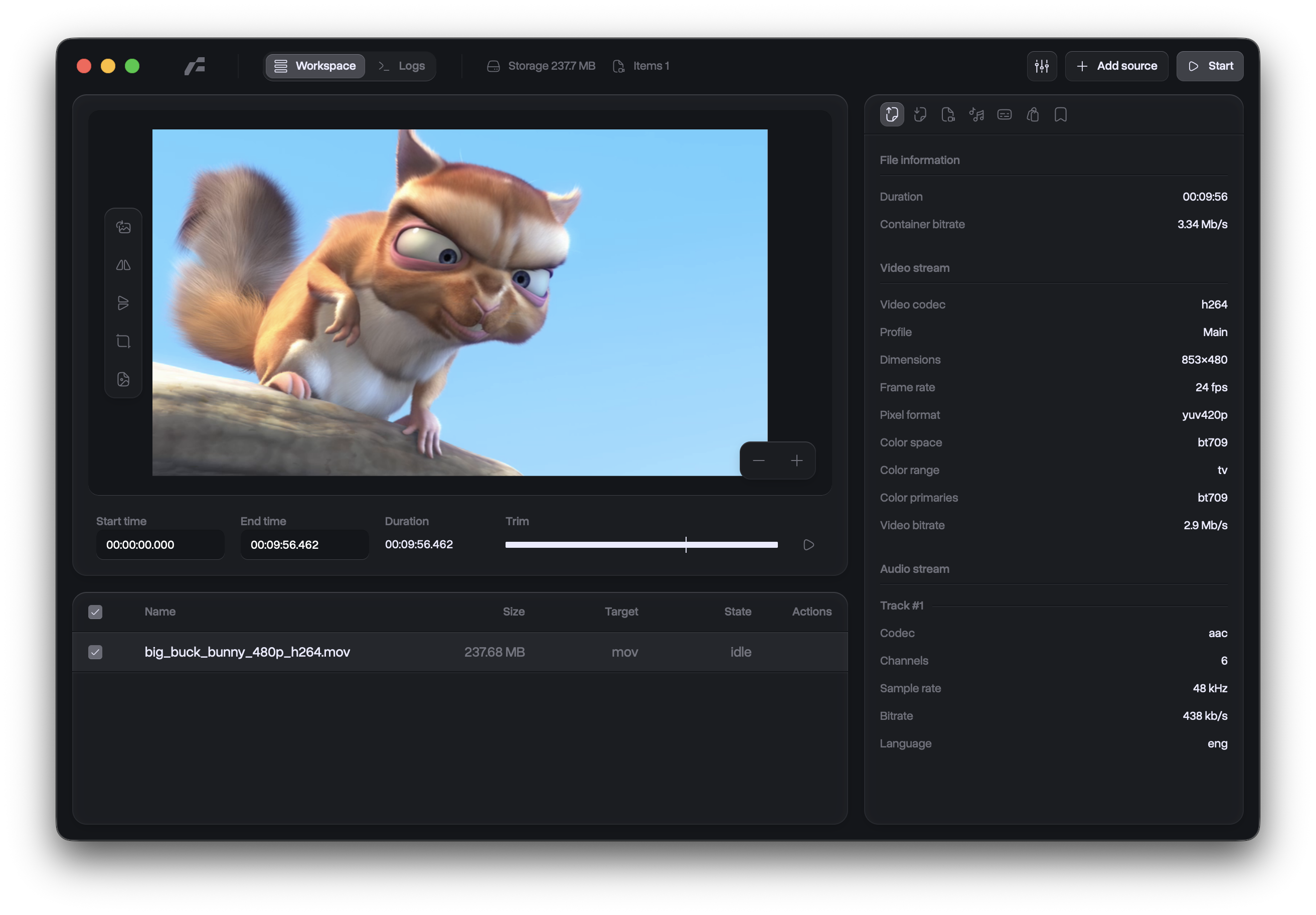
Frame is a native desktop media conversion utility built in Rust that provides a graphical interface for FFmpeg operations. It specializes in granular control over video, audio, image, and subtitle conversion with support for multiple codecs and hardware acceleration, serving users who need precise FFmpeg control without command-line interaction. Best suited for content creators, media professionals, and users requiring batch media conversion with advanced codec options on Windows, macOS, and...
Inferred from signals mentioned in the README (tests, CI, type safety) — not a review of the actual code.
AI's overall editorial judgment — not an average of the bars above, can weigh other factors too.
New Rust-native FFmpeg GUI with rapid early adoption, nascent ecosystem fit
Frame is a desktop media conversion application written in Rust that wraps FFmpeg, providing a graphical interface for video, audio, and image transcoding. Built on GPUI-CE and released in January 2026, it has accumulated 1,298 stars and 163 new stars in the past week, suggesting strong initial interest from Rust developers and media professionals seeking an alternative to command-line FFmpeg. Real-world production adoption remains unverified; the project is too young to establish sustained user base patterns.
Frame was created January 19, 2026, making it approximately 5.5 months old as of July 2026. It represents a recent wave of Rust-based desktop applications targeting media workflows traditionally dominated by CLI tools or legacy GUIs like HandBrake. The project is maintained by a single primary developer (66HEX) and is actively evolving.
The project gained 163 stars in 7 days (ending July 9, 2026), suggesting recent visibility spike or feature release. The 1,298 total stars over ~6 months indicates steady interest rather than viral adoption. Growth appears driven by: (1) novelty of a modern Rust FFmpeg GUI, (2) appeal to Rust developer communities, and (3) active maintenance visible in last push date (July 9, 2026). The funding requirement for code-signing certificates suggests the developer is seeking resources to reduce friction for macOS and Windows users.
Adoption not verified. No case studies, enterprise deployments, or documented user bases mentioned. GitHub Sponsors setup suggests the developer is seeking financial sustainability, which may indicate current adoption does not generate sufficient income. The project's youth and lack of public testimonials make it impossible to assess whether professionals actively rely on Frame for production workflows.
Based on README: Frame uses a modular architecture with a reusable `frame-core` conversion library (FFmpeg argument generation, media validation, task control) and a GPUI-CE native UI. Concurrent processing through Rust task controller. Runtime relies on bundled or system FFmpeg/FFprobe binaries. The project appears to separate concerns between UI and media logic, which is a sound design pattern. Actual implementation quality cannot be assessed from README alone.
Not documented in README. No mention of test suite, CI/CD pipeline, or testing strategy provided.
Last push July 9, 2026 (1 day before analysis date) indicates active ongoing work. Repository created January 2026 and continuously updated suggests the developer is committed. However, project age (5.5 months) is too short to assess long-term maintenance patterns. Single-developer projects carry succession risk if funding/interest wanes.
ADOPT IF: you are comfortable with early-stage software, value open-source licensing (GPL-3.0), and need a modern desktop FFmpeg GUI on macOS/Windows/Linux with Rust-native UI and granular codec control. AVOID IF: you require production-hardened stability, extensive documentation, large community support, or enterprise warranties. Code-signing friction on macOS/Windows may deter non-technical users despite fixes being straightforward. MONITOR IF: you are evaluating long-term media workflow tooling; Frame's trajectory over the next 12 months will clarify whether it gains adoption beyond Rust enthusiasts or remains a niche tool.
Independent dimensions
Mainstream potential
3/10
Technical importance
5/10
Adoption evidence
2/10
- Single-developer project; succession risk and burnout potential if funding goals unmet or personal circumstances change.
- Code-signing certificate costs ($400–$800/year) are not trivial for solo developer; project sustainability hinges on sponsorship, which is currently unverified as functional revenue source.
- Test coverage not documented; production reliability and regression safety cannot be assessed from public metadata.
- Network effects favor incumbents (HandBrake); Frame must overcome inertia despite superior UI. Niche adoption may plateau without significant differentiation or institutional backing.
- Very recent creation (5.5 months); insufficient data to predict whether project will sustain updates or follow common pattern of enthusiast tools that stall after initial momentum.
Frame will likely remain a viable but modest-adoption tool within the Rust/open-source media communities through 2027. Further growth depends on: securing sponsorship for code-signing (removing friction), building documentation and tutorials, and establishing production case studies. Without evidence of institutional adoption or significant community contributions, mainstream displacement of HandBrake or CLI workflows is improbable. Most probable outcome: stable niche tool serving ~1–5K active users within 18 months.
Newsletter
Get analyses like this every Monday
Free weekly digest of the most interesting open-source discoveries.
Languages
Information
- Website
- https://www.framegui.app/
- Language
- Rust
- License
- GPL-3.0
- Last updated
- 15h ago
- Created
- 6mo ago
- Analyzed with
- anthropic/claude-haiku-4-5
Stars over time
Contributors over time
Top 100 contributors only — repos with more will plateau at 100.
Open issues
Open pull requests
No open pull requests.
Top contributors
Similar repos

Lake1059/FFmpegFreeUI
FFmpegFreeUI (3FUI) is a professional FFmpeg wrapper for Windows that provides...

yazaldefilimone/ffmpreg
FFmpReg is a Rust-native multimedia toolkit for decoding, transforming, and...
| Repository | Stars | Week Δ | Language | Score | Updated |
|---|---|---|---|---|---|
|
66HEX/frame
this
|
1.3k | +199 | Rust | 7/10 | 15h ago |
|
Lake1059/FFmpegFreeUI
|
7.3k | — | Visual Basic .NET | 7/10 | 3d ago |
 zmwangx/rust-ffmpeg zmwangx/rust-ffmpeg
|
1.9k | — | Rust | 7/10 | 1d ago |
|
yazaldefilimone/ffmpreg
|
1.1k | — | Rust | 6/10 | 2mo ago |
 FFmpeg/FFmpeg FFmpeg/FFmpeg
|
61.9k | — | C | 10/10 | 8h ago |
 rdp/ffmpeg-windows-build-helpers rdp/ffmpeg-windows-build-helpers
|
1.2k | — | Shell | 7/10 | 4mo ago |
Mature, cross-platform FFmpeg GUI with decades of adoption and established user base. Frame offers more granular codec/bitrate controls and modern Rust-native UI. HandBrake has vastly larger adoption and ecosystem maturity; Frame is a nascent alternative.
Frame targets users who want GUI convenience over direct FFmpeg command-line usage. FFmpeg CLI offers maximum flexibility and zero learning curve for power users; Frame adds friction for advanced workflows but lowers entry barrier.
Supports video transcoding as secondary feature alongside editing. Frame is conversion-focused; DaVinci is full-featured NLE that happens to support export. Different user personas.
Cross-platform open-source multimedia editor with transcoding capabilities. Shotcut is editing-first; Frame is conversion-first. Overlapping but distinct use cases.
Professional-grade closed-source batch transcoding. Frame is open-source and free. Adoption, feature completeness, and stability incomparable; different market segments.