Stable Diffusion web UI
164.2k
Stars
30.5k
Forks
2.5k
Open issues
100+
Contributors




AI Analysis
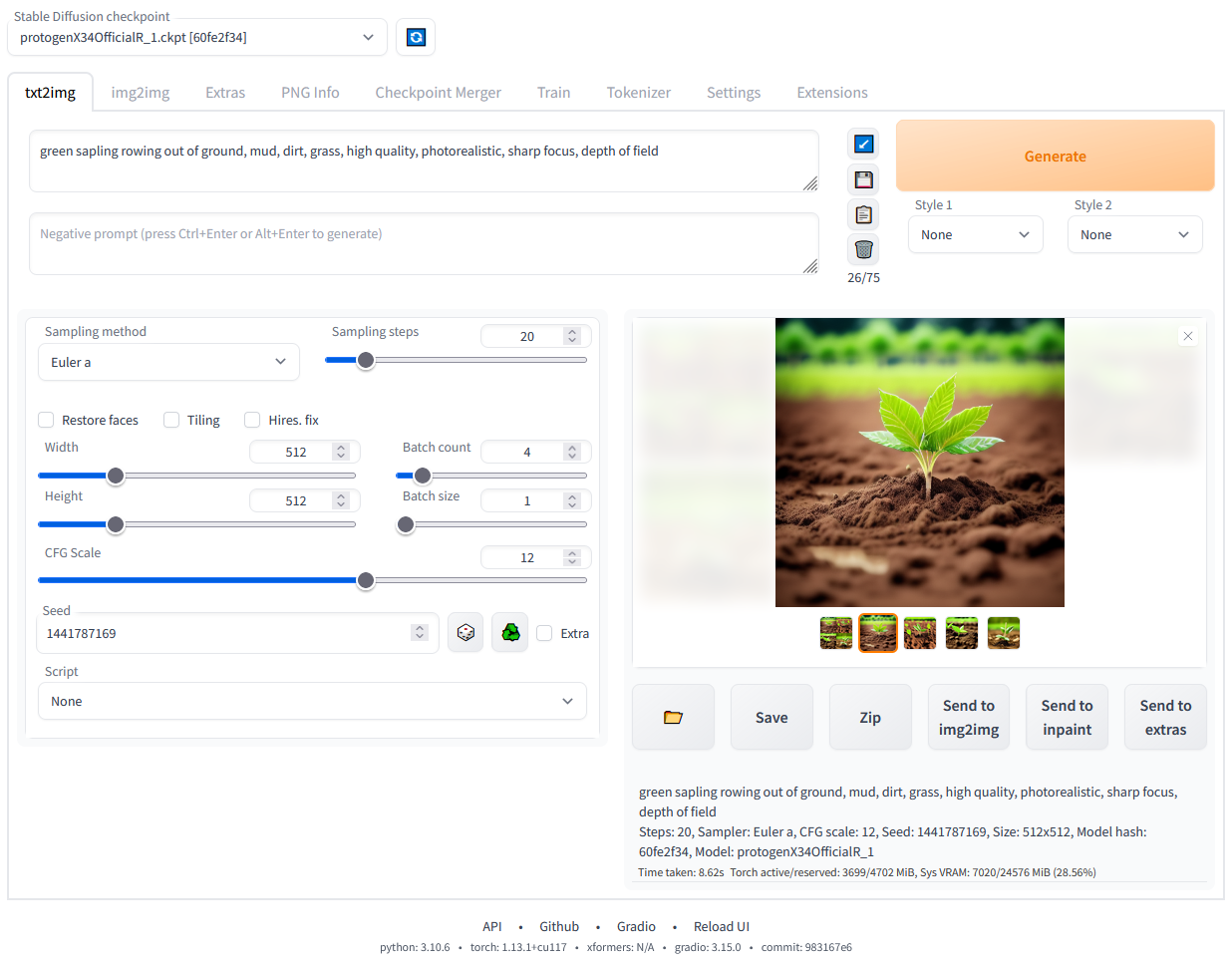
AUTOMATIC1111/stable-diffusion-webui is a feature-rich browser-based interface for running Stable Diffusion image generation models locally, built on the Gradio library. It serves enthusiasts, artists, and researchers who want a self-hosted, no-code-required UI for text-to-image, image-to-image, inpainting, upscaling, and related workflows. It is not intended for developers building production ML pipelines or for users without a capable GPU and basic Python/Git setup.
Inferred from signals mentioned in the README (tests, CI, type safety) — not a review of the actual code.
AI's overall editorial judgment — not an average of the bars above, can weigh other factors too.
AUTOMATIC1111's SD WebUI: The de facto local image generation interface for 163K+ stars
Stable Diffusion web UI is a Gradio-based web interface for running Stable Diffusion models locally. It targets hobbyists, artists, and researchers who want a feature-rich, extensible local image generation environment without writing code. It became the dominant self-hosted SD frontend largely by shipping features fast, supporting a massive extension ecosystem, and offering low hardware barriers (4GB VRAM minimum). Real-world adoption is exceptionally well documented — it underpins a large share of community model sharing on CivitAI and HuggingFace.
Launched August 2022, days after Stable Diffusion's public release. AUTOMATIC1111 rapidly iterated on features, establishing it as the community standard before serious alternatives emerged. Maintained as a solo/small-team open source project under AGPL-3.0.
Explosive initial growth was driven by the SD model release wave in late 2022 and community momentum on Reddit and Discord. Extension ecosystem created a flywheel: more extensions attracted users who built more extensions. Growth has plateaued as the SD ecosystem matured and alternatives like Forge emerged, but the installed base remains enormous. Current 144 stars/week indicates steady but not expanding attention.
Adoption is extensively verified. 163K+ GitHub stars, 30K+ forks. Directly referenced by CivitAI (largest SD model hub) as a primary target for model compatibility. Cited in academic papers on diffusion model tooling. Numerous cloud services (RunDiffusion, Massed Compute, etc.) offer hosted versions of this exact UI. HuggingFace Spaces instances of AUTOMATIC1111's fork are widely used. Docker wrapper repo at 7K+ stars corroborates infrastructure-level deployment.
Appears to use Gradio as the UI layer over Python-based Stable Diffusion inference. Likely modular with a plugin/extension API that allows third-party scripts to hook into generation pipelines. Backend likely wraps PyTorch model inference with xformers optimization support. API endpoint availability is explicitly documented, suggesting a REST-like interface layer.
not documented in README
Last push was 2026-03-02, approximately 3.5 months before the evaluation date. For a project of this size and age, this suggests maintenance activity has slowed but is not fully stagnant. The project appears to be in a stable/mature maintenance mode rather than active feature development. No recent major release signals visible from metadata alone.
ADOPT IF: you want a battle-tested, feature-complete local SD interface with the largest extension ecosystem and most community model compatibility. AVOID IF: you need cutting-edge model support (SDXL, Flux, SD3) with maximum performance — ComfyUI or Forge are better positioned there. MONITOR IF: you are currently using A1111 in production and want to assess whether maintenance decline will affect long-term viability.
Independent dimensions
Mainstream potential
6/10
Technical importance
8/10
Adoption evidence
10/10
- Maintenance pace has visibly slowed (last push ~3.5 months ago), and the project appears to rely heavily on one primary maintainer, creating bus-factor risk.
- Newer model architectures (SDXL, SD3, Flux) are better supported in forks like Forge or alternative tools like ComfyUI, meaning A1111 may lag on future model compatibility.
- AGPL-3.0 license creates commercial use friction — businesses integrating this must open-source derivative works or negotiate separately.
- The extension ecosystem, while a strength, is largely community-maintained with variable quality and may break across versions without coordinated compatibility guarantees.
- Community gravity appears to be shifting toward ComfyUI as the enthusiast standard, which could gradually reduce the extension contribution rate over time.
Likely to remain a large installed base and community reference point for years, but unlikely to recover peak growth momentum. Forge and ComfyUI will absorb most new users. A1111 stabilizes as a legacy-compatible, broadly supported option rather than the leading edge.
Newsletter
Get analyses like this every Monday
Free weekly digest of the most interesting open-source discoveries.
Languages
Information
- Language
- Python
- License
- AGPL-3.0
- Last updated
- 4mo ago
- Created
- 47mo ago
- Analyzed with
- anthropic/claude-sonnet-4-6
Stars over time
Contributors over time
Top 100 contributors only — repos with more will plateau at 100.
Open issues
Top contributors
Similar repos

camenduru/stable-diffusion-webui-colab
This repository provides Google Colab notebook implementations of Stable...

lllyasviel/stable-diffusion-webui-forge
Stable Diffusion WebUI Forge is a specialized platform extending the...

TheLastBen/fast-stable-diffusion
fast-stable-diffusion provides optimized Google Colab notebooks for running...
| Repository | Stars | Week Δ | Language | Score | Updated |
|---|---|---|---|---|---|
|
AUTOMATIC1111/stable-diffusion-webui
this
|
164.2k | +192 | Python | 8/10 | 4mo ago |
 Sygil-Dev/sygil-webui Sygil-Dev/sygil-webui
|
7.9k | — | Python | 6/10 | 7mo ago |
|
camenduru/stable-diffusion-webui-colab
|
15.9k | — | Jupyter Notebook | 5/10 | 7mo ago |
|
lllyasviel/stable-diffusion-webui-forge
|
12.8k | — | Python | 7/10 | 11mo ago |
|
TheLastBen/fast-stable-diffusion
|
7.9k | — | Python | 6/10 | 7mo ago |
 Comfy-Org/ComfyUI Comfy-Org/ComfyUI
|
120.2k | — | Python | 9/10 | 1h ago |
Fork of AUTOMATIC1111 that significantly improves performance and VRAM efficiency, particularly for SDXL and newer architectures. Actively pulls from the original while adding backend optimizations. Represents the most credible successor for users on constrained hardware. Growing rapidly at 12K+ stars.
Node-based graph interface for SD pipelines. More flexible for complex workflows and power users; steeper learning curve. Has surpassed A1111 in growth momentum as of 2024-2025 and is increasingly the enthusiast standard for SDXL/SD3/Flux models.
More polished, professionally maintained alternative with a structured team and roadmap. Better suited for creative professionals seeking stability over bleeding-edge features. Smaller but dedicated user base.
Early community fork that did not sustain momentum. Significantly smaller adoption than A1111 (7.9K stars vs 163K). Appears largely superseded.
Not a competing interface but a containerization layer for A1111 itself. Its 7K+ stars reflect demand for easier deployment of the same tool, not a replacement.