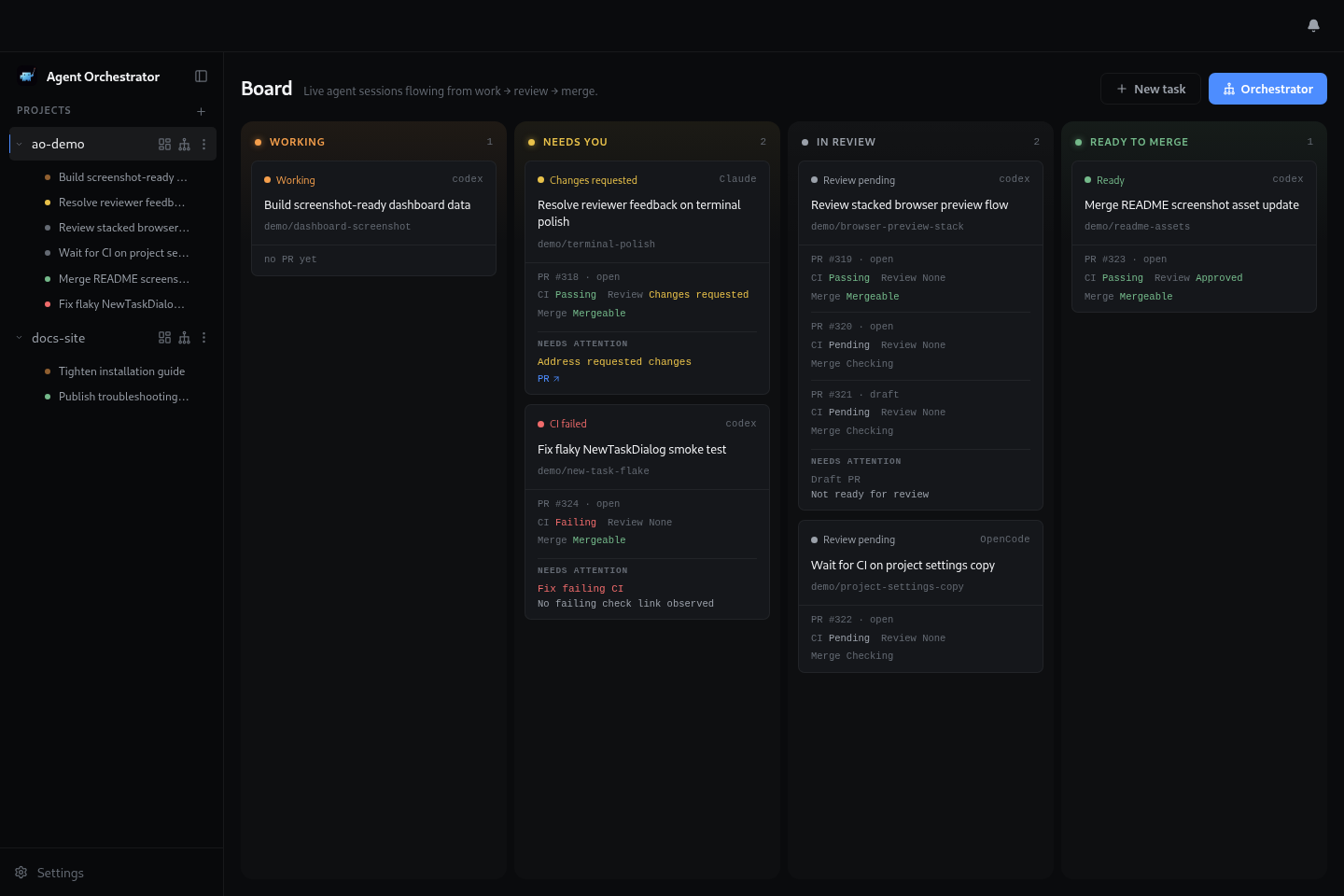
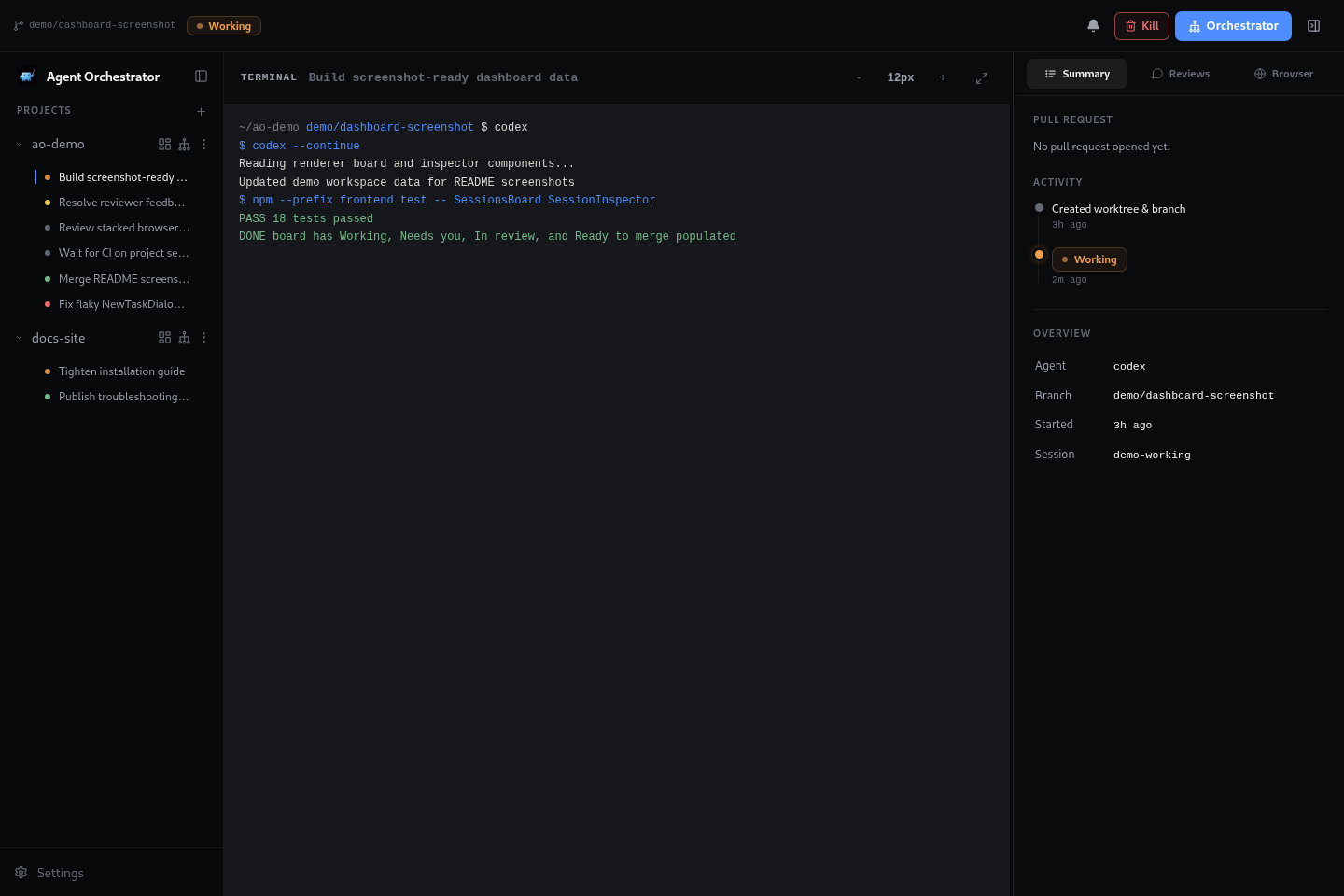
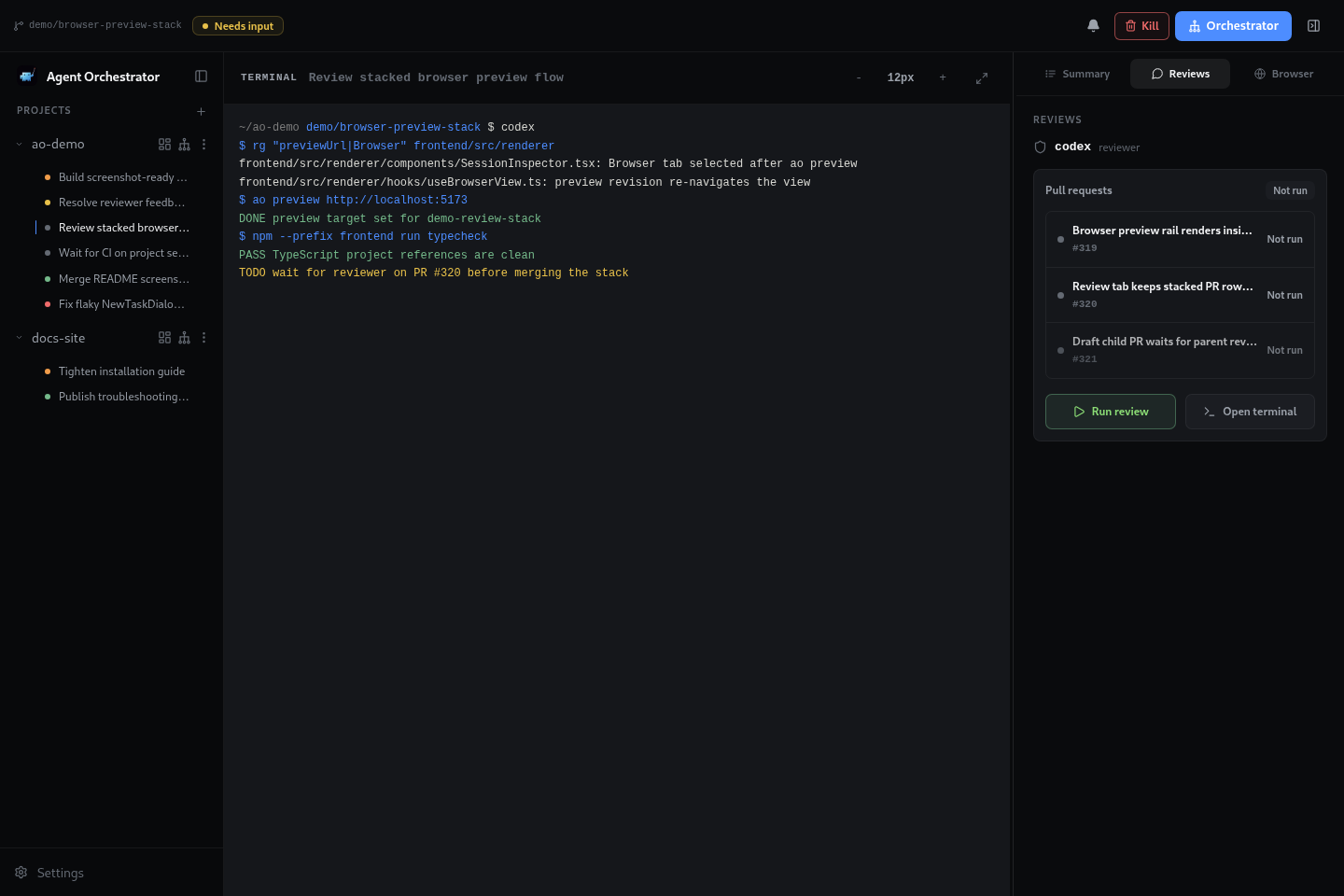
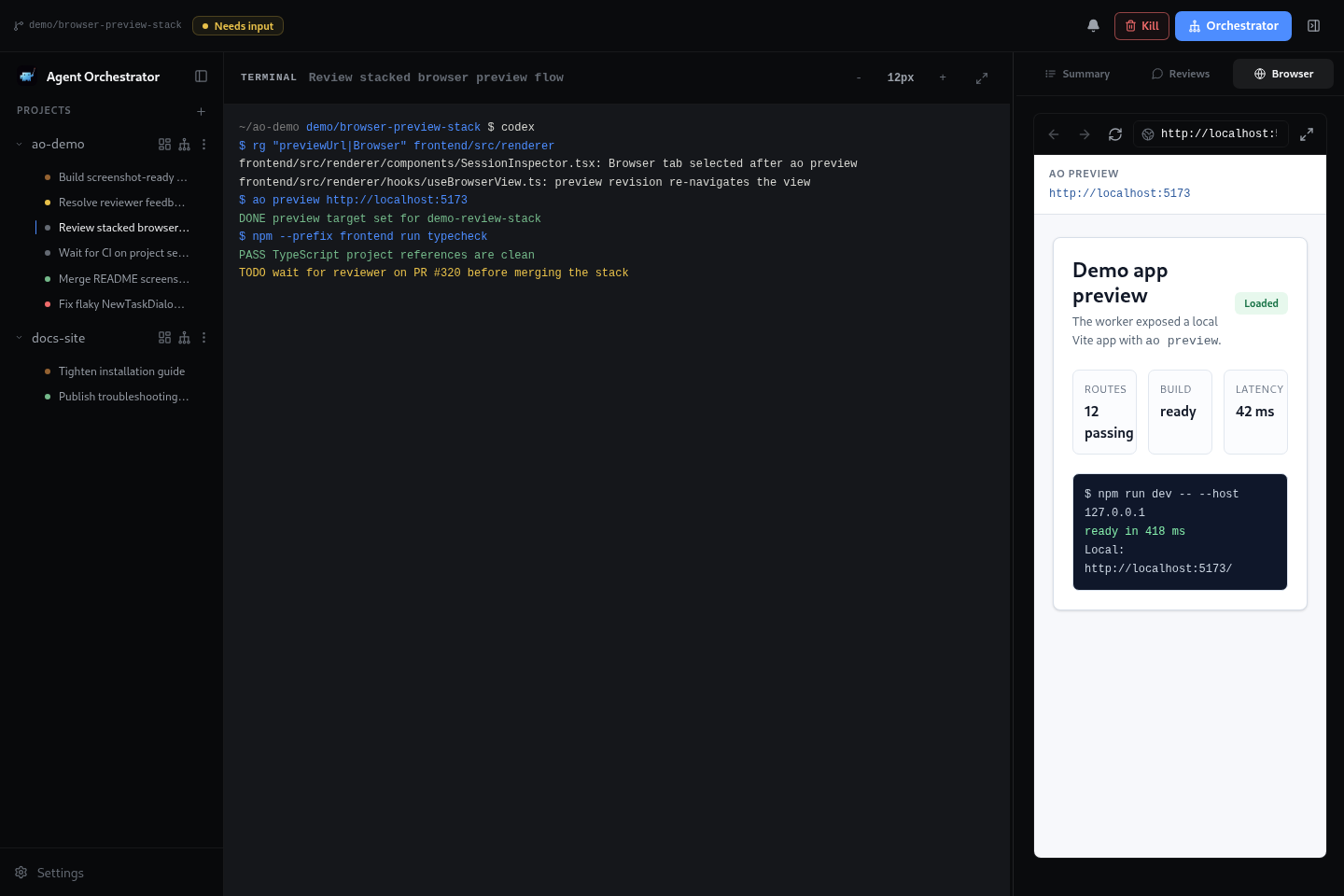
Agentic orchestrator for parallel coding agents — plans tasks, spawns agents, and autonomously handles CI fixes, merge conflicts, and code reviews.
8.2k
Stars
1.2k
Forks
434
Open issues
30
Contributors


AI Analysis
Agent Orchestrator is a meta-harness IDE for supervising multiple AI coding agents (Claude Code, Cursor, Aider, etc.) working in parallel on the same project, each in isolated git worktrees. It automates feedback loops from CI failures, code reviews, and merge conflicts back to the correct agent session. This is a specialized tool for teams or individuals who want to coordinate multiple autonomous coding agents at scale; it is not for general development or single-agent workflows.
Inferred from signals mentioned in the README (tests, CI, type safety) — not a review of the actual code.
AI's overall editorial judgment — not an average of the bars above, can weigh other factors too.
Go-based meta-harness for managing parallel AI coding agents across isolated git workspaces
Agent Orchestrator is a local orchestration layer that wraps terminal-based AI coding agents (Claude Code, Codex, Aider, Cursor, etc.) in isolated git worktrees, automatically routing CI failures, review comments, and merge conflicts back to the correct agent session. It targets developers or teams running multiple AI coding agents simultaneously who need a unified supervisor instead of manually tracking parallel terminal sessions and branches. At 8K stars in roughly 5 months, it has attracted meaningful early attention in a rapidly expanding category of agentic development tooling.
Created February 2026, this project emerged as AI coding agents proliferated and developers began running them in parallel, surfacing a coordination gap that no single CLI or IDE addressed. It is written in Go, distinguishing it from most TypeScript competitors in this space.
Gained 8,079 stars in approximately 5 months, with 286 stars in the last 7 days suggesting sustained organic momentum rather than a single viral spike. Growth likely correlates with rising adoption of Claude Code, Codex CLI, and similar agent CLIs as professional tools, creating demand for a meta-harness. An active Discord and Twitter presence appear to support community-driven discovery.
Adoption not verified in production environments. The project has community signals (Discord, Twitter, fork count) and mentions support for widely-used agents (Claude Code, Codex, Aider), but no documented case studies, enterprise usage, or quantified install counts are present in the README. Early-adopter usage is plausible given star trajectory, but cannot be confirmed.
Appears to follow a daemon-plus-desktop-app architecture: a local daemon watches git worktrees, session state, terminal activity, PRs, CI, and review feedback, while a desktop app and CLI surface state and allow instruction routing. Likely uses git worktrees as the primary isolation primitive. The Go backend likely handles process management, IPC, and the event loop for feedback routing. Architecture description in README is clear, but internal implementation details cannot be verified.
Not documented in README
Last push was 2026-07-06, same day as analysis — indicating active, current development. The project is under 5 months old with 1,148 forks and an active social presence, suggesting ongoing contributor engagement. No signs of stagnation; cadence appears high for an early-stage project.
ADOPT IF: you are actively running multiple AI coding agent CLIs in parallel and losing time to manual branch coordination, CI triage, or PR routing — especially if your stack is Go-friendly. AVOID IF: you only run a single agent at a time, your team has no established CI/PR workflow to integrate with, or you need a vetted production-grade tool with documented stability guarantees. MONITOR IF: you are evaluating agentic development workflows and want to track which orchestration layer gains the most ecosystem traction over the next 6–12 months.
Independent dimensions
Mainstream potential
6/10
Technical importance
8/10
Adoption evidence
2/10
- Very young project (5 months old) — API surfaces, configuration formats, and core behaviors may change significantly without stability guarantees.
- No documented production usage or case studies means real-world edge cases (complex monorepos, large teams, flaky CI) are largely untested publicly.
- Competes in a fast-moving category where well-funded projects (including from AI labs themselves) could absorb this functionality into first-party tooling.
- Go toolchain requirement may limit adoption in teams whose infrastructure and contributors are TypeScript or Python-centric.
- Local daemon architecture may introduce reliability concerns (process crashes, state drift) that are not yet addressed by documented recovery or persistence mechanisms.
Likely to grow steadily as parallel agent usage becomes standard practice. Risk of consolidation around a smaller number of dominant tools in 12–18 months; AO's trajectory puts it in contention but not yet in a leading position.
Newsletter
Get analyses like this every Monday
Free weekly digest of the most interesting open-source discoveries.
Languages
Information
- Website
- https://aoagents.dev
- Language
- Go
- License
- Apache-2.0
- Last updated
- 7h ago
- Created
- 5mo ago
- Analyzed with
- anthropic/claude-haiku-4-5
Stars over time
Contributors over time
Top 100 contributors only — repos with more will plateau at 100.
Top contributors
Similar repos

jnMetaCode/agency-orchestrator
Agency Orchestrator is a multi-agent AI orchestration platform that automates...

agent-of-empires/agent-of-empires
Agent of Empires is a session manager and orchestrator for multiple AI coding...
| Repository | Stars | Week Δ | Language | Score | Updated |
|---|---|---|---|---|---|
|
AgentWrapper/agent-orchestrator
this
|
8.2k | +285 | Go | 7/10 | 7h ago |
 stablyai/orca stablyai/orca
|
15.3k | — | TypeScript | 8/10 | 6h ago |
|
jnMetaCode/agency-orchestrator
|
1.7k | — | TypeScript | 8/10 | 2d ago |
|
agent-of-empires/agent-of-empires
|
2.8k | — | Rust | 7/10 | 1d ago |
 preset-io/agor preset-io/agor
|
1.3k | — | TypeScript | 7/10 | 9h ago |
 first-fluke/oh-my-agent first-fluke/oh-my-agent
|
1.2k | — | TypeScript | 8/10 | 11h ago |
Orca (12,597 stars, TypeScript) is the current star-count leader in this category. AO differentiates with a Go backend, git worktree isolation as a first-class primitive, and an explicit focus on CI/PR feedback loops rather than just session management.
1code (5,626 stars, TypeScript) appears closer to an AI IDE experience. AO positions itself explicitly as a meta-harness for existing agent CLIs rather than a replacement IDE, which is a narrower but potentially more composable approach.
Written in Rust (2,761 stars), this project appears to target a similar orchestration use case. Rust vs Go is a meaningful runtime difference for long-running daemons; neither has a clear advantage without more implementation detail.
TypeScript-based with 1,661 stars; likely appealing to JS/TS-native teams. AO's Go toolchain may be preferable in environments where Node.js is not the default runtime.
agor (1,312 stars, TypeScript) is smaller and less documented publicly. AO has substantially more traction and a more explicit feature surface for CI and PR feedback routing.