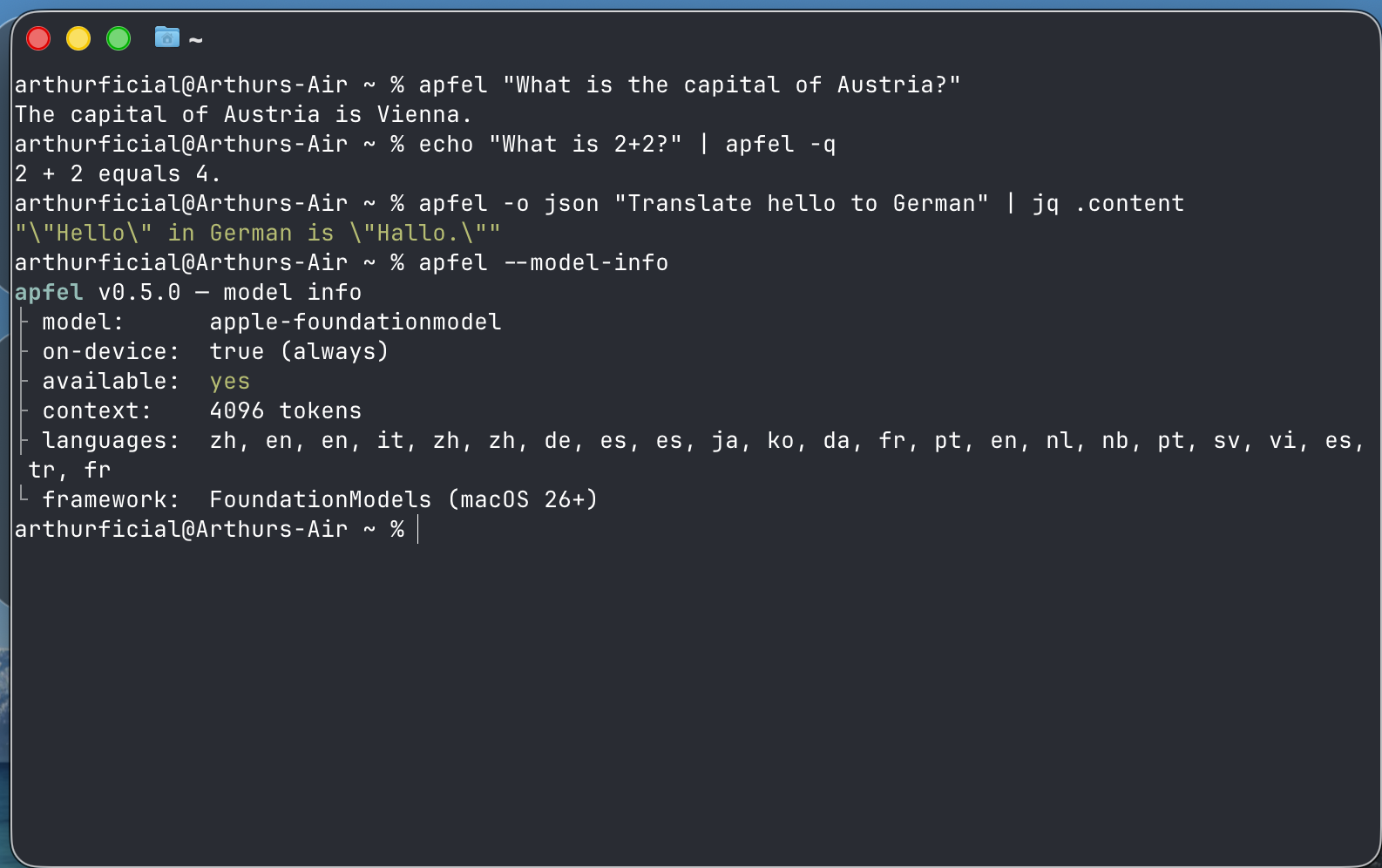
The free AI already on your Mac. CLI tool, OpenAI-compatible server, and interactive chat — all on-device via Apple Intelligence. No API keys, no cloud, no downloads.
6.1k
Stars
232
Forks
12
Open issues
13
Contributors


AI Analysis
apfel is a CLI tool and local OpenAI-compatible server that exposes Apple's built-in FoundationModels LLM on Apple Silicon Macs, enabling on-device AI inference without API keys or cloud dependencies. It serves developers and Mac users who want to integrate or interact with LLMs locally, specifically those running macOS 26 Tahoe+ on M1+ hardware; it is not suitable for non-Apple platforms or older macOS versions.
Inferred from signals mentioned in the README (tests, CI, type safety) — not a review of the actual code.
AI's overall editorial judgment — not an average of the bars above, can weigh other factors too.
apfel wraps Apple's on-device LLM as a Unix CLI and OpenAI-compatible server for macOS 26 Tahoe
apfel exposes the Apple FoundationModels API — the on-device LLM shipped with macOS 26 Tahoe — as a Unix pipe-friendly CLI, an interactive REPL, and a local OpenAI-compatible HTTP server. Its core value proposition is zero cost and zero data exfiltration: no API keys, no model downloads, no cloud calls. It targets macOS developers, privacy-conscious power users, and shell scripters who want LLM capabilities in automation workflows. The OpenAI-compatible endpoint (`/v1/chat/completions` on port 11434) allows drop-in use with existing OpenAI SDK code. The audience is currently gated by macOS 26 Tahoe and Apple Silicon, which limits it to a defined but growing hardware base.
Created in March 2026, shortly after Apple announced macOS 26 Tahoe and the public FoundationModels framework. Version 1.6.0 as of mid-2026 suggests rapid iteration since launch roughly three months ago.
The project gained ~5,800 stars in roughly three months, likely driven by developer curiosity around Apple Intelligence's public API debut and the novelty of free, fully offline LLM access on Apple Silicon. Growth appears to have stabilized (62 stars in the most recent 7-day window), suggesting the initial viral wave has passed and the audience is settling to genuine macOS 26 early adopters.
Homebrew availability and the presence of a background service mode (`brew services start apfel`) suggest some degree of real-world workflow integration. A companion website (apfel.franzai.com) and a separate apfel-chat GUI repo indicate ecosystem investment beyond a toy project. However, concrete production deployment evidence (download counts, user testimonials, integration reports) is not publicly documented. Adoption not verified at scale.
Appears to be a Swift 6.3 command-line binary with three operational modes: a one-shot Unix tool, an interactive REPL, and an HTTP server. The HTTP server likely implements a subset of the OpenAI Chat Completions API, routing requests to the local FoundationModels framework. Tool calling and MCP (Model Context Protocol) server support are mentioned, suggesting a plugin/dispatch layer. Likely uses Swift's async/await concurrency model. No Xcode required for build — Command Line Tools with the macOS 26.4 SDK suffice.
Not documented in README.
Last push was 2026-06-23, one day before the evaluation date — actively maintained. Version 1.6.0 with a documented changelog cadence, Homebrew formula presence, and a companion GUI project (apfel-chat) suggest sustained developer commitment rather than a one-off release.
ADOPT IF: you are on macOS 26 Tahoe with Apple Silicon and Apple Intelligence enabled, want zero-config LLM access in shell scripts or local automation, or need a free drop-in OpenAI-compatible endpoint for prototyping without API costs. AVOID IF: you need a capable frontier model, more than 4096-token context, cross-platform deployment, or are not yet on macOS 26 Tahoe — the hardware and OS gate is strict. MONITOR IF: you are building macOS tooling and want to track how Apple expands FoundationModels capabilities in future OS releases, which would directly increase apfel's practical value.
Independent dimensions
Mainstream potential
4/10
Technical importance
6/10
Adoption evidence
3/10
- Strictly gated to macOS 26 Tahoe+ and Apple Silicon with Apple Intelligence enabled — the eligible user base, while growing, remains limited until Tahoe adoption widens.
- Apple FoundationModels capability is controlled entirely by Apple; model quality, context window (currently 4096 tokens), and API surface can change or be restricted without notice.
- The 4096-token context limit is a hard practical ceiling that rules out many document-processing and long-conversation use cases.
- If Apple ships an official CLI or expands the SDK to cover these use cases natively, demand for a third-party wrapper may decline.
- Dependency on Apple's guardrails (the `--permissive` flag hints at false-positive refusals) may frustrate users needing reliable outputs for creative or technical prompts.
apfel is likely to remain a useful convenience layer for macOS 26+ power users as Tahoe adoption grows, but its ceiling is tied directly to whatever Apple ships in FoundationModels. Slow, steady growth is the most probable trajectory.
Newsletter
Get analyses like this every Monday
Free weekly digest of the most interesting open-source discoveries.
Languages
Information
- Website
- https://apfel.franzai.com
- Language
- Swift
- License
- MIT
- Last updated
- 20h ago
- Created
- 4mo ago
- Analyzed with
- anthropic/claude-haiku-4-5
Stars over time
Contributors over time
Top 100 contributors only — repos with more will plateau at 100.
Open issues
test-infra follow-up: reduce fresh-process model startup in cli_e2e/test_chat (85 spawns per run)
dist-sync: nixpkgs behind v1.8.0 by ~72h
feat(model): --adapter <path.fmadapter> - serve custom LoRA adapters [DEFERRED to macOS 27 epic #189]
Support macOS 26 + macOS 27 from one binary: availability-gating strategy for OS-27 FoundationModels APIs
Evaluate adopting OS 27 FoundationModels APIs: ToolCallingMode + improved error types
Open pull requests
No open pull requests.
Top contributors
Recent releases
Similar repos

apple/python-apple-fm-sdk
Python bindings for Apple's Foundation Models framework, enabling on-device...
| Repository | Stars | Week Δ | Language | Score | Updated |
|---|---|---|---|---|---|
|
Arthur-Ficial/apfel
this
|
6.1k | +177 | Swift | 8/10 | 20h ago |
 AtomicBot-ai/Atomic-Chat AtomicBot-ai/Atomic-Chat
|
1.1k | — | TypeScript | 7/10 | 1d ago |
 signerlabs/Klee signerlabs/Klee
|
1.7k | — | Swift | 7/10 | 4mo ago |
 raullenchai/Rapid-MLX raullenchai/Rapid-MLX
|
3.2k | — | Python | 8/10 | 6h ago |
|
apple/python-apple-fm-sdk
|
1.2k | — | Python | 7/10 | 3d ago |
 osaurus-ai/osaurus osaurus-ai/osaurus
|
6.9k | — | Swift | 8/10 | 9h ago |
Ollama also exposes a local OpenAI-compatible server (same default port 11434), but requires model downloads and runs on a broader range of hardware. apfel requires no downloads and no configuration, but is strictly limited to Apple's on-device model on macOS 26 Tahoe+ Apple Silicon. They can coexist; apfel is not a general replacement.
A similar-star Swift project targeting Apple AI APIs. Exact feature overlap is unclear from available metadata, but both appear to target the same FoundationModels surface area. May represent a competing approach or complementary tooling in the same emerging ecosystem.
Apple's own Python SDK for FoundationModels targets Python developers building applications rather than CLI/shell automation users. apfel is more accessible for shell scripting and piping workflows; the SDK is more appropriate for Python application integration.
LM Studio offers a GUI-first local OpenAI server with model management, supporting many model families. It does not use Apple's built-in model and requires model downloads. apfel trades model choice for zero-setup convenience.
The `llm` Python CLI is broadly cross-platform and supports many backends via plugins. apfel is narrower in scope but requires no Python environment and has zero-config on qualifying hardware — a meaningful ergonomic advantage for Swift/shell-native Mac users.