
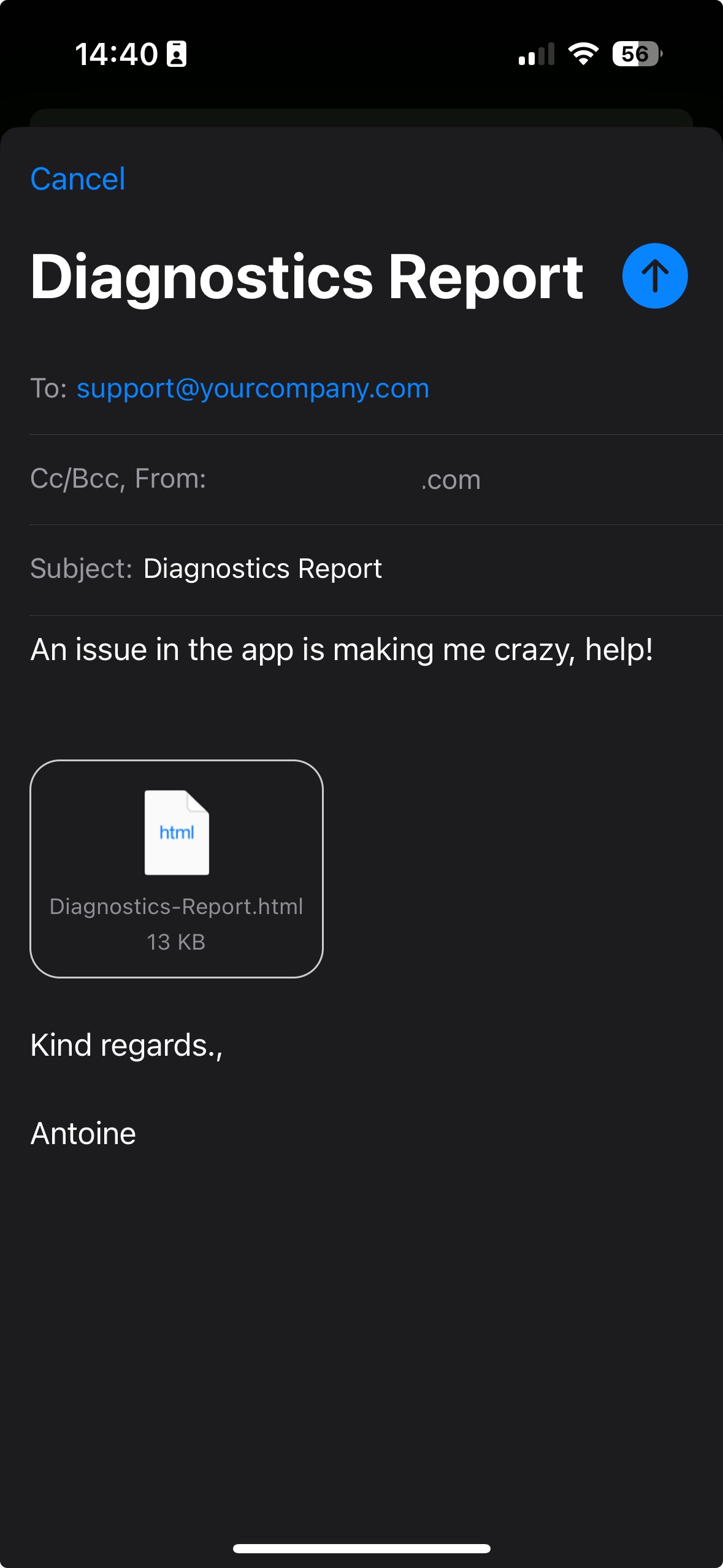
Allow users to easily share Diagnostics with your support team to improve the flow of fixing bugs.
1.3k
Stars
66
Forks
2
Open issues
23
Contributors


AI Analysis
Diagnostics is a Swift library that enables iOS/macOS/iPadOS app developers to easily generate and share diagnostic reports with support teams. It captures app metadata, system information, and logs in formats ranging from email-friendly HTML to structured JSON, helping streamline bug reporting and support workflows. Best suited for developers building production apps who need better visibility into user environments during troubleshooting.
Inferred from signals mentioned in the README (tests, CI, type safety) — not a review of the actual code.
AI's overall editorial judgment — not an average of the bars above, can weigh other factors too.
Swift library for packaging app diagnostics into shareable reports for support teams
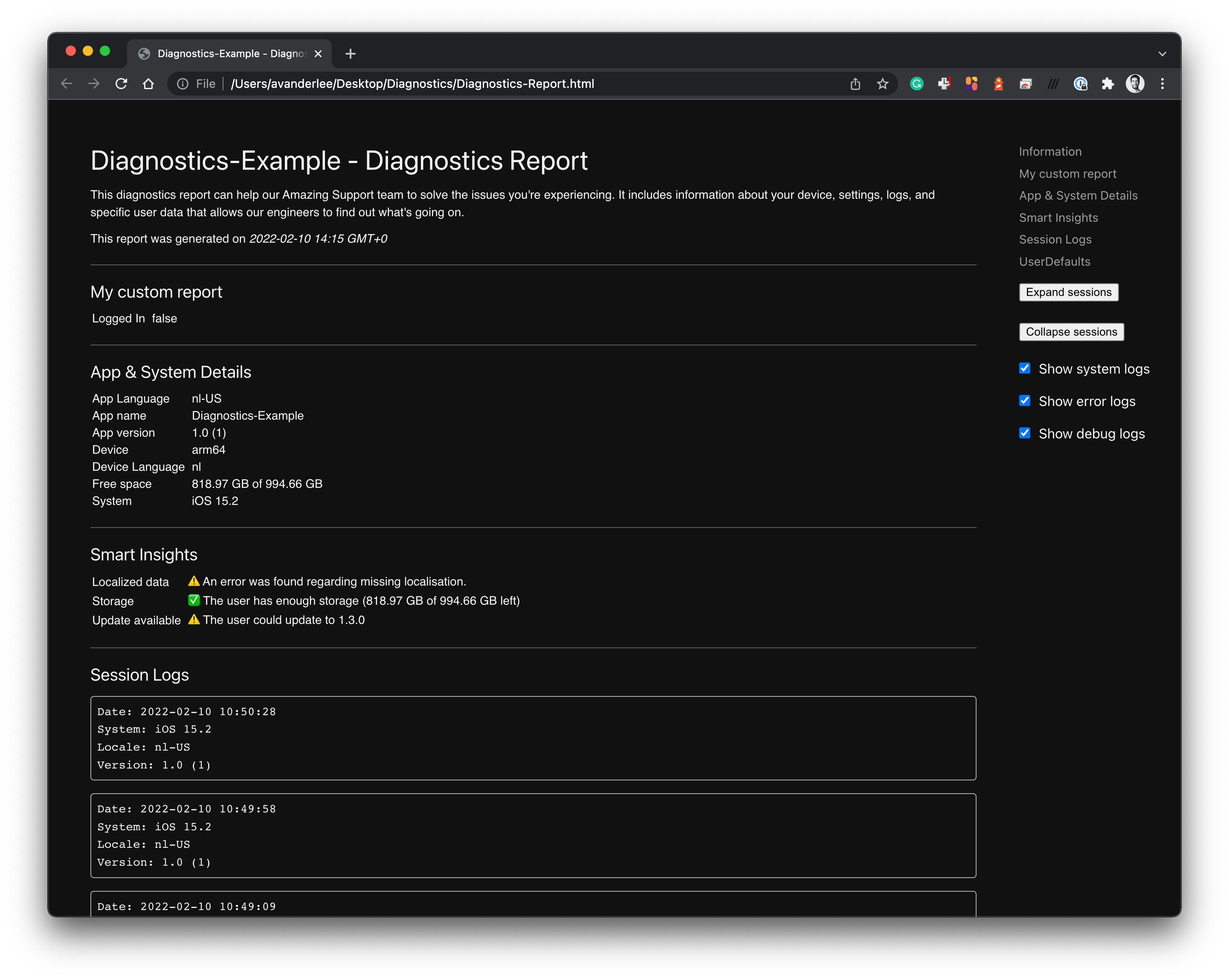
Diagnostics is a Swift library that simplifies the process of collecting and sharing application diagnostic data with support teams via email or other channels. It bundles system metadata, logs, app state, and custom data into single-file HTML or JSON reports. Designed for iOS, iPadOS, and macOS developers who need structured bug reporting workflows. The library appears to serve a well-defined niche rather than mass adoption, with moderate GitHub presence (1,201 stars) and steady maintenance.
Created in December 2019, Diagnostics emerged to address friction in bug report collection workflows. The project has evolved to support both HTML reports with embedded JSON and standalone JSON formats, with recent additions of 'agent-friendly' structured data and AI-compatible skill definitions for automated analysis.
The repository gained approximately 20 stars in the 7 days prior to 2026-07-09, indicating modest and stable growth rather than rapid adoption. Comparable Swift debugging libraries (DebugSwift, StikDebug, GDPerformanceView) have higher star counts (2,100–2,300), suggesting Diagnostics occupies a slightly smaller but focused segment. Steady maintenance through 2026 indicates continued investment rather than abandonment.
Adoption not verified. README includes examples of integration patterns and references to 'support agents' and 'AI tools' consuming JSON, but provides no public case studies, testimonials, or quantified adoption metrics. The moderate star count and presence on GitHub suggest some professional use, but the specific audience size and commercial deployment scope remain undocumented.
Based on README, the library appears structured around modular reporters (app metadata, system metadata, session logs) with a plugin-like system for custom diagnostics and filters. Likely uses Swift 6.0 and provides both synchronous integration (MFMailComposeViewController) and async report generation (DiagnosticsReporter.create()). The recent introduction of embedded JSON-in-HTML and standalone JSON formats suggests architectural flexibility for different consumption patterns.
Not documented in README. No mention of test suites, coverage targets, or testing strategy.
Last push on 2026-07-08 (1 day before evaluation date) indicates active, ongoing maintenance. Repository shows consistent updates and README references Swift 6.0 compatibility, suggesting current toolchain alignment. No evidence of unresolved critical issues or abandonment periods in the metadata provided.
ADOPT IF: you build iOS/iPadOS/macOS apps and need structured, user-initiated diagnostic sharing with support teams; your team prefers modular, customizable report generation over monolithic solutions; you want to emit both human-readable and machine-parseable (JSON) diagnostic formats. AVOID IF: you need real-time, in-app performance profiling or runtime instrumentation; your primary use case is local developer debugging rather than end-user-to-support communication; you require extensive plugin ecosystem or third-party integrations. MONITOR IF: you are evaluating AI-driven support automation and considering agent-friendly diagnostic payloads; the project's evolution toward structured JSON and 'agent skills' may become more valuable as support workflows become agentic.
Independent dimensions
Mainstream potential
3/10
Technical importance
6/10
Adoption evidence
3/10
- Adoption not publicly documented—difficult to gauge whether production implementations are rare or simply undisclosed.
- Narrow scope (support reporting only) may limit mainstream appeal compared to broader debugging frameworks; risk of becoming relegated to specialized workflows.
- Test coverage not mentioned in README—implementation robustness and edge-case handling cannot be assessed without source inspection.
- Dependency on MFMailComposer and platform-specific email/sharing APIs may create friction in alternative delivery workflows (e.g., cloud uploads, Slack integration).
- Recent additions of 'agent-friendly' JSON and 'agent skills' are forward-looking but lack established real-world usage patterns; may require iteration based on feedback.
Diagnostics will likely remain a stable, niche tool for iOS developers who explicitly need structured diagnostic sharing workflows. Growth will continue at current modest pace, driven by word-of-mouth and evolving support/QA practices. The introduction of agent-friendly JSON and skill definitions suggests the maintainer is positioning the library for future AI-driven support automation, which could modestly expand adoption if such workflows become industry standard.
Newsletter
Get analyses like this every Monday
Free weekly digest of the most interesting open-source discoveries.
Languages
Information
- Language
- Swift
- License
- MIT
- Last updated
- 2d ago
- Created
- 80mo ago
- Analyzed with
- anthropic/claude-haiku-4-5
Stars over time
Contributors over time
Top 100 contributors only — repos with more will plateau at 100.
Open issues
Open pull requests
No open pull requests.
Top contributors
Similar repos

StephenDev0/StikDebug
StikDebug is an on-device debugger and JIT (Just-In-Time) compiler enabler for...
| Repository | Stars | Week Δ | Language | Score | Updated |
|---|---|---|---|---|---|
|
AvdLee/Diagnostics
this
|
1.3k | +88 | Swift | 8/10 | 2d ago |
 DebugSwift/DebugSwift DebugSwift/DebugSwift
|
2.3k | — | Swift | 8/10 | 3d ago |
 dotnet/diagnostics dotnet/diagnostics
|
1.3k | — | C++ | 8/10 | 10h ago |
 apple/swift-log apple/swift-log
|
4k | — | Swift | 9/10 | 1w ago |
|
StephenDev0/StikDebug
|
2.1k | — | Swift | 7/10 | 1w ago |
 dani-gavrilov/GDPerformanceView-Swift dani-gavrilov/GDPerformanceView-Swift
|
2.3k | — | Swift | 7/10 | 5mo ago |
2,340 stars; appears broader in scope (runtime debugging overlay, performance monitoring). Diagnostics is narrower, focused specifically on structured report generation and support workflows.
4,032 stars; foundational logging framework. Diagnostics builds on top of logging infrastructure and is complementary rather than competitive; solves report packaging rather than core logging.
2,129 stars; appears to emphasize runtime debugging and visual inspection. Diagnostics emphasizes post-facto diagnostic sharing and structured data for asynchronous analysis.
2,274 stars; focused on performance metrics visualization. Diagnostics is orthogonal—covers broader app state, logs, and system info rather than performance profiling alone.
.NET ecosystem tool; different language and platform. No direct rivalry; illustrates that 'diagnostics' is a recurring domain across ecosystems rather than a novel concept.




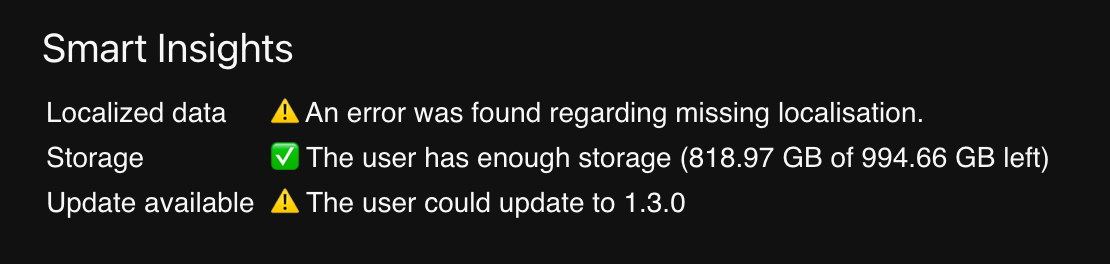 By default, standard Smart Insights are provided: