A framework for building agent-native applications.
3.6k
Stars
338
Forks
18
Open issues
30
Contributors





AI Analysis
Agent-Native is a TypeScript framework for building applications where AI agents are first-class citizens, enabling the same business logic to be executed as UI actions, agent tools, HTTP endpoints, and CLI commands. It's specifically designed for developers building agentic applications that combine polished interfaces with integrated AI capabilities, positioning itself as an alternative to bolting AI onto existing SaaS tools or using raw agents without UI. This framework is best suited for ...
Inferred from signals mentioned in the README (tests, CI, type safety) — not a review of the actual code.
AI's overall editorial judgment — not an average of the bars above, can weigh other factors too.
TypeScript framework for building agentic applications with shared UI and agent actions, 3.5 months old with rapid early adoption.
Agent-Native is a framework for building applications where AI agents and humans interact through a unified backend, shared database, and bidirectional UI. It provides primitives for actions, agent runtime, observability, and templates. Built by BuilderIO, it reached 2,690 stars in ~3.5 months with 1,476 stars in the last 7 days alone. Target audience: developers building multi-modal applications where agents and UIs operate on the same state and data.
Project launched 2026-03-12. Emerged during a period of rapid commercialization of LLM agent frameworks. BuilderIO's focus on visual/builder tools positioned it to create a framework blending agent patterns with reactive UI paradigms. No evidence of prior evolution or major versioning.
Explosive initial growth: 1,476 stars in 7 days (as of 2026-06-27) suggests recent viral moment, likely driven by template gallery release, media coverage, or tooling integration announcement. Total 2,690 stars over 3.5 months indicates sustained interest rather than one-off spike, though trajectory data is limited. Comparable to openai/openai-agents-js (3,297 stars) despite being significantly newer, suggesting strong initial market reception.
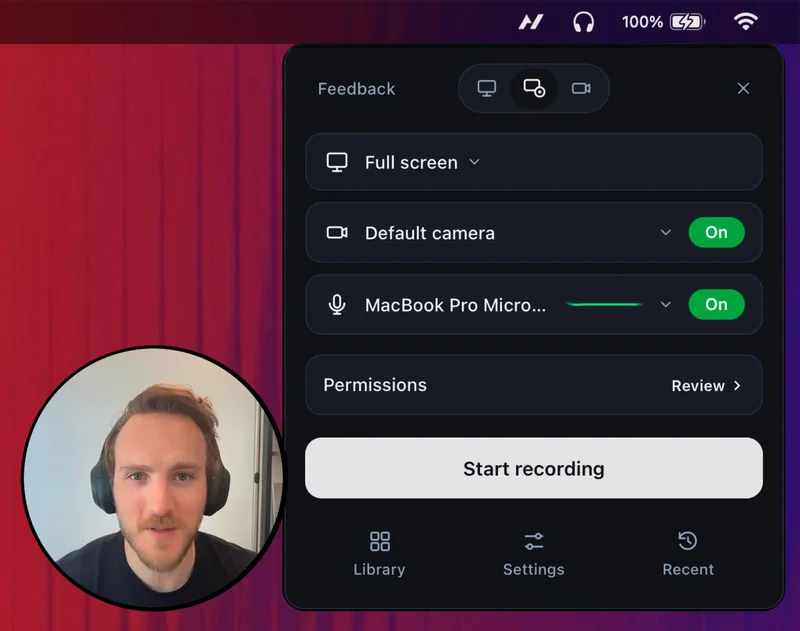
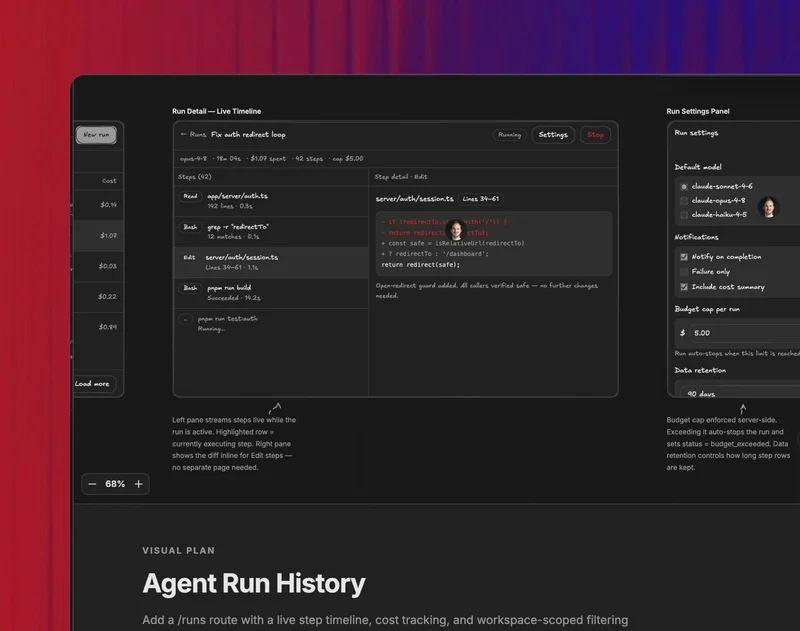
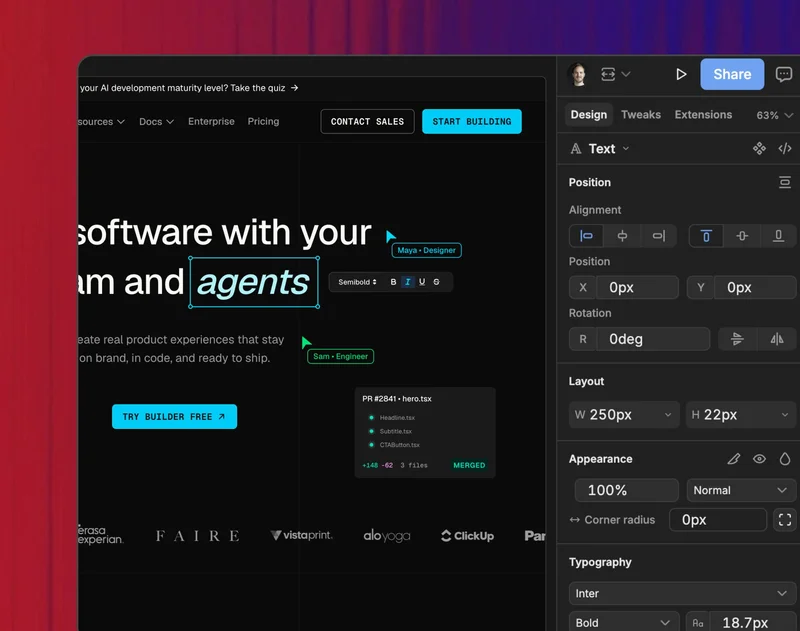
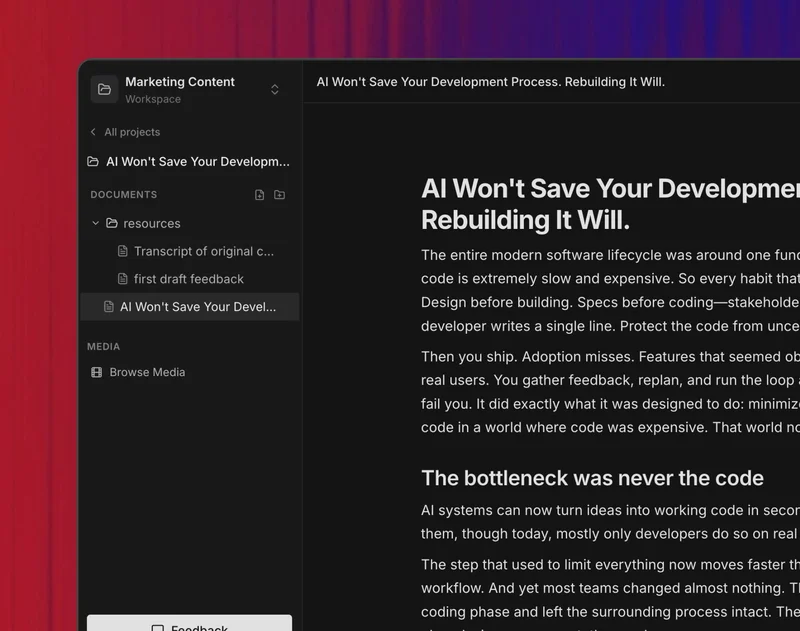
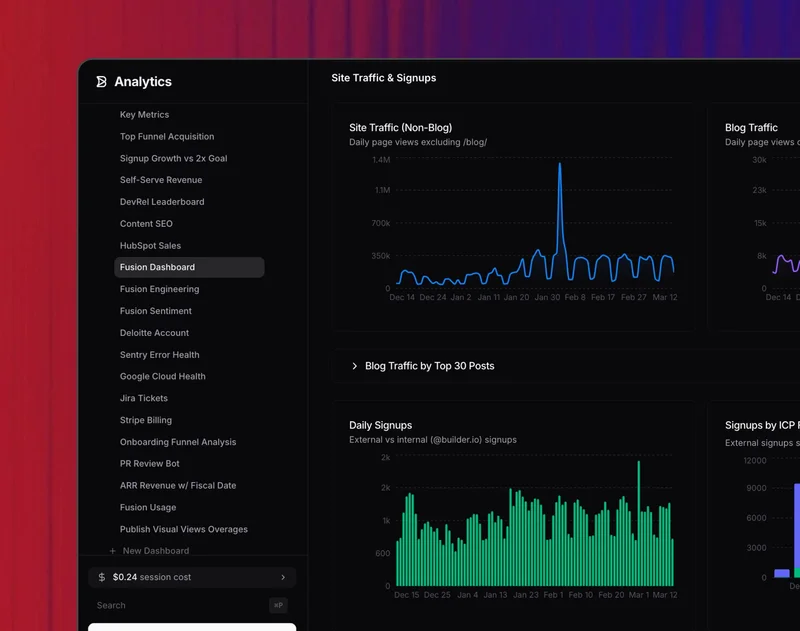
adoption not verified. README describes six full SaaS templates (Clips, Plans, Design, Content, Slides, Analytics) claimed as 'cloneable' examples, but no case studies, testimonials, or documented deployments. No mention of production instances, user counts, or organizational usage. Early adoption likely exists given explosive star growth, but cannot be confirmed from public metadata.
Based on README: TypeScript/Node.js stack. Uses Drizzle ORM for database abstraction (SQL-backed state), Nitro for hosting compatibility, Zod for schema validation. Single action primitive (`defineAction`) designed to work across UI, HTTP, MCP, A2A (agent-to-agent), and CLI. Appears to separate concerns between action definition (business logic), agent runtime (chat, tools, skills, jobs), and UI surfaces. Database agnostic within SQL ecosystem. No monolithic framework — described as pluggable primitives.
not documented in README
Last push 2026-06-27 (1 day before analysis date); repository is actively maintained. However, at 3.5 months old, 'maintenance' is still establishing patterns. No evidence of issue response times, PR review cycles, or release cadence in available metadata. Rapid star growth and current development activity suggest active core team, but long-term maintenance sustainability cannot be assessed from metadata alone.
ADOPT IF: you are building applications where agents and humans operate on shared state with tight UI-agent coupling, you want a pluggable backend (bring your own database/host), and you prioritize template-driven development. AVOID IF: you need production-hardened agent frameworks with extensive case studies and long-term maintenance track record, you require language diversity beyond TypeScript, or you prioritize agent-only patterns (no UI requirements). MONITOR IF: you are evaluating agent frameworks in early 2026 — this project's trajectory is steep but unproven at scale; assess again in Q4 2026 for production stability and real-world deployments.
Independent dimensions
Mainstream potential
4/10
Technical importance
6/10
Adoption evidence
2/10
- Project is 3.5 months old with no documented production deployments — early architecture decisions may not withstand scale; unknown how well the action-primitive model handles complex state mutations or distributed coordination.
- Template gallery is showpiece code, not necessarily production-hardened. Real-world adoption unverified; early star growth may not reflect sustained interest or enterprise viability.
- Framework binds to TypeScript, Drizzle ORM, and SQL databases — limits language flexibility and excludes users invested in NoSQL, GraphQL, or alternative stacks.
- Maintenance risk: BuilderIO is sole apparent maintainer; no evidence of community contribution patterns, issue triage process, or sustainability plan if core team deprioritizes.
- Positioning ambiguity: competes with both agent frameworks (OpenAI, LangChain-adjacent tools) and full-stack web frameworks (Next.js + agent library); unclear if it excels at either or serves a permanent intersection.
Likely to remain niche-to-moderate: Agent-Native appears well-suited for BuilderIO's existing design-tool user base and builders prioritizing visual/template-driven development. Mainstream framework adoption (Django, Rails scale) is unlikely unless it expands beyond TypeScript and demonstrates measurable enterprise deployments. If real-world usage validates the UI-agent duality model, could become reference architecture within AI-native SaaS space; if adoption plateaus, may consolidate as specialized tool within BuilderIO ecosystem.
Newsletter
Get analyses like this every Monday
Free weekly digest of the most interesting open-source discoveries.
Languages
Information
- Website
- https://agent-native.com
- Language
- TypeScript
- Last updated
- 9h ago
- Created
- 4mo ago
- Analyzed with
- anthropic/claude-haiku-4-5
Stars over time
Contributors over time
Top 100 contributors only — repos with more will plateau at 100.
Open issues
Similar repos

dabit3/react-native-ai
React Native AI is a full-stack framework for building cross-platform mobile...

openai/openai-agents-js
The OpenAI Agents SDK is a TypeScript framework for building multi-agent AI...
| Repository | Stars | Week Δ | Language | Score | Updated |
|---|---|---|---|---|---|
|
BuilderIO/agent-native
this
|
3.6k | +184 | TypeScript | 7/10 | 9h ago |
 wrtnlabs/agentica wrtnlabs/agentica
|
1k | — | TypeScript | 7/10 | 2mo ago |
 AgentDock/AgentDock AgentDock/AgentDock
|
1.7k | — | TypeScript | 7/10 | 1mo ago |
|
dabit3/react-native-ai
|
1.3k | — | TypeScript | 7/10 | 17h ago |
|
openai/openai-agents-js
|
3.4k | — | TypeScript | 8/10 | 11h ago |
 a2ui-project/a2ui a2ui-project/a2ui
|
15.7k | — | TypeScript | 7/10 | 8h ago |
Slightly larger star count (3,297 vs 2,690) and likely older, but both target similar scope. Agent-Native appears to emphasize UI-agent duality and template gallery; OpenAI's offering likely more focused on API-first agent patterns. Direct feature parity unclear from README.
1,654 stars; appears to be agent framework but with unclear positioning. Agent-Native's emphasis on actions-as-primitives and UI/agent symmetry differs from AgentDock's likely architecture.
1,031 stars; Korean-originated project. Positioning relative to Agent-Native unclear. Both TypeScript but different maturity/focus unknown.
1,277 stars; appears mobile-focused (React Native), whereas Agent-Native targets full-stack applications. Different niches.
15,513 stars but different purpose (UI/builder project, not agent framework). Included for scale context only; not a true competitor.