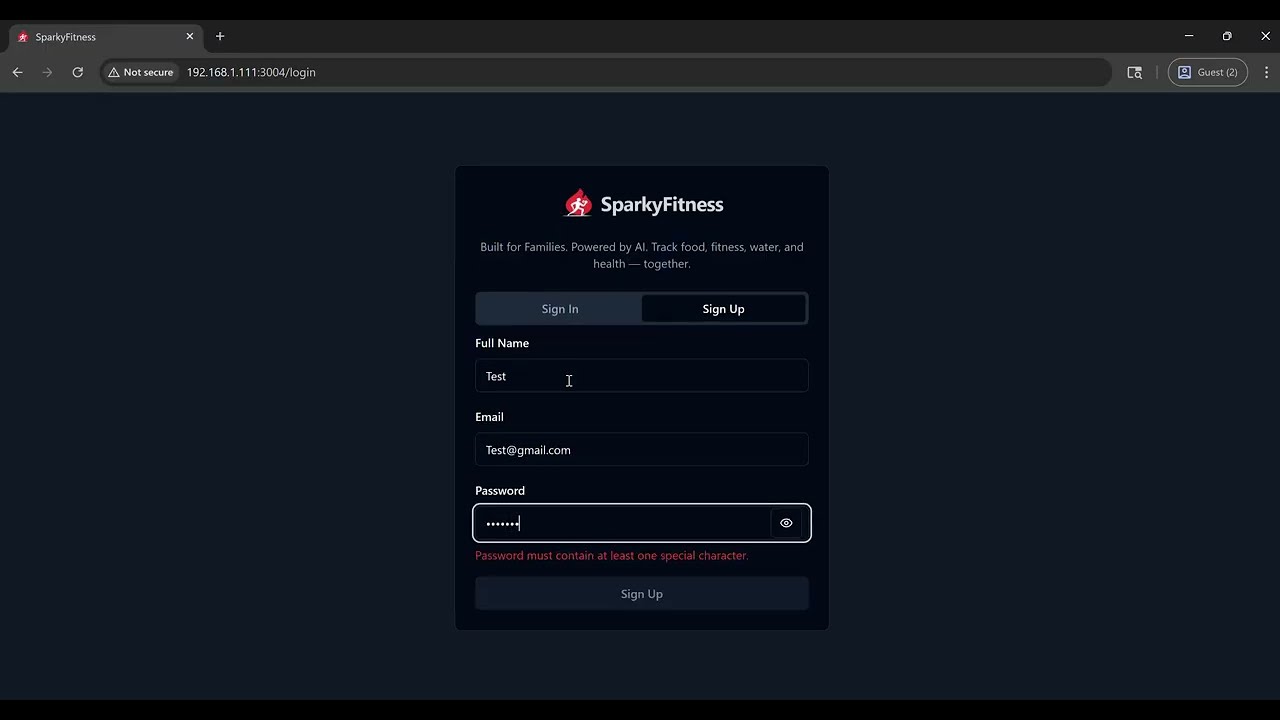
SparkyFitness: Built for Families. Powered by AI. Track food, fitness, water, and health — together.
4.6k
Stars
253
Forks
70
Open issues
30
Contributors


AI Analysis
SparkyFitness is a self-hosted, privacy-first fitness tracking platform that replaces commercial services like MyFitnessPal by letting users track nutrition, exercise, hydration, sleep, and health metrics on their own infrastructure. It serves individuals and families seeking data privacy and control, offering web and native mobile apps with multi-user support, AI health coaching, and device integrations. It is best suited for privacy-conscious users comfortable with self-hosting, not for tho...
Inferred from signals mentioned in the README (tests, CI, type safety) — not a review of the actual code.
AI's overall editorial judgment — not an average of the bars above, can weigh other factors too.
Self-hosted family fitness tracker with AI logging, launched mid-2025, gaining traction in privacy-conscious segment
SparkyFitness is a self-hosted alternative to MyFitnessPal, emphasizing privacy and family multi-user support. Built in TypeScript with Docker deployment, it tracks nutrition, exercise, hydration, sleep, and mood. The project has grown to ~4,500 stars in one year with recent momentum (85 stars in 7 days as of June 2026). It targets families and privacy-conscious individuals who want to run fitness infrastructure on their own servers. Real-world adoption beyond GitHub metrics is not documented in the README.
SparkyFitness launched June 21, 2025. Within approximately 12 months it reached 4,469 stars, suggesting rapid initial interest in the self-hosted fitness tracking niche. The project positions itself against centralized SaaS fitness trackers, particularly MyFitnessPal. No prior history or predecessor versions mentioned.
Early adoption appears driven by privacy-first positioning and self-hosting narrative. Recent weekly growth rate (85 stars/week) is moderate but consistent. The project is less than one year old, so trajectory interpretation is premature. Multilingual README suggests intentional international outreach. Growth may reflect interest in self-hosted health infrastructure rather than saturated market demand for yet another fitness app.
Adoption not verified. README mentions PikaPods cloud hosting option but provides no user counts, case studies, or deployment statistics. No evidence of production installations in enterprise, clinical, or large-scale consumer contexts. Project is too young (< 1 year) to have substantial production footprint data.
Based on README: TypeScript backend (API + storage), web frontend, and native iOS/Android mobile apps. Deployment via Docker Compose. Integrations with 18+ health platforms (Apple Health, Garmin, Fitbit, Strava, etc.) and food databases. Includes optional AI chat interface (beta) for logging. Architecture appears conventional for a full-stack SaaS-like product, but code-level design patterns, scalability choices, and dependency management cannot be assessed from README alone.
Not documented in README.
Last push June 29, 2026 (one day before evaluation date), indicating active ongoing development. However, only 242 forks across one year suggests limited fork ecosystem or community contribution. No commit frequency, issue response time, or CI/CD pipeline details in README. Recent push date is positive; cannot assess pre-release stability or test infrastructure.
ADOPT IF: You prioritize data privacy, are comfortable self-hosting infrastructure, want family-shared fitness tracking, tolerate rapid development cycles and potential breaking changes, and can run Docker. AVOID IF: You need a battle-tested, production-hardened system with extensive user base validation, require vendor SLA guarantees, or prefer managed cloud without DevOps responsibility. MONITOR IF: You are evaluating self-hosted fitness platforms long-term; this project shows promising velocity but lacks production maturity signals and documented real-world deployments to confirm reliability.
Independent dimensions
Mainstream potential
3/10
Technical importance
6/10
Adoption evidence
2/10
- Project is < 1 year old; long-term maintenance and feature stability uncertain. Single maintainer or small core team (not documented, inferred from fork count) creates single-point-of-failure risk.
- AI features marked 'beta' suggest incomplete, potentially buggy implementation. Safety and accuracy of AI logging not validated in README.
- 18+ third-party integrations expand attack surface and create dependency on external APIs. Changes to Fitbit, Garmin, or other platforms could break sync functionality without maintainer control.
- No documented security audit, encryption details, or compliance certification (HIPAA, GDPR) mentioned. Health data is sensitive; security posture cannot be verified from README.
- Adoption is unverified; project may be popular in GitHub stars but lack practical production deployments. High star count does not guarantee users or community support.
SparkyFitness likely remains a viable niche project for privacy-conscious families over 18–36 months, provided maintainer commits to ongoing development. Unlikely to displace mainstream fitness apps (MyFitnessPal, Apple Fitness) due to UX overhead of self-hosting. May consolidate into self-hosted fitness tracker space alongside ryot and FitTrackee. If maintenance lags or integrations break, adoption could stall.
Newsletter
Get analyses like this every Monday
Free weekly digest of the most interesting open-source discoveries.
Languages
Information
- Language
- TypeScript
- License
- NOASSERTION
- Last updated
- 10h ago
- Created
- 13mo ago
- Analyzed with
- anthropic/claude-haiku-4-5
Stars over time
Contributors over time
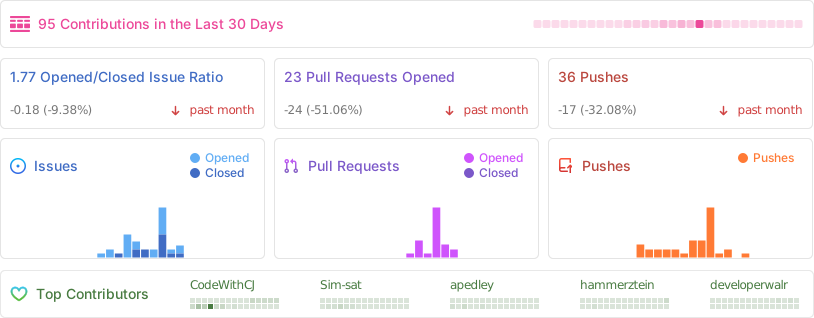
Top 100 contributors only — repos with more will plateau at 100.
Open issues
[Feature]: Add localization (i18n) support to the mobile app
[Bug]: The SparkyFitness-SERVER container stopped unexpectedly on Synology NAS
[Feature]: Excercise goals
[Feature]: Add Suplements/Vitamins
[Bug]: Android app delays API requests for several minutes on cellular with Tailscale, but responds immediately when Wi-Fi is enabled
Top contributors
Similar repos

Snouzy/workout-cool
Workout.cool is a modern, open-source fitness coaching platform that enables...
| Repository | Stars | Week Δ | Language | Score | Updated |
|---|---|---|---|---|---|
|
CodeWithCJ/SparkyFitness
this
|
4.6k | +143 | TypeScript | 7/10 | 10h ago |
 IgnisDa/ryot IgnisDa/ryot
|
3.4k | — | TypeScript | 8/10 | 2d ago |
 SamR1/FitTrackee SamR1/FitTrackee
|
1.1k | — | Python | 8/10 | 5d ago |
|
Snouzy/workout-cool
|
8.1k | — | TypeScript | 7/10 | 3mo ago |
 jovandeginste/workout-tracker jovandeginste/workout-tracker
|
1.2k | — | Go | 7/10 | 1w ago |
 wger-project/wger wger-project/wger
|
6.4k | — | Python | 8/10 | 14h ago |
Similar self-hosted fitness tracker with more stars and longer history. Likely more mature; direct feature parity not assessable from README alone.
Self-hosted alternative with established community. Smaller star count and different language stack. Feature breadth not comparable without detailed feature matrix.
Highest-starred similar project. Likely broader appeal or earlier launch; positioning and feature scope not clear from stars alone.
SparkyFitness explicitly positions as privacy-first alternative. Different business model (self-hosted vs. SaaS); not a direct replacement but an escape valve for privacy-concerned users.
Smaller but established community project. Different language; feature differentiation unclear.