Lightweight analytics abstraction layer for tracking page views, custom events, & identifying visitors
2.7k
Stars
263
Forks
112
Open issues
30
Contributors


AI Analysis
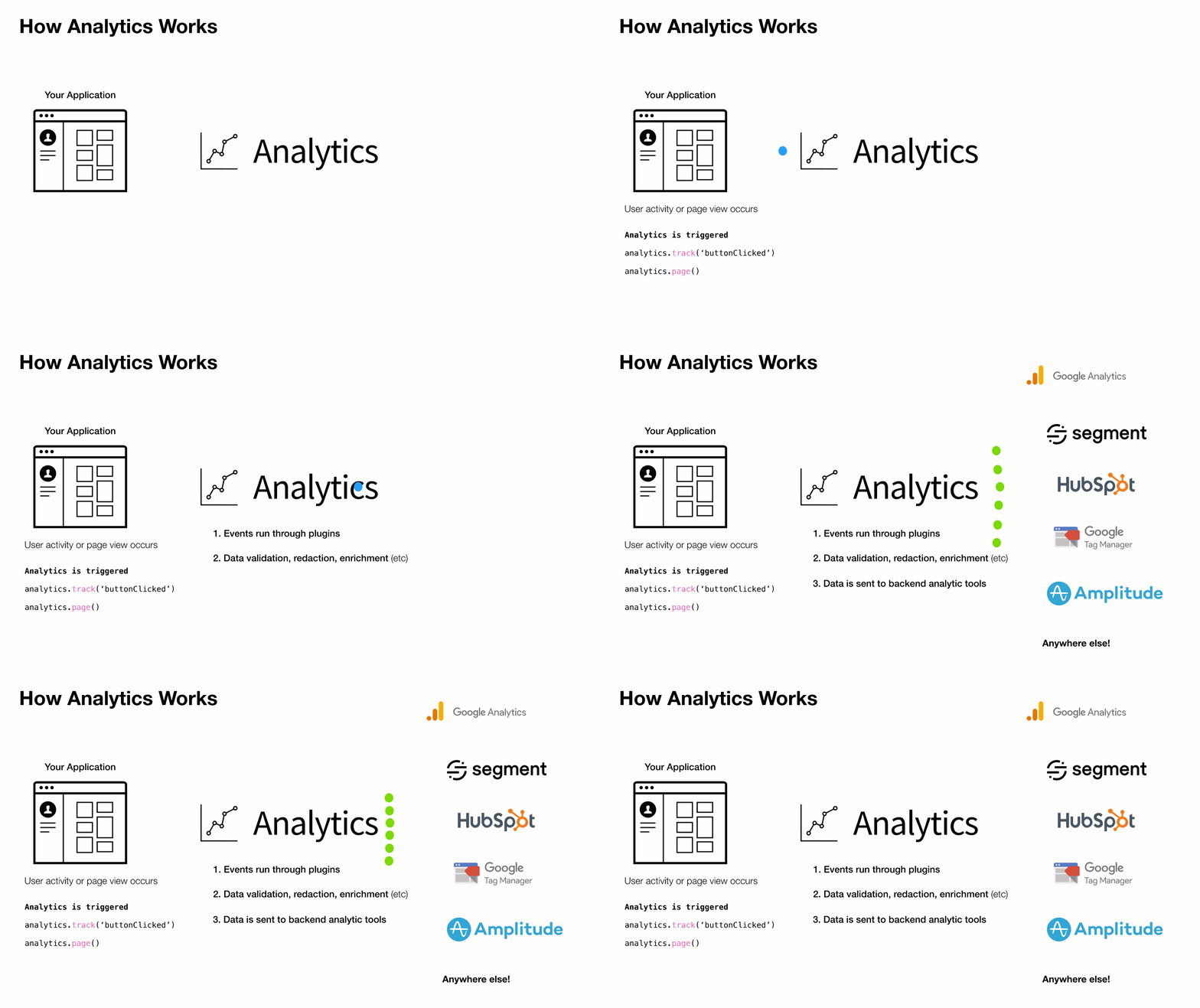
A lightweight abstraction layer for analytics that decouples applications from specific analytics vendors through a plugin-based architecture. It's designed for teams that need to switch, add, or remove analytics tools without rewriting tracking code, and serves developers building applications with evolving analytics requirements.
Inferred from signals mentioned in the README (tests, CI, type safety) — not a review of the actual code.
AI's overall editorial judgment — not an average of the bars above, can weigh other factors too.
Lightweight abstraction layer for multi-provider analytics tracking with plugin architecture
analytics is a JavaScript library providing a vendor-agnostic wrapper around analytics services (Google Analytics, Segment, etc.). It enables developers to swap analytics providers without rewriting tracking code. The project serves teams managing multiple analytics tools or anticipating provider changes. Adoption appears moderate and specialized; the library occupies a deliberate niche rather than competing for mass-market dominance.
Created October 2018 by David Wells. The project emerged from the practical problem of vendor lock-in: as companies evolve their analytics stack, rewriting instrumentation becomes costly. The library crystallizes a common pattern used by agencies and product teams managing complex analytics requirements.
The project gained initial traction (2,658 stars by 2026) and has maintained slow but consistent activity. The recent 7-day star gain of 1 and last push on 2026-06-27 indicate ongoing maintenance rather than rapid expansion. Growth appears plateaued at a steady state, suggesting the project has found its addressable market and maintains it rather than pursuing explosive adoption.
Adoption not verified in available metadata. No documented case studies, enterprise customers, or usage statistics provided. The presence of a live demo app and detailed documentation site (getanalytics.io) suggests genuine use, but quantitative adoption evidence is absent. npm download statistics referenced in README badge are not provided here.
Based on README, the library implements a plugin-based architecture where analytics providers are loaded as plugins that respond to lifecycle hooks (page, track, identify, reset). Appears to support isomorphic JavaScript (browser and Node.js). The design prioritizes ease of adding/removing providers without code changes to calling code. TypeScript support is documented.
Not documented in README. No explicit mention of test suite, coverage percentages, or testing infrastructure.
Last push 2026-06-27 (9 days before evaluation date) indicates active maintenance. Project is 7+ years old (created 2018), suggesting stable, mature codebase. The modest rate of new stars (1 in 7 days) combined with recent commits suggests maintenance mode rather than rapid development — not stagnation, but deliberate steady-state.
ADOPT IF: your team manages multiple analytics providers simultaneously, anticipates provider changes, or needs to enforce consistent tracking semantics across a codebase. The library's plugin model handles vendor switching elegantly. AVOID IF: you need extensive pre-built integrations with newer analytics platforms (adoption of plugins outside core providers not verified), require active community contribution, or need guaranteed commercial support. MONITOR IF: you are evaluating multi-provider analytics strategies; the project's stability and maintenance suggest it will remain a reliable option for the niche it occupies, though growth is unlikely to accelerate.
Independent dimensions
Mainstream potential
3/10
Technical importance
6/10
Adoption evidence
2/10
- Adoption depth not verified: high star count may reflect theoretical interest rather than production deployment at scale.
- Plugin ecosystem limited: the project appears to depend on either first-party plugins or community contributions. Breadth of third-party provider support not documented.
- Slow growth trajectory: may indicate the abstraction pattern is not compelling enough for broad adoption, or the market addressed is inherently small.
- Maintenance dependency: project relies on David Wells' continued stewardship; no evidence of active co-maintainers or organizational backing.
- TypeScript support documented but implementation quality and completeness not verifiable from README alone.
The project will likely persist in steady-state maintenance mode, serving teams with specific multi-provider requirements. Unlikely to achieve mainstream adoption or become the dominant abstraction layer in analytics. More probable outcome: remains a useful specialist tool for enterprises and agencies managing complex analytics stacks, with modest but stable user base.
Newsletter
Get analyses like this every Monday
Free weekly digest of the most interesting open-source discoveries.
Languages
Information
- Website
- https://getanalytics.io
- Language
- JavaScript
- License
- MIT
- Last updated
- 2w ago
- Created
- 94mo ago
- Analyzed with
- anthropic/claude-haiku-4-5
Stars over time
Contributors over time
Top 100 contributors only — repos with more will plateau at 100.
Open issues
Add react native/expo support
Convert to Typescript
Segment Plugin Feature Request: Passing options to analytics.load()
Google Analytics - Allow enhanced conversions
Google analytics has outdated UTM parameters handler
Top contributors
Recent releases
No releases published yet.
Similar repos

Open-Web-Analytics/Open-Web-Analytics
Open Web Analytics is a self-hosted, open-source web analytics platform that...

electerious/Ackee
Ackee is a self-hosted, privacy-focused analytics platform built on Node.js and...
| Repository | Stars | Week Δ | Language | Score | Updated |
|---|---|---|---|---|---|
|
DavidWells/analytics
this
|
2.7k | +1 | JavaScript | 7/10 | 2w ago |
 plausible/analytics plausible/analytics
|
27.6k | — | Elixir | 8/10 | 21h ago |
|
Open-Web-Analytics/Open-Web-Analytics
|
2.7k | — | PHP | 7/10 | 4d ago |
|
electerious/Ackee
|
4.7k | — | JavaScript | 8/10 | 1w ago |
 Swetrix/swetrix Swetrix/swetrix
|
1.1k | — | TypeScript | 8/10 | 14h ago |
 googleanalytics/ga-dev-tools googleanalytics/ga-dev-tools
|
1.5k | — | TypeScript | 6/10 | 3w ago |
Plausible (27.5K stars) is a complete privacy-focused analytics service with its own backend; analytics.js is a client-side abstraction layer agnostic to the backend. Different problem domain: Plausible replaces Google Analytics; analytics.js coordinates among multiple providers.
Segment serves a similar abstraction role but operates as a hosted service with data warehouse capabilities. analytics.js is open-source, lightweight, library-only; Segment is enterprise platform. analytics.js likely appeals to teams avoiding vendor dependency for orchestration logic itself.
OWA (2,674 stars) is a self-hosted analytics platform; analytics.js is a client SDK. Different layers of the stack: OWA is a destination; analytics.js routes events to destinations.
Swetrix (1,060 stars) is a privacy-focused analytics platform. analytics.js is infrastructure-agnostic; Swetrix is an opinionated service. Complementary rather than directly competitive.
GA DevTools (1,535 stars) focuses on GA-specific debugging and development; analytics.js is multi-provider abstraction. Narrower scope vs. broader scope.