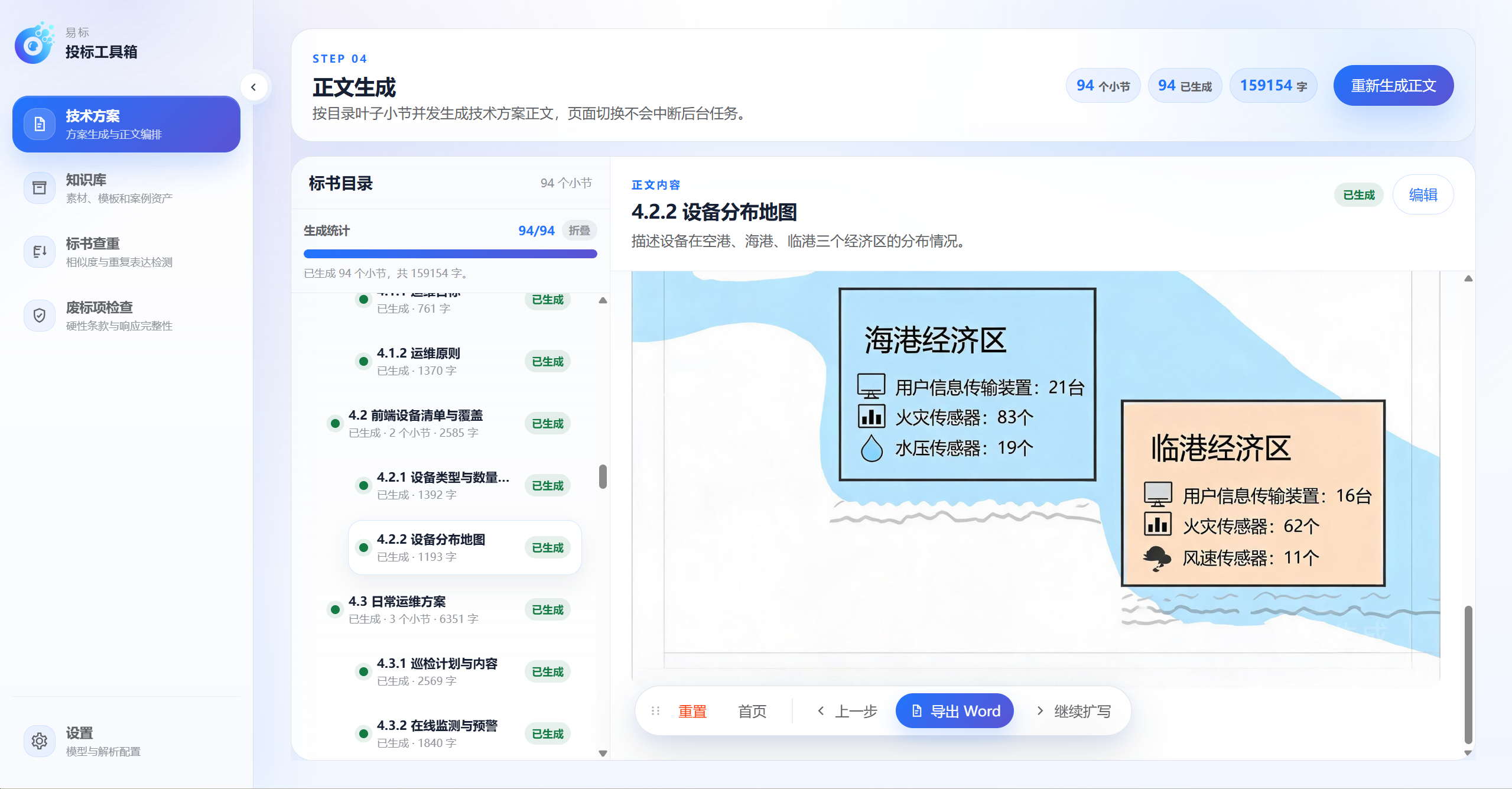
开箱即用的AI标书编写工具,标书AI生成工具,投标工具箱、知识库、标书查重、废标项检查,完全开源免费,欢迎使用
1.3k
Stars
356
Forks
41
Open issues
7
Contributors


AI Analysis
OpenBidKit Yibiao is an open-source AI-powered bidding document authoring tool designed for Chinese tender and proposal writing scenarios. It provides AI-assisted technical proposal generation, document composition, knowledge base management, plagiarism checking, and disqualification risk detection. This specialized tool serves procurement professionals, bid managers, and enterprises engaged in competitive bidding processes, and is not intended for general document writing use cases.
Inferred from signals mentioned in the README (tests, CI, type safety) — not a review of the actual code.
AI's overall editorial judgment — not an average of the bars above, can weigh other factors too.
Open-source AI proposal-writing toolkit for Chinese bidding market, locally-deployed with knowledge base and risk-checking
OpenBidKit (易标) is a Electron-based desktop application designed to automate technical and commercial proposal drafting for Chinese bidding/tender contexts. The tool integrates multiple LLM backends (OpenAI, DeepSeek, Llama via Ollama), local knowledge base management, duplicate detection, and compliance checking. Target users are small and mid-sized enterprises unable to afford commercial proposal-writing services. Early adoption appears concentrated in mainland China; the project gained 178 stars in the last 7 days, suggesting recent momentum within its niche.
Repository created August 2025; very recent project. README frames it as addressing a gap where commercial proposal tools cost 10–50 RMB per document, pricing small enterprises out of market. Positions itself as an open-source alternative to proprietary bid-writing SaaS platforms common in China's government tender ecosystem.
Steep recent climb: 1,121 stars with 178 gained in the last 7 days alone (15.9% weekly growth). Last commit 2026-06-27, indicating active ongoing development. Growth likely driven by pricing frustration in target market (Chinese SMEs) and the open-source licensing (AGPL-3.0). Comparable projects (Beav, AIWriteX, BuildingAI) have similar star counts, suggesting a cohort of emerging tooling around AI-assisted writing and automation in this region.
Adoption not verified. README mentions an online experience portal (yibiao.pro) and links to a Bilibili demo video, suggesting user-facing availability. However, no public case studies, deployment counts, company testimonials, or third-party references provided. GitHub forks (315) suggest some interest in local deployment, but real-world production usage remains undocumented.
Desktop app built on Electron 41+, React 19, TypeScript 5.9, and Vite 7. Based on README, architecture appears to include: (1) local workspace with persistent configuration and caching, (2) pluggable LLM backend selection, (3) document parsing via local or MinerU-based methods, (4) knowledge base management subsystem, (5) task queue with recovery/resumption. No open-source dependencies or architecture diagram visible in README; implementation details are opaque from available metadata.
not documented in README
Last push 2026-06-27 (1 day before evaluation date), indicating very active current development. Repository is 10 months old and still rapidly evolving. No stagnation indicators present; opposite signal. Issue counts, PR velocity, and contributor base not visible in metadata; cannot assess collaboration dynamics.
ADOPT IF: (1) You are a Chinese SME needing to author technical/commercial bids regularly and cannot justify SaaS cost; (2) you require local deployment and control over LLM integrations; (3) you are comfortable running Electron desktop software and managing knowledge base setup. AVOID IF: (1) You need production-grade reliability and vendor support; (2) you operate outside mainland China and lack domain knowledge of Chinese tender processes; (3) you expect a mature, battle-tested tool with extensive documentation and community. MONITOR IF: (1) You work in adjacent bid-automation or proposal-writing domains and want to track open-source tooling maturity; (2) you are evaluating whether to invest in integrating OpenBidKit into a larger workflow platform.
Independent dimensions
Mainstream potential
3/10
Technical importance
5/10
Adoption evidence
2/10
- Adoption concentrated in single geographic/regulatory market (China); internationalization roadmap unclear; limits addressable market and long-term sustainability.
- No visible test suite or CI/CD pipeline in README; quality assurance process opaque; rapid release cadence may introduce bugs.
- AGPL-3.0 licensing may deter some commercial users; unclear if dual-licensing or commercial support is available.
- LLM backend dependency on third-party APIs (OpenAI, DeepSeek, etc.) creates operational lock-in and cost exposure; local Ollama support only partially documented.
- Early-stage project (10 months old); API stability, feature backwards-compatibility, and long-term maintenance commitments not established.
Likely to remain a niche but stable tool within Chinese SME bidding workflows over the next 12–24 months. Rapid early growth may plateau as market saturation occurs. Mainstream potential depends on: (1) successful Ollama/local-LLM integration (reducing third-party API dependency), (2) international localization, (3) establishing a sustainable governance model. Without these, adoption will likely remain bounded to 5K–15K active users in China.
Newsletter
Get analyses like this every Monday
Free weekly digest of the most interesting open-source discoveries.
Languages
Information
- Website
- https://yibiao.pro
- Language
- JavaScript
- License
- AGPL-3.0
- Last updated
- 10h ago
- Created
- 11mo ago
- Analyzed with
- anthropic/claude-haiku-4-5
Stars over time
Contributors over time
Top 100 contributors only — repos with more will plateau at 100.
Open issues
Open pull requests
Similar repos

XiaomingX/ai-money-maker-handbook
This is a curated Chinese-language handbook and resource collection for...
| Repository | Stars | Week Δ | Language | Score | Updated |
|---|---|---|---|---|---|
|
FB208/OpenBidKit_Yibiao
this
|
1.3k | +95 | JavaScript | 7/10 | 10h ago |
 Jamailar/Beav Jamailar/Beav
|
1.2k | — | TypeScript | 7/10 | 1d ago |
 iniwap/AIWriteX iniwap/AIWriteX
|
1.3k | — | Python | 7/10 | 10h ago |
 BidingCC/BuildingAI BidingCC/BuildingAI
|
1.8k | — | TypeScript | 7/10 | 1mo ago |
|
XiaomingX/ai-money-maker-handbook
|
2.7k | — | CSS | 6/10 | 2w ago |
 lintsinghua/DeepAudit lintsinghua/DeepAudit
|
6.6k | — | Python | 7/10 | 3d ago |
Similar GitHub presence and tech stack. BuildingAI's higher star count may indicate broader appeal or longer visibility; OpenBidKit's rapid 7-day gains suggest competitive momentum in the narrower bidding-automation niche.
Substantially larger ecosystem presence, likely addresses a broader problem (data auditing vs. document generation). Different problem domain; not a direct replacement.
Likely a general AI-assisted writing tool; OpenBidKit appears more narrowly specialized for bidding/tender documents, suggesting less competition in niche but smaller addressable market.
OpenBidKit's stated value proposition is cost and openness; competes on price (1 RMB vs. 10–50 RMB per document) and control rather than feature parity or UX polish.