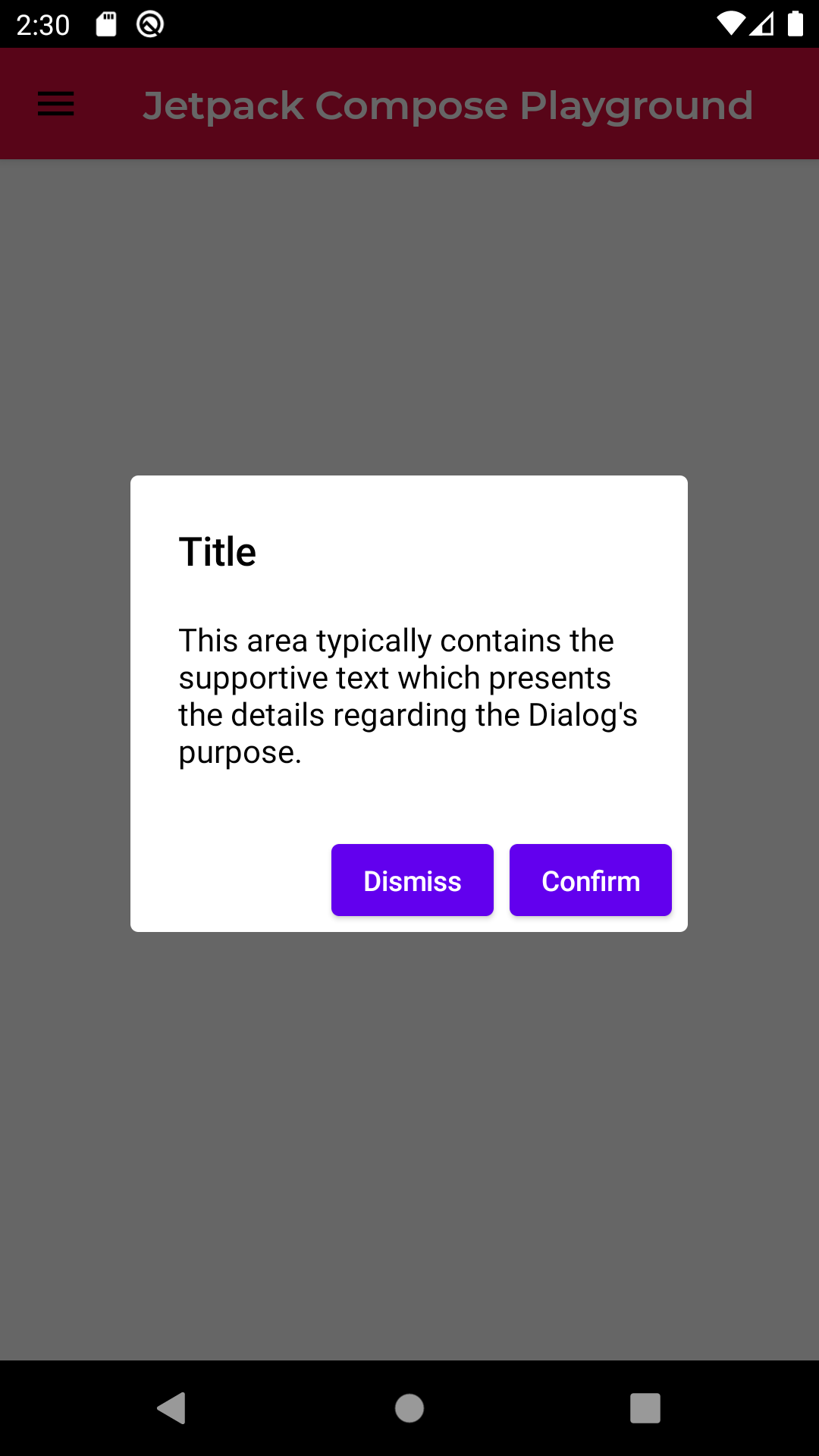
Community-driven collection of Jetpack Compose example code and tutorials :rocket: https://foso.github.io/compose
3.7k
Stars
308
Forks
16
Open issues
30
Contributors


AI Analysis
Jetpack Compose Playground is a community-driven collection of example code, tutorials, and demonstrations for Jetpack Compose, Google's modern declarative UI toolkit for Android. It serves developers learning Compose or building Android UIs, with examples spanning animations, layouts, foundation components, and Material Design. This is specialized educational content for Android developers adopting Compose; it is not useful for non-Android developers or those working with other UI frameworks.
Inferred from signals mentioned in the README (tests, CI, type safety) — not a review of the actual code.
AI's overall editorial judgment — not an average of the bars above, can weigh other factors too.
Community example gallery for Jetpack Compose with stable, modest adoption and slow maintenance cadence
Jetpack Compose Playground is a curated collection of Kotlin code examples, tutorials, and demos covering Jetpack Compose UI components and patterns. Built primarily for Android developers learning Compose, it aggregates sample implementations of layouts, animations, Material Design components, and cookbook recipes. Adoption appears modest relative to Google's official samples, with ~3,600 stars and community contribution welcome, but maintenance has slowed since 2023.
Launched May 2019 as a personal learning project by Jens Klingenberg, the repository grew during Compose's early adoption phase (2019-2021) when official documentation was sparse. It evolved into a community reference alongside Google's official samples, gaining traction via Android Weekly features and steady pull request contributions.
Repository achieved ~3,600 stars by 2024, positioning it within the top tier of Compose example collections. However, growth has plateaued significantly: only 2 stars in the 7 days prior to the evaluation date (July 2026) suggests the project no longer attracts substantial new visibility. Last push was March 2026, indicating ongoing but infrequent maintenance. Growth likely peaked during Compose's 2020-2022 stabilization window.
Adoption not verified. No deployment, package distribution, or real-world usage metrics are documented. The project is a learning reference and example repository, not a library or tool deployed to production. Indirect signals of influence include Android Weekly feature mention and 3,600 GitHub stars, but these do not establish production usage or organizational adoption.
Appears to be an Android application project (not a library) structured as a monolithic example app with examples organized by category (animations, layouts, foundation, material, cookbook). README indicates Kotlin 2.0.20 and Compose 1.7.0 compatibility, suggesting the codebase tracks relatively recent versions. Likely uses standard Gradle-based Android build system. Beyond category organization, architectural details are not documented in the README.
Not documented in README.
Last push March 31, 2026 (3 months prior to evaluation date) indicates active but infrequent maintenance. Badges list Kotlin 2.0.20 and Compose 1.7.0, suggesting the maintainer updates dependencies occasionally. However, growth rate of 2 stars in 7 days and apparent lack of recent high-visibility commits suggest the project is in a stable, low-activity maintenance mode rather than actively growing. Repository accepts pull requests ('PRs Welcome' badge present), but cadence and responsiveness are not quantified in public metadata.
ADOPT IF: you are an Android developer new to Jetpack Compose seeking accessible, categorized examples of common components and patterns, and you value community-contributed code snippets over official documentation. AVOID IF: you require actively maintained, officially supported reference material with guaranteed compatibility and rapid updates, or if you need production-grade architectural guidance beyond component-level examples. MONITOR IF: you are selecting from multiple Compose example repositories for a team learning initiative; track whether maintenance cadence improves or further declines, and compare tutorial quality against competing collections (ComposeCookBook, SmartToolFactory) for your specific learning goals.
Independent dimensions
Mainstream potential
3/10
Technical importance
5/10
Adoption evidence
2/10
- Maintenance cadence has slowed substantially (2 stars in 7 days, ~3 months since last commit); further decline could leave code outdated as Compose evolves, reducing utility for new developers.
- Positioned as a community project competing with Google's official samples (23k+ stars); official sources are likely to be prioritized by organizations and educators, limiting adoption growth and relevance.
- No documented testing, deployment, or real-world validation; examples are illustrative code snippets without quality assurance or compatibility guarantees beyond Kotlin/Compose version badges.
- Dependency on single maintainer (Jens Klingenberg) with no visible succession plan or governance model; absence of active core team increases abandonment risk if maintainer loses interest.
- Example-only format provides limited architectural or design guidance; developers may struggle to scale patterns from isolated component examples to production applications.
Repository will likely remain a stable reference resource within the Compose learning community but will not grow substantially in adoption or influence. As Compose documentation and official samples mature and become more comprehensive, the competitive advantage of community-contributed examples diminishes. Project is expected to transition into a low-maintenance archive or slow-growth reference over the next 2–3 years unless community contribution velocity increases significantly.
Newsletter
Get analyses like this every Monday
Free weekly digest of the most interesting open-source discoveries.
Languages
Information
- Website
- https://foso.github.io/compose
- Language
- Kotlin
- License
- MIT
- Last updated
- 3mo ago
- Created
- 87mo ago
- Analyzed with
- anthropic/claude-haiku-4-5
Stars over time
Contributors over time
Top 100 contributors only — repos with more will plateau at 100.
Open issues
Doc issue with foundation/lazyverticalgrid/ page
Fake progress at the end of the linear progress bar
Doc issue with general/testing/ page
Example for a multiplatform Compose library
Doc issue with material/topappbar/ page
Top contributors
Recent releases
Similar repos

SmartToolFactory/Jetpack-Compose-Tutorials
A comprehensive tutorial series and interactive playground for learning Jetpack...

Gurupreet/ComposeCookBook
ComposeCookBook is a comprehensive collection of Jetpack Compose UI elements,...

android/codelab-android-compose
This repository contains a curated collection of Android Studio projects that...
| Repository | Stars | Week Δ | Language | Score | Updated |
|---|---|---|---|---|---|
|
Foso/Jetpack-Compose-Playground
this
|
3.7k | +2 | Kotlin | 7/10 | 3mo ago |
|
android/compose-samples
|
23.3k | — | Kotlin | 9/10 | 3w ago |
|
SmartToolFactory/Jetpack-Compose-Tutorials
|
3.7k | — | Kotlin | 7/10 | 1mo ago |
|
Gurupreet/ComposeCookBook
|
6.8k | — | Kotlin | 8/10 | 1mo ago |
|
android/codelab-android-compose
|
1.7k | — | Kotlin | 7/10 | 15h ago |
 joreilly/PeopleInSpace joreilly/PeopleInSpace
|
3.4k | — | Kotlin | 8/10 | 6d ago |
Google's official samples repository has 6.3× more stars (23,252 vs. 3,649), represents the canonical reference, and carries direct Google maintenance and support. Playground is a community alternative with more tutorial-oriented explanations but lower authority and maintenance consistency.
ComposeCookBook has 1.9× more stars (6,839 vs. 3,649) and appears to emphasize practical recipes and component showcases. Playground and CookBook are similar in scope; CookBook's higher star count may indicate stronger developer perception of comprehensiveness or freshness.
Nearly identical star count (3,657 vs. 3,649) and similar creation era, suggesting direct competition for the same niche. Both serve learning audiences; differentiation likely lies in tutorial depth, code organization, and maintainer responsiveness.
Official Google codelabs with 1,710 stars. Represents the most authoritative pedagogical path for Compose learning; Playground complements rather than replaces this resource through community examples.
Real-world demo app (3,349 stars) showcasing Compose in a functional application context. Differs from Playground by showing architecture and real app patterns rather than isolated component examples.
 ]() [
]() [ ]()
]()