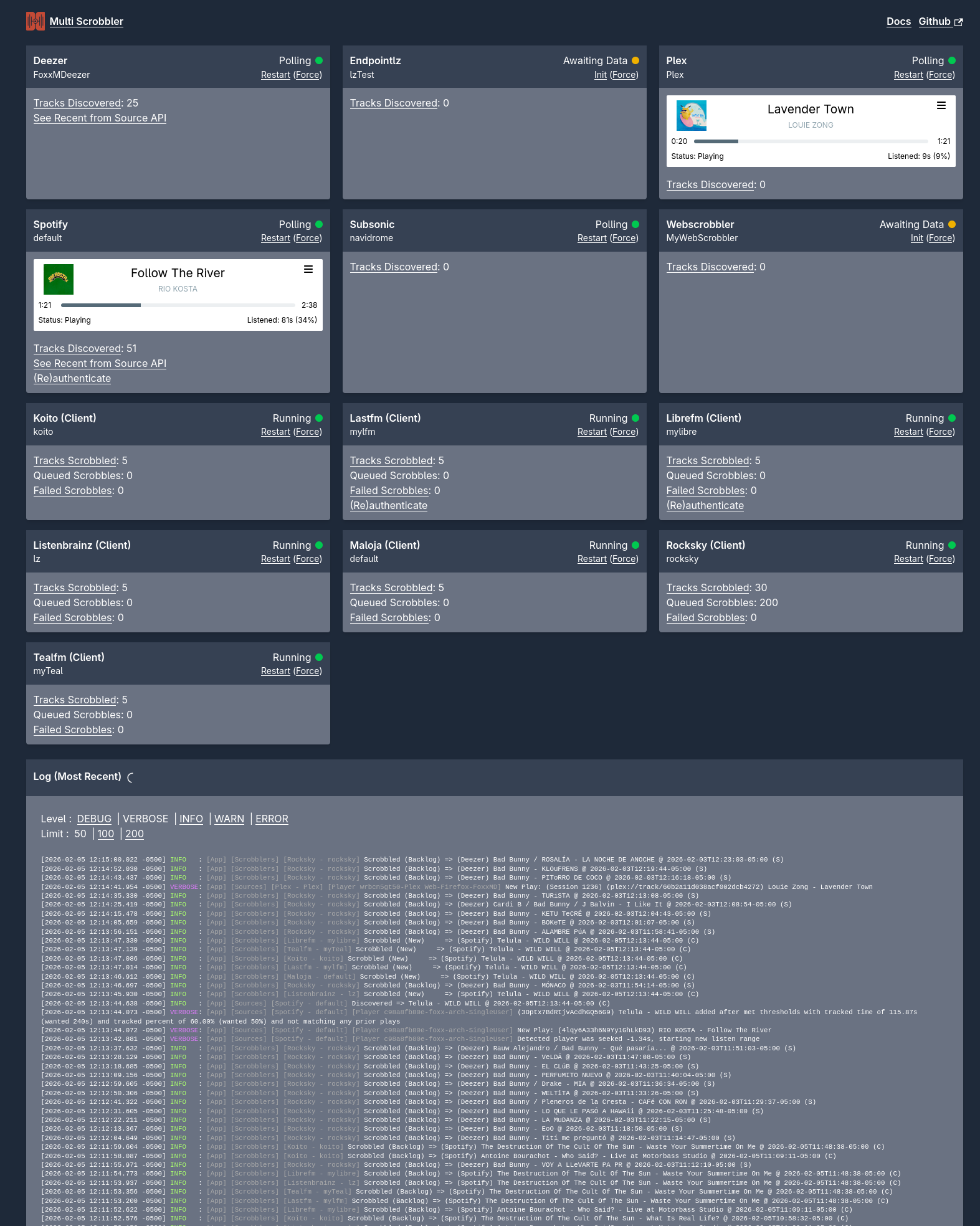
Scrobble plays from multiple sources to multiple clients
1.1k
Stars
43
Forks
37
Open issues
22
Contributors


AI Analysis
multi-scrobbler is a self-hosted Docker application that aggregates music listening activity from 30+ sources (Spotify, Plex, Jellyfin, YouTube Music, etc.) and forwards scrobbles to multiple music tracking clients (Last.fm, ListenBrainz, Maloja, etc.). It serves music enthusiasts and self-hosters who want centralized scrobbling across heterogeneous playback sources and tracking platforms. This tool is specialized for the music-tracking niche and not a general-purpose utility.
Inferred from signals mentioned in the README (tests, CI, type safety) — not a review of the actual code.
AI's overall editorial judgment — not an average of the bars above, can weigh other factors too.
Dockerized aggregator for scrobbling music playback from 30+ sources to multiple tracking services
multi-scrobbler is a self-hosted application that monitors music listening across diverse platforms (Spotify, Jellyfin, Plex, MPD, Kodi, Chromecast, VLC, and 20+ others) and forwards scrobbles to multiple tracking backends (Last.fm, ListenBrainz, Maloja, etc.). It targets privacy-conscious users and those with fragmented music stacks who want unified listening history without platform-specific apps. The project appears actively maintained with responsive development, serving a narrow but underserved niche in the scrobbling ecosystem.
Created November 2020, multi-scrobbler emerged as a successor concept to single-purpose scrobblers by consolidating source and sink multiplexing into one agent. It was built for environments where users operate multiple music sources (local servers, streaming services, internet radios) simultaneously and need unified tracking without installing separate bridge tools for each combination.
The project gained 1,109 stars over 5+ years with modest but consistent momentum (6 stars in last 7 days as of June 2026). Growth appears driven by organic discovery within self-hosted and privacy-focused communities rather than mainstream adoption. Docker availability and extensive source/client support likely contributed to gradual adoption. Recent activity (last push June 25, 2026) indicates sustained, not declining, maintenance.
Docker Hub pulls metric is referenced but not quantified in README excerpt. No specific production user testimonials, enterprise deployments, or adoption statistics visible. Community appears primarily self-hosted enthusiasts based on source types supported (MPD, MPRIS, Kodi) and architecture choices. adoption not verified at scale, but low baseline adoption expected for a niche tool.
Based on README, likely a Node.js/TypeScript service with modular architecture separating sources (polling/API adapters), clients (scrobble sinks), and a web UI. Appears designed for containerized deployment with configuration via ENV or JSON. README mentions webhook support, Prometheus metrics, and credential management, suggesting mature operational patterns.
not documented in README
Last push on 2026-06-25 (2 days before evaluation date) indicates active maintenance. Project has 44 forks suggesting some derivative/customization activity. README links point to comprehensive external documentation site (docs.multi-scrobbler.app), indicating commitment to user support beyond code comments.
ADOPT IF: you operate multiple music sources (self-hosted servers, streaming services, local players) simultaneously and want unified listening history without maintaining separate bridge tools for each combination, and you're comfortable self-hosting a Docker container. AVOID IF: you use only one streaming platform and want zero-friction cloud-based scrobbling, or you lack Docker/Linux infrastructure familiarity. MONITOR IF: you're building a privacy-first music tracking system and want to evaluate whether multi-scrobbler's source/client matrix meets future expansion needs before committing to a fork.
Independent dimensions
Mainstream potential
3/10
Technical importance
6/10
Adoption evidence
4/10
- Adoption appears limited to self-hosted and privacy communities; mainstream music platforms (Spotify, Apple Music official clients) may not depend on it, creating version-compatibility fragility when source APIs change.
- Maintenance dependent on single maintainer (FoxxMD) based on repository structure; project may face delays if maintainer availability drops, though MIT license enables community forks.
- Configuration complexity (30+ sources × 8 clients matrix) may create high onboarding friction for non-technical users despite UI efforts.
- Scrobble destination services (Last.fm, ListenBrainz) control their own API stability; multi-scrobbler is a consumer dependent on external ecosystem health.
- Docker-first deployment model excludes users without containerization capability; local Node.js install documented but may lag container release cycle in testing/support.
Likely to remain a stable but slowly-growing niche tool for self-hosted and privacy-conscious music enthusiasts. May see incremental adoption as federated/self-hosted music services (Jellyfin, Navidrome, Funkwhale) grow in popularity. Unlikely to reach mainstream visibility unless significant music platforms integrate scrobbling APIs or the maintainer pivots to lighter, SaaS deployment.
Newsletter
Get analyses like this every Monday
Free weekly digest of the most interesting open-source discoveries.
Languages
Information
- Website
- https://docs.multi-scrobbler.app
- Language
- TypeScript
- License
- MIT
- Last updated
- 17h ago
- Created
- 69mo ago
- Analyzed with
- anthropic/claude-haiku-4-5
Stars over time
Contributors over time
Top 100 contributors only — repos with more will plateau at 100.
Open issues
feat: Improve MusicBrainz "no match" caching
bug: Rocksky Authentication Issue after Latest Update 0.14.2
feat: Make MS config and persistent data conform to XDG Base Directory Specification
refactor: Replace native TS config schema/generator with a purpose-built library
bug: Most recent / final scrobble is not cleared from Now Playing.
Top contributors
Similar repos

web-scrobbler/web-scrobbler
Web Scrobbler is a browser extension (Chrome, Firefox, Safari, Edge) that...

kawaiiDango/pano-scrobbler
Pano Scrobbler is a multi-platform music scrobbling application for Windows,...

FuzzyGrim/Yamtrack
Yamtrack is a self-hosted media tracking platform for movies, TV shows, anime,...
| Repository | Stars | Week Δ | Language | Score | Updated |
|---|---|---|---|---|---|
|
FoxxMD/multi-scrobbler
this
|
1.1k | +9 | TypeScript | 8/10 | 17h ago |
|
web-scrobbler/web-scrobbler
|
3k | — | TypeScript | 7/10 | 1w ago |
|
kawaiiDango/pano-scrobbler
|
2.2k | — | Kotlin | 7/10 | 1d ago |
 jeffvli/feishin jeffvli/feishin
|
9k | — | TypeScript | 8/10 | 9h ago |
|
FuzzyGrim/Yamtrack
|
3k | — | Python | 7/10 | 1w ago |
 IrosTheBeggar/mStream IrosTheBeggar/mStream
|
2.4k | — | JavaScript | 7/10 | 1d ago |
Browser extension focused; platform-specific, passive monitoring. multi-scrobbler spans arbitrary sources including non-web ones (Chromecast, Plex, Kodi), requires active deployment. Different niche: web-scrobbler for light browser-based users vs. multi-scrobbler for complex multi-source setups.
Mobile-first Android scrobbler for Spotify/YouTube Music. Covers single source well; multi-scrobbler is source-agnostic and self-hosted. Complementary rather than competitive.
Music player focused on Subsonic-compatible servers. multi-scrobbler integrates Subsonic as one source among 30+ but doesn't replicate feishin's playback UI. Different problem domain: playback vs. scrobble aggregation.
Self-hosted music server/player. Overlaps in self-hosted positioning but orthogonal: mStream is a source, multi-scrobbler can consume from it and forward scrobbles elsewhere.
Music download/sync tool. Different goal; multi-scrobbler is purely about tracking, not acquisition or management of music files.