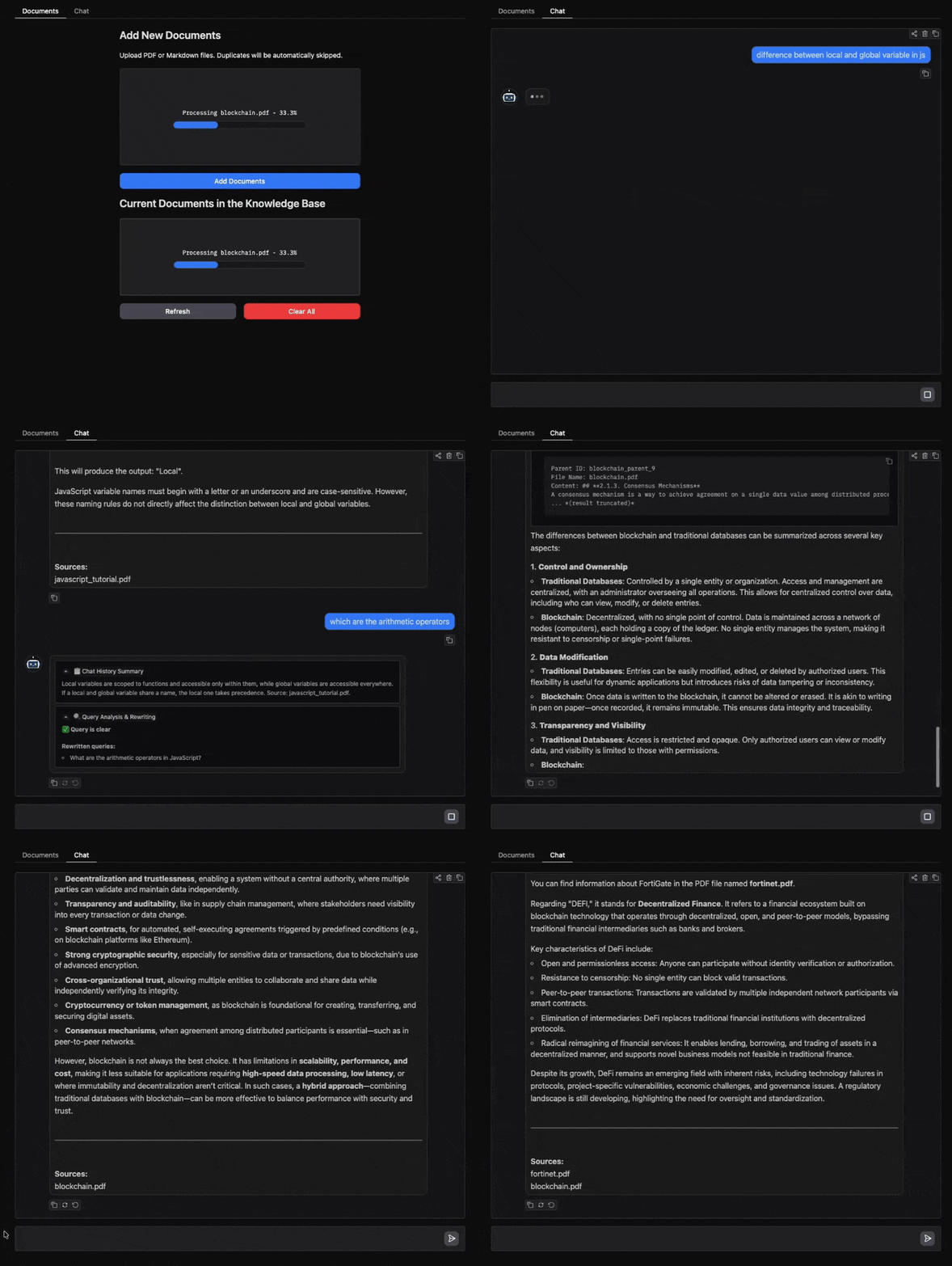
A modular Agentic RAG built with LangGraph — learn Retrieval-Augmented Generation Agents in minutes.
3.6k
Stars
473
Forks
0
Open issues
3
Contributors


AI Analysis
A modular educational framework for building Agentic RAG systems with LangGraph, designed to teach retrieval-augmented generation with practical features like conversation memory, query clarification, and multi-agent orchestration. Best suited for developers and ML engineers learning agentic AI patterns and building production RAG systems; less relevant for those seeking simple document QA without agent reasoning.
Inferred from signals mentioned in the README (tests, CI, type safety) — not a review of the actual code.
AI's overall editorial judgment — not an average of the bars above, can weigh other factors too.
Educational Agentic RAG template using LangGraph, gaining adoption among learning-focused users
Agentic RAG for Dummies is a Jupyter Notebook-based learning project demonstrating modular Retrieval-Augmented Generation agents built with LangGraph. It targets developers learning agentic RAG patterns, not production deployment. Features include hierarchical chunking, conversation memory, query clarification, multi-agent map-reduce, and self-correction. The project has modest but active adoption (3,574 stars, 466 forks as of June 2026) with accelerating interest in the past 12 months. It serves as educational material first, adaptable template second.
Created October 2025, the project emerged during peak LangGraph adoption momentum. It positions itself explicitly as an educational bridge — filling a gap between basic RAG tutorials and production agentic systems. The author later created Chunky, a companion project for RAG document preparation, suggesting iterative product thinking.
The project gained ~3,500 stars over 8 months, averaging 438 stars/month. Recent 7-day gain of 39 stars suggests steady but not explosive growth. Adoption likely driven by: (1) LangGraph's maturing ecosystem, (2) 'for Dummies' framing reducing perceived complexity barrier, (3) inclusion in awesome-langgraph badge, (4) Google Colab integration lowering friction. Growth appears sustainable but not accelerating sharply.
adoption not verified. The project positions itself as educational ('for Dummies', 'learn in minutes') rather than production-grade. While Jupyter Notebooks are adaptable to production via nbconvert or manual porting, no case studies, company testimonials, or production deployment documentation are evident. The companion project Chunky suggests author is exploring production tooling, but core agentic-rag-for-dummies appears solidly in the learning/template space.
Based on README, architecture is modular with pluggable components: LLM provider abstraction (Ollama, OpenAI, Anthropic, Google), embedding models, PDF conversion, and LangGraph agent workflows. Likely implements hierarchical chunking (parent/child splits based on Markdown headers), conversation memory management, and a four-stage query pipeline (conversation summary → query rewrite → clarification → parallel agent reasoning → aggregation). Appears to use Qdrant for vector storage and Langfuse for observability. README suggests extensibility but actual code quality cannot be verified from metadata alone.
not documented in README
Last push 2026-06-21 (9 days before evaluation date) indicates active maintenance. README is comprehensive and well-structured, suggesting ongoing attention to documentation. No signals of maintenance burden — the project is a focused template, not a framework with heavy support obligations. Update cadence appears sustainable.
ADOPT IF: you are learning agentic RAG patterns, want a modular template to adapt for a custom agent-driven retrieval system, or need LangGraph examples with conversation memory and clarification loops. The README is pedagogically clear and the Colab integration enables zero-setup learning. AVOID IF: you need production-hardened code, extensive test coverage, or a supported library (this is a template, not a maintained package). MONITOR IF: the author continues shipping Chunky and related tooling — the ecosystem around this template may mature into more production-facing offerings.
Independent dimensions
Mainstream potential
3/10
Technical importance
6/10
Adoption evidence
5/10
- Educational positioning may not scale to production demands; users will need to build robustness themselves (error handling, retry logic, rate limiting not evident in README).
- Dependency on LangGraph API stability; breaking changes in LangGraph 2.0+ would require maintenance effort to keep examples functional.
- Jupyter Notebook format limits discoverability and CI/CD integration compared to Python packages; adoption may plateau among teams preferring importable libraries.
- No test coverage documented; learning code may harbor subtle bugs that users copy into production without catching.
- Maintenance burden could spike if user base expands beyond learners to early-stage projects — current README suggests single-author maintenance.
Likely to remain a well-regarded educational reference and adaptable template for LangGraph-based agentic RAG, with steady modest growth in the 400–600 stars/month range. May inspire more production-focused forks or derivative projects. Unlikely to evolve into a mainstream production framework unless author significantly increases maintenance investment or hands off to a community org.
Newsletter
Get analyses like this every Monday
Free weekly digest of the most interesting open-source discoveries.
Languages
Information
- Language
- Jupyter Notebook
- License
- MIT
- Last updated
- 3w ago
- Created
- 9mo ago
- Analyzed with
- anthropic/claude-haiku-4-5
Stars over time
Contributors over time
Top 100 contributors only — repos with more will plateau at 100.
Open issues
No open issues — clean slate.
Open pull requests
No open pull requests.
Top contributors
Recent releases
Similar repos

NirDiamant/Controllable-RAG-Agent
This repository provides an advanced RAG (Retrieval-Augmented Generation)...
| Repository | Stars | Week Δ | Language | Score | Updated |
|---|---|---|---|---|---|
|
GiovanniPasq/agentic-rag-for-dummies
this
|
3.6k | +46 | Jupyter Notebook | 8/10 | 3w ago |
 bragai/bRAG-langchain bragai/bRAG-langchain
|
4.1k | — | Jupyter Notebook | 7/10 | 8mo ago |
 Andrew-Jang/RAGHub Andrew-Jang/RAGHub
|
2k | — | — | 7/10 | 3w ago |
|
NirDiamant/Controllable-RAG-Agent
|
1.6k | — | Jupyter Notebook | 7/10 | 1mo ago |
 pguso/rag-from-scratch pguso/rag-from-scratch
|
1.5k | — | JavaScript | 8/10 | 4mo ago |
Slightly higher star count and similar Jupyter Notebook format. Both are educational, but bRAG likely has marginally broader adoption. Agentic RAG for Dummies differentiates via explicit agentic orchestration (LangGraph) and query clarification loops; bRAG positioning unclear from metadata.
Lower adoption. Likely overlaps in agent orchestration but agentic-rag-for-dummies appears more comprehensive (multi-agent map-reduce, self-correction, conversation memory explicitly featured in README).
Similar star tier to agentic-rag-for-dummies. Positioning and differentiation unclear from metadata alone; both likely serve tutorial/template roles.
Lower adoption and different language (JS vs Python/Notebooks). Less directly comparable, but suggests broader RAG-tutorial ecosystem. Agentic RAG for Dummies differentiates via agent-centric design and LangGraph specificity.