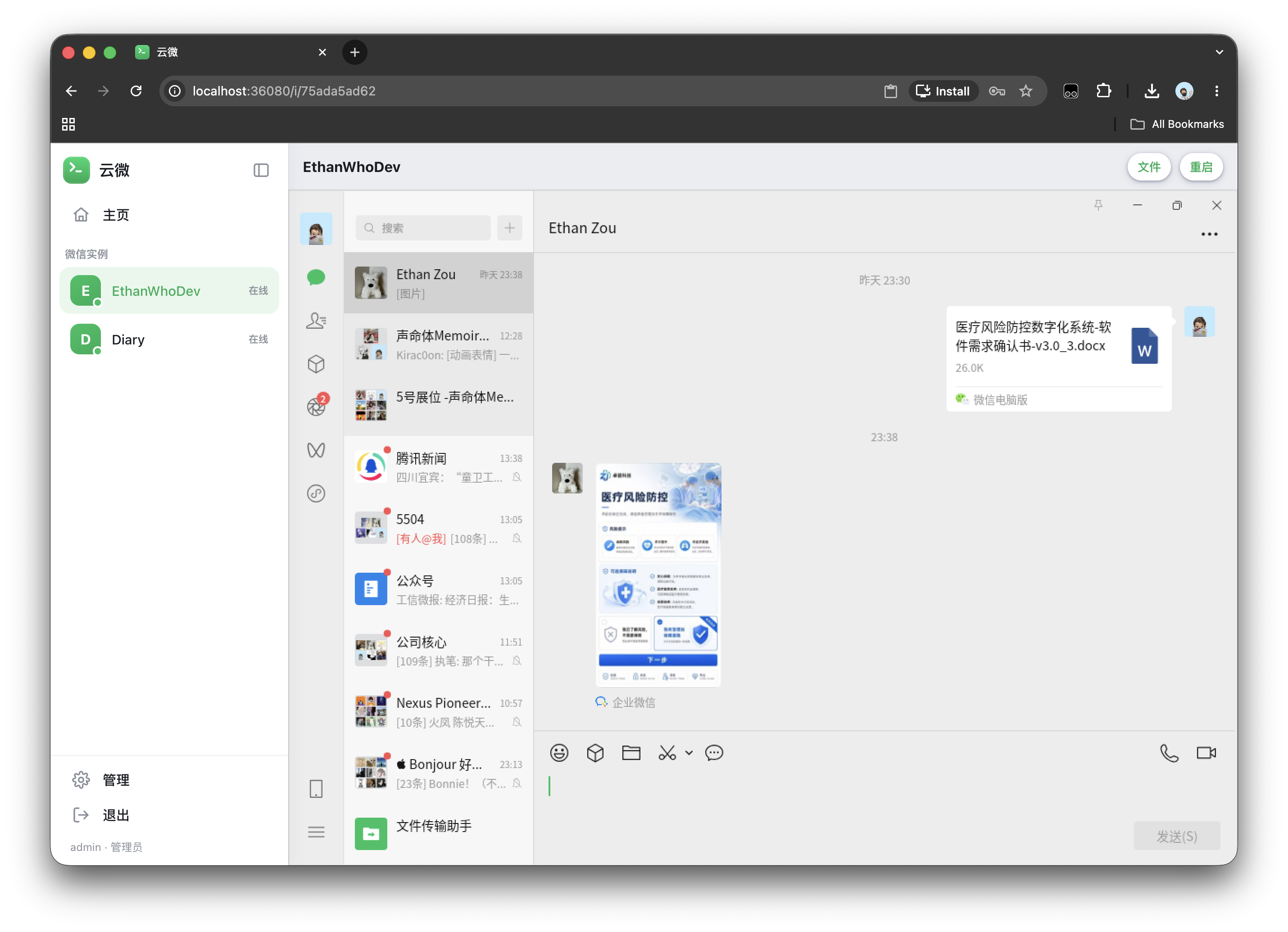
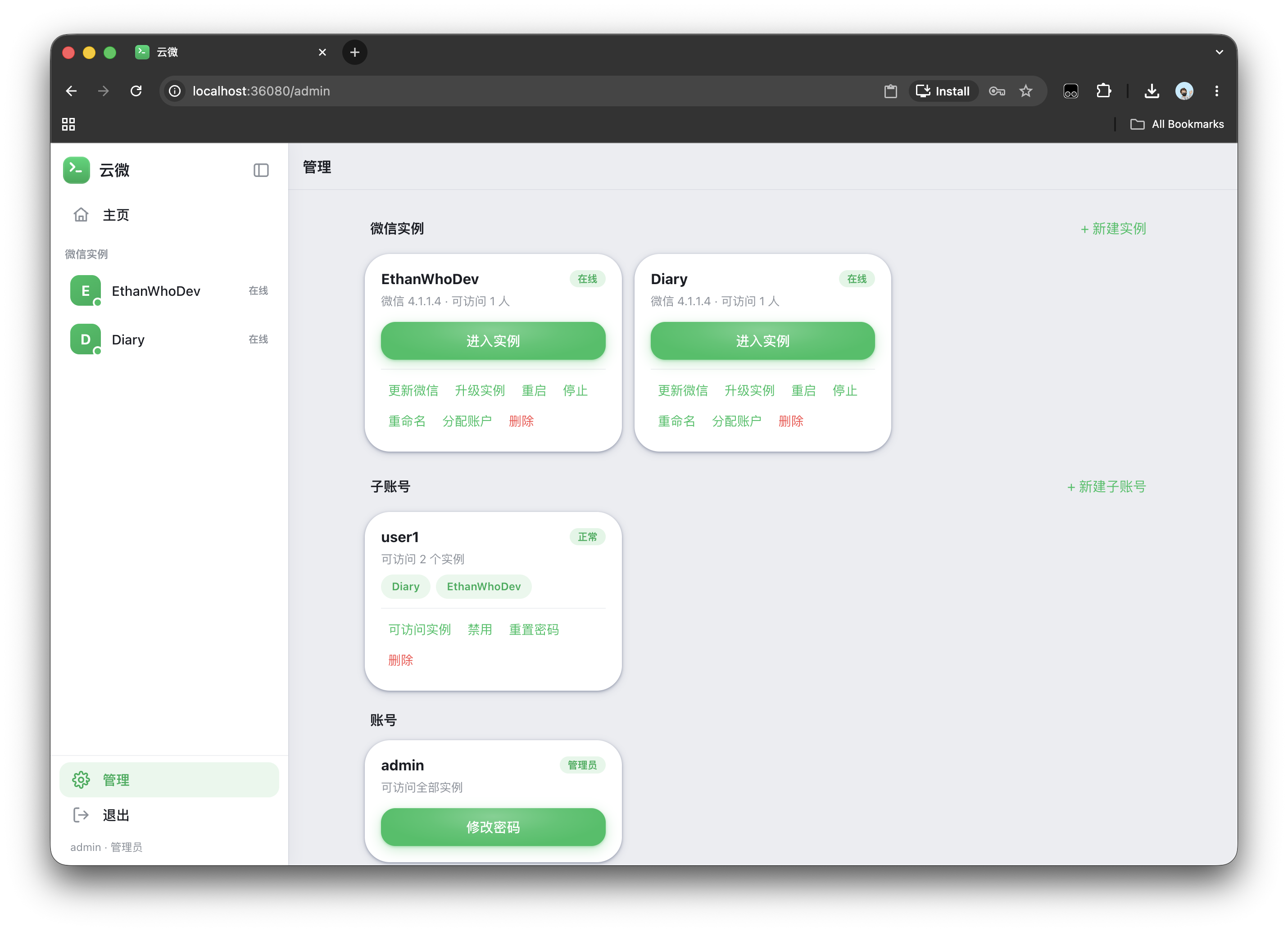
云微WOC,云微信,自由连接
3.4k
Stars
766
Forks
11
Open issues
7
Contributors


AI Analysis
WechatOnCloud is a self-hosted platform that runs WeChat (or Chromium browser instances) on NAS/servers with multi-user, multi-device session sharing through a web interface. It is purpose-built for users who need persistent, cloud-based WeChat sessions synchronized across multiple devices—not a general-purpose communication tool, and requires Docker expertise and server infrastructure to deploy.
Inferred from signals mentioned in the README (tests, CI, type safety) — not a review of the actual code.
AI's overall editorial judgment — not an average of the bars above, can weigh other factors too.
Self-hosted WeChat and web-app hub running on NAS/servers with multi-device session sharing via browser
WechatOnCloud (WOC) is a TypeScript-based self-hosted platform that runs the official WeChat client and Chromium browser instances in isolated Docker containers, accessible via web interface from multiple devices sharing the same session. Designed for power users, NAS owners, and organizations seeking persistent cloud-based access to WeChat and social-media web apps without modifying the official client. Early adoption signals visible in China-focused developer communities; deployed primarily on consumer NAS hardware and small-scale private servers.
Repository created 2026-05-29; extremely recent project (less than one month old at evaluation date). Gained 3,247 stars and 748 forks in approximately one month, with 312 stars added in the final week. Appears positioned as a successor to or alternative approach compared to Wechatsync (5,842 stars), which likely influenced market awareness.
Explosive early adoption trajectory: 3,247 stars in ~30 days suggests strong initial discovery, possibly through Chinese tech communities, NAS forums, and social-media sharing. Weekly star velocity (312 in week 7 days) indicates sustained interest rather than immediate plateau. Growth pattern consistent with a newly-released tool filling a perceived gap in self-hosted WeChat access; however, whether growth sustains beyond the launch window remains unknown. No evidence yet of declining velocity.
Adoption not verified through documented case studies or public deployment reports. Growth signals (star count, fork rate, weekly velocity) indicate interest, but stars do not equal production deployments. README targets NAS users (飞牛 OS, Synology) and self-hosters, suggesting intended audience is consumer/prosumer segment rather than enterprise. Community channels (Telegram group @WechatOnCloud, Twitter) listed but no public data on member counts or deployment testimonials. Adoption appears concentrated in Chinese-speaking communities based on documentation language and NAS focus.
Based on README: TypeScript-built panel serving as single entry point; manages Docker containers via docker.sock; each instance is a separate container running Xvfb (virtual display) + application (WeChat or Chromium) + KasmVNC (VNC-over-web). Multi-architecture support (amd64/arm64) via GitHub Actions auto-build. PWA-ready frontend. Appears to follow container-per-app design with reverse-proxy access control. Likely decouples UI from runtime via containerization, enabling multi-tenant isolation. README documents design rationale but code review not possible from metadata alone.
Not documented in README. No CI/test pipeline mentioned in metadata or truncated documentation.
Last push 2026-06-26 (1 day before evaluation date). Extremely active recent development. Repository created 2026-05-29, so entire history spans 28 days — insufficient to assess long-term maintenance patterns. No evidence of deprecated dependencies or stalled issues. Detailed documentation (运行原理.md, 技术方案.md, etc.) and responsive deployment guidance suggest active author involvement. Too young to predict sustainability; high velocity and thorough documentation are positive short-term indicators.
ADOPT IF: you operate a NAS or personal server in China/Asia, need persistent multi-device WeChat access without client modification, tolerate early-stage software, have Docker experience, and prioritize local control over SaaS. AVOID IF: you require guaranteed long-term support (project is <1 month old), need enterprise SLAs, use Windows/Mac as primary server runtime, or prefer established tools with multi-year track records. MONITOR IF: you are evaluating self-hosted communication infrastructure, interested in container-based session sharing patterns, or tracking WeChat automation ecosystems — this project's sustainability and feature maturity over the next 6–12 months will clarify whether it becomes a standard tool or remains a niche experiment.
Independent dimensions
Mainstream potential
3/10
Technical importance
6/10
Adoption evidence
2/10
- Sustainability risk: Project created 2026-05-29; no evidence of long-term maintenance commitment beyond launch enthusiasm. Author burnout or loss of interest could stall development.
- WeChat terms-of-service compliance: Running headless WeChat server instances may violate Tencent's ToS; no legal review documented. Risk of account bans or tool shutdown.
- Security maturity: README acknowledges security as a priority but project is too young to have undergone independent security audit. KasmVNC credentials injection is documented but has not been validated against real attacks.
- Docker/NAS-specific: Requires Docker and docker.sock access; unsuitable for serverless, Kubernetes-first, or non-containerized deployments. NAS target market is smaller than general Linux servers.
- Chinese market dependency: Documentation, community, and target hardware (飞牛 NAS) are China-centric. Adoption outside Asia-Pacific may remain marginal; internationalization effort uncertain.
Project likely to remain a specialized niche tool for Chinese-speaking NAS enthusiasts and self-hosting communities over the next 12 months. Probability of mainstream adoption outside Asia limited unless: (a) legal landscape clarifies, (b) documentation/support expands to English, (c) author sustains development post-launch. May see consolidation into broader self-hosted communication platforms or deprecation if Tencent enforcement increases.
Newsletter
Get analyses like this every Monday
Free weekly digest of the most interesting open-source discoveries.
Languages
Information
- Language
- TypeScript
- Last updated
- 2d ago
- Created
- 1mo ago
- Analyzed with
- anthropic/claude-haiku-4-5
Stars over time
Contributors over time
Top 100 contributors only — repos with more will plateau at 100.
Open issues
Top contributors
Similar repos

wechatsync/Wechatsync
Wechatsync is a Chrome browser extension that syncs articles from one platform...

freestylefly/openclaw-wechat
A WeChat channel plugin for OpenClaw that enables stable integration of...
| Repository | Stars | Week Δ | Language | Score | Updated |
|---|---|---|---|---|---|
|
Gloridust/WechatOnCloud
this
|
3.4k | +58 | TypeScript | 8/10 | 2d ago |
|
wechatsync/Wechatsync
|
5.9k | — | TypeScript | 7/10 | 1mo ago |
|
freestylefly/openclaw-wechat
|
1.7k | — | TypeScript | 6/10 | 5mo ago |
 semicons/java_oci_manage semicons/java_oci_manage
|
2k | — | Java | 7/10 | 2w ago |
Older, larger ecosystem; WOC differs by offering persistent server-side instances vs. likely client-side sync model. WOC adds non-WeChat apps (Telegram, X, Instagram web). Wechatsync's higher star count reflects maturity advantage; WOC's rapid rise suggests market differentiation resonates.
Official web client is free, but tied to mobile session and lacks persistent server presence. WOC adds server persistence, multi-device unlock, and local control.
Programmatic/bot-focused; WOC targets GUI-based users and session sharing. Complementary rather than directly competitive.
WOC wraps KasmVNC + Docker orchestration + WeChat-specific features (device spoofing, account management). Adds application-layer value; standalone VNC requires manual container/app setup.
Traditional desktop-sharing; WOC adds web-native access, RBAC, multi-instance management, and automatic container lifecycle. Modern alternative targeting web-first users.