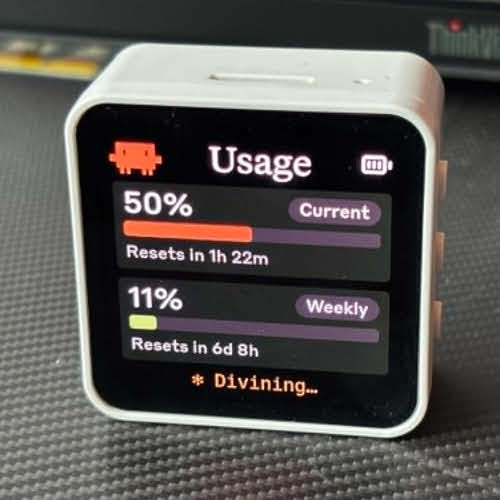
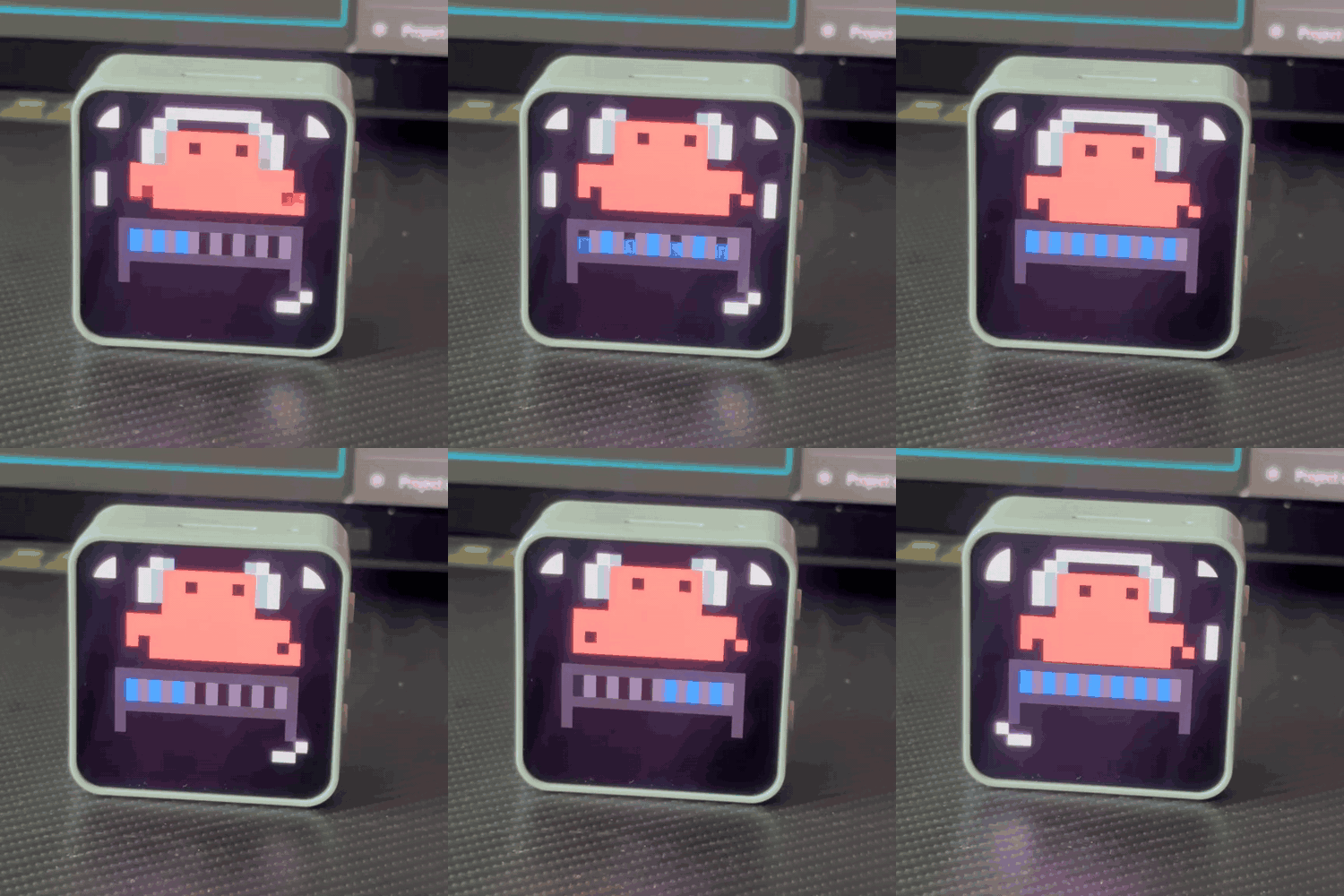
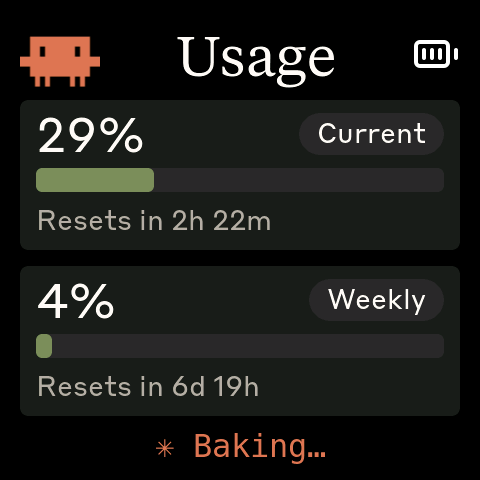
ESP32 desk dashboard that shows Claude Code usage
1.8k
Stars
242
Forks
41
Open issues
18
Contributors


AI Analysis
Clawdmeter is a specialized ESP32 desk dashboard that displays real-time Claude Code API usage metrics via Bluetooth, featuring animated pixel-art Clawd sprites that respond to usage intensity. It is purpose-built for Claude Code subscribers who want tangible, at-a-glance visibility into their API consumption and is not a general-purpose device or framework—it serves a narrow audience of Claude Code users with specific hardware support.
Inferred from signals mentioned in the README (tests, CI, type safety) — not a review of the actual code.
AI's overall editorial judgment — not an average of the bars above, can weigh other factors too.
ESP32 desk dashboard for Claude Code usage monitoring via Bluetooth HID
Clawdmeter is a specialized hardware project that runs on Waveshare ESP32-S3 touchscreen boards to display real-time Claude Code API usage metrics. It pairs with a host daemon over Bluetooth, polls usage every 60 seconds, and animates a pixel-art mascot based on consumption rate. Built by an individual developer, it appeals to power users of Claude Code who want physical, real-time visibility into API spend—a niche use case distinct from software-only monitoring tools.
Created 2026-05-11, approximately 7 weeks before evaluation date. Gained rapid early attention (1,718 stars in ~7 weeks, 54 stars in final 7 days), suggesting it resonated with the Claude Code user community shortly after launch. No prior art or historical evolution documented.
Project experienced steep initial growth immediately post-launch, likely driven by novelty appeal and alignment with a highly engaged Claude Code subscriber base during a period of AI tooling enthusiasm. Sustained 54-star weekly gain suggests continued discovery, but the trajectory will depend on whether Clawdmeter becomes integrated into power-user workflows or remains a viral curiosity. Early adoption by a specialized audience (ESP32 hobbyists + Claude Code subscribers) is evident; sustained growth requires non-trivial setup friction to be tolerable.
Adoption not verified through public case studies, company usage, or community testimonials in README. Star count and fork count suggest interest, but stars do not equate to production deployment. The hardware barrier (requires specific Waveshare boards + manual flashing + daemon setup) likely keeps real-world usage to a small enthusiast subset. No evidence of commercial deployment, integration with managed services, or enterprise adoption.
Appears to use a thin hardware abstraction layer with board-specific implementations under `firmware/src/boards/`, suggesting modularity across multiple ESP32 variants. Host-side daemons for Linux, macOS, and Windows written in Python (using `bleak` for BLE, `httpx` for HTTP); firmware likely in C/C++ (PlatformIO-based). README documents clear porting path for new boards, indicating intentional extensibility.
Not documented in README. No mention of unit tests, integration tests, or CI/CD pipelines. Given the embedded nature and small team, formal test coverage likely minimal.
Last push 2026-06-26 (3 days before evaluation), indicating active recent work. Project is young (7 weeks old) and shows no signs of abandonment. Maintainer appears responsive to hardware porting requests (README explicitly discourages duplicate PRs in favor of QA feedback). Too early to assess long-term maintenance commitment, but current signals are positive. Lack of license specification in metadata is a documentation gap.
ADOPT IF: You own a Waveshare ESP32-S3 touchscreen board, use Claude Code actively, value physical ambient feedback, and are comfortable with embedded systems setup (flashing, Bluetooth pairing, daemon management). AVOID IF: You prefer plug-and-play solutions, use Claude Code only occasionally, require cross-platform hardware compatibility, or want official vendor support. MONITOR IF: You're interested in hardware-software integration patterns for API monitoring, or if the maintainer significantly reduces setup friction (e.g., pre-flashed boards, cloud-based daemon alternative).
Independent dimensions
Mainstream potential
3/10
Technical importance
5/10
Adoption evidence
3/10
- Setup complexity (firmware flashing, Bluetooth pairing, daemon installation across three OS variants) will limit adoption to technical users; each prerequisite drop-off compounds the addressable market.
- Hardware dependency on specific Waveshare boards and their continued availability; supply chain or board discontinuation directly breaks the value proposition.
- No documented license, potentially creating legal ambiguity for forks and reuse; ambiguous terms may deter enterprise or institutional interest.
- Small single-maintainer project with no visible governance, CI/CD, or issue triage process; bus factor is high, and maintenance may stall if creator loses interest.
- Dependency on Claude Code API and Anthropic's willingness to expose usage metrics via OAuth; API changes, rate limits, or authentication model shifts could break the integration without warning.
Likely to remain a niche enthusiast project serving a small, devoted community of hardware hobbyists and Claude Code power users. Early viral growth may plateau as the novelty effect wears off and hardware barrier filters most casual users. Success metrics should be: (1) sustained 1-2 new board ports per quarter, (2) stable daemon reliability, (3) evidence of active maintenance beyond 12 months. If setup friction is reduced or official support materializes, addressable market could expand modestly.
Newsletter
Get analyses like this every Monday
Free weekly digest of the most interesting open-source discoveries.
Languages
Information
- Language
- C
- Last updated
- 24h ago
- Created
- 2mo ago
- Analyzed with
- anthropic/claude-haiku-4-5
Stars over time
Contributors over time
Top 100 contributors only — repos with more will plateau at 100.
Open issues
3D Printed Desk Shell
install-windows.ps1: interactive config prompts (dirs/clock/chime) parity (follow-up to #96)
Windows daemon: multi config-dir + active-plan parity (follow-up to #95)
Surface pending Claude Code prompts on-device and answer them by touch
Windows daemon: unbounded start_notify can wedge like the macOS daemon (#84)
Top contributors
Recent releases
No releases published yet.
Similar repos

Maciek-roboblog/Claude-Code-Usage-Monitor
Claude Code Usage Monitor is a real-time terminal utility that tracks API...

anthropics/claude-desktop-buddy
This is a reference implementation and example firmware for connecting hardware...

jarrodwatts/claude-hud
Claude HUD is a Claude Code plugin that provides real-time visibility into...
| Repository | Stars | Week Δ | Language | Score | Updated |
|---|---|---|---|---|---|
|
HermannBjorgvin/Clawdmeter
this
|
1.8k | +40 | C | 8/10 | 24h ago |
|
Maciek-roboblog/Claude-Code-Usage-Monitor
|
8.4k | — | Python | 8/10 | 5d ago |
|
anthropics/claude-desktop-buddy
|
2.4k | — | C++ | 7/10 | 3mo ago |
|
jarrodwatts/claude-hud
|
26.3k | — | JavaScript | 8/10 | 6d ago |
 phuryn/claude-usage phuryn/claude-usage
|
2k | — | Python | 7/10 | 1w ago |
 tddworks/ClaudeBar tddworks/ClaudeBar
|
1.3k | — | Swift | 7/10 | 1w ago |
Browser-based monitoring tool with significantly larger audience. Clawdmeter differentiates via physical hardware presence and Bluetooth HID integration (side buttons for voice mode shortcuts); claude-hud is software-only and requires running browser/app.
Python-based software monitoring with wider platform support. Clawdmeter trades broader compatibility for tangible physical feedback and automation (animated display, tactile integration into desk workspace).
Official or semi-official monitoring tool. Clawdmeter competes on novelty and hardware differentiation rather than authority or official integration.
Simpler Python usage monitor. Both serve similar problem space (Claude Code spend tracking), but Clawdmeter adds physical visualization; phuryn/claude-usage likely more accessible to non-hardware users.
Focuses on historical tracking and detailed analytics. Clawdmeter targets real-time ambient awareness rather than deep historical analysis.