Universal memory layer for AI Agents. It provides scalable, extensible, and interoperable memory storage and retrieval to streamline AI agent state management for next-generation autonomous systems.
3.3k
Stars
194
Forks
84
Open issues
30
Contributors


AI Analysis
MemMachine is an open-source memory layer that adds persistent, multi-tiered memory (episodic, profile, working) to AI agents and LLM applications, enabling stateful assistants that learn and recall information across sessions. It serves teams building agentic AI systems that need to maintain user context and agent state, particularly those using LangChain, LangGraph, CrewAI, or LlamaIndex—not suitable for stateless chatbots or simple retrieval-augmented generation without agent loops.
Inferred from signals mentioned in the README (tests, CI, type safety) — not a review of the actual code.
AI's overall editorial judgment — not an average of the bars above, can weigh other factors too.
Python memory layer for AI agents with multi-type storage and framework integrations
MemMachine is an open-source persistent memory system for AI agents, offering episodic (graph-based), profile (SQL), and working memory types. Designed for developers building stateful agents with LangChain, CrewAI, and similar frameworks. Adoption appears modest relative to larger competitors (mem0ai at 60k stars), but shows recent momentum with 42 stars/week and documented Docker/PyPI downloads. Solves real problem of agent state persistence across sessions.
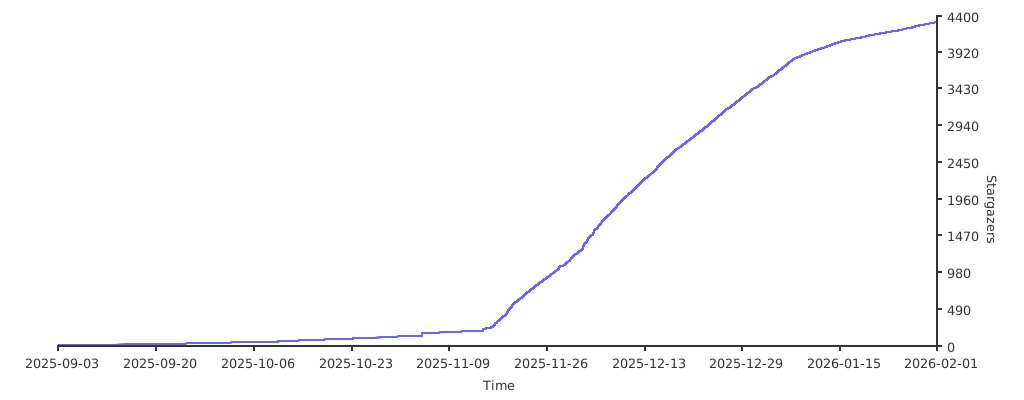
Created August 2025, MemMachine entered a crowded field of agent memory solutions roughly 1 year before analysis date. Competitors like mem0 (59k stars) and Memori (15k stars) predate it. Despite later entry, gained 3.1k stars in ~10 months, suggesting either strong marketing or genuine traction in underserved use cases.
Steady acquisition of 42 stars/week indicates consistent interest, though growth rate is moderate compared to earlier-stage viral projects. PyPI and Docker pull metrics are mentioned in README but actual numbers not visible in metadata. Multi-framework integration strategy (LangChain, CrewAI, LlamaIndex, n8n, Dify) appears intentional to capture users already embedded in agent ecosystems. MCP server support aligns with recent Claude-ecosystem popularity.
Adoption not verified at scale. README mentions Docker pulls and PyPI downloads (memmachine-client, memmachine-server) but exact figures not provided. Presence of integrations with production frameworks (LangChain, CrewAI, Dify, n8n) suggests some real-world deployment, but no case studies, blog posts, or company endorsements visible in available metadata. Discord community mentioned but size unknown.
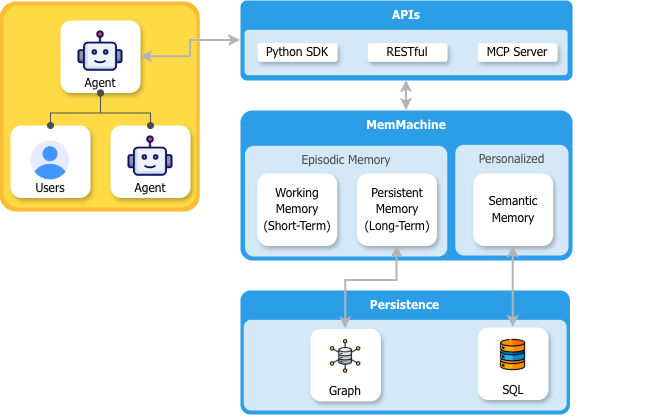
Based on README, appears to use Neo4j for episodic memory (graph-based conversational context), SQL for profile memory (user facts), and ephemeral working memory. Client-server split with Python SDK and RESTful API suggests service-oriented design. MCP server layer adds protocol flexibility. Likely designed for horizontal scalability given emphasis on 'universal memory layer' and 'interoperable' storage.
Not documented in README excerpt. No mention of test suite, CI/CD configuration, or code coverage targets.
Last push 2026-06-30 (analysis date), indicating active development as of report generation. 180 forks and presence of multiple integrations suggest reasonable contributor engagement. No public evidence of deprecation warnings or maintenance backlog; appears actively maintained rather than in slow decline.
ADOPT IF: you are building Python-based agents with LangChain, CrewAI, or LlamaIndex and need persistent cross-session memory without vendor lock-in; your team can self-host or accept managed service dependency; you need graph-based conversational context combined with SQL user profiles. AVOID IF: you require proven production stability at enterprise scale, extensive case studies, or mature third-party ecosystem tooling; you prioritize framework agnosticism beyond Python; your memory needs are simple key-value and don't justify operational overhead of Neo4j+SQL stack. MONITOR IF: you are considering mem0 vs MemMachine; real-world adoption metrics (PyPI downloads, production deployments) would clarify market positioning; long-term maintenance commitment and performance benchmarks under load remain unclear.
Independent dimensions
Mainstream potential
4/10
Technical importance
6/10
Adoption evidence
3/10
- Adoption evidence is limited; PyPI/Docker metrics mentioned but not quantified, making true real-world usage unclear relative to GitHub stars.
- Neo4j+SQL dual-storage model introduces operational complexity and potential data consistency challenges not addressed in README; self-hosted deployments may struggle with infrastructure.
- Newer entrant (1 year old) in crowded field dominated by larger projects (mem0); may face long-term sustainability or funding pressures if growth plateaus.
- Framework integrations listed but integration depth/maturity unknown; README does not clarify whether integrations are official, maintained by community, or experimental.
- No benchmarks, performance characteristics, or scalability limits published; unclear how system behaves with millions of episodic memories or concurrent agent sessions.
MemMachine likely continues as a viable niche solution for Python-agent teams, especially those already using LangChain/CrewAI ecosystems. Unlikely to displace mem0 as category leader due to head start and larger ecosystem, but may capture users seeking local control or multi-memory-type architecture. Growth rate suggests steady adoption rather than viral expansion; sustainability depends on maintaining framework integrations and establishing credible production deployments.
Explore similar
Newsletter
Get analyses like this every Monday
Free weekly digest of the most interesting open-source discoveries.
Languages
Information
- Website
- https://memmachine.ai
- Language
- Python
- License
- Apache-2.0
- Last updated
- 1d ago
- Created
- 11mo ago
- Analyzed with
- anthropic/claude-haiku-4-5
Stars over time
Contributors over time
Top 100 contributors only — repos with more will plateau at 100.
Open issues
Top contributors
Recent releases
Similar repos
| Repository | Stars | Week Δ | Language | Score | Updated |
|---|---|---|---|---|---|
|
MemMachine/MemMachine
this
|
3.3k | +67 | Python | 7/10 | 1d ago |
 mem0ai/mem0 mem0ai/mem0
|
60.5k | — | Python | 8/10 | 37 min ago |
 MemoriLabs/Memori MemoriLabs/Memori
|
15.6k | — | Python | 8/10 | 4w ago |
 MemTensor/MemOS MemTensor/MemOS
|
10.2k | — | TypeScript | 8/10 | 1d ago |
 moorcheh-ai/memanto moorcheh-ai/memanto
|
1.6k | — | Python | 7/10 | 18h ago |
 memvid/memvid memvid/memvid
|
15.7k | — | Rust | 8/10 | 1mo ago |
Significantly larger user base and earlier market entry. MemMachine's multi-memory-type architecture (episodic+profile+working) vs mem0's approach; unclear which resonates more with users from README alone.
MemMachine appears newer but growing steadily. Both target AI agent memory; differentiation on storage backend (Neo4j+SQL vs Memori's approach) not clearly established in README.
Different language ecosystem (TypeScript vs Python). MemMachine's framework integrations more numerous; unclear if MemOS has equivalent breadth.
Similar size to MemMachine but fewer stars. Both appear to serve niche memory management roles; MemMachine's integration breadth likely provides advantage.
Different language and likely different problem focus (memory codec/compression vs agent memory layer). Not direct competitor.