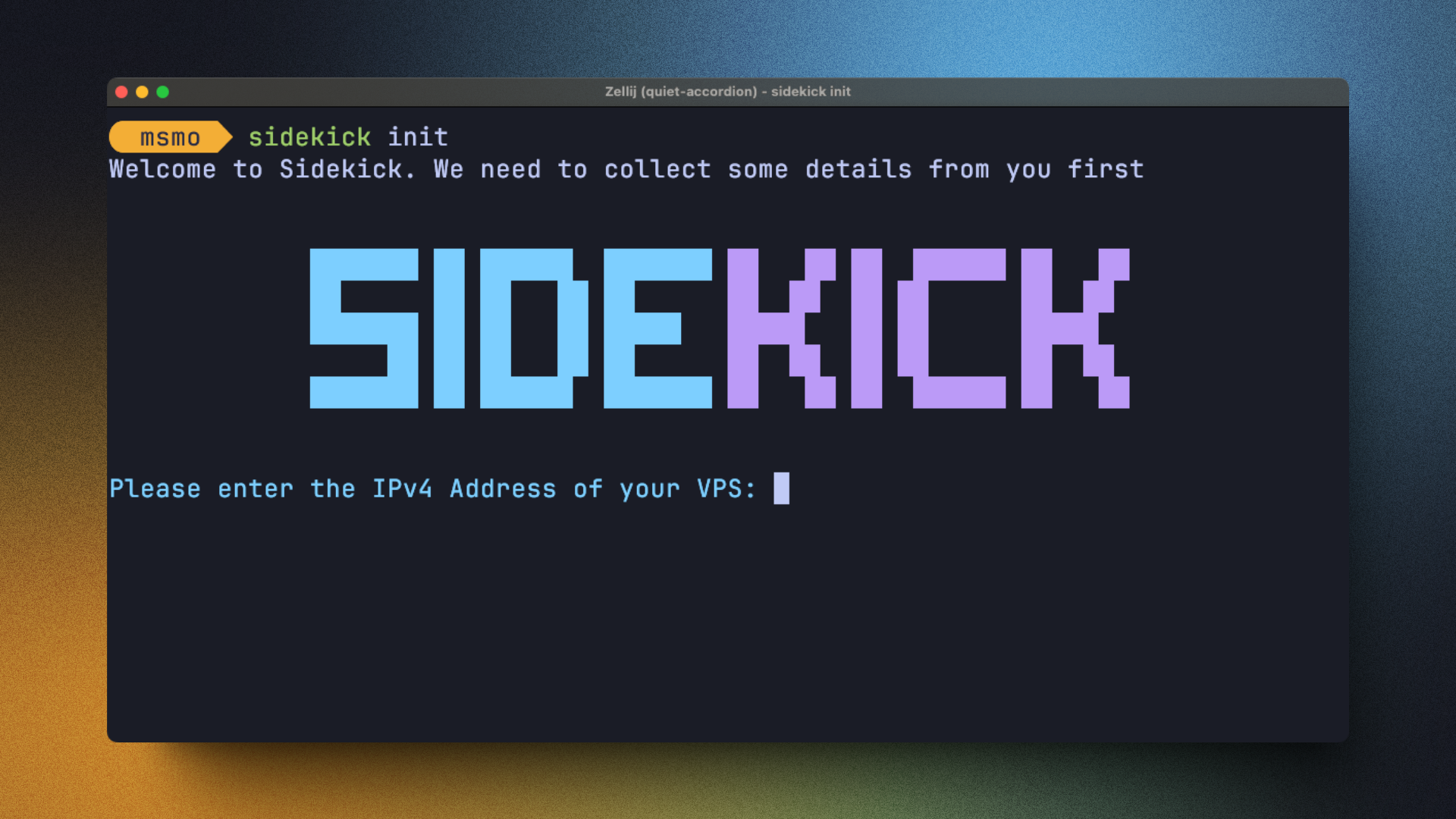
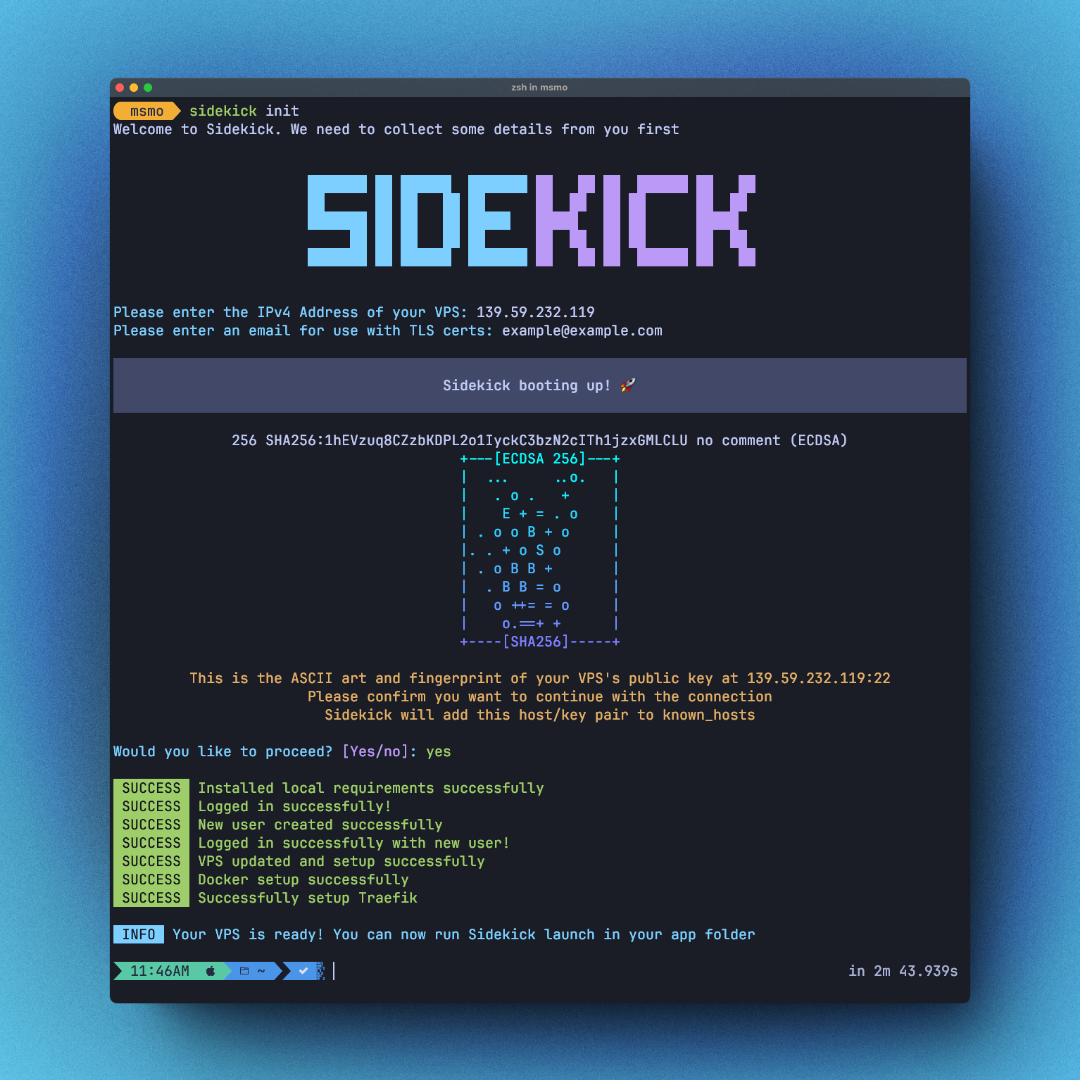
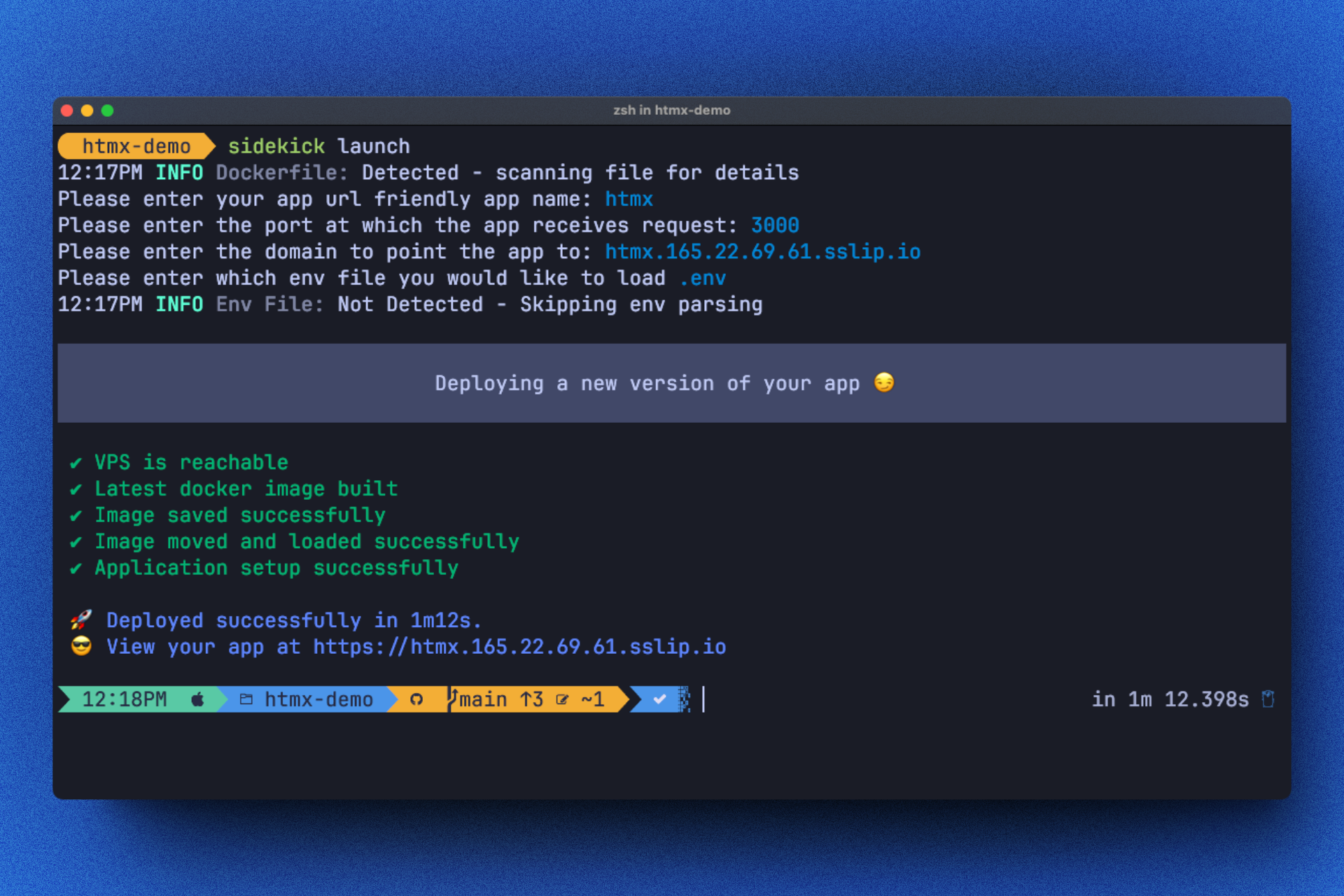
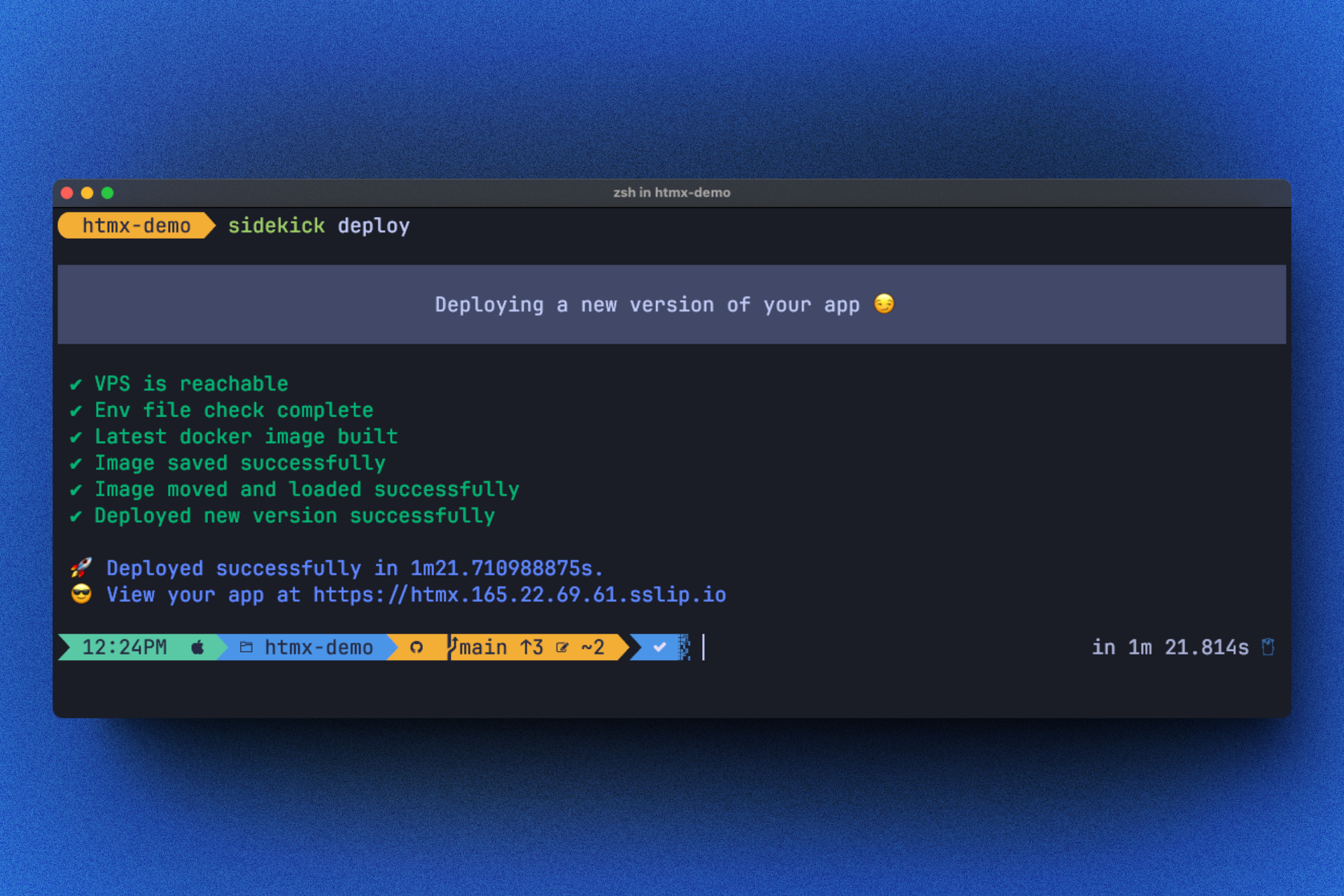
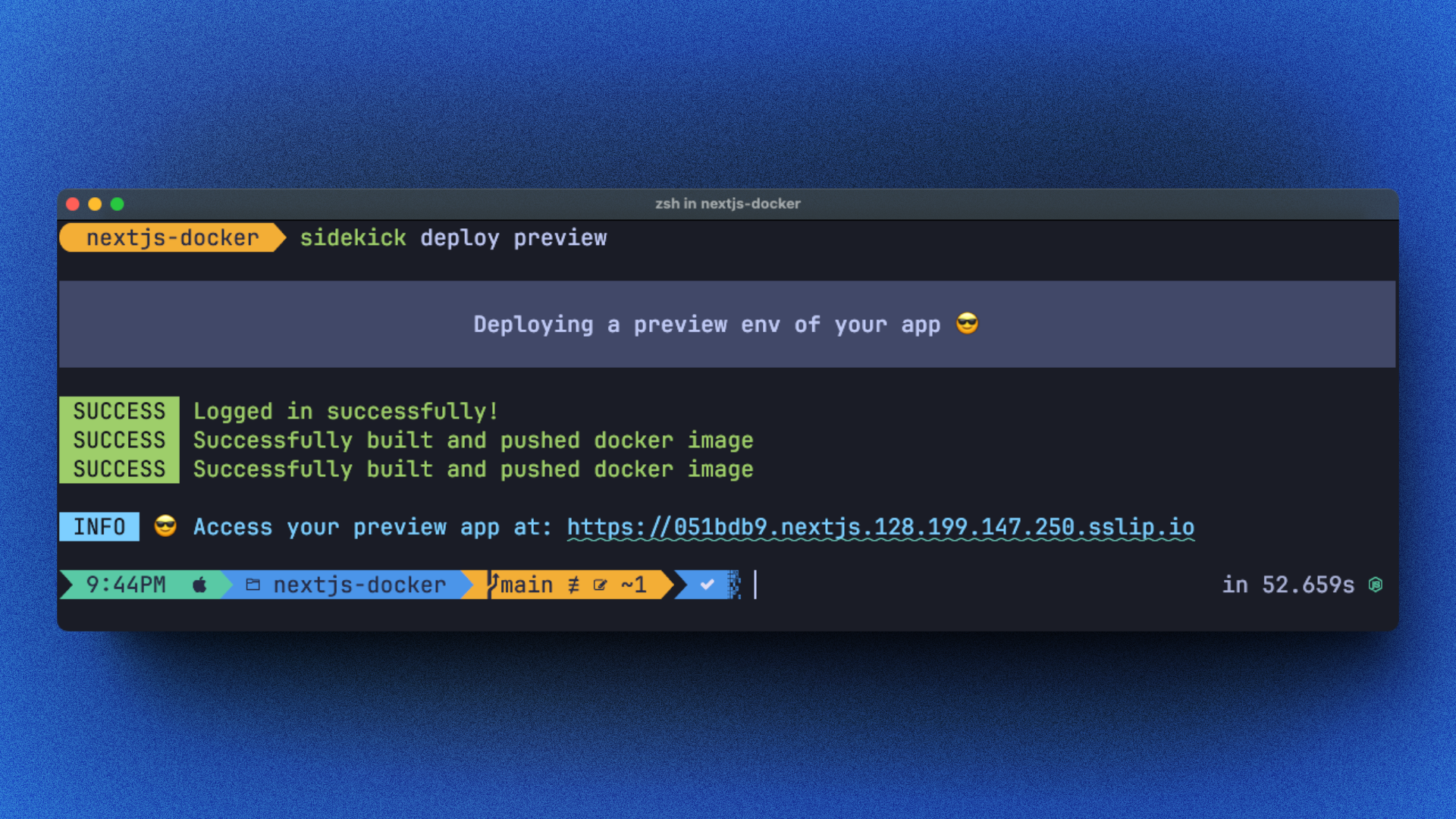
Bare metal to production ready in mins; your own fly server on your VPS.
7.5k
Stars
162
Forks
17
Open issues
8
Contributors




AI Analysis
Sidekick is a Go-based deployment tool that automates infrastructure setup and application deployment on a user's own VPS, positioning itself as a self-hosted alternative to Fly.io. It targets developers who want to deploy side projects affordably on commodity VPS hardware (e.g., DigitalOcean, Hetzner) without managing Docker, Traefik, SSL, or secrets infrastructure manually. It is not a general-purpose hosting platform and is best suited for developers comfortable with VPS administration who...
Inferred from signals mentioned in the README (tests, CI, type safety) — not a review of the actual code.
AI's overall editorial judgment — not an average of the bars above, can weigh other factors too.
Sidekick turns a bare Ubuntu VPS into a Fly.io-like deployment platform in minutes using Docker and Traefik
Sidekick is a Go CLI tool that automates the full lifecycle of deploying Dockerized apps to a self-owned VPS: it provisions the server (Docker, Traefik, SOPS/age for secrets), builds and transfers images, manages zero-downtime deploys, and handles SSL via Let's Encrypt. It targets indie developers and small teams who want cloud PaaS convenience without cloud PaaS pricing or vendor lock-in. It requires only an Ubuntu VPS and a Dockerfile. The project is opinionated and simple by design — not a full platform, but a sharp CLI for the solo/small-team use case.
Created in July 2024, Sidekick emerged from a specific developer frustration: the complexity and cost of platforms like Fly.io for simple side projects. It reached 7,400+ stars relatively quickly, suggesting it resonated with a latent demand in the indie dev community.
The project gained significant early traction likely through Hacker News and developer Twitter/X communities where VPS-self-hosting and 'escape vendor lock-in' narratives consistently attract attention. Growth appears to have slowed from an early spike — 55 stars in the last 7 days is moderate, not viral — suggesting the initial wave has passed and the project is settling into steady organic discovery.
Adoption not verified through formal case studies or public production testimonials. The star count (7,470) and Homebrew distribution suggest a real user base exists, and the README's practical tone implies real usage feedback shaped the tool. However, no quantified deployment counts, testimonials, or community forum activity are referenced in available metadata.
Appears to be a Go CLI application that orchestrates SSH commands against a remote Ubuntu VPS. Likely uses Go's SSH libraries to provision the server, docker build/save/load for image transfer, docker-compose for container orchestration, Traefik for reverse proxying and SSL termination, and SOPS+age for secrets management. The architecture appears deliberately thin — a workflow orchestrator rather than a daemon or control plane.
not documented in README
Last push was 2026-02-03, approximately 5 months before current date. This is a meaningful gap for an actively developed CLI tool, though not alarming for a mature, feature-stable project. The README references documentation at sidekickdeploy.com, suggesting some investment beyond the repo itself. With only 160 forks, community contribution surface is limited. Maintenance pace appears to have slowed but cannot be confirmed as abandoned.
ADOPT IF: you are a solo developer or small team who wants to deploy Dockerized apps to a single Ubuntu VPS quickly, prefers CLI over web UIs, and wants secrets management (SOPS) baked in without standing up a full PaaS. AVOID IF: you need multi-server orchestration, a web dashboard, database provisioning, or a large community and ecosystem behind the tool — Coolify or Dokploy are better fits. MONITOR IF: you find Kamal or Dokku adequate today but want a simpler secrets-handling story, or if you are evaluating single-VPS deployment tooling for a growing side project.
Independent dimensions
Mainstream potential
4/10
Technical importance
6/10
Adoption evidence
3/10
- Maintenance velocity has slowed — last push 5 months ago with only one active maintainer apparent; project could stall if the author's priorities change.
- Homebrew-only installation and macOS-centric workflow (brew dependency) limits use in Linux-only or CI/CD environments without workarounds.
- GPL-3.0 license may create friction for commercial or embedded use cases compared to MIT/Apache-licensed alternatives.
- Single-server design is a feature, not a bug, for the target audience — but it becomes a ceiling if a project outgrows one VPS and migration to a multi-node setup requires switching tools entirely.
- Relatively small fork and contributor base means the project depends heavily on a single maintainer; bus-factor risk is real.
Sidekick will likely stabilize as a reliable niche tool for solo developers and remain popular in indie hacker circles, but is unlikely to significantly close the gap with Coolify or Dokku in overall adoption. Growth will be slow and steady rather than accelerating.
Explore similar
Newsletter
Get analyses like this every Monday
Free weekly digest of the most interesting open-source discoveries.
Languages
Information
- Website
- https://www.sidekickdeploy.com
- Language
- Go
- License
- GPL-3.0
- Last updated
- 5mo ago
- Created
- 25mo ago
- Analyzed with
- anthropic/claude-haiku-4-5
Stars over time
Contributors over time
Top 100 contributors only — repos with more will plateau at 100.
Open issues
Top contributors
Recent releases
Similar repos

coollabsio/coolify
Coolify is an open-source, self-hostable Platform-as-a-Service (PaaS) that lets...
| Repository | Stars | Week Δ | Language | Score | Updated |
|---|---|---|---|---|---|
|
MightyMoud/sidekick
this
|
7.5k | +8 | Go | 7/10 | 5mo ago |
|
coollabsio/coolify
|
58.2k | — | PHP | 8/10 | 1h ago |
 vitodeploy/vito vitodeploy/vito
|
3.2k | — | PHP | 7/10 | 7d ago |
 Dokploy/dokploy Dokploy/dokploy
|
35.5k | — | TypeScript | 8/10 | 1d ago |
 cortesi/devd cortesi/devd
|
3.5k | — | Go | 7/10 | 3w ago |
 SpectoLabs/hoverfly SpectoLabs/hoverfly
|
2.5k | — | Go | 7/10 | 3w ago |
Coolify (57k stars) offers a full web UI, database management, and supports multiple servers. It is substantially more feature-complete but also more complex to operate. Sidekick targets users who prefer a pure CLI workflow and minimal footprint over a self-hosted control plane.
Dokploy (35k stars) is another Coolify-style platform with a web dashboard. Like Coolify, it trades simplicity for broader feature coverage. Sidekick is more opinionated and faster to get started for single-server, single-developer scenarios.
Dokku (32k stars) is the closest spiritual predecessor — a git-push Heroku replacement. Dokku is more mature and widely deployed in production but requires server-side daemon setup. Sidekick is more Mac-local-CLI-centric and integrates secrets management natively.
Kamal (not in the similar list but directly comparable) is also a CLI-based zero-downtime deployer for Docker apps on VPS. Kamal has broader community backing via Basecamp/DHH, which likely competes directly for the same audience. Sidekick's SOPS integration and simpler init flow may appeal to users who find Kamal's configuration more involved.
Kubero (4k stars) targets Kubernetes-based self-hosted PaaS, making it more complex and infrastructure-heavy. Sidekick and Kubero serve different scale assumptions — Sidekick is explicitly single-VPS focused.