Evaluate and improve models and agents using environments
1k
Stars
223
Forks
482
Open issues
30
Contributors


AI Analysis
NeMo Gym is a library for evaluating and improving AI models and agents in stateful environments (e.g., code execution, tool use), designed specifically for teams needing reproducible, scalable evaluation and training workflows. It provides modular interfaces, an environment hub, and integration with NVIDIA's broader NeMo ecosystem. Best suited for ML practitioners and researchers building and optimizing agentic systems; not for simple stateless scoring tasks.
Inferred from signals mentioned in the README (tests, CI, type safety) — not a review of the actual code.
AI's overall editorial judgment — not an average of the bars above, can weigh other factors too.
NVIDIA's evaluation and training platform for AI agents in stateful environments
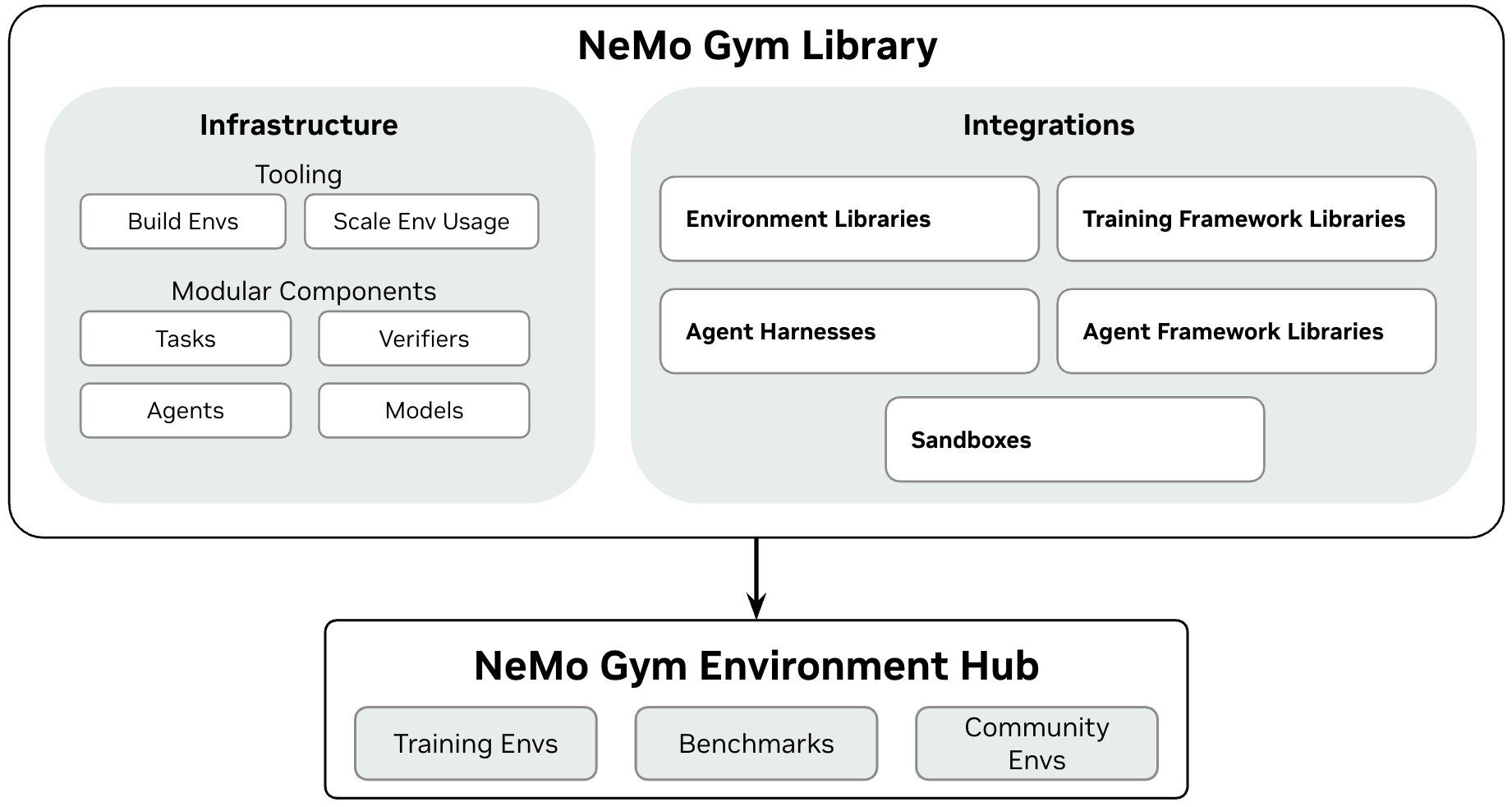
NeMo Gym is a framework for evaluating and training AI models and agents within interactive environments (code execution, tool calling, sandboxes). It provides modular interfaces for agents, tasks, verifiers, and state management; integrates with popular benchmarks; and scales to concurrent evaluation and RL training. Built by NVIDIA as part of the NeMo ecosystem, targeting practitioners who need reproducible, scalable agent evaluation beyond stateless scoring.
Created August 2025, NeMo Gym reached public release (v0.1.0) in November 2025. It emerged from NVIDIA's internal work on Nemotron model training, particularly agent training workflows requiring stateful evaluation and rollout collection at scale. Part of the broader NeMo platform for generative AI.
Rapid iteration: v0.1.0 (Nov 2025) → v0.2.0 (Mar 2026, expanded environments) → v0.2.1 (Apr 2026, docs) → v0.3.0 (Jun 2026, 70+ environments, VeRL integration). Repository gained ~20 stars in 7 days (as of Jun 2026) and maintains active push cadence. Growth appears driven by expanding environment hub and ecosystem integration rather than viral adoption.
README claims 'battle-tested in production Nemotron training' — specific validation unknown beyond NVIDIA's own use. PyPI release available. Integration with NVIDIA NeMo ecosystem, NeMo RL, VeRL, Unsloth suggests internal adoption. No public case studies, customer testimonials, or third-party adoption documented. Adoption not verified for external organizations.
Likely follows modular, composable design: agents interact with environments via standardized harnesses; tasks define what to solve; verifiers score completion; state manages per-task execution context. README emphasizes extensibility and interop with external libraries (Aviary, Harbor, OpenEnv, Reasoning Gym). Scalability for concurrent evaluation suggested but implementation details not documented in README.
CI badge present (unit-tests workflow referenced), but coverage percentage not stated in README. Testing infrastructure exists but depth unknown.
Very active: last push 2026-06-29 (today relative to analysis date 2026-06-30). Repository 10 months old. Multiple releases in 6-month window. Explicit notice: 'currently in early development — expect evolving APIs, incomplete documentation, occasional bugs.' Candid maturity positioning suggests active iteration, not stagnation.
ADOPT IF: you need to evaluate and train agents in stateful environments (code execution, tool calling), require reproducible cross-team benchmarking, or want to scale evaluation and RL training to thousands of concurrent tasks. Strong if you're already in NVIDIA NeMo ecosystem or training Nemotron-style models. AVOID IF: you need stable, frozen APIs (project is pre-1.0 with intentional breaking changes); you require exhaustive documentation and community support (README notes incomplete docs); or you only score stateless model outputs (existing scripts suffice). MONITOR IF: you evaluate agents at moderate scale but aren't locked into NVIDIA tooling — watch for v1.0 stability milestone and third-party adoption signals to assess whether early-stage friction is worth the integration benefit.
Independent dimensions
Mainstream potential
4/10
Technical importance
7/10
Adoption evidence
3/10
- Pre-1.0 stability: README explicitly warns of evolving APIs and bugs. Early adopters may face breaking changes in minor releases.
- Documentation incomplete: README acknowledges 'incomplete documentation.' Implementation details, troubleshooting, and advanced patterns may be sparse.
- Adoption concentration: adoption evidence limited to NVIDIA internal use; external traction unverified. Risk of being perceived as NVIDIA-specific rather than general-purpose.
- Ecosystem lock-in risk: deep integration with NeMo, NeMo RL, VeRL, and other NVIDIA libraries may create friction for users with heterogeneous toolchains.
- Resource server dependencies: many environments delegate to external 'resource servers' (Aviary, Harbor, OpenEnv); operational complexity and failure modes of these integrations not documented in README.
NeMo Gym likely becomes the de-facto standard for NVIDIA-internal agent training and evaluation, with modest third-party adoption among teams already using NeMo. Mainstream adoption in broader ML engineering hinges on v1.0 stabilization, external case studies, and whether the ecosystem lock-in is perceived as benefit (unified platform) or friction (proprietary). Growth trajectory suggests continued iteration but not viral adoption.
Explore similar
Newsletter
Get analyses like this every Monday
Free weekly digest of the most interesting open-source discoveries.
Languages
Information
- Language
- Python
- License
- Apache-2.0
- Last updated
- 9h ago
- Created
- 11mo ago
- Analyzed with
- anthropic/claude-haiku-4-5
Stars over time
Contributors over time
Top 100 contributors only — repos with more will plateau at 100.
Open issues
Top contributors
Recent releases
Similar repos

NVIDIA/NeMo-Agent-Toolkit
NVIDIA NeMo Agent Toolkit is an open-source library for building, connecting,...
| Repository | Stars | Week Δ | Language | Score | Updated |
|---|---|---|---|---|---|
|
NVIDIA-NeMo/Gym
this
|
1k | +19 | Python | 8/10 | 9h ago |
|
NVIDIA-NeMo/RL
|
1.8k | — | Python | 8/10 | 11h ago |
|
NVIDIA/NeMo-Agent-Toolkit
|
2.5k | — | Python | 8/10 | 8h ago |
|
NVIDIA-NeMo/Guardrails
|
6.7k | — | Python | 8/10 | 22h ago |
Gymnasium is stateless-focused general RL environment standard; NeMo Gym is specialized for stateful agent evaluation (code, tool-use, verification). Non-overlapping primary use cases.
LangChain/LangGraph focus on agent choreography and tool-calling; NeMo Gym focuses on evaluation infrastructure and environment scalability for training. Complementary; NeMo Gym can use LangGraph agents.
Sibling project for RL training; NeMo Gym is the environment/evaluation layer feeding into NeMo RL training pipelines.
VeRL is a separate RL training framework. NeMo Gym v0.3.0 integrated VeRL as an option for training within collected rollouts.
NeMo Gym targets practitioners currently writing ad-hoc evaluation harnesses; README explicitly states: 'if you're scoring stateless outputs with a script, a script is probably sufficient.'