Knowhere extracts, parses, and outputs structured chunks ready for AI Agents and RAG.
1.9k
Stars
240
Forks
14
Open issues
8
Contributors


AI Analysis
Knowhere is a document ingestion and parsing pipeline that transforms unstructured documents (PDFs, Office files, images, tables, Markdown) into structured, semantically-aware chunks optimized for AI agents and RAG systems. It is specialized for organizations building agentic RAG applications and self-hosted document processing workflows; it is not a general-purpose document tool and requires infrastructure setup or reliance on their managed cloud service.
Inferred from signals mentioned in the README (tests, CI, type safety) — not a review of the actual code.
AI's overall editorial judgment — not an average of the bars above, can weigh other factors too.
Python toolkit for parsing unstructured documents into structured chunks for AI agents and RAG systems
Knowhere is a Python library that ingests unstructured documents (PDFs, Office files, images, tables) and outputs hierarchically-structured chunks with semantic context, designed for agentic RAG workflows. Built by Ontos-AI, it positions itself as a post-parsing layer that adds hierarchy reconstruction and graph construction on top of markdown extraction. The project open-sourced in May 2026 after operating as a managed service, targeting organizations building AI agent systems that need better document understanding than flat vector retrieval.
Knowhere originated as a closed-source managed service (knowhereto.ai) and was open-sourced on May 7, 2026. The project is approximately 2 months old in its public repository as of June 28, 2026. It was created by Ontos-AI to address perceived gaps in existing document parsing and RAG infrastructure, particularly around hierarchy preservation and agentic retrieval patterns.
The repository gained 1,804 stars in roughly 59 days, with 134 stars in the final 7 days alone (as of June 27, 2026). Growth acceleration suggests timing coincided with the open-source announcement and appears to follow a typical launch curve for newly-open-sourced projects. The timing overlaps with broader industry discussion of agentic RAG and document parsing improvements, indicating responsive market positioning rather than organic discovery.
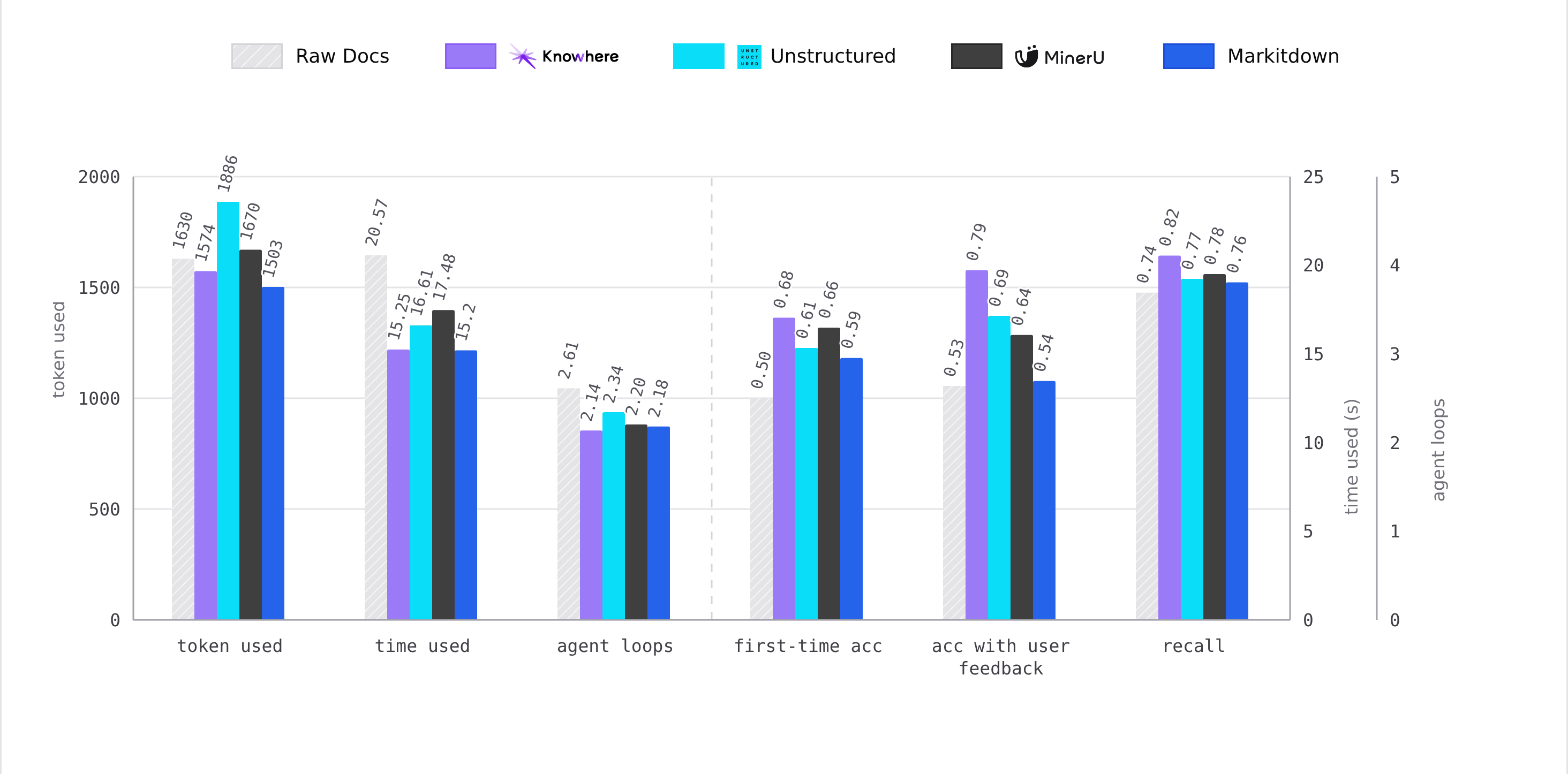
Adoption not verified in public documentation. The managed service (knowhereto.ai) existed prior to open-source release, suggesting some production usage in closed form, but no customer case studies, deployment counts, or enterprise adoption metrics are published. The $5 free credits promotion targets new users. Benchmark comparison claimed against MinerU, Markitdown, and Unstructured, but benchmark data image is truncated in README. Self-hosted repository exists, indicating infrastructure for self-deployment, but usage telemetry is absent.
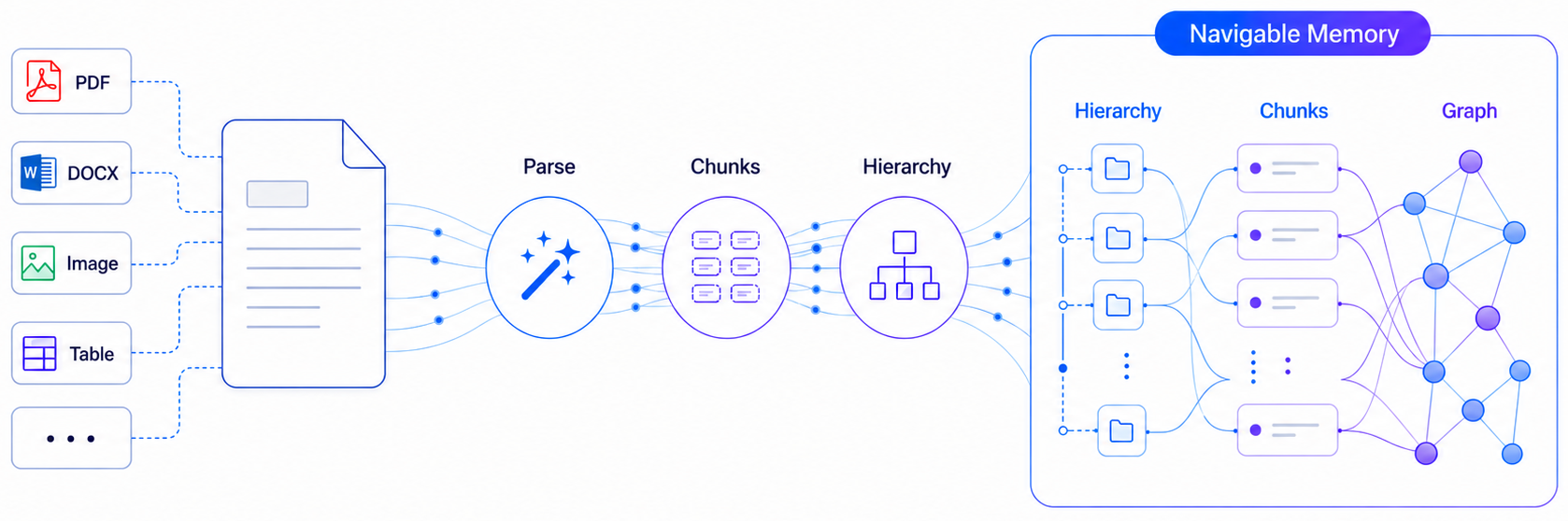
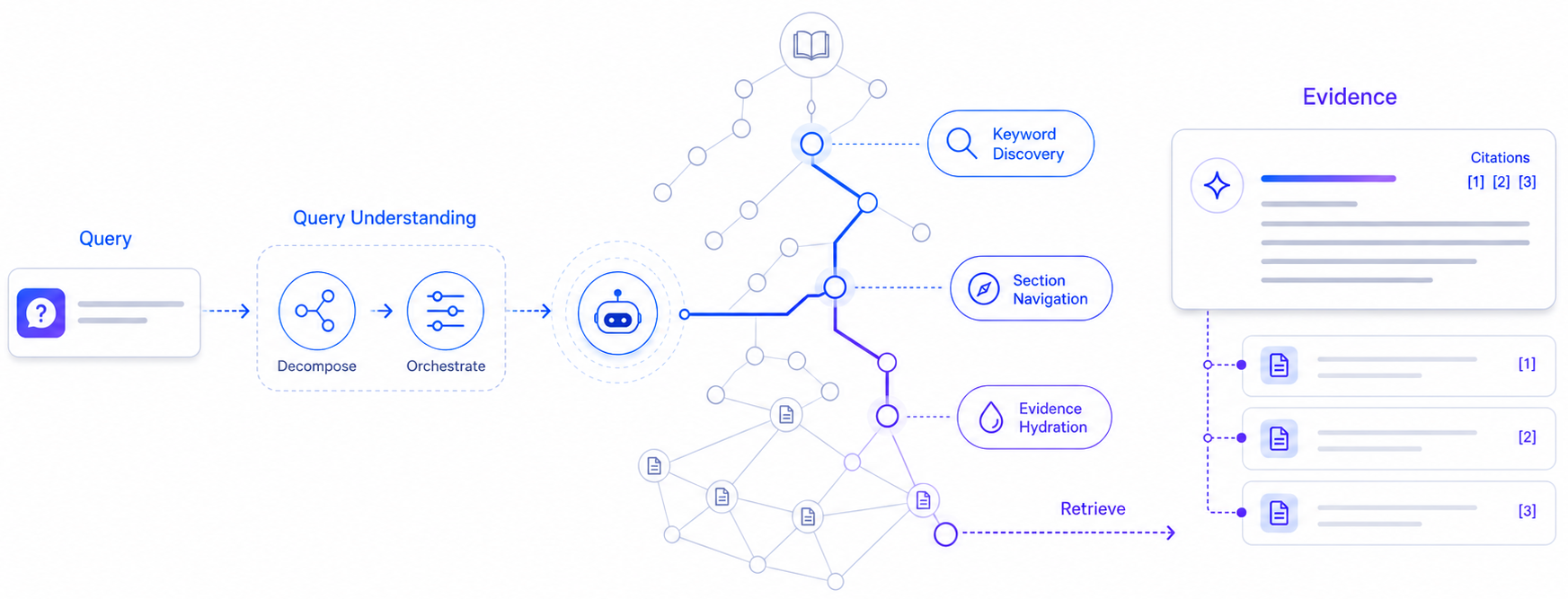
Based on README, Knowhere appears to operate as a two-stage pipeline: (1) specialized parsers route different document types (PDF, images, tables, Markdown) through type-specific handling; (2) a proprietary 'Tree-like algorithm' reconstructs document hierarchy instead of flattening; (3) chunks are stored with navigation trees, summaries, and graph links. The system is model-agnostic, defaulting to DeepSeek for summarization and Qwen-VL for image processing. Implementation details are not visible; README claims MinerU is the default parser but notes any Markdown-outputting tool works. Self-hosted deployment is available separately.
Not documented in README. CI badge present (GitHub Actions pr-ci.yml) but scope and coverage metrics not specified.
Last push June 27, 2026 (1 day before analysis date), indicating active development. Repository is 59 days old with 202 forks. Build status badge present and passing. Community discussion channel exists. No evidence of delayed issue response or stalled maintenance; project appears under active iteration post-launch.
ADOPT IF: you are building agentic RAG systems, need document hierarchy preservation for multi-hop reasoning, can tolerate a very young open-source project (2 months), and are willing to self-host or use the managed service. AVOID IF: you need mature, battle-tested infrastructure with extensive production case studies, prefer established parsers like Unstructured, or require on-premises-only guarantees without managed service dependency. MONITOR IF: you are evaluating agentic RAG architectures; the hierarchy reconstruction and graph-based retrieval patterns are potentially valuable, but real-world adoption evidence is still accumulating, and the project's sustainability post-launch is unproven.
Independent dimensions
Mainstream potential
4/10
Technical importance
7/10
Adoption evidence
2/10
- Very early-stage project (open-sourced 2 months ago); risk of API churn, breaking changes, or reduced maintenance investment if adoption plateau occurs.
- Real-world production adoption metrics not published; customer demand and product-market fit remain unverified despite managed service history.
- Dependency on third-party models (DeepSeek, Qwen-VL) for core functionality; model availability, pricing, or performance changes could impact utility and increase operational cost.
- Benchmark data truncated in README; claimed +36% performance advantage over competitors cannot be fully validated from available documentation.
- Self-hosted complexity not fully transparent; deployment effort, infrastructure requirements, and operational toil could exceed expectations; managed service dependency may be the actual recommended path.
Knowhere will likely remain a specialized tool for agentic RAG builders rather than achieving mainstream adoption as a general-purpose document parsing library. Success will depend on whether the hierarchy reconstruction and graph navigation patterns become standard in agentic AI systems (possible but uncertain). The project will either consolidate around a stable API with growing adoption or slow if enterprises prefer simpler, more mature alternatives. Acquisition or deep integration with a larger agent framework remains a plausible outcome.
Newsletter
Get analyses like this every Monday
Free weekly digest of the most interesting open-source discoveries.
Languages
Information
- Website
- https://knowhereto.ai
- Language
- Python
- License
- Apache-2.0
- Last updated
- 1d ago
- Created
- 2mo ago
- Analyzed with
- anthropic/claude-haiku-4-5
Stars over time
Contributors over time
Top 100 contributors only — repos with more will plateau at 100.
Open issues
Connected image chunks silently dropped in assemble_retrieval_results
Add original/normalized file download API for SDK page-memory citations
Optimize BM25 retrieval candidate loading with Postgres FTS prefilter
[Feature]: How to manually modify the parsed blocks?
[Feature]: ask about project
Top contributors
Similar repos

HKUDS/RAG-Anything
RAG-Anything is a multi-modal retrieval-augmented generation framework built on...
| Repository | Stars | Week Δ | Language | Score | Updated |
|---|---|---|---|---|---|
|
Ontos-AI/knowhere
this
|
1.9k | +41 | Python | 8/10 | 1d ago |
 Tencent/WeKnora Tencent/WeKnora
|
18.1k | — | Go | 7/10 | 6h ago |
 Zleap-AI/SAG Zleap-AI/SAG
|
2k | — | TypeScript | 8/10 | 2w ago |
 VectifyAI/OpenKB VectifyAI/OpenKB
|
2.9k | — | Python | 8/10 | 1d ago |
|
HKUDS/RAG-Anything
|
22.1k | — | Python | 7/10 | 21h ago |
 adithya-s-k/omniparse adithya-s-k/omniparse
|
7.6k | — | Python | 7/10 | 7mo ago |
Larger and more established project in RAG pipeline space; Knowhere differentiates via hierarchy reconstruction and agentic retrieval patterns rather than flat chunking. Knowhere is narrower but explicitly targets agents; RAG-Anything appears broader.
Both handle multi-modal document parsing. omniparse emphasizes parser consolidation; Knowhere emphasizes post-parse memory structure and graph construction. Likely complementary rather than direct competitors.
Large-scale retrieval system with different language and scope. Knowhere focuses on upstream document preparation; WeKnora on downstream retrieval at scale. Different positions in the pipeline.
Unstructured is a well-funded document parsing library. Knowhere explicitly positions itself as a layer above parsers, not a replacement for them, claiming +36% performance gains in agent tasks (benchmark truncated in README).
Knowhere uses MinerU as default parser but explicitly states MinerU alone is insufficient; Knowhere's value proposition is hierarchy reconstruction and agentic retrieval post-parsing, not parser replacement.