MiniCPM5-1B: A SOTA 1B on-device LLM, small yet powerful.
9.7k
Stars
641
Forks
18
Open issues
30
Contributors


AI Analysis
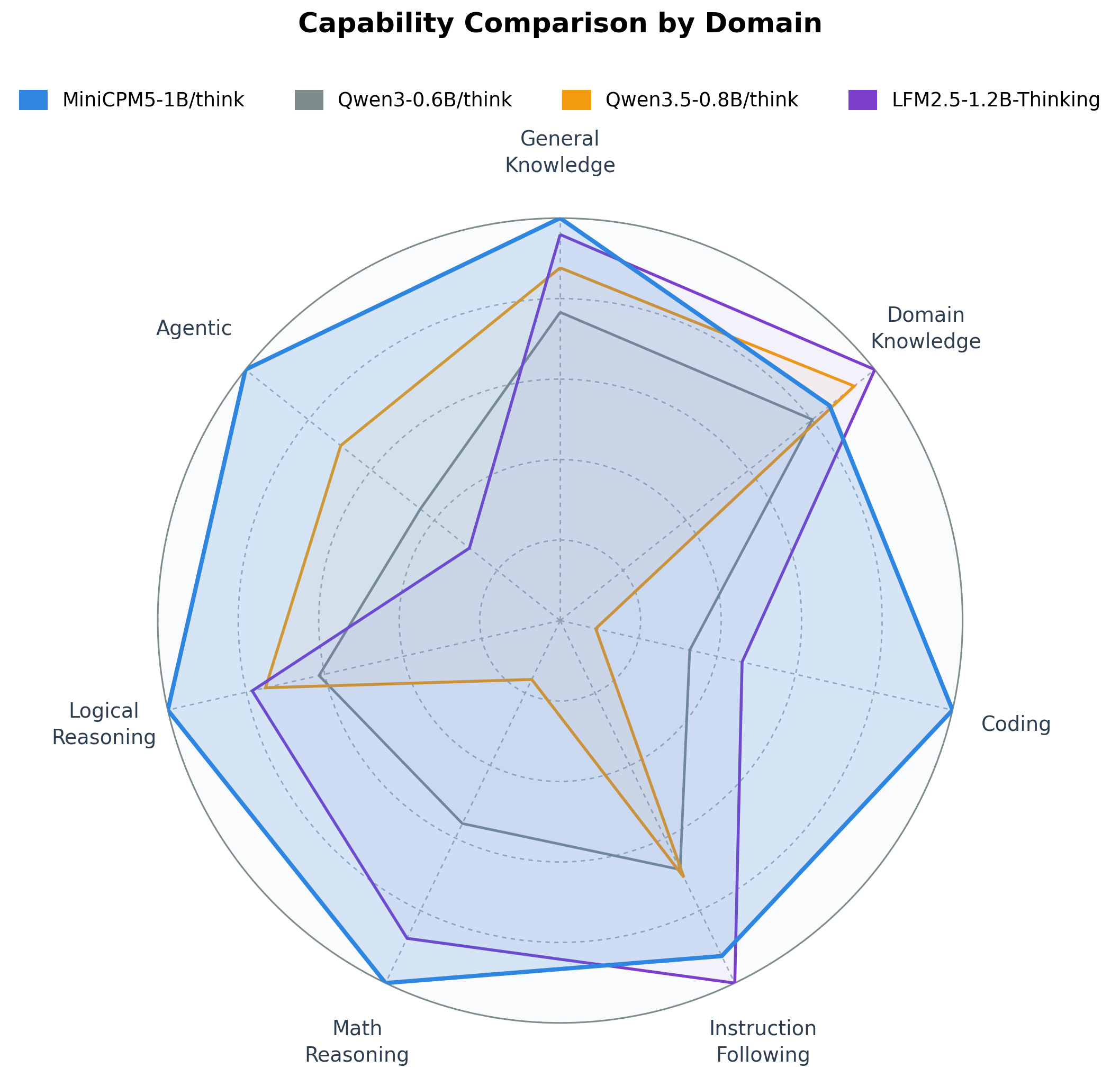
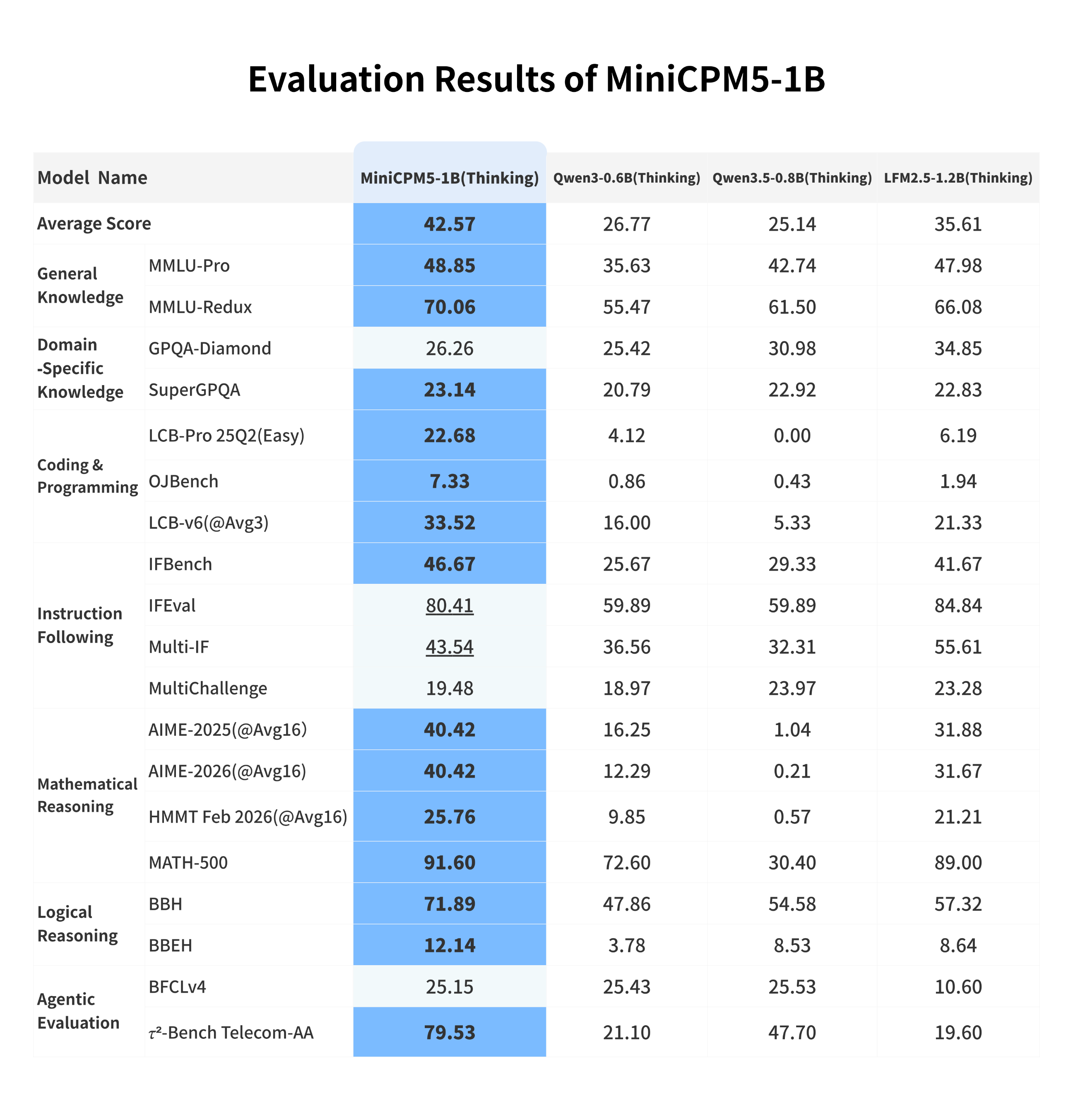
MiniCPM5-1B is a 1 billion parameter dense language model optimized for on-device and resource-constrained deployment, achieving state-of-the-art performance in its size class across reasoning, code, and agentic benchmarks. It serves developers and organizations requiring efficient local LLM inference on edge devices, mobile platforms, and low-resource environments where larger models are infeasible. This project is not a general-purpose foundation model framework but a specialized, productio...
Inferred from signals mentioned in the README (tests, CI, type safety) — not a review of the actual code.
AI's overall editorial judgment — not an average of the bars above, can weigh other factors too.
MiniCPM5-1B: OpenBMB's compact on-device LLM targeting resource-constrained deployment
MiniCPM is a series of small language models from OpenBMB/Tsinghua, with MiniCPM5-1B as the current flagship: a 1-billion-parameter dense Transformer designed for on-device and edge deployment. It targets developers, researchers, and product teams who need capable LLM inference on mobile, embedded, or compute-limited hardware. The repo covers the full lifecycle — model weights (BF16, GGUF, MLX), deployment cookbooks, fine-tuning guides, and an optional hybrid-reasoning mode. It sits in a crowded but important niche: maximizing quality per parameter at sub-2B scale.
Launched January 2024, MiniCPM has shipped six major version lines in roughly 2.5 years: MiniCPM-2B, MiniCPM3-4B, MiniCPM4, MiniCPM4.1, MiniCPM-SALA, and now MiniCPM5-1B, reflecting sustained lab investment in efficient small models.
Initial traction came from strong benchmark results versus Mistral-7B at 2B scale in early 2024, which attracted Chinese and international research interest. The multimodal sibling (MiniCPM-V, 25k+ stars) amplified visibility. Growth has moderated — 41 stars in the past 7 days as of evaluation date — suggesting the project has moved past its viral phase into a steady, specialist-audience stage. MiniCPM5-1B's May 2026 release is too recent to show a new growth wave yet.
Adoption not fully verified via public deployment disclosures. HuggingFace model availability (multiple weight formats), ModelScope mirroring, and Discord/Feishu community channels suggest real developer uptake, particularly in the Chinese AI ecosystem. The multimodal variant (MiniCPM-V) has substantially more stars and likely more documented production use. Direct production deployment evidence for MiniCPM5-1B specifically is too recent to assess thoroughly.
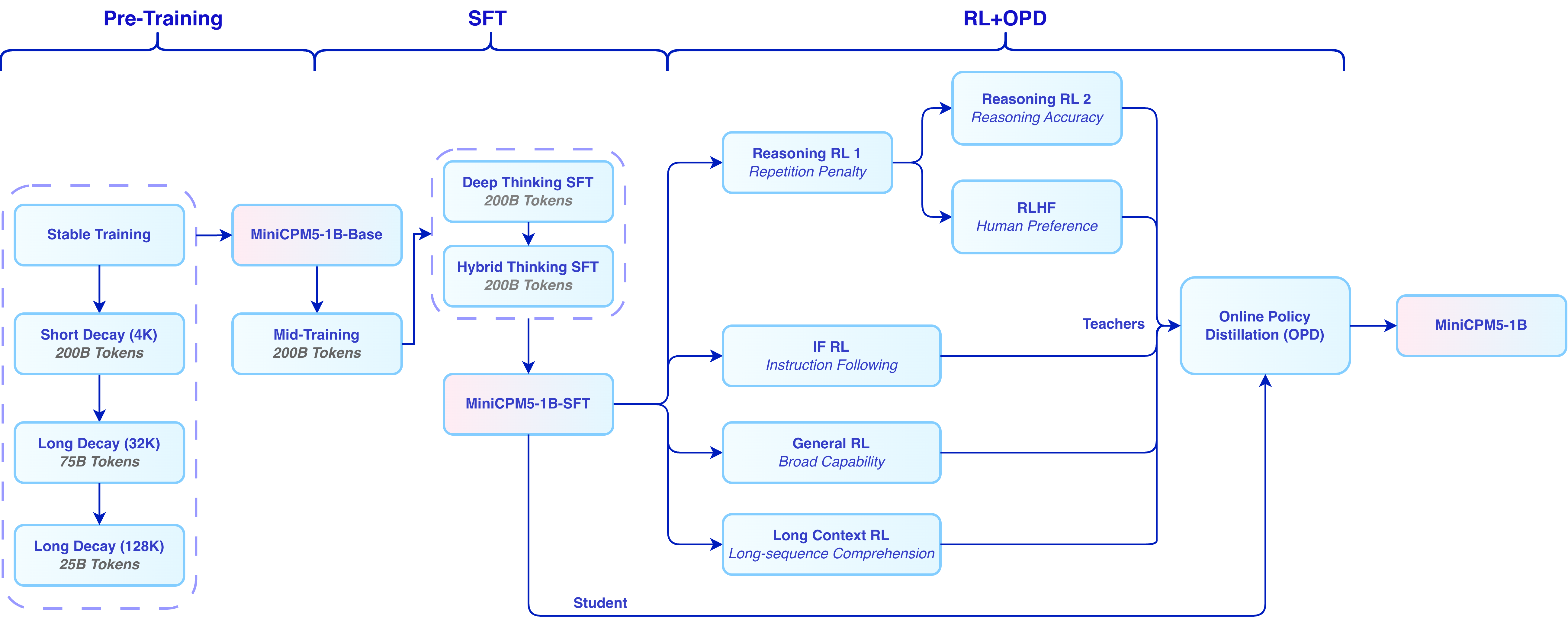
MiniCPM5-1B appears to be a dense Transformer (not MoE, per README description 'dense 1B Transformer'). It likely uses a standard decoder-only architecture with modifications for efficiency. Built-in hybrid reasoning via a '<think>' chat template suggests the base checkpoint is trained to support both fast-response and chain-of-thought modes without separate weights. GGUF and MLX variants indicate quantization-friendly design. MiniCPM-SALA (a sibling) uses sparse-and-linear hybrid attention for long-context — this may inform future MiniCPM5 variants but is not the current 1B model.
Not documented in README. The repo uses Jupyter Notebooks as primary language, suggesting evaluation scripts rather than unit tests. Formal CI/test coverage is not described.
Last push June 20, 2026 — 6 days before evaluation date — indicates active maintenance. Changelog shows multiple releases across 2024–2026 with consistent cadence (~2–4 major releases per year). The project appears healthy and actively developed by a university-affiliated lab with ongoing research output (arXiv tech report linked).
ADOPT IF: you need a <1B parameter model with strong reasoning and agentic tool-use capabilities for on-device/edge deployment, especially if operating in Chinese-language contexts or already using the OpenBMB ecosystem. AVOID IF: you need broad enterprise support, well-documented production case studies, or Western ecosystem integrations — more established alternatives like Qwen or Gemma 3 1B may offer lower integration risk. MONITOR IF: you are evaluating 1B-class models for agentic pipelines; MiniCPM5-1B is very recently released and its real-world performance outside benchmark conditions needs community validation over the next 3–6 months.
Independent dimensions
Mainstream potential
4/10
Technical importance
7/10
Adoption evidence
4/10
- Benchmark self-reporting: claimed SOTA scores are on a benchmark suite selected and reported by the same lab, without fully independent third-party validation at time of analysis.
- Ecosystem concentration: the strongest community presence appears to be in the Chinese AI ecosystem (Feishu, ModelScope, WeChat); adoption in Western developer communities appears more limited.
- Longevity uncertainty: rapid versioning (six major lines in 2.5 years) is a sign of active research but also means any given model generation may receive limited long-term maintenance as the lab moves forward.
- MiniCPM5-1B is newly released (May 2026); real-world edge-case behavior, production failure modes, and fine-tuning stability are not yet well-documented by third parties.
- Small-model performance ceiling: at 1B parameters, capability gaps versus 3B–7B models in complex multi-step reasoning remain significant, regardless of benchmark scores within the 1B class.
MiniCPM will likely continue as a research-led project with steady niche adoption, particularly in Chinese academia and resource-constrained deployment scenarios. Mainstream Western adoption will remain secondary to Qwen and Phi/Gemma lines unless a breakout capability or partnership emerges.
Newsletter
Get analyses like this every Monday
Free weekly digest of the most interesting open-source discoveries.
Languages
Information
- Language
- Jupyter Notebook
- License
- Apache-2.0
- Last updated
- 3w ago
- Created
- 30mo ago
- Analyzed with
- anthropic/claude-haiku-4-5
Stars over time
Contributors over time
Top 100 contributors only — repos with more will plateau at 100.
Open issues
Top contributors
Recent releases
Similar repos

MiniMax-AI/MiniMax-M2
MiniMax-M2 is an open-source mixture-of-experts language model (230B total, 10B...

jingyaogong/minimind-o
MiniMind-O is a 0.1B multimodal Omni model trained from scratch that handles...
| Repository | Stars | Week Δ | Language | Score | Updated |
|---|---|---|---|---|---|
|
OpenBMB/MiniCPM
this
|
9.7k | +167 | Jupyter Notebook | 8/10 | 3w ago |
|
OpenBMB/MiniCPM-V
|
25.8k | — | Python | 8/10 | 2w ago |
 RightNow-AI/picolm RightNow-AI/picolm
|
1.7k | — | C | 7/10 | 5mo ago |
|
MiniMax-AI/MiniMax-M2
|
2.6k | — | — | 8/10 | 8mo ago |
|
jingyaogong/minimind-o
|
2.1k | — | Python | 8/10 | 2w ago |
 m87-labs/moondream m87-labs/moondream
|
9.8k | — | Python | 7/10 | 3mo ago |
Qwen series at similar scale is likely the strongest direct competitor, with broad ecosystem support, extensive multilingual training, and high benchmark scores. MiniCPM5-1B claims higher averages on its reported benchmark set, but comparisons depend heavily on benchmark selection. Qwen has substantially larger community adoption.
SmolLM2 targets similar on-device use cases and benefits from HuggingFace's distribution reach. MiniCPM5-1B claims better reasoning and agentic capabilities; SmolLM2 benefits from a Western-facing community and tighter HF integration.
Phi-3.5-mini is larger (~3.8B) but still edge-focused. MiniCPM5-1B competes at a smaller footprint. Phi models benefit from Microsoft's enterprise credibility and integration into Azure AI.
Moondream overlaps in the tiny-model space but is multimodal-first. MiniCPM-V is the closer competitor to moondream; the text-only MiniCPM5-1B serves different use cases.
Google's Gemma 3 1B is a direct scale competitor with strong benchmark performance and broad framework support. MiniCPM5-1B's agentic and reasoning focus may differentiate it for tool-use scenarios, but Gemma benefits from Google's distribution and trust.