rack layout designer
1.6k
Stars
79
Forks
176
Open issues
11
Contributors


AI Analysis
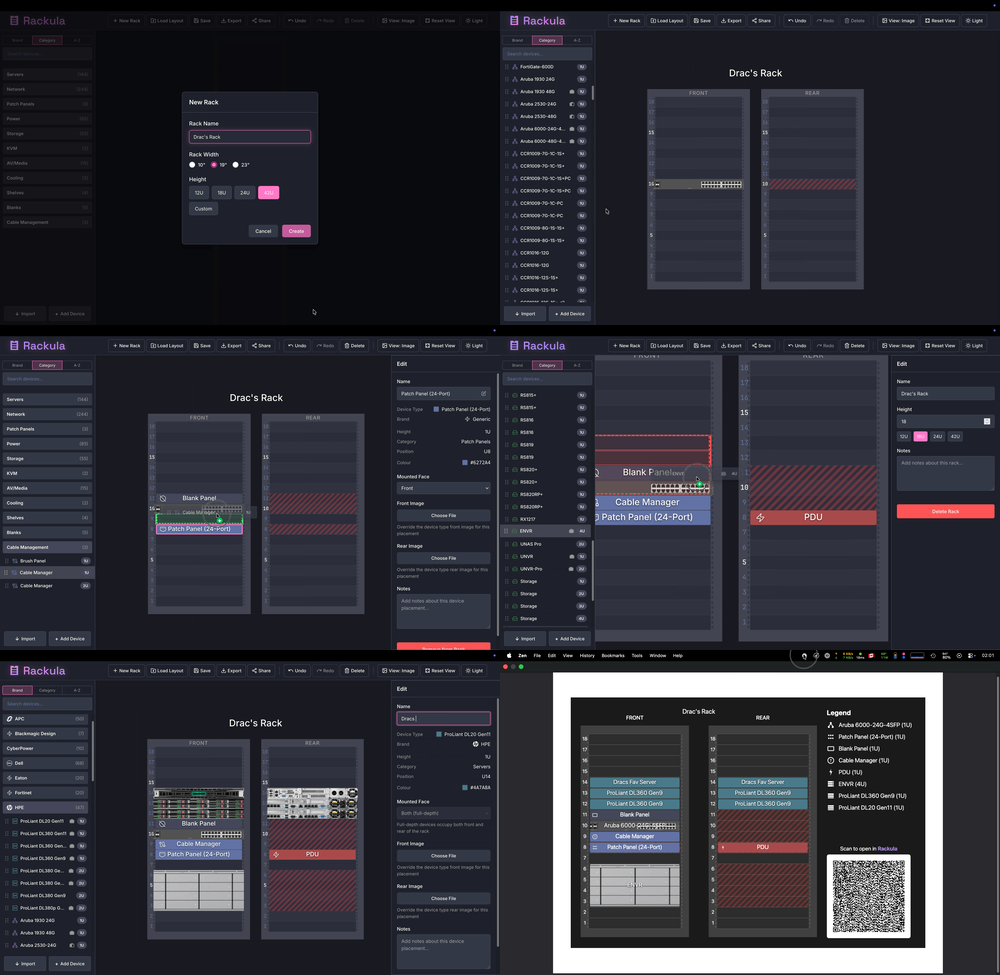
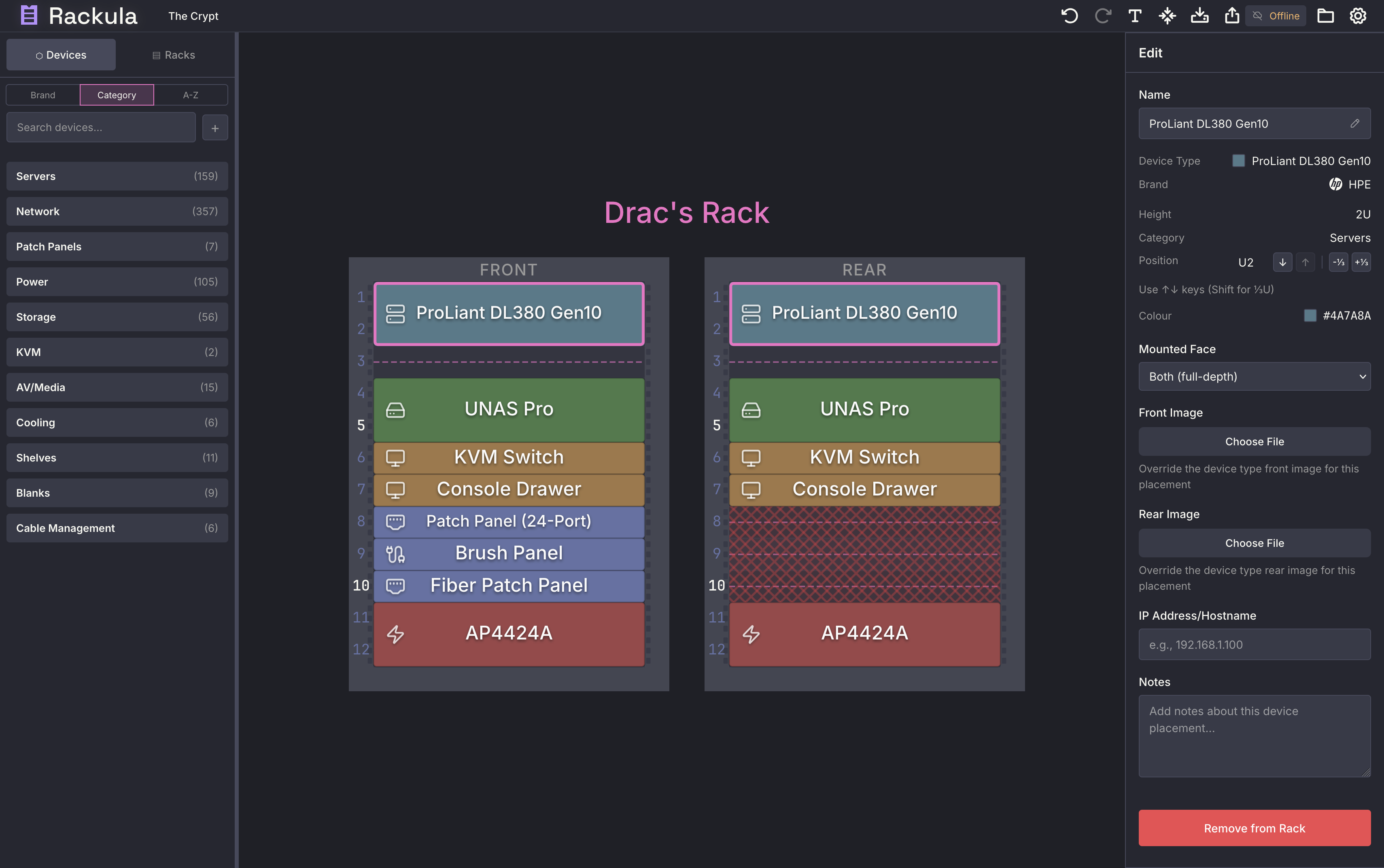
Rackula is a drag-and-drop rack layout designer that helps IT professionals, homelab enthusiasts, and AV technicians visualize and plan physical server and network equipment arrangements before installation. It uses real device images from NetBox libraries, supports export to multiple formats, and offers optional self-hosted deployment with persistent storage. The tool is purpose-built for infrastructure planning and documentation in specialized technical domains rather than general-purpose s...
Inferred from signals mentioned in the README (tests, CI, type safety) — not a review of the actual code.
AI's overall editorial judgment — not an average of the bars above, can weigh other factors too.
TypeScript drag-and-drop rack layout designer with hardware library integration, self-hostable and mobile-friendly
Rackula is a web-based tool for visually planning and documenting server rack configurations using real device images from NetBox's hardware library. Built for homelabbers, AV technicians, network engineers, and data centre teams, it enables layout planning before physical installation, with export to PNG/PDF/SVG and URL-based sharing. Self-hostable via Docker with optional authentication. The project is 6 months old, recently created (December 2025), and shows active development with 1,500 GitHub stars and regular commits as of late June 2026.
Rackula launched in late December 2025 as an AI-assisted development project (authored with Claude), designed to solve the physical and cognitive burden of planning equipment layouts in server racks. It directly addresses the gap between grey-box design tools and visual, device-accurate planning. The project is authored with transparency about AI involvement marked in commits.
The project gained 1,500 stars over approximately 6 months and acquired 35 stars in the final 7 days (measured as of 2026-06-27), indicating sustained interest and recent acceleration. The trajectory suggests adoption among infrastructure enthusiasts and technical practitioners who value visual planning tools. Growth appears organic within the infrastructure/homelab communities rather than driven by enterprise marketing.
Adoption not verified through public documentation, case studies, or deployment statistics. The hosted instance at count.racku.la is operational (no-auth access). Self-hosting documentation and Docker Compose examples suggest intended production use, but no public evidence of enterprise or large-scale adoption is documented. Adoption appears limited to early adopters in homelab and AV/infrastructure communities based on positioning.
Appears to be a TypeScript frontend with optional backend API for persistence and authentication. README documents Docker deployment, LXC support, and stateless operation. Likely uses React or similar UI framework based on drag-and-drop interaction model. Optional OIDC and local auth support suggests modular auth architecture. Specific framework details not disclosed in README.
CI workflow referenced in README (test.yml badge present), but specific test coverage metrics not documented in README. CI status badge implies active testing practice, though coverage percentage not stated.
Repository shows very recent activity: last push 2026-06-27 05:00:17 (current date reference), indicating active maintenance. Project is only 6 months old but demonstrates consistent commit activity. Docker container versioning and CalVer versioning scheme suggest deliberate release cadence. Contributing guide referenced but truncated in README excerpt.
ADOPT IF: you are planning server/network/AV rack layouts and need visual, pre-installation validation; you want a free, self-hostable alternative to proprietary design tools; your team values device-accurate representations over generic boxes; you can tolerate a young, community-maintained project and are willing to report issues. AVOID IF: you require enterprise support contracts, extensive third-party integrations, or mature ecosystem tooling; your organization mandates vendor-backed software; you need proven long-term stability in production (project is 6 months old). MONITOR IF: you work in data centre operations and want to evaluate it for team deployment; you are considering contributing and want to track project velocity and community response; you need an open-source alternative to proprietary rack design software and can accept early-stage maturity risk.
Independent dimensions
Mainstream potential
3/10
Technical importance
5/10
Adoption evidence
2/10
- Project age (6 months): insufficient track record to assess long-term maintenance commitment or breaking change frequency. Creator burnout or priority shift could stall development.
- Adoption not publicly documented: unclear if real production deployments exist beyond hosted demo. May lack battle-tested reliability signals or deployment best practices from operators.
- Dependency on NetBox devicetype-library: if that upstream source changes significantly or is discontinued, Rackula's device accuracy is compromised. No alternative device source mentioned.
- Small team or single-author project (not disclosed): no evidence of multi-contributor maintenance structure. Bus factor likely high. Sustainability depends on creator's sustained interest.
- Mobile-friendly claim not validated: README states 'mobile-friendly interface' but no evidence of actual mobile device testing, responsive design validation, or touch-interaction quality assurance provided.
Rackula will likely remain a niche but stable tool for infrastructure enthusiasts, homelabbers, and AV technicians through 2027. Growth will depend on organic word-of-mouth adoption and sustained creator interest rather than enterprise adoption. If the creator maintains regular updates and the self-hosting deployment story remains frictionless, adoption may expand within the infrastructure planning space, but unlikely to displace established proprietary vendors or achieve mainstream adoption outside technical infrastructure roles.
Explore similar
Newsletter
Get analyses like this every Monday
Free weekly digest of the most interesting open-source discoveries.
Languages
Information
- Website
- https://racku.la
- Language
- TypeScript
- License
- MIT
- Last updated
- 18h ago
- Created
- 7mo ago
- Analyzed with
- anthropic/claude-haiku-4-5
Stars over time
Contributors over time
Top 100 contributors only — repos with more will plateau at 100.
Open issues
Top contributors
Similar repos

rack/rack-attack
Rack::Attack is middleware for protecting Rails and Rack applications from...
| Repository | Stars | Week Δ | Language | Score | Updated |
|---|---|---|---|---|---|
|
RackulaLives/Rackula
this
|
1.6k | +46 | TypeScript | 8/10 | 18h ago |
 Timmoth/RackPeek Timmoth/RackPeek
|
1.6k | — | JavaScript | 8/10 | 4w ago |
|
rack/rack
|
5.1k | — | Ruby | 9/10 | 4w ago |
 Shelf-nu/shelf.nu Shelf-nu/shelf.nu
|
2.7k | — | TypeScript | 8/10 | 21h ago |
|
rack/rack-attack
|
5.7k | — | Ruby | 8/10 | 3mo ago |
 Pouzor/homelable Pouzor/homelable
|
2.2k | — | TypeScript | 7/10 | 12h ago |
Similar star count and project age characteristics; direct competitor in visual rack layout space. Rackula appears to differentiate via real device images, bayed rack support for AV, and self-hosting emphasis.
Broader inventory/shelf management tool, not rack-specific. Rackula is more specialized and domain-focused; shelf.nu appears to serve retail/general inventory use cases.
Event scheduling/polling tool in same language; demonstrates how TypeScript web tools can achieve moderate scale adoption. Rackula is narrower in scope (infrastructure vs. general scheduling).
Foundational Ruby web framework, entirely different category (middleware/framework vs. application). Not a direct competitor; mentioned in similar repos likely due to keyword overlap.
Ruby middleware for rate limiting, orthogonal to Rackula's purpose. Not a functional competitor despite keyword similarity.