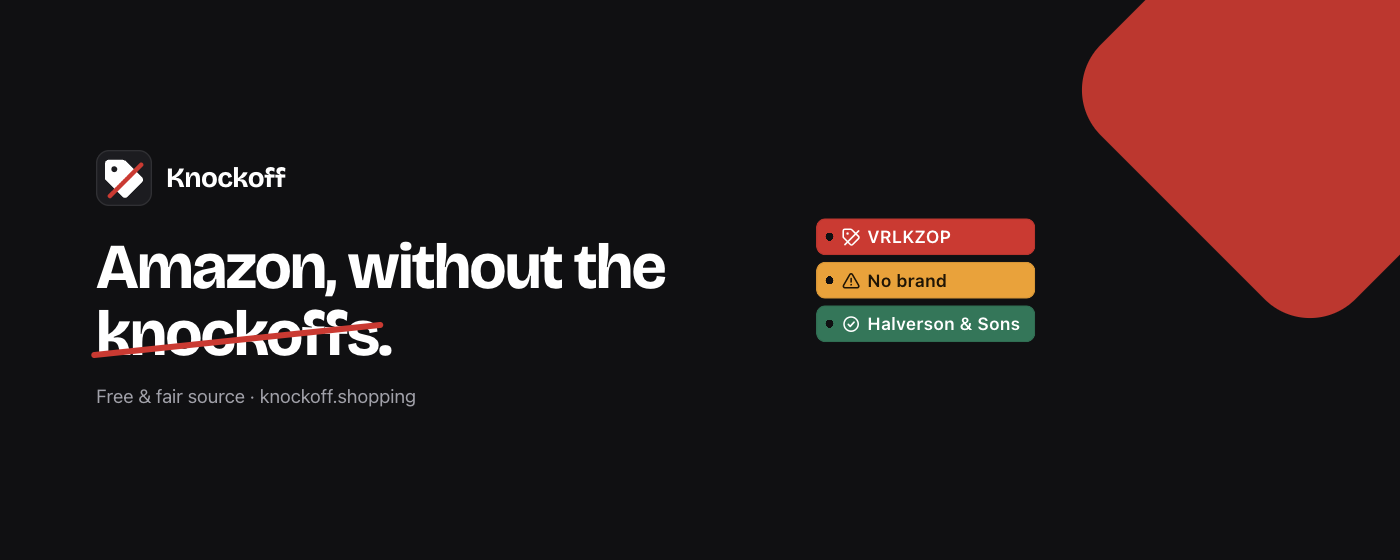
Chrome extension that filters pseudo-brand junk out of Amazon. Buy from real, established brands.
1.6k
Stars
50
Forks
5
Open issues
3
Contributors


AI Analysis
Knockoff is a browser extension for Chrome, Firefox, and Safari that automatically filters out pseudo-brand listings from Amazon search results, allowing users to shop for products from established brands instead. It uses local detection logic combining seed lists of notorious fake brands, known legitimate brands, and linguistic heuristics to identify trademark-squatting listings. The extension is purpose-built for consumers frustrated with Amazon's proliferation of unbranded commodity goods ...
Inferred from signals mentioned in the README (tests, CI, type safety) — not a review of the actual code.
AI's overall editorial judgment — not an average of the bars above, can weigh other factors too.
Chrome/Firefox extension that filters trademark-squat brands from Amazon search results using heuristics and curated brand lists.
Knockoff is a browser extension launched in early July 2026 that helps Amazon shoppers identify and filter pseudo-brand listings — randomly-named trademark registrations (SZHLUX, HORUSDY, etc.) that exploit Amazon's Brand Registry. It runs entirely locally using heuristic scoring on brand names, a seed blocklist, and a curated allowlist of ~5,000 established brands. The project gained 223 stars in its first week and is available on Chrome Web Store and Firefox Add-ons, suggesting rapid early adoption among Amazon shoppers frustrated with commodity-brand flooding.
Repository created 2026-07-06, first commit to last push 2026-07-09 — this is a brand-new release. The extension appears to solve a pain point that has existed for years (Amazon's proliferation of low-reputation pseudo-brands) but the project itself is days old at the analysis date.
223 stars in 7 days (from ~1,262 baseline to 1,485) indicates strong initial viral adoption, likely driven by word-of-mouth and Reddit/Hacker News discussion among Amazon users. Early momentum suggests product-market fit with a specific user segment (quality-conscious shoppers), though it is far too early to determine if growth will sustain or plateau.
Adoption not verified via detailed metrics, but circumstantial evidence suggests real initial uptake: (1) published to Chrome Web Store and Firefox Add-ons within launch window; (2) 1,485 stars and 45 forks in 3 days; (3) README mentions report intake via Cloudflare Worker and GitHub issues, implying expectation of user feedback; (4) daily sync of community-maintained brand list suggests early user contributions. However, no published DAU, retention, or review data available.
Likely a Manifest V3 Chrome extension with content scripts that run locally on Amazon product pages. Based on README, detection pipeline chains: user allowlist → blocklist → ~200 flagged pseudo-brands → ~5,000 known brands → linguistic heuristics (vowel ratio, character bigrams, ALL-CAPS patterns). Community brand list syncs daily from `api.knockoff.shopping`. No external tracking; all processing in-browser. Safari support via native Xcode wrapper.
Not documented in README. No mention of unit tests, integration tests, or CI/CD pipeline. Given the extension is 3 days old, testing infrastructure is likely minimal or absent.
Last push 2026-07-09 (within 24 hours of analysis date), indicating very active initial development. Repo contains documentation (CONTRIBUTING.md), multiple data files, build scripts, and a Cloudflare Worker backend for reports. Early maintenance appears thorough for a new project, but long-term sustainability unclear.
ADOPT IF: You regularly buy on Amazon and are frustrated by low-reputation pseudo-brands crowding search results, OR you manage a curated brand allowlist and want your team to use it. Installation is one-click and data stays local. AVOID IF: You rely on budget commodity brands (many will be filtered at Standard or Strict levels), OR you distrust third-party brand lists and heuristics, OR you need guaranteed accuracy (heuristics misclassify mixed-case gibberish at Standard level; README acknowledges this). MONITOR IF: You are uncertain whether the heuristic model generalizes beyond English-language Amazon, or whether the community brand list will remain accurate as trademark-squat strategies evolve. Early adoption carries unknown stability risk.
Independent dimensions
Mainstream potential
4/10
Technical importance
5/10
Adoption evidence
4/10
- Heuristic-based classification (vowel ratios, character patterns) is language and culture-specific; accuracy may degrade on non-English Amazon marketplaces or for non-Latin scripts. README acknowledges mixed-case gibberish misses at Standard level.
- Community brand list (refreshed daily from API) is only as good as its curators. Malicious or biased contributions could break trust; no apparent moderation policy documented.
- Browser extension ecosystem risk: Chrome or Firefox policy changes, manifest version deprecation, or security sandboxing tightening could break functionality. Safari support requires native app wrapper, raising maintenance burden.
- No published data on false positive or false negative rates. Users may accidentally hide legitimate brands or miss pseudo-brands, with no metrics to quantify error frequency.
- Very early-stage project (3 days old). No history of handling scaling, API outages, abuse, or competing priorities. Long-term maintenance by single creator (Shpigford) is unverified.
Likely to remain a niche, high-utility tool for quality-conscious Amazon shoppers over 12–24 months. Mainstream adoption depends on whether the heuristic model and community list scale without degradation. Risk of stalling if initial viral wave tapers and curation becomes tedious, or of being superceded if Amazon itself implements native pseudo-brand filtering.
Newsletter
Get analyses like this every Monday
Free weekly digest of the most interesting open-source discoveries.
Languages
Information
- Website
- https://knockoff.shopping
- Language
- JavaScript
- License
- NOASSERTION
- Last updated
- 17h ago
- Created
- 4d ago
- Analyzed with
- anthropic/claude-haiku-4-5
Stars over time
Contributors over time
Top 100 contributors only — repos with more will plateau at 100.
Open issues
Top contributors
Recent releases
No releases published yet.
Similar repos

EFForg/privacybadger
Privacy Badger is a browser extension that automatically learns to block hidden...

duckduckgo/duckduckgo-privacy-extension
DuckDuckGo Privacy Essentials is a browser extension for Firefox, Chrome, Edge,...

CloakHQ/CloakBrowser
CloakBrowser is a stealth Chromium browser with source-level C++ fingerprint...
| Repository | Stars | Week Δ | Language | Score | Updated |
|---|---|---|---|---|---|
|
Shpigford/knockoff
this
|
1.6k | +315 | JavaScript | 8/10 | 17h ago |
|
EFForg/privacybadger
|
3.8k | — | JavaScript | 8/10 | 24h ago |
|
duckduckgo/duckduckgo-privacy-extension
|
1.5k | — | JavaScript | 7/10 | 23h ago |
 ajayyy/SponsorBlock ajayyy/SponsorBlock
|
13.4k | — | TypeScript | 8/10 | 1w ago |
|
CloakHQ/CloakBrowser
|
28k | — | Python | 8/10 | 15h ago |
 ghostery/ghostery-extension ghostery/ghostery-extension
|
1.7k | — | JavaScript | 7/10 | 23h ago |
Amazon natively sorts by brand and shows ratings, but does not proactively hide low-reputation pseudo-brands. Knockoff is a client-side layer on top of Amazon search, not a replacement.
These focus on price history and deal alerts, not brand authenticity. Knockoff occupies an orthogonal niche: brand filtering.
These evaluate review credibility and seller reputation; Knockoff filters at the brand level before purchase, using naming heuristics rather than review analysis.
Advanced users could manually block pseudo-brand domains, but Knockoff is a plug-and-play, pre-curated solution; no ongoing maintenance required from end user.
General shopping assistants focus on coupons and price comparisons. Knockoff is narrower and more focused on brand authenticity specifically.