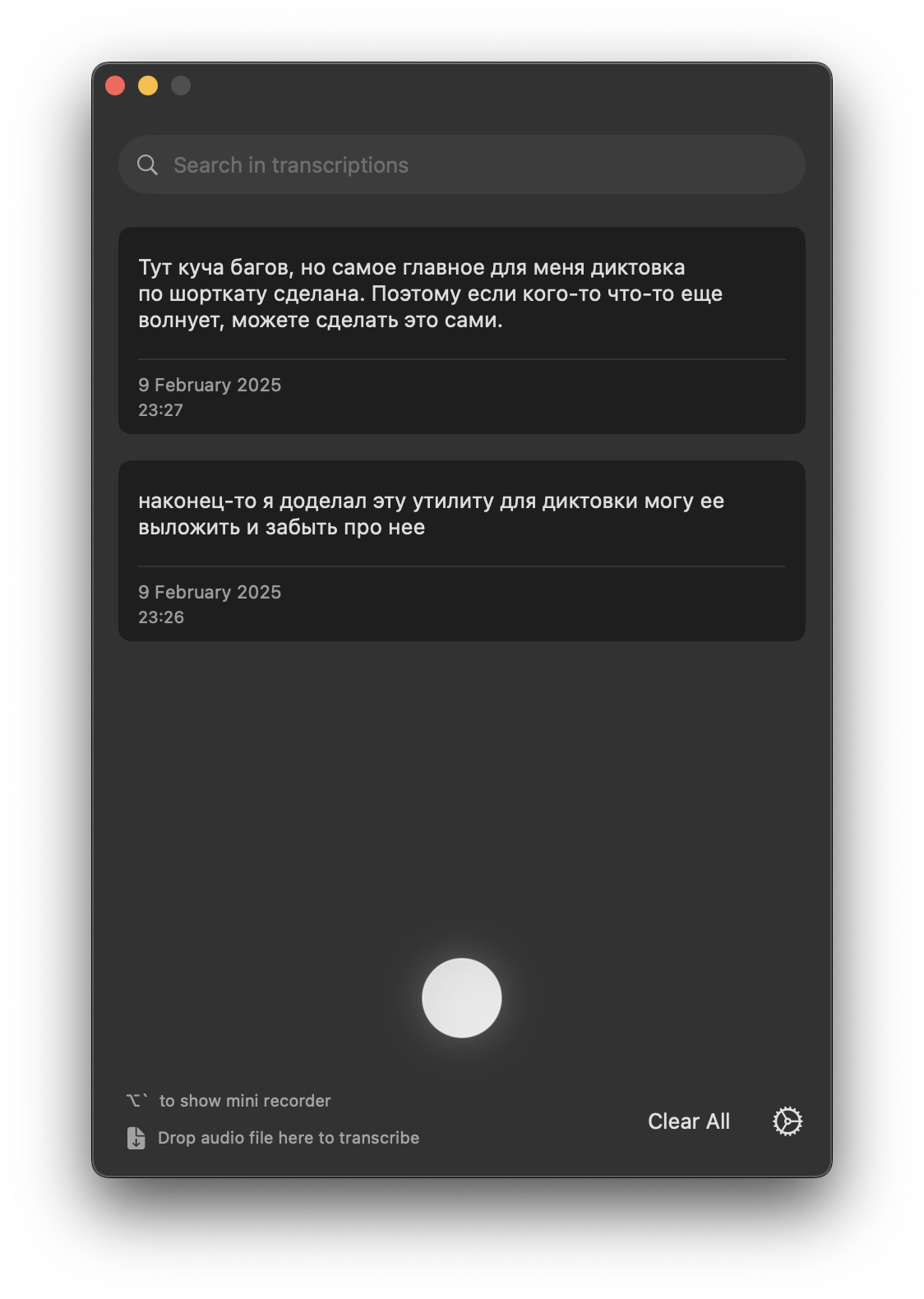
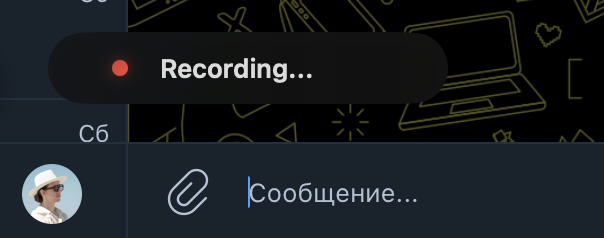
macOS dictation app
2k
Stars
165
Forks
69
Open issues
20
Contributors




AI Analysis
OpenSuperWhisper is a macOS dictation application that provides real-time audio transcription using Whisper and Parakeet models, with global keyboard shortcuts, mouse button triggers, and support for multiple languages. It serves macOS users who need offline, customizable voice-to-text functionality, particularly those requiring privacy-preserving transcription and non-English language support. Not suitable for Windows/Linux users or those requiring cloud-based transcription services.
Inferred from signals mentioned in the README (tests, CI, type safety) — not a review of the actual code.
AI's overall editorial judgment — not an average of the bars above, can weigh other factors too.
macOS dictation app using Whisper and Parakeet for local audio transcription
OpenSuperWhisper is a native Swift application for macOS that provides real-time speech-to-text transcription using Whisper or Parakeet models. It targets users seeking local, privacy-preserving dictation without cloud dependencies. Created in February 2025, it has accumulated 1,182 stars and gained 179 stars in the past week as of June 2026, suggesting recent discovery or viral interest. The project positions itself within a crowded ecosystem of macOS voice apps but differentiates via keyboard shortcut flexibility, multiple transcription engines, and hold-to-record gestures.
OpenSuperWhisper launched in February 2025, entering a mature ecosystem that already includes TypeWhisper, VoiceInk, FluidVoice, and ghost-pepper. The project was likely motivated by demand for an open-source, Apple Silicon-native alternative to proprietary dictation tools, leveraging publicly available Whisper and Parakeet models.
The repository shows strong recent velocity: 179 stars gained in 7 days (as of late June 2026) against a 4-month history. This spike may indicate recent press coverage, discovery on a trending list, or viral social media amplification. The consistent maintenance (last push 2026-06-24) and open contribution model suggest the creator is actively steering the project. Growth pattern is steep but project age is too recent to assess sustainability.
Adoption not verified. No documentation of enterprise use, production deployments, or user testimonials in README. GitHub stars (1,182) indicate awareness but do not confirm active installation base. Brew package availability suggests distribution infrastructure exists, but download metrics are not provided. Real-world usage cannot be determined from available metadata.
Based on README, the app is built in Swift for macOS and appears to wrap whisper.cpp and Parakeet transcription engines as system dependencies. The architecture likely uses Swift UI for UI layer and native audio capture APIs. Build process indicates C/C++ compilation alongside Swift (cmake, libomp, rust dependencies suggest mixed-language compilation). Submodules and CI workflow (`build.yml`) suggest modular structure.
Not documented in README. CI workflow existence implies automated builds but test suite details are absent from provided materials.
Last push June 24, 2026 (4 days before evaluation date) indicates active maintenance. README explicitly lists contribution TODO items (streaming transcription, Intel support, custom dictionaries), suggesting roadmap-driven development. Issue references (#15, #18, #19, #14, #8) demonstrate engagement with user requests. License (MIT) and contribution guidelines are present. Maintenance status: actively maintained, not stagnant.
ADOPT IF: you need local, offline dictation on Apple Silicon macOS; you value keyboard-driven workflows; you want to avoid cloud transcription services and their privacy/cost implications; you are willing to manage model downloads manually. AVOID IF: you require Intel macOS support (explicitly not supported); you need streaming transcription (not yet implemented); you require production-grade stability guarantees (project is 4 months old); you need extensive community ecosystem or third-party integrations. MONITOR IF: you want local transcription but are evaluating other similar projects; you need Intel support (issue #15 is tracked but not resolved); you are considering this for team/organizational deployment (adoption maturity is unclear).
Independent dimensions
Mainstream potential
4/10
Technical importance
6/10
Adoption evidence
2/10
- Project immaturity: 4 months old at evaluation, insufficient runtime history to predict reliability or long-term maintenance commitment.
- Adoption validation gap: no evidence of real-world production use; star spike may reflect viral trending rather than durable user base.
- Architectural lock-in: Apple Silicon-only design excludes Intel users and older hardware; large segment of macOS installed base.
- Feature gaps vs. competitors: TODO list (streaming, custom dictionaries, agent mode) suggests missing features that similar projects may already offer.
- Dependency on external models: Whisper and Parakeet model maintenance and versioning are outside project control; breaking changes upstream could affect functionality.
OpenSuperWhisper will likely remain a niche, specialized tool serving Apple Silicon macOS users who prioritize local transcription and keyboard-driven interaction. Without evidence of organizational adoption or differentiated features, it may stabilize as a mid-tier community project (500–2,000 active users) within 18 months. Expansion to Intel or streaming transcription could broaden appeal; stagnation in maintenance or competing projects' feature leaps could erode momentum.
Newsletter
Get analyses like this every Monday
Free weekly digest of the most interesting open-source discoveries.
Languages
Information
- Language
- Swift
- License
- MIT
- Last updated
- 17h ago
- Created
- 17mo ago
- Analyzed with
- anthropic/claude-haiku-4-5
Stars over time
Contributors over time
Top 100 contributors only — repos with more will plateau at 100.
Open issues
Bug: Mini recorder z-index is off, cant see it over many applications
Microphone menu goes stale: Bluetooth mic missing after reconnect, app silently records from wrong (dead) device
Whisper model stays loaded in RAM (~1GB) at all times even when idle
Request: release 0.1.1 — 7 commits on master since March 0.1.0
Filter filler words (um, uh, er, ah) from transcription output
Top contributors
Similar repos

OpenWhispr/openwhispr
OpenWhispr is a privacy-first, open-source voice-to-text application for macOS,...
| Repository | Stars | Week Δ | Language | Score | Updated |
|---|---|---|---|---|---|
|
Starmel/OpenSuperWhisper
this
|
2k | +431 | Swift | 7/10 | 17h ago |
 TypeWhisper/typewhisper-mac TypeWhisper/typewhisper-mac
|
1.6k | — | Swift | 8/10 | 1d ago |
|
OpenWhispr/openwhispr
|
4.4k | — | TypeScript | 7/10 | 7h ago |
 altic-dev/FluidVoice altic-dev/FluidVoice
|
7k | — | Swift | 7/10 | 12h ago |
 Beingpax/VoiceInk Beingpax/VoiceInk
|
5.4k | — | Swift | 7/10 | 3d ago |
 matthartman/ghost-pepper matthartman/ghost-pepper
|
2.8k | — | Swift | 8/10 | 4w ago |
Larger, more established project in same category. OpenSuperWhisper may offer more flexible keyboard shortcut configuration and dual engine choice; VoiceInk may have deeper community or more mature feature set (not verifiable from README alone).
Similar scope and language. Direct comparison of feature depth and UI/UX not possible from README; both target macOS dictation niche.
Slightly lower star count but longer establishment likely. OpenSuperWhisper's recent spike may indicate stronger current momentum or different distribution channel.
Established peer in macOS voice ecosystem. Feature differentiation unclear from README.
Different language (TypeScript vs. Swift) may target web/cross-platform instead of native macOS. Not directly equivalent use case.