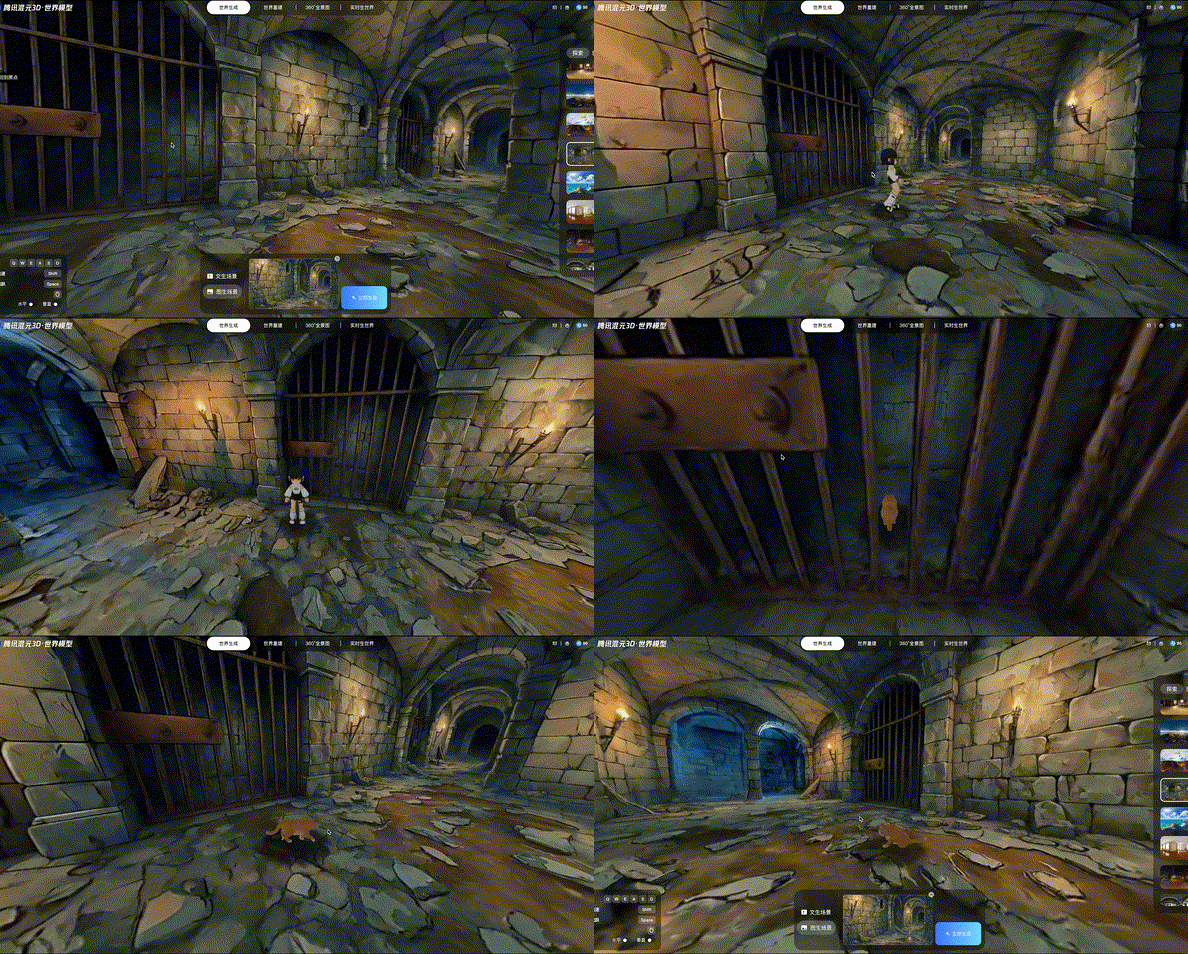
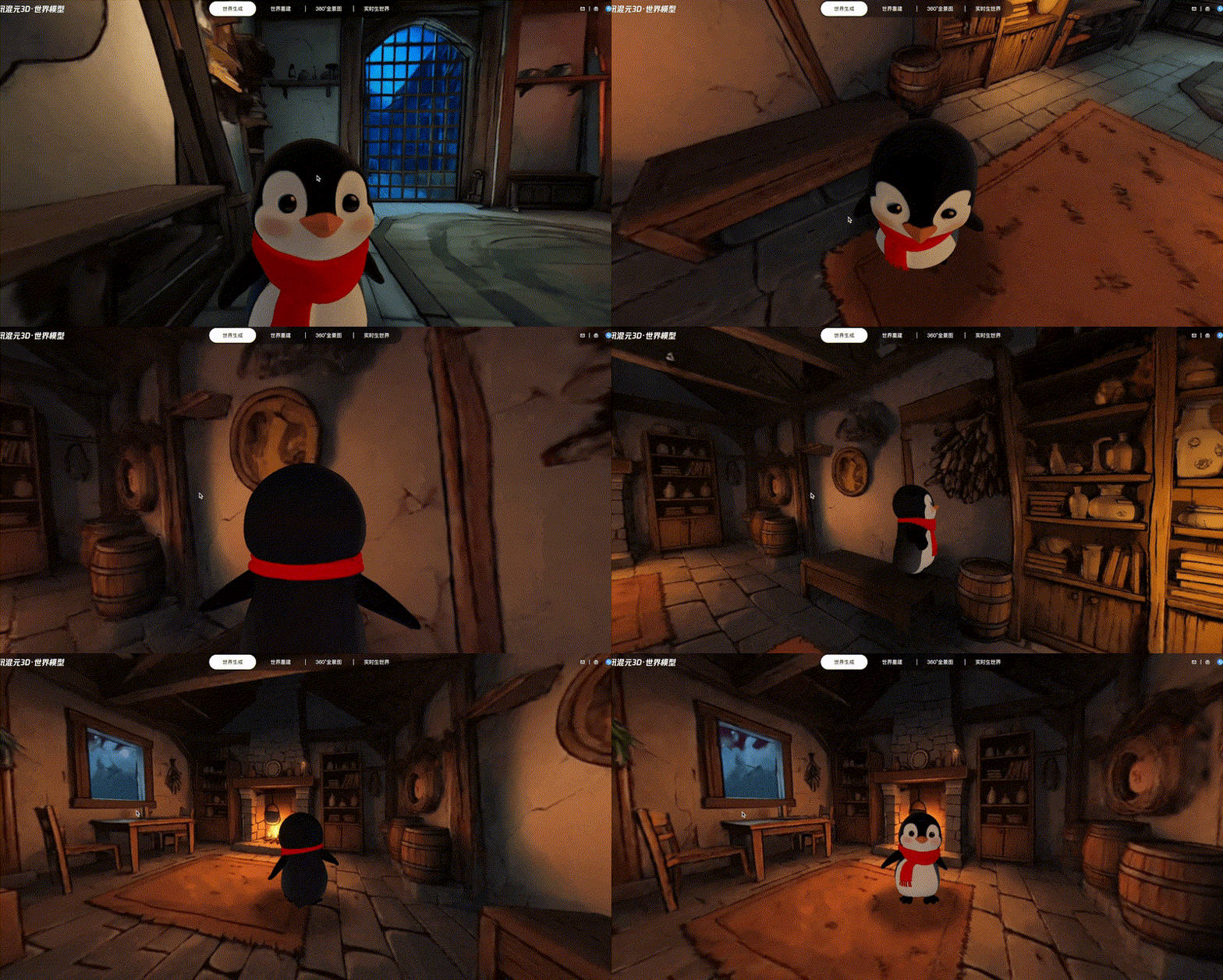
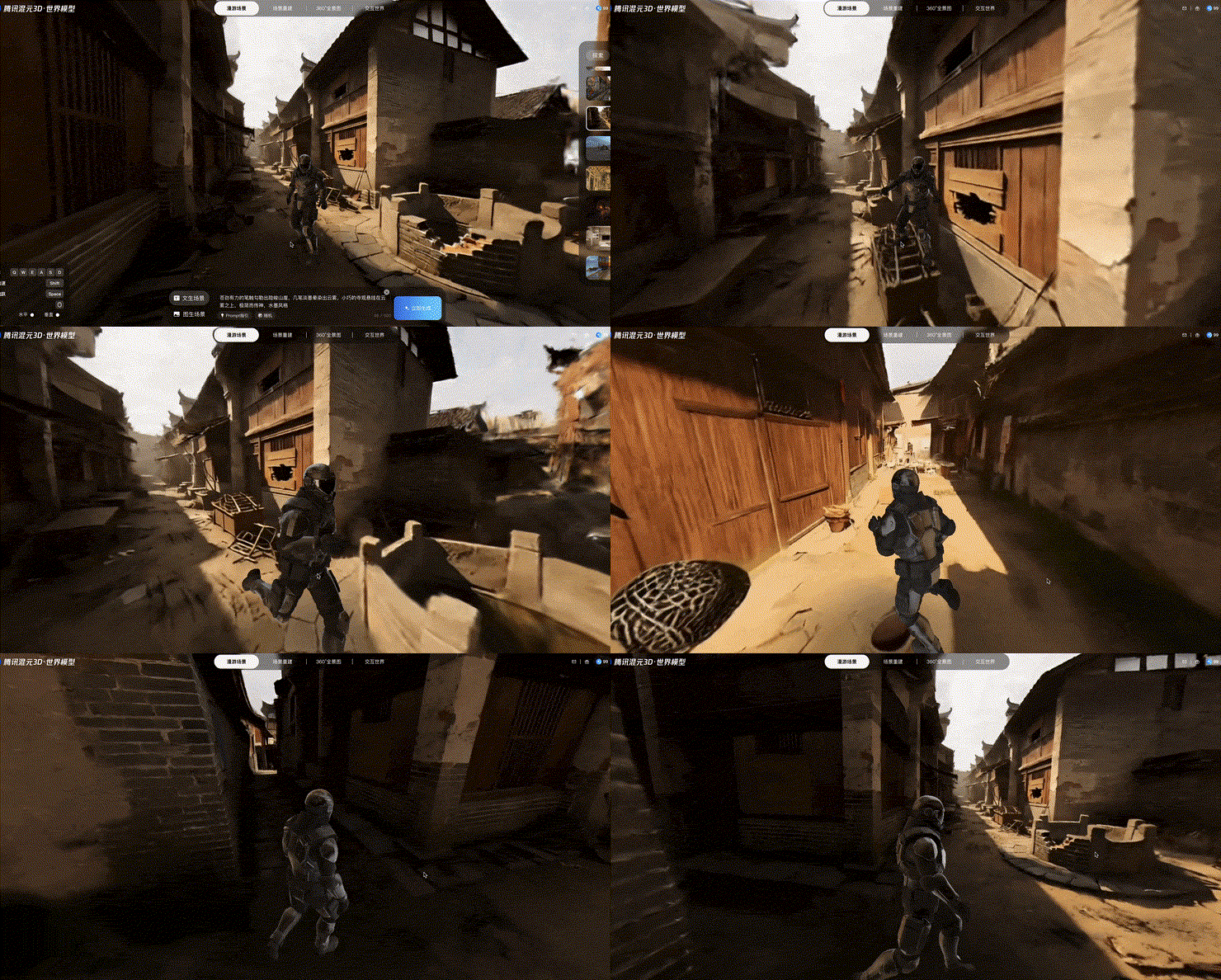
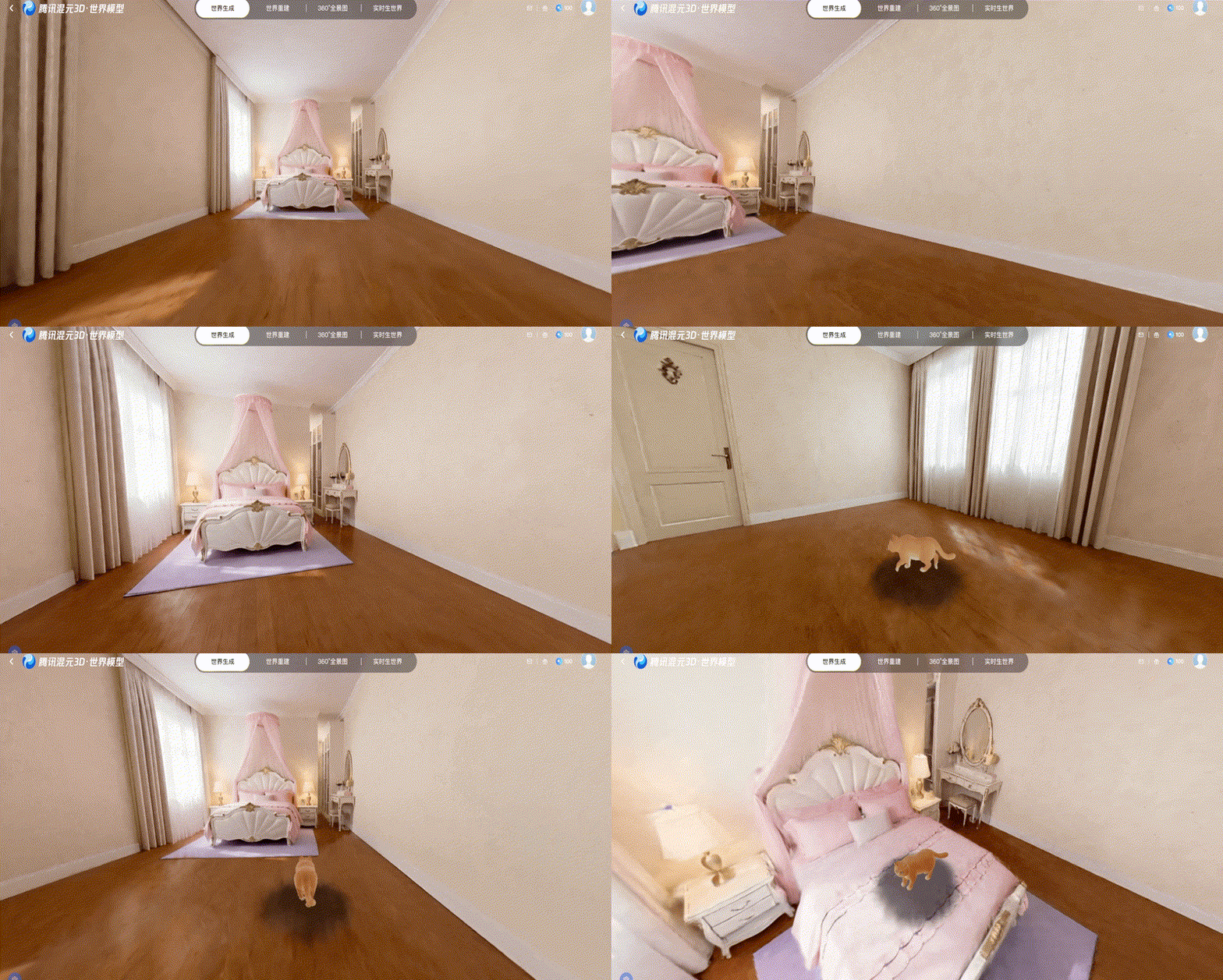
HY-World 2.0: A Multi-Modal World Model for Reconstructing, Generating, and Simulating 3D Worlds
2.3k
Stars
199
Forks
14
Open issues
2
Contributors


AI Analysis
HY-World 2.0 is a multi-modal 3D world model that reconstructs and generates navigable 3D scenes from text, images, or video inputs, producing mesh or Gaussian Splat representations. It serves research and professional applications in 3D content creation, scene understanding, and digital reconstruction—not a general-purpose tool but a specialized framework for researchers and studios working with 3D world synthesis.
Inferred from signals mentioned in the README (tests, CI, type safety) — not a review of the actual code.
AI's overall editorial judgment — not an average of the bars above, can weigh other factors too.
Tencent's 3D world model generates persistent game-ready assets from text/images instead of ephemeral videos
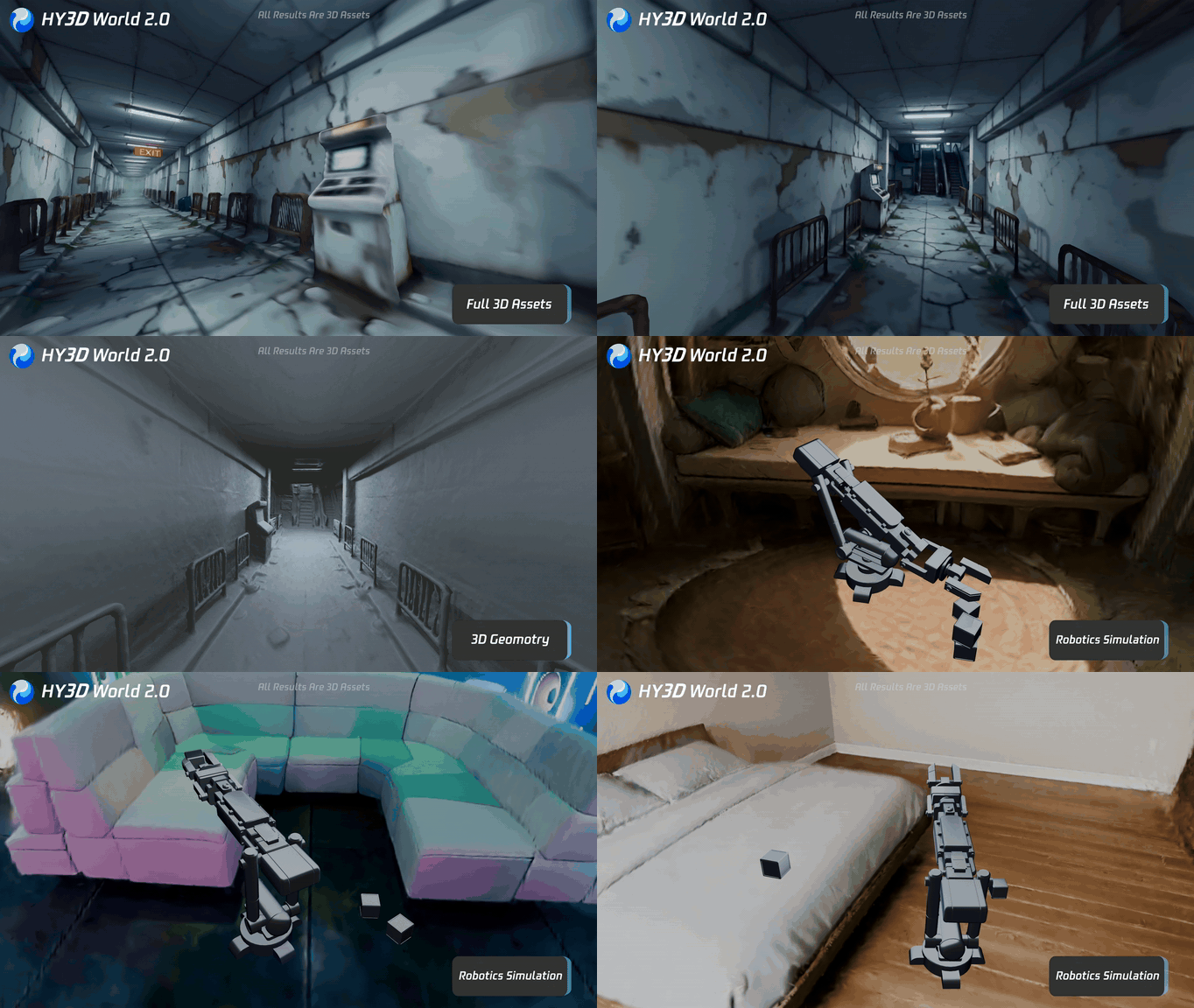
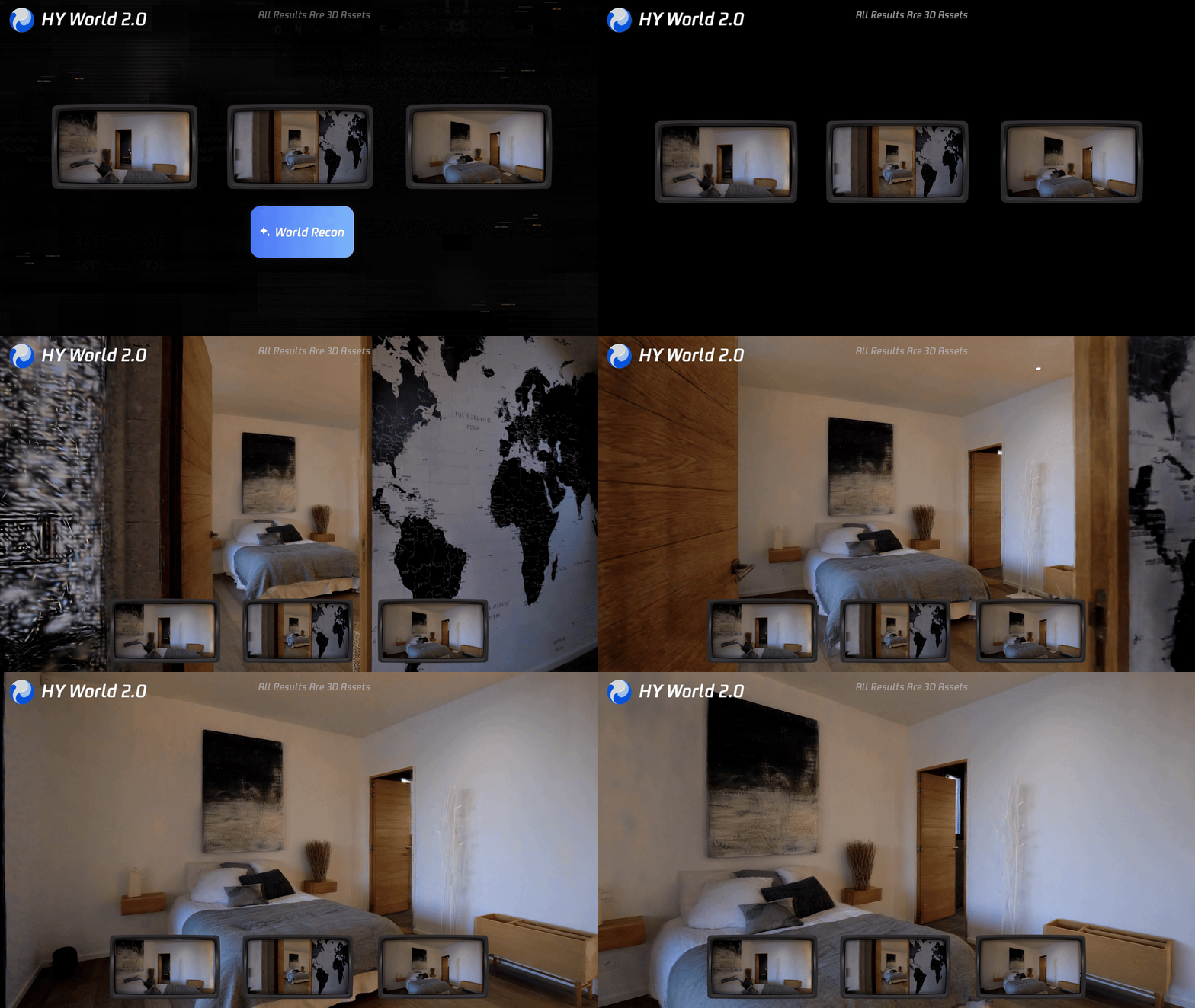
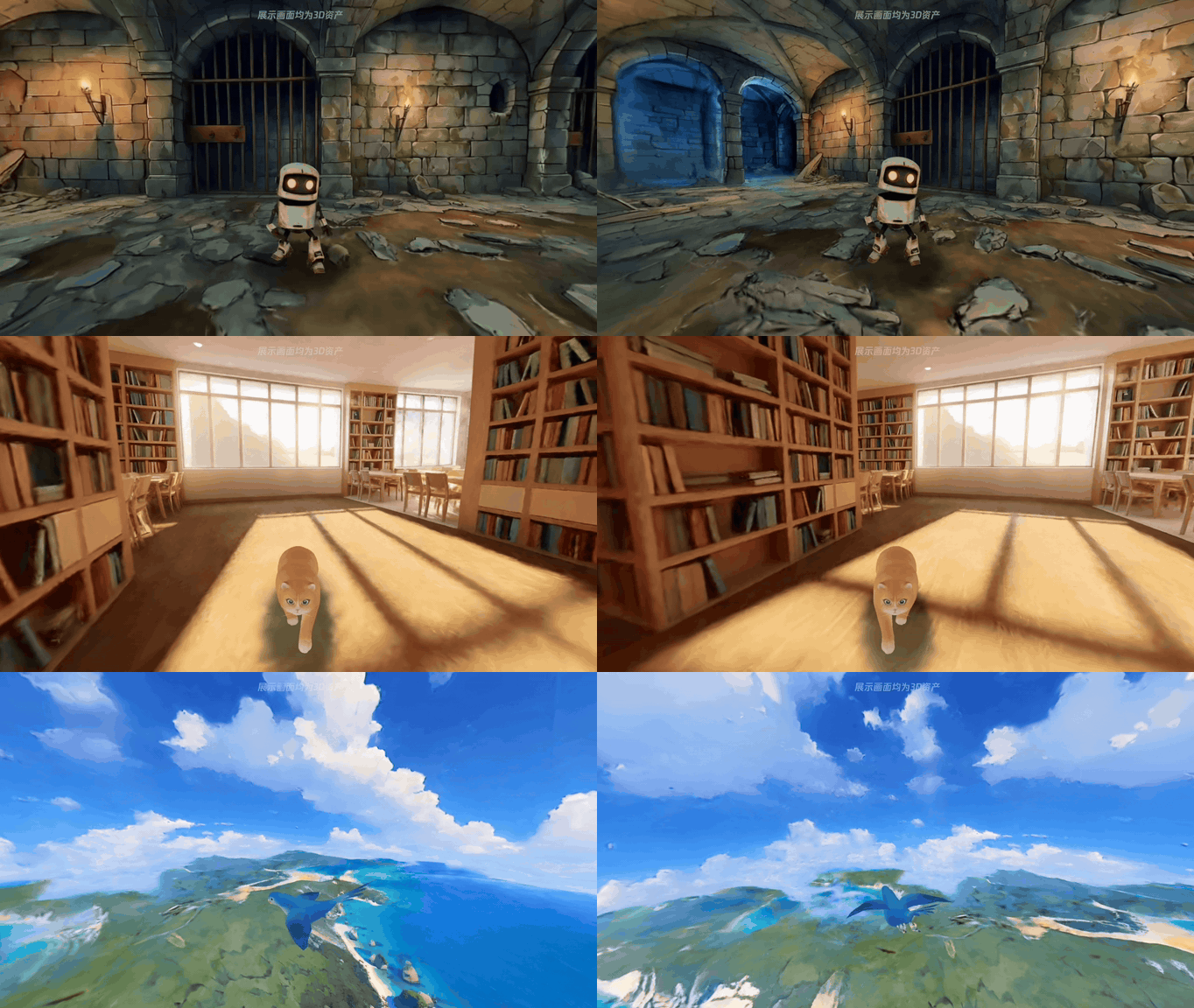
HY-World 2.0 is a multi-modal world model that converts text, single images, multi-view images, and video into editable 3D assets (meshes and Gaussian Splattings) rather than pixel videos. Built by Tencent's Hunyuan team, it targets 3D content creators, game developers, and simulation researchers who need persistent, engine-compatible 3D worlds. The project positions itself as fundamentally different from video-based world models by producing real 3D geometry suitable for game engines and physics simulation.
HY-World 2.0 is the latest iteration in Tencent Hunyuan's generative 3D modeling line, following Hunyuan3D and preceding models. Released April 2026 with full open-source intent, it builds on research trajectories in panoramic generation, depth prediction, and 3D Gaussian Splatting techniques. The shift from video generation to 3D asset production represents an explicit strategic pivot in the Hunyuan ecosystem.
Project launched April 10, 2026 with strong initial momentum: 2,293 stars within ~2.5 months, 38 stars in the last 7 days (as of June 29, 2026), 194 forks. Rapid successive releases of model weights and inference code through May 2026 (HY-Pano 2.0, WorldStereo 2.0, WorldMirror 2.0) indicate active staged deployment. Stars and activity suggest adoption beyond curiosity, though growth rate appears to be normalizing post-launch spike.
Official Tencent deployment noted (3d.hunyuan.tencent.com/sceneTo3D), HuggingFace model hosting, ModelScope distribution in China. Evidence suggests internal/official use. Adoption by external developers or third-party production workflows not verified in README. Community engagement through Discord indicated but scale unknown.
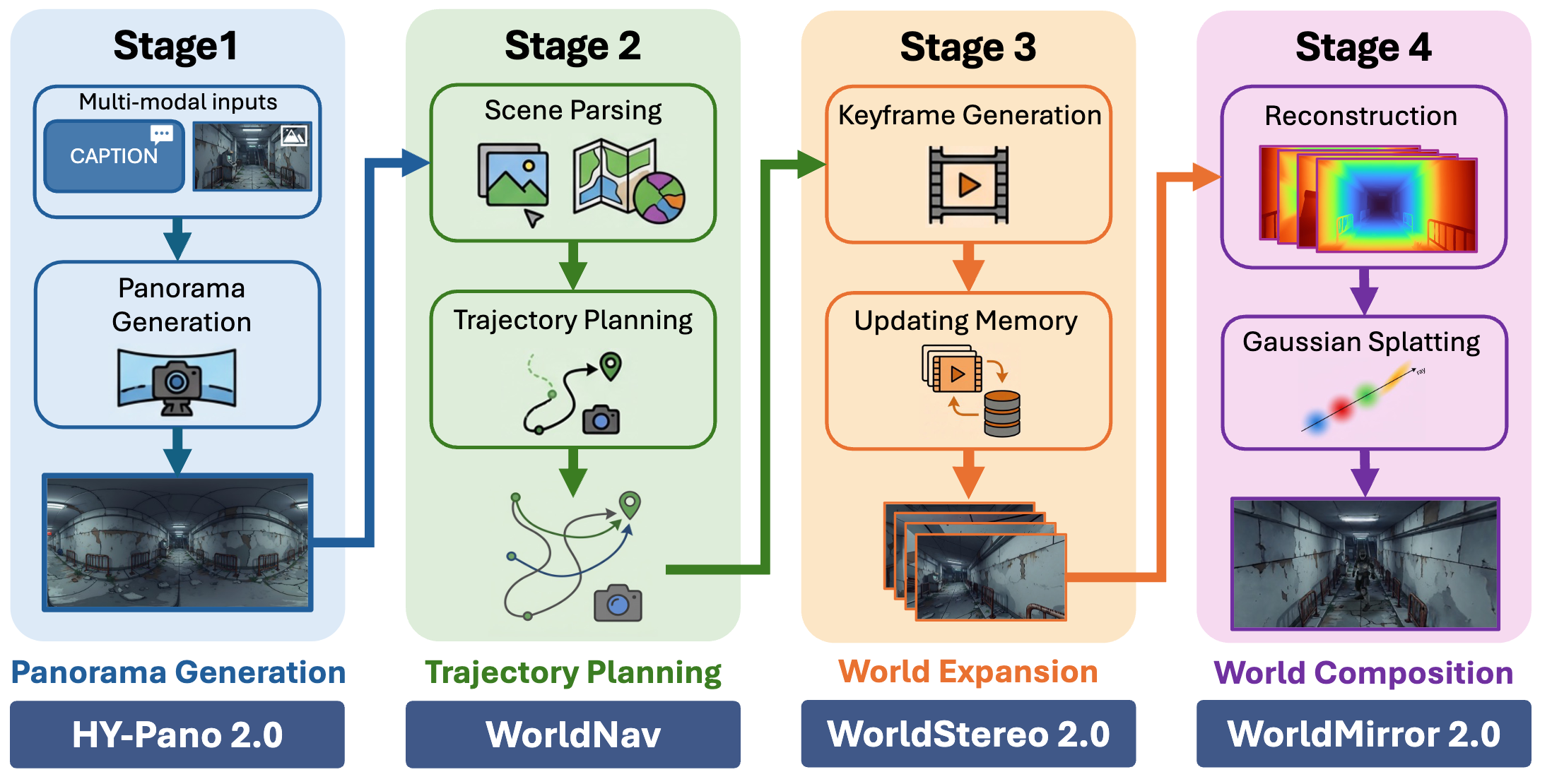
Based on README, the system comprises four interconnected stages: (1) HY-Pano 2.0 for panorama generation from single images, (2) WorldNav for trajectory planning, (3) WorldStereo 2.0 for world expansion via multi-view synthesis, (4) WorldMirror 2.0 for unified depth/normal/camera/3DGS prediction and composition. Architecture appears modular and stage-wise, with unified feed-forward inference for reconstruction tasks. Repository structure not visible; actual implementation quality cannot be verified from README alone.
Not documented in README. No mention of unit tests, benchmark suites, or evaluation protocols in excerpt.
Last push May 27, 2026 (33 days ago relative to June 29, 2026) indicates active maintenance. Four dated release announcements between April 16 and May 18, 2026 show structured, phased open-sourcing. Official channels documented (Discord, Twitter, Hugging Face, ModelScope). Likely still in active development given recent cadence and beta-stage feature releases.
ADOPT IF: you need to generate persistent, engine-ready 3D assets (meshes/3DGS) from text or images for game development, VR/AR, or simulation; you operate on infrastructure supporting recent Tencent Hunyuan models; you can tolerate a young project still in staged open-sourcing. AVOID IF: you require production-hardened, stable APIs (project appears to be in active flux with staged releases); you need comprehensive documentation or community ecosystem support beyond official Tencent channels; you cannot depend on internet-based inference or Tencent-hosted services; you need offline-first or edge deployment without cloud services. MONITOR IF: you work in digital asset creation or simulation and want to track whether this matures into a de facto standard; ecosystem tooling and third-party integrations have not yet formed; mainstream adoption in production pipelines remains unverified outside official Tencent contexts.
Independent dimensions
Mainstream potential
4/10
Technical importance
7/10
Adoption evidence
3/10
- Project is extremely new (2.5 months old). Stability, API surface, and long-term maintenance commitment are unproven. Breaking changes or deprecation risk in early iterations.
- Staged open-sourcing with staggered model releases suggests some components may remain proprietary or unavailable. Full reproducibility cannot be confirmed until all promised releases complete.
- Adoption evidence is limited to Tencent's own deployment. Third-party production use and real-world workflow integration are not documented. May remain a research/demo project if external adoption does not materialize.
- Dependency on Tencent's infrastructure (HuggingFace mirrors, official demo sites) for inference and model serving. Long-term service availability cannot be assumed; no clear offline-first or self-hosted path documented in README.
- Comparison table in README positions 3D world models as superior to video models on multiple axes. This framing, while technically motivated, may oversimplify tradeoffs and create unrealistic expectations about what the model can deliver in practice.
HY-World 2.0 will likely remain a specialized tool within the Tencent Hunyuan ecosystem and among advanced 3D content creators and researchers for the next 12–24 months. Mainstream adoption in game engines or production pipelines will depend on: (1) community-contributed integrations (Blender/UE plugins), (2) documentation and tutorial maturity, (3) cost/performance tradeoffs vs. alternatives, (4) third-party hosting/API access beyond official Tencent services. Probability of becoming a category standard is low to moderate; probability of sustained technical relevance is high if development continues.
Newsletter
Get analyses like this every Monday
Free weekly digest of the most interesting open-source discoveries.
Languages
Information
- Language
- Python
- License
- NOASSERTION
- Last updated
- 1mo ago
- Created
- 3mo ago
- Analyzed with
- anthropic/claude-haiku-4-5
Stars over time
Contributors over time
Top 100 contributors only — repos with more will plateau at 100.
Open issues
Top contributors
Recent releases
No releases published yet.
Similar repos
Tencent-Hunyuan/Hunyuan3D-2
Hunyuan3D-2 is a specialized 3D asset generation system using large-scale...
Tencent-Hunyuan/HY-Motion-1.0
HY-Motion 1.0 is a text-to-3D human motion generation model series developed by...

Robbyant/lingbot-world
LingBot-World is an open-source world model for video generation and simulation...
Tencent-Hunyuan/HunyuanImage-3.0
HunyuanImage-3.0 is a native multimodal model for text-to-image and...
| Repository | Stars | Week Δ | Language | Score | Updated |
|---|---|---|---|---|---|
|
Tencent-Hunyuan/HY-World-2.0
this
|
2.3k | +21 | Python | 8/10 | 1mo ago |
|
Tencent-Hunyuan/Hunyuan3D-2
|
14.1k | — | Python | 8/10 | 9mo ago |
|
Tencent-Hunyuan/HY-Motion-1.0
|
2.4k | — | Python | 8/10 | 2mo ago |
|
Robbyant/lingbot-world
|
4.1k | — | Python | 7/10 | 1d ago |
|
Tencent-Hunyuan/HunyuanImage-3.0
|
3.2k | — | Python | 7/10 | 2w ago |
|
Tencent-Hunyuan/HunyuanVideo
|
12.3k | — | Python | 8/10 | 2w ago |
Sibling project with 6× higher star count (14,053 vs 2,293). Both Tencent-owned; Hunyuan3D-2 likely more mature and broader adoption. HY-World 2.0 is newer (April 2026) and narrower-scoped (world models vs single 3D object generation).
Also Tencent; 12,260 stars. Generates video rather than 3D assets. HY-World 2.0 explicitly positions itself as the 3D alternative to video world models like HunyuanVideo, targeting different downstream use cases (persistent assets vs playable clips).
Curated collection (1,841 stars) rather than implementation. HY-World 2.0 is one entry in a broader landscape of world models. Does not compete head-to-head but is positioned within a growing category.
Alternative 3D world model framework (1,124 stars). Similar problem domain; HY-World 2.0 has 2× stars. Both are relatively new entrants to the 3D world modeling space (dates not visible but low star counts suggest recent launches).





 with HY-Pano 2.0, b)
  with WorldNav, c)
  with WorldStereo 2.0, and d)
  with WorldMirror 2.0 & 3DGS learning.