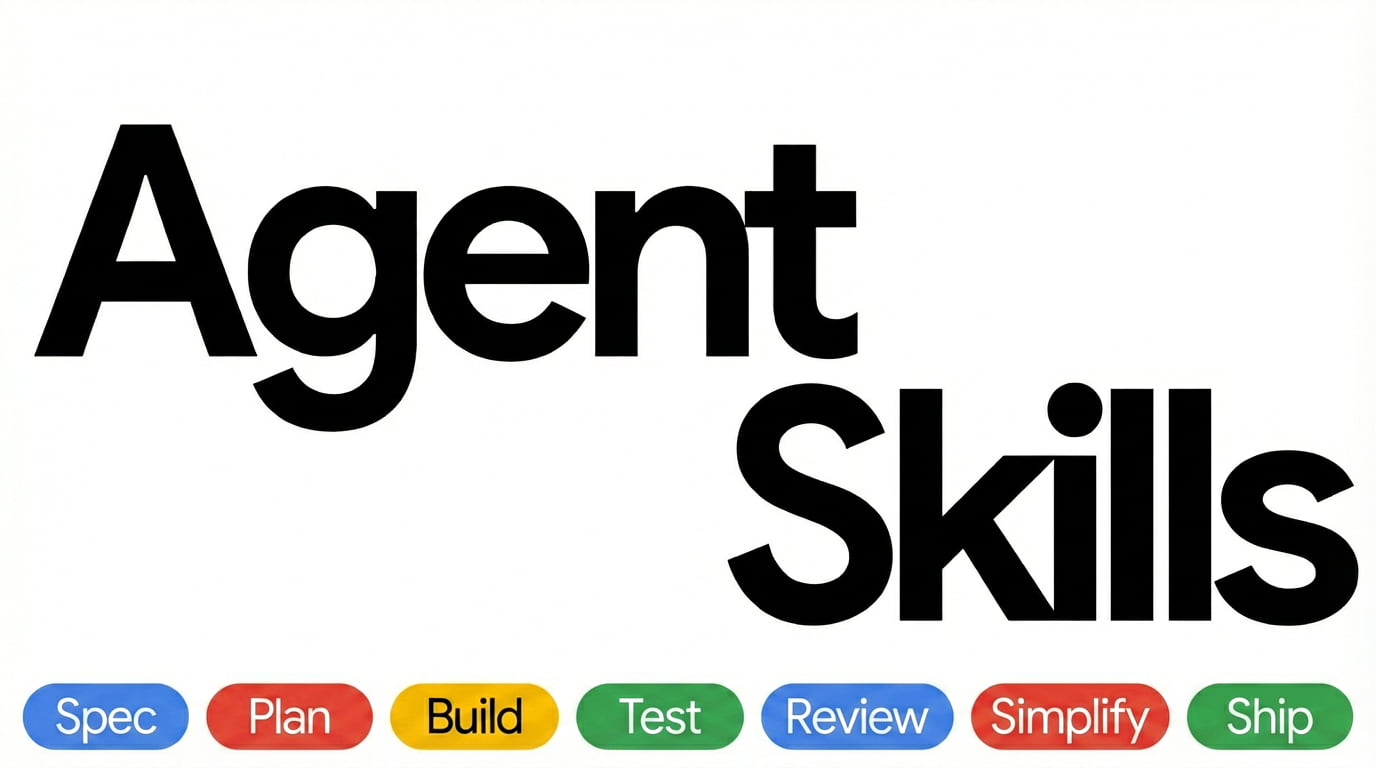
Production-grade engineering skills for AI coding agents.
76.5k
Stars
8.2k
Forks
133
Open issues
45
Contributors


AI Analysis
Agent Skills is a curated collection of 24 production-grade workflow definitions ('skills') that instruct AI coding agents (Claude Code, Cursor, Codex, Copilot, etc.) to follow senior-engineer best practices across the full development lifecycle — from spec to ship. It is best suited for developers who regularly use AI coding agents and want to enforce consistent quality gates, test-driven development, and structured workflows without manually prompting the agent each time. It is not for user...
Inferred from signals mentioned in the README (tests, CI, type safety) — not a review of the actual code.
AI's overall editorial judgment — not an average of the bars above, can weigh other factors too.
Addy Osmani's AI agent skill pack encodes senior engineering workflows as portable Markdown rules for coding agents
agent-skills packages senior engineering best practices — spec writing, incremental building, test-driven verification, code review, and shipping gates — as structured Markdown skill files that AI coding agents (Claude Code, Cursor, Copilot, Gemini CLI, and others) can follow consistently. It targets developers who want AI agents to behave less like autocomplete and more like disciplined engineers. The project ships 24 skills covering the full development lifecycle and integrates with at least seven major AI coding tools. With 63k+ stars and 5,600+ gained in the past week, it has achieved rapid organic traction likely driven by Addy Osmani's established reputation in the web engineering community.
Created February 2026 by Addy Osmani (Google Chrome DevRel lead and widely followed engineering author), the project emerged alongside the rapid proliferation of AI coding agents and the industry's recognition that raw LLM capability without structured workflows produces inconsistent output.
Growth appears driven by three compounding factors: Osmani's large existing audience in the web/frontend engineering community, a genuinely underserved pain point (AI agents lacking engineering discipline), and the timing alignment with Claude Code, Cursor, and Gemini CLI all reaching production readiness in early-to-mid 2026. The 5,649 stars gained in a single week as of June 2026 suggests continued viral sharing rather than a one-time spike.
Stars and fork count (63k stars, 6.9k forks) indicate significant discovery and adoption intent. The multi-tool integration documentation (Claude Code marketplace, Gemini CLI, Cursor, Windsurf, GitHub Copilot, Kiro, OpenCode) suggests real usage across diverse environments. However, direct evidence of production engineering teams adopting these skills at scale — such as public case studies, company blog posts, or downstream dependency counts — is not available from repository metadata alone. Adoption appears real but self-reported depth is unverifiable.
Appears to be entirely content-driven: plain Markdown SKILL.md files organized per skill under a skills/ directory, with shell scripts likely handling plugin packaging and installation. Likely no runtime binary — the 'code' is structured prose consumed as context by AI agents. The slash-command system appears to be a plugin convention defined per target tool (Claude Code plugin format, Cursor rules, AGENTS.md, etc.) rather than a shared runtime.
Not documented in README. Given the content-based nature of the project, traditional test coverage is likely not applicable; quality assurance probably relies on manual validation of skill effectiveness against agent outputs.
Last push June 19, 2026 — one day before evaluation date — indicates very active maintenance. The README documents integrations with at least eight tools including recently-released platforms (Kiro IDE, Antigravity CLI), suggesting the maintainer is actively tracking the fast-moving AI tooling landscape. Activity appears healthy and accelerating rather than declining.
ADOPT IF: you use Claude Code, Cursor, Gemini CLI, or similar AI coding agents and want to enforce consistent engineering discipline (spec-first, test-driven, incremental commits) without writing your own system prompts from scratch. AVOID IF: your team has already invested in custom agent instructions or organization-specific coding standards — forking and adapting may create maintenance overhead, and the generic best practices may conflict with domain-specific conventions. MONITOR IF: you are evaluating AI agent governance tooling for a team and want to see whether a shared skill-pack standard emerges across the industry before committing to one author's opinionated workflow.
Independent dimensions
Mainstream potential
7/10
Technical importance
6/10
Adoption evidence
5/10
- Content quality and effectiveness depend entirely on how well the Markdown instructions translate into consistent agent behavior — this varies significantly by model version and agent platform, and cannot be verified without runtime testing.
- The fast-moving AI tooling landscape means integration docs for specific tools (Kiro, Antigravity, Gemini CLI) may go stale quickly if those platforms change their plugin APIs.
- Single-maintainer dependency: the project's trajectory is tightly coupled to Osmani's continued involvement; no visible core contributor team is documented.
- The proliferation of similar repos (five visible competitors with meaningful star counts) suggests the category may fragment rather than converge on one standard, reducing network effects.
- Skills encode opinionated engineering workflows; teams with different practices (e.g., no TDD, trunk-based vs. PR-based development) may find the prescriptive structure a friction point rather than a benefit.
Likely to become a widely referenced starting point for AI agent skill configuration, especially in the Claude Code ecosystem, but may plateau as team-specific customization needs diverge and competing packs consolidate around different toolchains.
Newsletter
Get analyses like this every Monday
Free weekly digest of the most interesting open-source discoveries.
Languages
Information
- Language
- JavaScript
- License
- MIT
- Last updated
- 10h ago
- Created
- 5mo ago
- Analyzed with
- anthropic/claude-sonnet-4-6
Stars over time
Contributors over time
Top 100 contributors only — repos with more will plateau at 100.
Open issues
Top contributors
Recent releases
Similar repos

tech-leads-club/agent-skills
Agent Skills is a curated, security-validated skill registry for AI coding...

softaworks/agent-toolkit
Agent Toolkit is a curated collection of reusable skills for AI coding agents...

VoltAgent/awesome-agent-skills
Awesome Agent Skills is a curated collection of 1,500+ skills for AI agent...
| Repository | Stars | Week Δ | Language | Score | Updated |
|---|---|---|---|---|---|
|
addyosmani/agent-skills
this
|
76.5k | +7.4k | JavaScript | 8/10 | 10h ago |
|
tech-leads-club/agent-skills
|
4.9k | — | TypeScript | 8/10 | 3d ago |
|
softaworks/agent-toolkit
|
2.2k | — | Python | 7/10 | 4mo ago |
 BuilderIO/skills BuilderIO/skills
|
3.6k | — | JavaScript | 7/10 | 18h ago |
|
VoltAgent/awesome-agent-skills
|
27.7k | — | — | 8/10 | 1w ago |
 alirezarezvani/claude-skills alirezarezvani/claude-skills
|
21.9k | — | Python | 8/10 | 2d ago |
Likely the category leader by star count; targets a similar audience of developers using AI coding agents. Osmani's project differentiates on explicit engineering lifecycle framing (spec → plan → build → test → review → ship) and tighter integration with Claude Code's plugin marketplace.
Appears to be a curated list (awesome-list format) rather than an installable skill pack. Complementary rather than directly competing — discovery resource vs. deployable artifact.
Claude-specific skills written in Python, suggesting a more programmatic or runtime-heavy approach. Osmani's pack is tool-agnostic Markdown, giving it broader portability across agent platforms.
TypeScript-based, likely tied to Vercel's ecosystem and Next.js-oriented workflows. Osmani's pack is language and framework agnostic by design.
Smaller, TypeScript-implemented alternative. Less multi-tool coverage based on available metadata; Osmani's pack has broader documented compatibility.