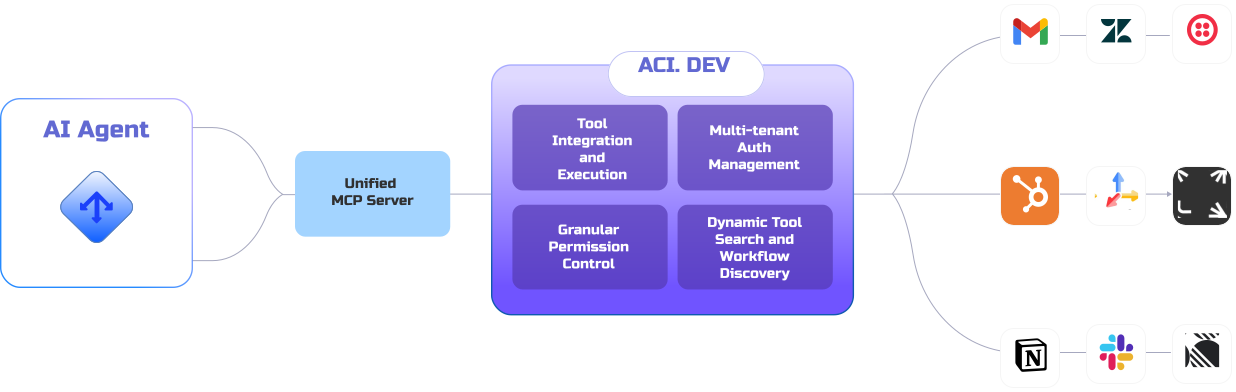
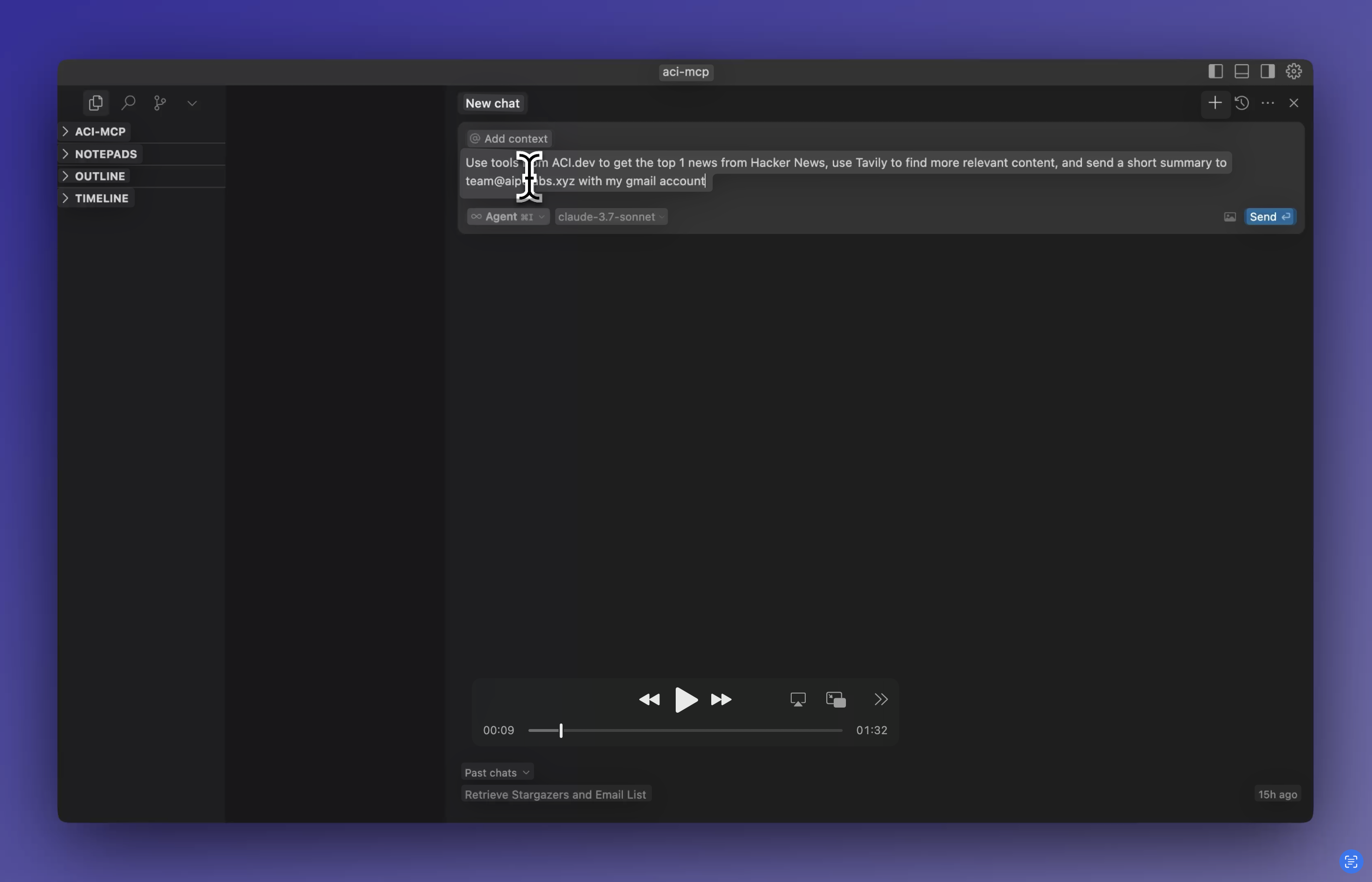
ACI.dev is the open source tool-calling platform that hooks up 600+ tools into any agentic IDE or custom AI agent through direct function calling or a unified MCP server. The birthplace of VibeOps.
4.8k
Stars
463
Forks
63
Open issues
28
Contributors


AI Analysis
ACI.dev is an open-source platform that integrates 600+ tools into AI agents and agentic IDEs, providing unified function calling with multi-tenant authentication and granular permissions. It serves developers building AI agents and infrastructure, offering both direct function calls and a unified MCP server interface. This is specialized infrastructure for the AI agent ecosystem, not a general-purpose tool.
Inferred from signals mentioned in the README (tests, CI, type safety) — not a review of the actual code.
AI's overall editorial judgment — not an average of the bars above, can weigh other factors too.
Open-source tool-calling platform for AI agents with 600+ integrations and unified MCP server access
ACI.dev is a Python-based platform for connecting AI agents to external tools through managed authentication, permissions, and discovery. It exposes 600+ pre-built integrations via a unified MCP server or direct SDKs, targeting developers building agentic applications and DevOps automation. The project emphasizes multi-tenant auth, granular permissions, and framework-agnostic tool access. Adoption appears concentrated in early-stage AI agent builders and internal DevOps automation rather than mainstream enterprise deployment.
Created September 2024, ACI.dev emerged during rapid growth in AI agent frameworks and tool-calling patterns. The project introduced 'VibeOps'—using agents for infrastructure automation—as a branded use case. It sits at the intersection of model-context-protocol standardization and the broader AI agent ecosystem.
Grew to 4,806 stars in ~21 months with modest recent velocity (5 stars in 7 days as of June 2026). The project appears to have gained traction through MCP server positioning and agent framework adoption rather than explosive growth. Last commit May 28, 2026 indicates active maintenance but not rapid iteration. Discord community and demo videos suggest targeted community building rather than viral adoption.
Adoption not verified through concrete deployment metrics. README references 'common use cases' (VibeOps, personal assistants, research agents, sales agents, support agents) but provides no customer names, case studies, or quantified usage. Presence of managed service (aci.dev) and multiple SDKs (Python, TypeScript) suggests intent to support production but not evidence of current scale.
Based on README, appears to be a Python backend exposing tool abstractions through both direct SDK calls and a unified MCP server interface. Supports 600+ integrations, likely via a plugin or registry pattern. Multi-tenant auth and secrets management are documented as core features. Actual implementation patterns and scalability architecture not verifiable from README alone.
Not documented in README. No reference to test suites, CI/CD pipelines, or coverage metrics visible in provided metadata.
Last push May 28, 2026 (32 days before analysis date) indicates active maintenance. Repository age ~21 months with consistent presence in similar-project rankings suggests sustained but modest development velocity. No evidence of crisis or abandonment, but growth rate suggests early-to-mature project phase rather than rapid scaling.
ADOPT IF: you are building an agentic application and need multi-tenant tool access with managed auth, MCP server support appeals to your stack, and the 600+ integrations cover your use cases. AVOID IF: you require production-grade SLAs, need verification of active production deployments at scale, or prefer tools with clearer enterprise adoption signals. MONITOR IF: you are evaluating AI agent infrastructure and want to track whether ACI.dev becomes the standard tool-calling layer in agentic IDEs (like cursor/claude) or remains a specialist library.
Independent dimensions
Mainstream potential
5/10
Technical importance
6/10
Adoption evidence
3/10
- Adoption not verified — no public case studies, customer testimonials, or deployment metrics visible; growth rate suggests early-stage rather than production-proven.
- Reliance on managed service (aci.dev) for ease of use may create friction if self-hosted deployment is required; open-source status does not guarantee all features are available in open-source version.
- Tool integration maintenance burden — 600+ integrations require ongoing updates to third-party APIs; community size may not support rapid fixes if integrations break.
- MCP server standardization is still evolving — if MCP adoption plateaus or competing standards emerge, the unified MCP positioning could become less valuable.
- Modest fork count (466) relative to stars suggests limited community contribution and potential single-team maintenance bottleneck.
ACI.dev will likely remain a capable specialized tool for AI agent builders and infrastructure automation rather than becoming a default choice across the ecosystem. Success depends on MCP server adoption in mainstream agentic IDEs and whether integration maintenance scales.
Newsletter
Get analyses like this every Monday
Free weekly digest of the most interesting open-source discoveries.
Languages
Information
- Website
- https://www.aci.dev/
- Language
- Python
- License
- Apache-2.0
- Last updated
- 1mo ago
- Created
- 22mo ago
- Analyzed with
- anthropic/claude-haiku-4-5
Stars over time
Contributors over time
Top 100 contributors only — repos with more will plateau at 100.
Open issues
Security: Fail-open in custom instruction violation check — inference failure bypasses guard
Security: SSRF in RestFunctionExecutor — no URL validation before HTTP request
Integration Request: OptionsAhoy (equity-comp tax/trade optimizer, 7 functions)
Proposal: Capability Manifest for 600+ tools — declare what agents CAN do before invocation
[Function Request] NOTTE__RUN_AGENT (extends existing Notte app)
Top contributors
Similar repos

codeaholicguy/ai-devkit
AI DevKit is a control plane and orchestration layer for multiple AI coding...
| Repository | Stars | Week Δ | Language | Score | Updated |
|---|---|---|---|---|---|
|
aipotheosis-labs/aci
this
|
4.8k | +7 | Python | 7/10 | 1mo ago |
 Klavis-AI/klavis Klavis-AI/klavis
|
5.8k | — | Python | 7/10 | 1mo ago |
|
codeaholicguy/ai-devkit
|
1.6k | — | TypeScript | 7/10 | 2d ago |
 iOfficeAI/AionUi iOfficeAI/AionUi
|
29.8k | — | TypeScript | 7/10 | -21 min ago |
 can1357/oh-my-pi can1357/oh-my-pi
|
17.1k | — | TypeScript | 8/10 | -33 min ago |
 agiresearch/AIOS agiresearch/AIOS
|
6k | — | Python | 7/10 | 3w ago |
Similar star count (5,763 vs 4,806) but appears to serve similar agent-tool integration space. Direct comparison not possible without inspecting both repositories.
Higher star count (5,987 vs 4,806) suggests AIOS may have broader visibility in agent research circles. Both target agent infrastructure but likely different positioning.
Significantly higher stars (29,034) suggests a different problem or broader audience, likely UI-focused rather than tool-integration-focused.
Lower stars (1,518) indicates ACI.dev has achieved higher visibility in the agent-tooling space but both target developer tooling for AI.
High star count (15,066) suggests different niche (likely automation/scripting) rather than direct competition for agent tool-calling.