The `boring` SSH tunnel manager
1.7k
Stars
54
Forks
4
Open issues
2
Contributors

AI Analysis
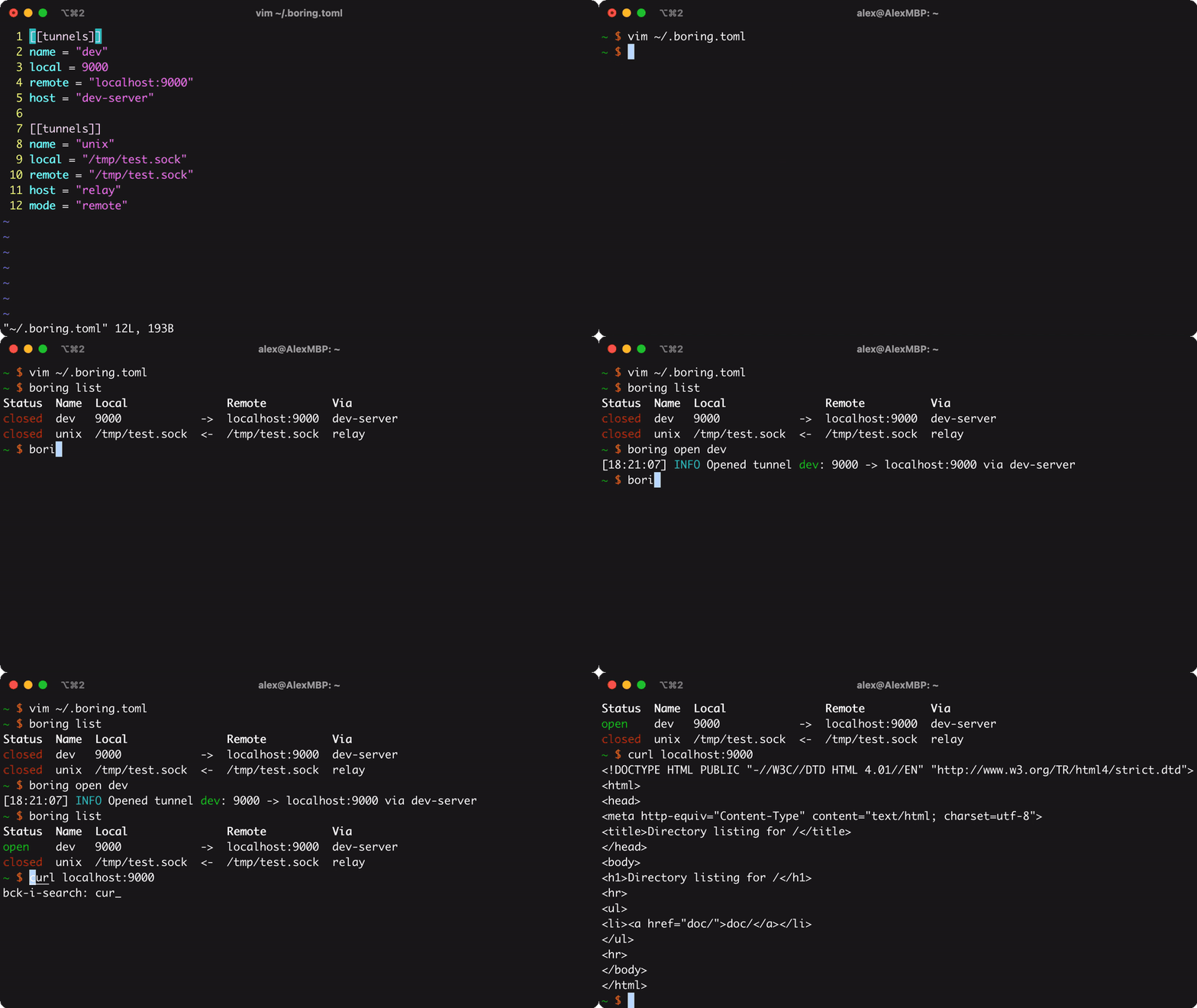
The `boring` SSH tunnel manager is a lightweight CLI tool for managing SSH port forwarding tunnels with TOML configuration. It's built specifically for developers and DevOps engineers who need to maintain multiple SSH tunnels and want an alternative to manual SSH command management. This tool is not suitable for use cases requiring programmatic tunnel management or GUI-based port forwarding.
Inferred from signals mentioned in the README (tests, CI, type safety) — not a review of the actual code.
AI's overall editorial judgment — not an average of the bars above, can weigh other factors too.
Lightweight SSH tunnel manager with TOML config, targeting developers who prefer simplicity over feature complexity
boring is a command-line SSH tunnel manager written in Go, focusing on ease of use through human-friendly TOML configuration and support for local, remote, and SOCKS5 forwarding. It targets individual developers and small teams managing multiple SSH tunnels. The project emphasizes simplicity and reliability over advanced features. Adoption appears modest but growing; real-world deployment evidence is not documented in public channels.
Created in September 2024, boring emerged as a minimalist alternative in a crowded SSH tunneling space. The project positions itself explicitly against feature-heavy tools, betting that simpler configuration and straightforward command structure would appeal to developers fatigued by complexity in existing solutions.
The project gained 40 stars in the week before this analysis (as of 2026-06-29), suggesting recent acceleration. With 1,640 total stars and 54 forks over ~21 months, growth appears steady but not exponential. The presence of Homebrew distribution and passing CI/coverage signals active maintenance and professional polish, which likely contributes to gradual adoption within developer communities.
Adoption not verified. No documented case studies, enterprise deployments, or community testimonials in README. Homebrew distribution suggests sufficient polish for mainstream package managers. GitHub forks (54) and modest star growth imply some real use, but scale and scope of production deployment cannot be determined from available metadata.
Appears to be a single-binary CLI tool written in Go, leveraging standard SSH libraries and ssh-agent integration. Based on README: supports configuration file parsing (TOML), tunnel lifecycle management (open/close/list), shell completion generation, and cross-platform Unix socket support. Likely uses Go's net and ssh packages; exact architectural decisions cannot be verified from README alone.
README documents coverage badge and CI workflow passing, including test_and_cover.yml GitHub Actions. Specific coverage percentage not stated in README excerpt; badge integration suggests active test discipline.
Last push 2026-06-20 (9 days before analysis date), indicating active maintenance. Created 2024-09-21, so project is ~21 months old. CI passing, release artifacts, and recent activity suggest the maintainer is engaged. No evidence of stagnation; steady, non-urgent maintenance pattern typical of mature single-maintainer tools.
ADOPT IF: you manage multiple SSH tunnels locally, prefer TOML configuration over imperative commands or scripts, and want a single Go binary without external dependencies. AVOID IF: you need advanced features (TCP multiplexing, encryption negotiation), centralized multi-user management, or production-scale tunnel orchestration. MONITOR IF: you rely on niche features (Unix socket forwarding, specific ssh-agent integration) and want to track whether boring's feature set and adoption remain sufficient for your use case over the next 12-18 months.
Independent dimensions
Mainstream potential
3/10
Technical importance
5/10
Adoption evidence
2/10
- Single maintainer (alebeck) with no visible backup or governance structure; risk of maintenance gaps if maintainer becomes unavailable.
- Adoption not verified at scale; limited evidence of production use in organizations or beyond individual developers.
- Feature parity with ssh -L/-R may be sufficient for users, reducing incentive to adopt yet another tool; competing against existing muscle memory.
- Modest fork count (54) suggests limited community contribution; dependency on maintainer for bug fixes and feature requests.
- No documented security audit or explicit security policy visible in README; security claims depend on underlying Go/SSH libraries.
boring likely remains a niche productivity tool for individual and small-team SSH tunnel management over the next 2-3 years. Steady adoption among developers seeking simplicity, but unlikely to displace ssh built-ins or centralized bastion solutions. Growth will depend on word-of-mouth and whether organizational adoption (with TOML config as team-shareable standard) accelerates.
Explore similar
Newsletter
Get analyses like this every Monday
Free weekly digest of the most interesting open-source discoveries.
Languages
Information
- Language
- Go
- License
- NOASSERTION
- Last updated
- 6d ago
- Created
- 22mo ago
- Analyzed with
- anthropic/claude-haiku-4-5
Stars over time
Contributors over time
Top 100 contributors only — repos with more will plateau at 100.
Open issues
Open pull requests
No open pull requests.
Similar repos
| Repository | Stars | Week Δ | Language | Score | Updated |
|---|---|---|---|---|---|
|
alebeck/boring
this
|
1.7k | +7 | Go | 8/10 | 6d ago |
 ekzhang/bore ekzhang/bore
|
11.3k | — | Rust | 8/10 | 5mo ago |
 amalshaji/portr amalshaji/portr
|
3.1k | — | Go | 7/10 | 2d ago |
 go-gost/gost go-gost/gost
|
7.1k | — | Go | 8/10 | 4d ago |
 antoniomika/sish antoniomika/sish
|
4.7k | — | Go | 8/10 | 2w ago |
 moul/sshportal moul/sshportal
|
1.9k | — | Go | 7/10 | 1d ago |
bore focuses on HTTP tunneling and lightweight public tunnels; boring is SSH-specific with local management. bore targets public sharing; boring targets private SSH infrastructure.
portr appears tunnel-agnostic; boring is SSH-focused. boring emphasizes TOML config and ssh-agent integration; portr positioning unclear from star count alone.
sish is a server-side SSH tunneling platform; boring is a client-side tunnel manager. Different use cases (hosted service vs. personal CLI).
gost is a general-purpose proxy/tunnel framework; boring is a focused SSH tunnel manager with TOML config. gost broader scope, boring narrower and opinionated.
sshportal is a server-side bastion/portal; boring is client-side tunnel management. Different architectural positioning.