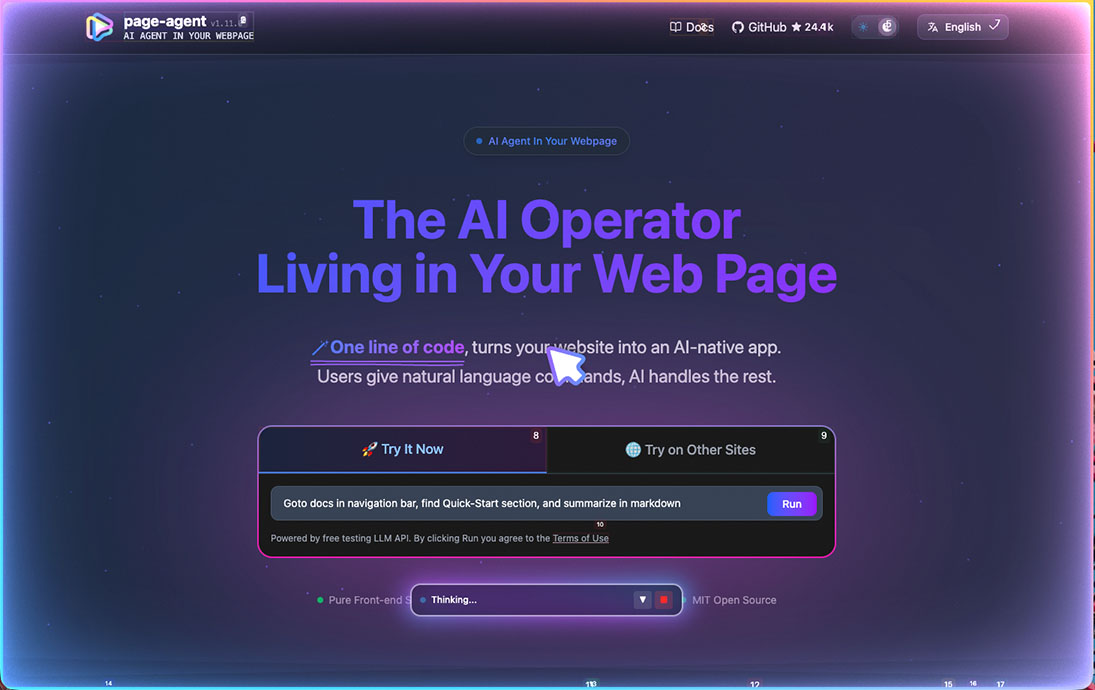
JavaScript in-page GUI agent. Control web interfaces with natural language.
25.6k
Stars
2.2k
Forks
50
Open issues
30
Contributors


AI Analysis
Page Agent is a TypeScript library that embeds an AI agent directly into web pages to control interfaces through natural language, without requiring browser extensions, Python, or headless browsers. It serves specialized use cases like SaaS AI copilots, smart form filling in enterprise systems (ERP/CRM), and web accessibility—best suited for developers building AI-driven features into existing web applications rather than general-purpose automation.
Inferred from signals mentioned in the README (tests, CI, type safety) — not a review of the actual code.
AI's overall editorial judgment — not an average of the bars above, can weigh other factors too.
Alibaba's in-page JavaScript agent lets web apps accept natural language commands without a headless browser
Page Agent is a TypeScript library that runs inside a web page's own JavaScript context to interpret natural language instructions and manipulate the DOM — no browser extension, no Python runtime, no screenshots. It is aimed at SaaS developers who want to embed an AI copilot, QA teams automating UI tests inside the page, and accessibility tooling authors. Because it works via text-based DOM analysis rather than vision models, it avoids multimodal LLM dependencies. Backed by Alibaba and acknowledging browser-use as an upstream inspiration, it occupies a distinct niche: client-side enhancement rather than server-side automation.
Created in September 2025 by Alibaba's open source team, building on DOM interaction patterns from the Python-based browser-use project. Positioned as the in-browser complement to headless/server automation tools rather than a replacement for them.
Reached ~18.7k stars within roughly nine months of creation, suggesting a burst of initial attention likely fueled by Alibaba's brand presence, a Hacker News discussion thread, and the broader wave of interest in browser-agent tooling through late 2025 and early 2026. The current 7-day star rate (50/week) indicates growth has normalized from any launch spike to a steadier, moderate pace.
NPM download badge is present but actual download counts are not disclosed in the README excerpt. The 'Awesome Page Agent' community showcase table has no entries yet beyond a placeholder, suggesting community-built production deployments are not yet publicly documented. Adoption not verified at production scale, though the library's availability on npm and jsdelivr CDN indicates it is packaged for real use.
Appears to use a text-based DOM serialization layer (likely converting the live DOM to a structured text representation) fed into an LLM, which returns action instructions that the library then executes via standard browser APIs. Likely event-driven and single-threaded, running fully in-browser. An optional Chrome extension appears to extend reach to multi-tab scenarios, and a beta MCP server allows external agent clients to drive it. Architecture is described as requiring no screenshots or multimodal models, suggesting a purely text-token pipeline.
not documented in README
Last push was 2026-06-17, four days before evaluation date, indicating active ongoing development. The project is at v1.10.0 as visible in CDN URLs, suggesting at least ten minor releases since launch — consistent with iterative, engaged maintenance. A maintainer's note linked from the README signals deliberate project governance. Contributions from bots/AI without human review are explicitly rejected, suggesting quality-conscious merge practices.
ADOPT IF: you are a frontend or SaaS developer who wants to add natural language UI control or an AI copilot to an existing web app without introducing a Python backend, headless browser infrastructure, or browser extension as a hard dependency. AVOID IF: you need reliable, auditable automation of arbitrary third-party websites at scale, require vision-based understanding of non-DOM content (canvas, PDF, images), or are building server-side RPA pipelines — headless tools like browser-use are better suited. MONITOR IF: you are evaluating in-page agent tooling for accessibility or QA use cases but need more evidence of production stability, broader LLM compatibility, and community adoption before committing.
Independent dimensions
Mainstream potential
5/10
Technical importance
7/10
Adoption evidence
2/10
- LLM API key exposure risk: running LLM calls from in-browser JavaScript may expose API keys to end users unless a backend proxy is introduced, which partially negates the 'no backend' pitch.
- DOM-only approach may break on SPAs with heavy canvas, WebGL, or shadow DOM usage where text-based DOM serialization is unreliable or incomplete.
- The project's free demo LLM API (Alibaba/Qwen-based) introduces a dependency on Alibaba's infrastructure for evaluation, which may raise data privacy concerns for enterprise evaluators.
- Relatively young project (under one year) with no publicly documented production deployments yet; API stability across minor versions is uncertain.
- Star growth has slowed to a modest pace (~50/week), which may indicate the initial hype cycle has passed without yet translating into a sustained contributor or user community.
Likely to grow into a stable niche tool for SaaS copilot embedding and in-browser accessibility over the next 12–18 months, but may struggle to expand beyond frontend-native use cases given the architectural constraints of running inside the page sandbox.
Newsletter
Get analyses like this every Monday
Free weekly digest of the most interesting open-source discoveries.
Languages
Information
- Language
- TypeScript
- License
- MIT
- Last updated
- 1d ago
- Created
- 10mo ago
- Analyzed with
- anthropic/claude-haiku-4-5
Stars over time
Contributors over time
Top 100 contributors only — repos with more will plateau at 100.
Open issues
Top contributors
Similar repos

agent0ai/space-agent
Space Agent is a frontend-runtime AI agent framework that dynamically builds...
| Repository | Stars | Week Δ | Language | Score | Updated |
|---|---|---|---|---|---|
|
alibaba/page-agent
this
|
25.6k | +4.2k | TypeScript | 8/10 | 1d ago |
 hyperbrowserai/HyperAgent hyperbrowserai/HyperAgent
|
1.5k | — | TypeScript | 7/10 | 2mo ago |
|
agent0ai/space-agent
|
1.3k | — | JavaScript | 7/10 | 1mo ago |
 wrtnlabs/agentica wrtnlabs/agentica
|
1k | — | TypeScript | 7/10 | 2mo ago |
 browser-use/web-ui browser-use/web-ui
|
16.2k | — | Python | 7/10 | 2mo ago |
 tinyfish-io/agentql tinyfish-io/agentql
|
1.4k | — | Python | 7/10 | 3d ago |
The Python-based reference implementation for LLM-driven browser automation. Uses Playwright and operates server-side with a headless browser. Page Agent explicitly positions itself as the client-side complement, not a replacement. browser-use has ~100k stars and a vastly larger ecosystem; Page Agent trades server infrastructure for simplicity of in-page embedding.
A Rust-based agent browser with 36k stars, likely optimized for performance and server-side headless scenarios. Targets a different integration model (compiled binary/service) versus Page Agent's npm-drop-in approach. Minimal functional overlap for the SaaS-copilot use case.
A UI layer on top of browser-use with 16k stars, still Python/server-side. Shares the goal of human-readable web control but requires backend infrastructure. Page Agent requires no backend rewrite, which is its primary differentiator for frontend teams.
TypeScript-based browser automation at 9.5k stars; likely targets programmatic or server-assisted automation. Less information available publicly. Page Agent's distinguishing claim is zero-extension, zero-backend in-page operation.
Microsoft's Python-based multi-agent web interaction framework at ~10k stars. Targets agentic orchestration workflows rather than single-page copilot embedding. Different audience (AI researchers, enterprise agentic systems) versus Page Agent's SaaS developer audience.