A Go (Golang) Backend Clean Architecture project with Gin, MongoDB, JWT Authentication Middleware, Test, and Docker.
6.1k
Stars
668
Forks
20
Open issues
3
Contributors


AI Analysis
This is a Go backend template project demonstrating clean architecture principles with Gin framework, MongoDB, JWT authentication, and Docker integration. It serves as a learning resource and starting point for developers building Go backends, particularly those seeking to understand layered architecture patterns (Router, Controller, Usecase, Repository, Domain). Best suited for intermediate Go developers and teams adopting clean architecture patterns; not a production framework itself but ra...
Inferred from signals mentioned in the README (tests, CI, type safety) — not a review of the actual code.
AI's overall editorial judgment — not an average of the bars above, can weigh other factors too.
Go clean architecture template with Gin, MongoDB, and JWT — a reference project for backend developers
This repository provides a well-structured Go backend template implementing Clean Architecture principles across five layers (Router, Controller, Usecase, Repository, Domain), using Gin, MongoDB, JWT auth, Viper for config, and Docker. It targets Go developers — especially learners and developers starting new backend projects — who want an opinionated but portable reference implementation. The project is explicitly positioned as a learning and bootstrapping tool, not a framework. Its 6k+ stars suggest broad appeal among developers exploring Go architecture patterns.
Created in January 2023 by Amit Shekhar, founder of Outcome School, primarily as a teaching artifact accompanying blog posts and a YouTube channel. It synthesizes patterns the author observed across 20+ similar open-source Go projects.
Growth appears driven by Outcome School's content marketing: blog posts, YouTube videos, and the author's social media presence. Star acquisition has been steady but is now slow (4 stars in the last 7 days as of evaluation date), suggesting the initial content-driven spike has plateaued. The 661 forks indicate meaningful use as a starter template.
Adoption not verified for production systems. The project is explicitly framed as a template for developers to build upon, not a deployed service. Forks (661) suggest many developers have used it as a starting point, but whether those forks resulted in production deployments is unknown. No testimonials, case studies, or production user references appear in the README.
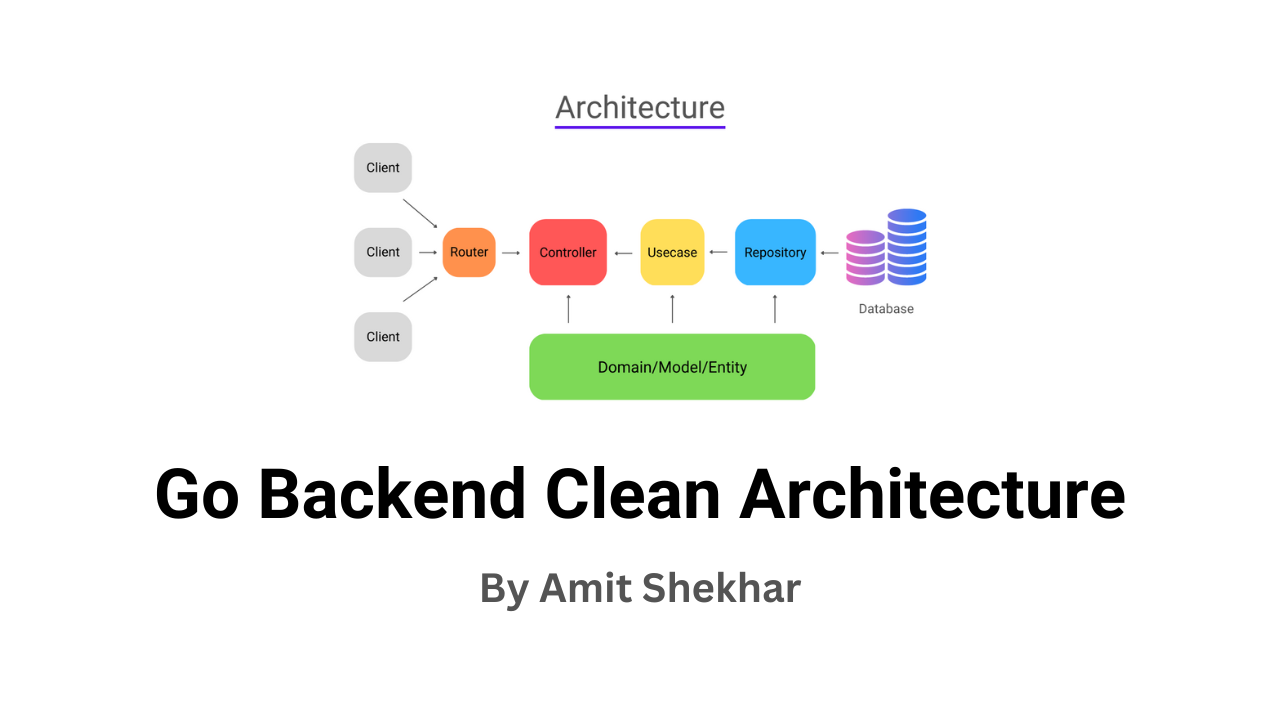
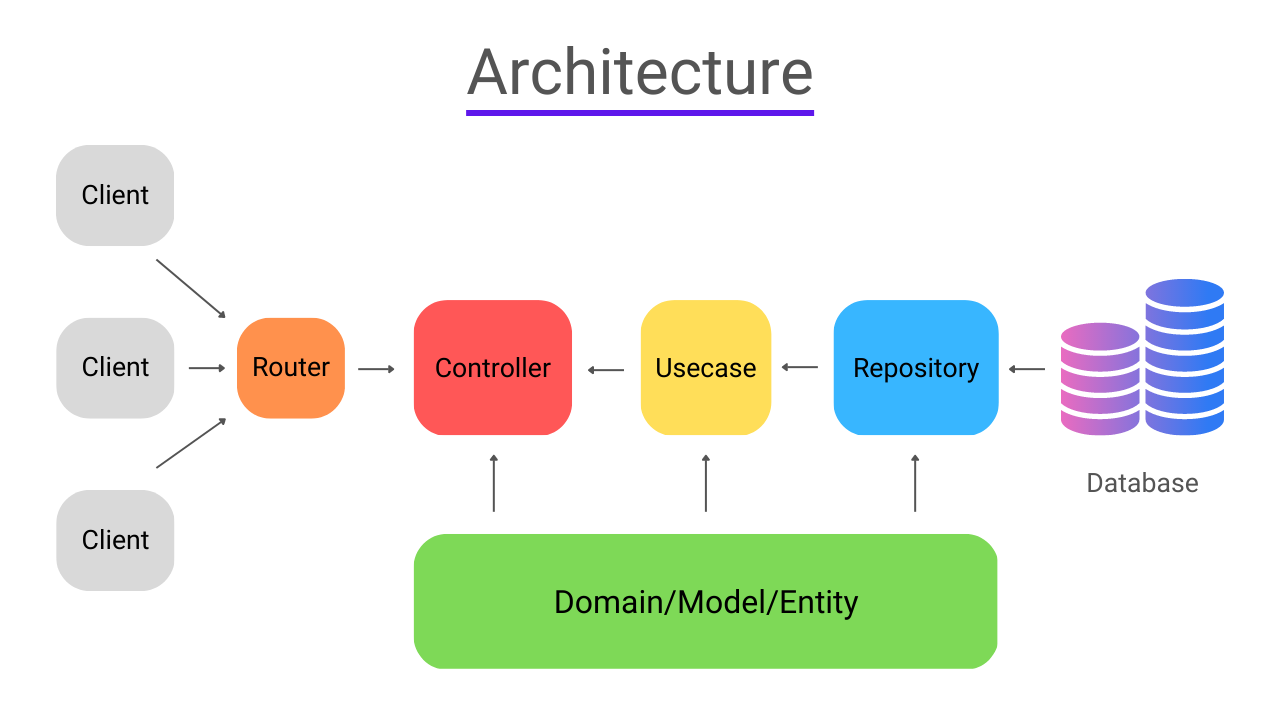
Appears to implement a textbook five-layer clean architecture: Router → Controller → Usecase → Repository → Domain. This separation of concerns is explicitly documented with diagrams. Likely enforces dependency inversion between layers, keeping domain logic free of framework and database dependencies. Based on README, the structure is suitable for medium-complexity APIs but may not demonstrate patterns for very large or distributed systems.
README explicitly mentions testing with Testify and Mockery for mock generation, and links to a dedicated blog post on testing. Test coverage percentage is not documented in README, but the presence of mockery integration suggests interface-based unit testing of use cases and repositories is likely supported.
Last push was February 5, 2026 — approximately 4.5 months before the evaluation date. This indicates the project is actively maintained, though update frequency appears moderate. Given it is a reference template rather than a production library, infrequent pushes are not inherently a quality concern. No evidence of unresolved critical issues from README.
ADOPT IF: you are starting a Go backend API project using Gin and MongoDB and want a structured, well-documented starting point with JWT auth and testing patterns already wired in. AVOID IF: you need a different database (PostgreSQL, etc.), a production-grade framework with active support guarantees, or require patterns for microservices, event-driven, or distributed architectures beyond what a REST API template covers. MONITOR IF: you are evaluating it for team-wide use as a standard — check whether the maintainer continues active development and whether the community around it matures into a more formal boilerplate ecosystem.
Independent dimensions
Mainstream potential
3/10
Technical importance
5/10
Adoption evidence
3/10
- MongoDB-only persistence layer limits applicability for teams using relational databases without significant refactoring.
- Positioned primarily as a learning tool tied to one creator's content ecosystem (Outcome School), which introduces single-maintainer bus factor risk.
- Star growth has flattened (~4/week), suggesting the project may not attract enough new contributors to evolve beyond its current feature set.
- No documented SLA, versioning policy, or migration path — adopting it as a production template means teams own all future maintenance.
- The Go clean architecture space is fragmented with multiple competing templates (evrone, eddycjy, etc.), making standardization around any single project unlikely.
Likely to remain a stable, niche-popular learning resource within the Go ecosystem, maintained by its author at a low cadence. Unlikely to become the canonical Go architecture template given market fragmentation and MongoDB specificity.
Newsletter
Get analyses like this every Monday
Free weekly digest of the most interesting open-source discoveries.
Languages
Information
- Language
- Go
- License
- Apache-2.0
- Last updated
- 5mo ago
- Created
- 43mo ago
- Analyzed with
- anthropic/claude-haiku-4-5
Stars over time
Contributors over time
Top 100 contributors only — repos with more will plateau at 100.
Open issues
Top contributors
Recent releases
No releases published yet.
Similar repos

evrone/go-clean-template
Go Clean Template is a well-structured reference implementation of Clean...

eddycjy/go-gin-example
A production-ready RESTful blog API example built with Go and Gin framework...

jasontaylordev/CleanArchitecture
Clean Architecture Solution Template is a professional .NET template for...
| Repository | Stars | Week Δ | Language | Score | Updated |
|---|---|---|---|---|---|
|
amitshekhariitbhu/go-backend-clean-architecture
this
|
6.1k | +9 | Go | 7/10 | 5mo ago |
|
evrone/go-clean-template
|
7.6k | — | Go | 8/10 | 1d ago |
|
eddycjy/go-gin-example
|
7.2k | — | Go | 7/10 | 4mo ago |
 gin-gonic/gin gin-gonic/gin
|
88.9k | — | Go | 9/10 | 2w ago |
|
jasontaylordev/CleanArchitecture
|
20.3k | — | C# | 8/10 | 1w ago |
 ardalis/CleanArchitecture ardalis/CleanArchitecture
|
18.3k | — | C# | 8/10 | 3d ago |
Has more stars (7.6k) and is slightly more opinionated with a project-generation focus. Less tied to a specific database (MongoDB). More mature community around it. This project differentiates through richer documentation and accompanying blog/video content.
Older, more tutorial-focused Gin example project (7.2k stars). Less architecturally structured — more of a feature showcase than a clean architecture blueprint. Serves a similar learning audience but different depth of architectural guidance.
Not a direct competitor — Gin is the underlying HTTP framework used here. This project sits one layer of abstraction above Gin, providing architectural scaffolding that Gin itself does not prescribe.
The dominant clean architecture reference in .NET/C# space (20k+ stars). Functionally analogous in purpose but for a different language ecosystem. Its scale of adoption sets an aspirational ceiling for Go equivalents, which remain more fragmented.
Another mature C# clean architecture template with strong community. Comparison highlights that Go clean architecture templates collectively have not consolidated around a single canonical project, leaving room for this repo but also limiting its ceiling.