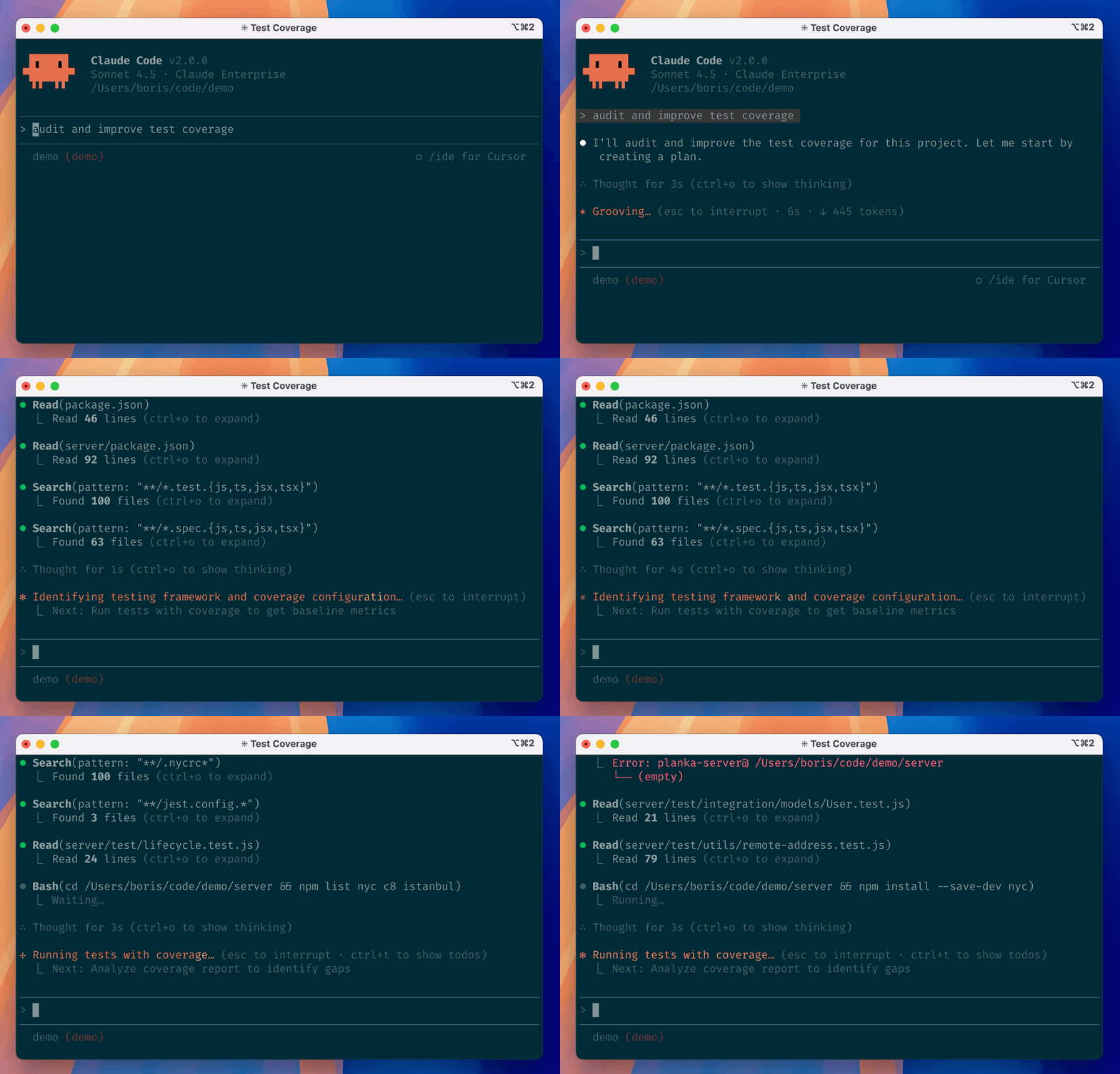
Claude Code is an agentic coding tool that lives in your terminal, understands your codebase, and helps you code faster by executing routine tasks, explaining complex code, and handling git workflows - all through natural language commands.
137.2k
Stars
22.2k
Forks
10.9k
Open issues
53
Contributors


AI Analysis
Claude Code is an agentic, terminal-based coding assistant developed by Anthropic that integrates with your codebase to execute tasks, explain code, manage git workflows, and respond to natural language commands directly in the shell or IDE. It serves software developers who want an AI pair-programmer tightly coupled to their local environment, with support across macOS, Linux, and Windows. It is not a general-purpose chat interface or a library/framework for building AI tools — it is a ready...
Inferred from signals mentioned in the README (tests, CI, type safety) — not a review of the actual code.
AI's overall editorial judgment — not an average of the bars above, can weigh other factors too.
Anthropic's terminal-based agentic coding assistant gains 133K stars in 16 months
Claude Code is an agentic coding CLI built by Anthropic that enables developers to interact with their codebase, run git workflows, explain code, and execute tasks through natural language. It is positioned as a first-party tool from the Claude model maker, targeting professional developers who prefer terminal-native workflows or want deep IDE integration. With 133K stars, active npm distribution (now transitioning to native installers), and a rich ecosystem of community projects orbiting it, real-world adoption appears substantial and growing.
Created in February 2025 as Anthropic's direct answer to AI coding assistants, it began as an npm package and has since matured to native OS installers (Homebrew, WinGet, shell scripts), signaling a shift from developer experiment to production-grade product.
Explosive early growth likely driven by Anthropic's brand credibility, the general AI coding assistant boom of 2025, and community enthusiasm evidenced by a 47K-star 'awesome-claude-code' list and 28K-star template repo. Sustained 1,195 stars/week as of evaluation date indicates the tool remains in active public attention, not a fading spike.
The ecosystem of derivative repos (47K-star awesome list, 28K-star templates, 8K-star GitHub Actions integration) strongly implies real-world production usage beyond experimentation. npm package history and native OS package manager presence (Homebrew, WinGet) suggest developer adoption at scale. Quantified installation figures are not publicly disclosed, but proxy signals are strong.
Appears to be a Node.js 18+ CLI tool (badge references Node.js despite Python listed as repo language, suggesting the installable artifact is Node-based while repo infrastructure may use Python). Likely follows an agent loop pattern: reads codebase context, calls Claude API, executes shell/git commands, and iterates. Plugin system is documented, suggesting a modular extension architecture.
Not documented in README
Last push June 19, 2026 — one day before evaluation date — indicates very active, near-daily maintenance. As a first-party Anthropic product with official docs at code.claude.com, maintenance is structurally supported by the company, not volunteer effort.
ADOPT IF: you are already using Claude API or Claude Pro and want a terminal-native agentic workflow with official Anthropic support and active development. AVOID IF: you require model flexibility, open-source licensing, or a self-hosted solution — Claude Code is proprietary and API-cost-dependent. MONITOR IF: you're evaluating AI coding tools for team or enterprise use and want to see how the plugin ecosystem and GitHub Actions integration mature before committing.
Independent dimensions
Mainstream potential
8/10
Technical importance
8/10
Adoption evidence
7/10
- Proprietary and model-locked: Claude Code only works with Anthropic's Claude models, creating cost and vendor dependency that open-source alternatives do not impose.
- API cost exposure: Agentic loops that read large codebases and iterate can generate significant token consumption, making costs unpredictable for heavy users or large repos.
- Data privacy: Code and conversation data are collected per the README; teams with strict IP or compliance requirements may find the data usage policy incompatible with their policies.
- Competitive saturation: The AI coding assistant space is crowded with well-funded alternatives; differentiation may erode as Copilot, Cursor, and others match agentic capabilities.
- License not disclosed: The repository lists 'unknown' license, which creates legal ambiguity for organizations that need to formally evaluate open-source license compliance.
Likely to consolidate as the preferred terminal-native AI coding tool for Anthropic ecosystem users, with continued growth tied directly to Claude's overall market share trajectory through 2026-2027.
Newsletter
Get analyses like this every Monday
Free weekly digest of the most interesting open-source discoveries.
Languages
Information
- Language
- Python
- Last updated
- 12h ago
- Created
- 17mo ago
- Analyzed with
- anthropic/claude-sonnet-4-6
Stars over time
Contributors over time
Top 100 contributors only — repos with more will plateau at 100.
Open issues
[BUG] Japanese text renders with Simplified Chinese glyphs (Han unification issue) in Claude Desktop for macOS
Claude in Chrome never connects to Claude Code CLI — list_connected_browsers returns [] / "Browser extension is not connected" despite matching account and full Chrome restart
[Bug] Anthropic API Error: Unintended safety flag on non-cybersecurity code audit request
[Feature Request] Label, group, and prioritise sessions in the agents view — with a maintained top-priority list
Feature request: smooth/paced text reveal in fullscreen TUI instead of instant chunk rendering
Top contributors
Similar repos

codeaashu/claude-code
Claude Code is Anthropic's official CLI tool for interacting with Claude from...

Cranot/claude-code-guide
This is a comprehensive, auto-updated CLI guide and reference for Claude Code,...
anthropics/claude-code-action
Claude Code Action is a GitHub Actions workflow automation tool that integrates...
| Repository | Stars | Week Δ | Language | Score | Updated |
|---|---|---|---|---|---|
|
anthropics/claude-code
this
|
137.2k | +1.5k | Python | 8/10 | 12h ago |
 tanbiralam/claude-code tanbiralam/claude-code
|
2k | — | TypeScript | 7/10 | 2mo ago |
|
codeaashu/claude-code
|
3.1k | — | TypeScript | 6/10 | 3mo ago |
|
Cranot/claude-code-guide
|
2.8k | — | Shell | 8/10 | 5mo ago |
|
anthropics/claude-code-action
|
8.3k | — | TypeScript | 8/10 | 14h ago |
 davila7/claude-code-templates davila7/claude-code-templates
|
28.6k | — | Python | 7/10 | 9h ago |
Copilot is more deeply embedded in VS Code and has Microsoft/GitHub distribution advantages. Claude Code differentiates on terminal-first workflow, longer context handling, and direct Anthropic model access without intermediary. Copilot has significantly larger measured install base.
Cursor is an IDE fork (VS Code-based) targeting the editor experience. Claude Code targets terminal-native developers and CI/CD pipelines. They serve overlapping but distinct workflows; Cursor has strong IDE adoption, Claude Code has stronger CLI/automation appeal.
Aider is an open-source, model-agnostic CLI coding assistant with a longer track record. Claude Code is model-locked to Claude but benefits from first-party optimization and support. Aider's open-source nature appeals to self-hosters; Claude Code appeals to those already paying for Claude API or Pro.
Amazon Q Developer CLI is a comparable terminal-native AI coding tool backed by AWS. Claude Code has higher community visibility and star momentum; Q Developer benefits from AWS enterprise reach and IAM integration.
Cline is an open-source VS Code extension supporting multiple models including Claude. It overlaps significantly in agentic task execution but lives inside an IDE. Claude Code targets the terminal and is closed-source but officially maintained.