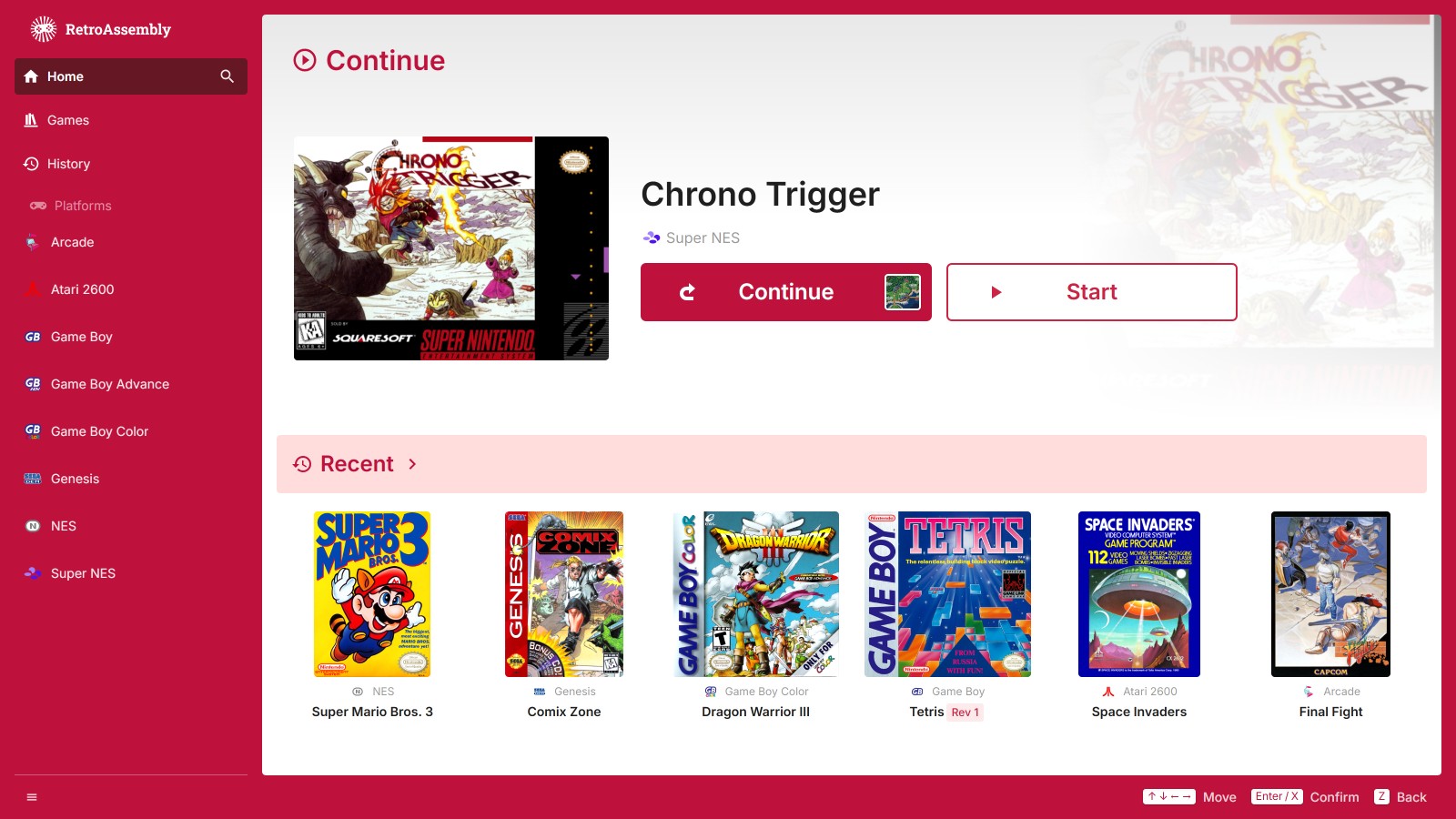
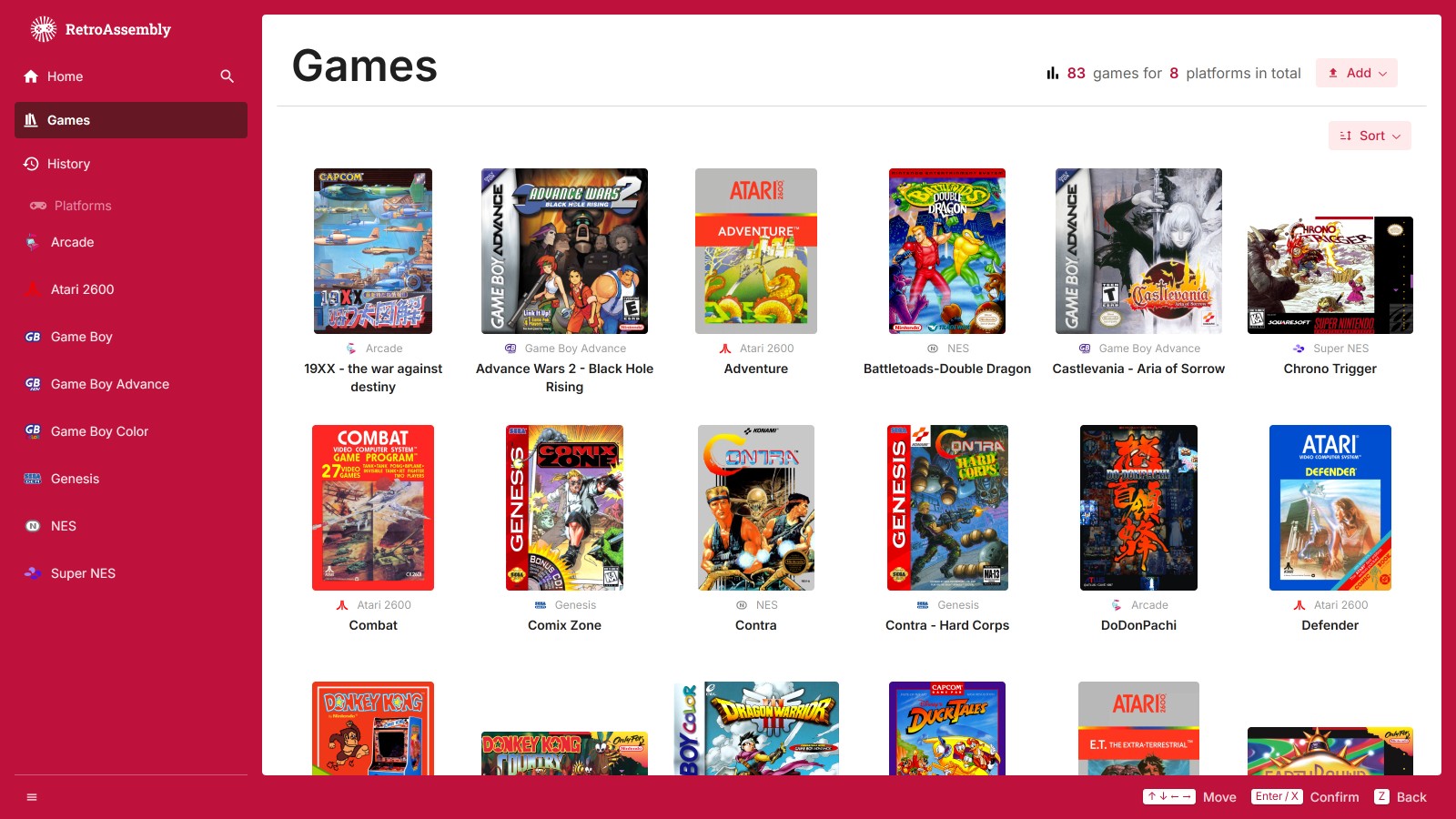
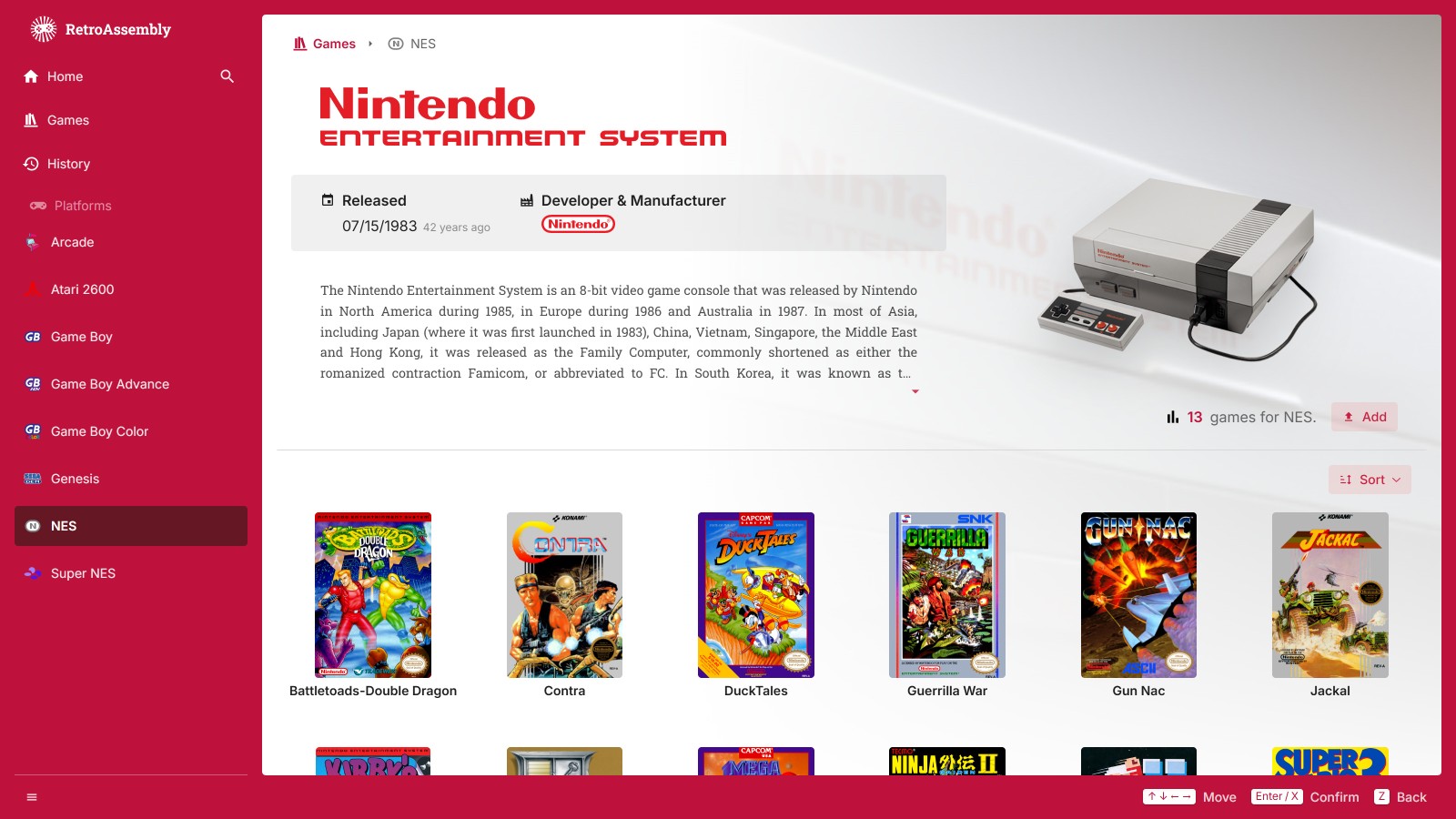
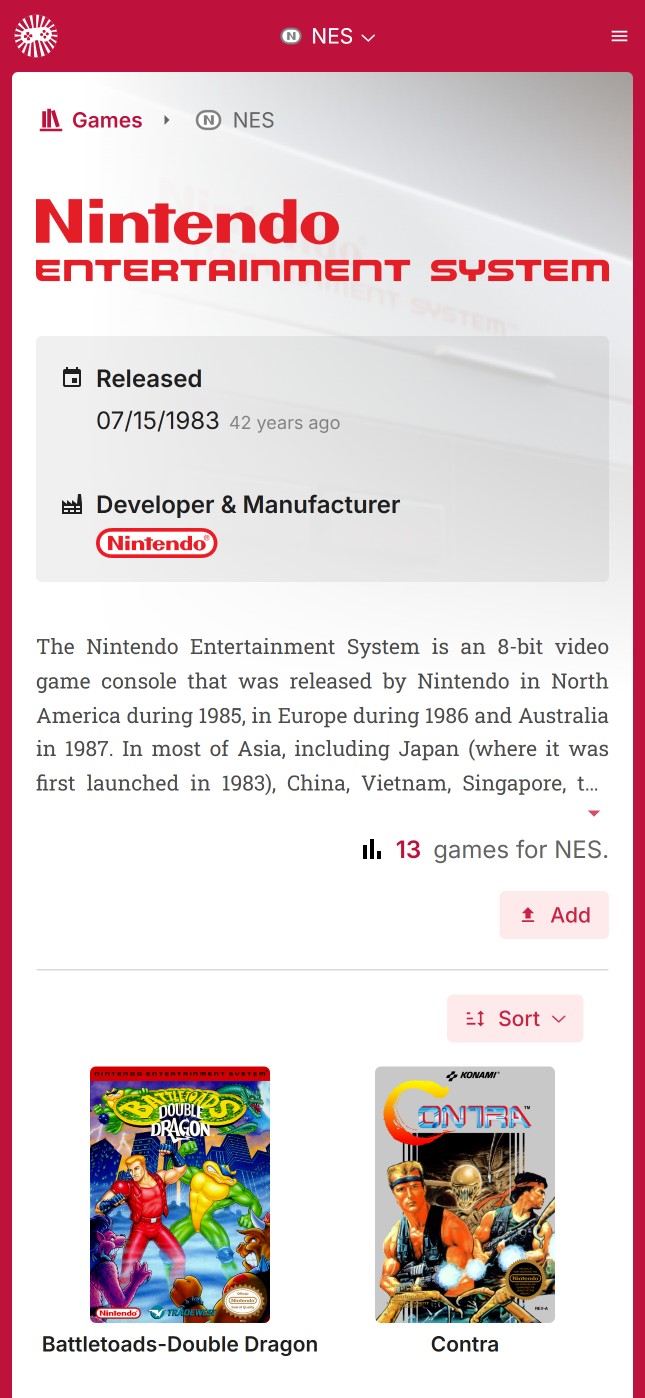
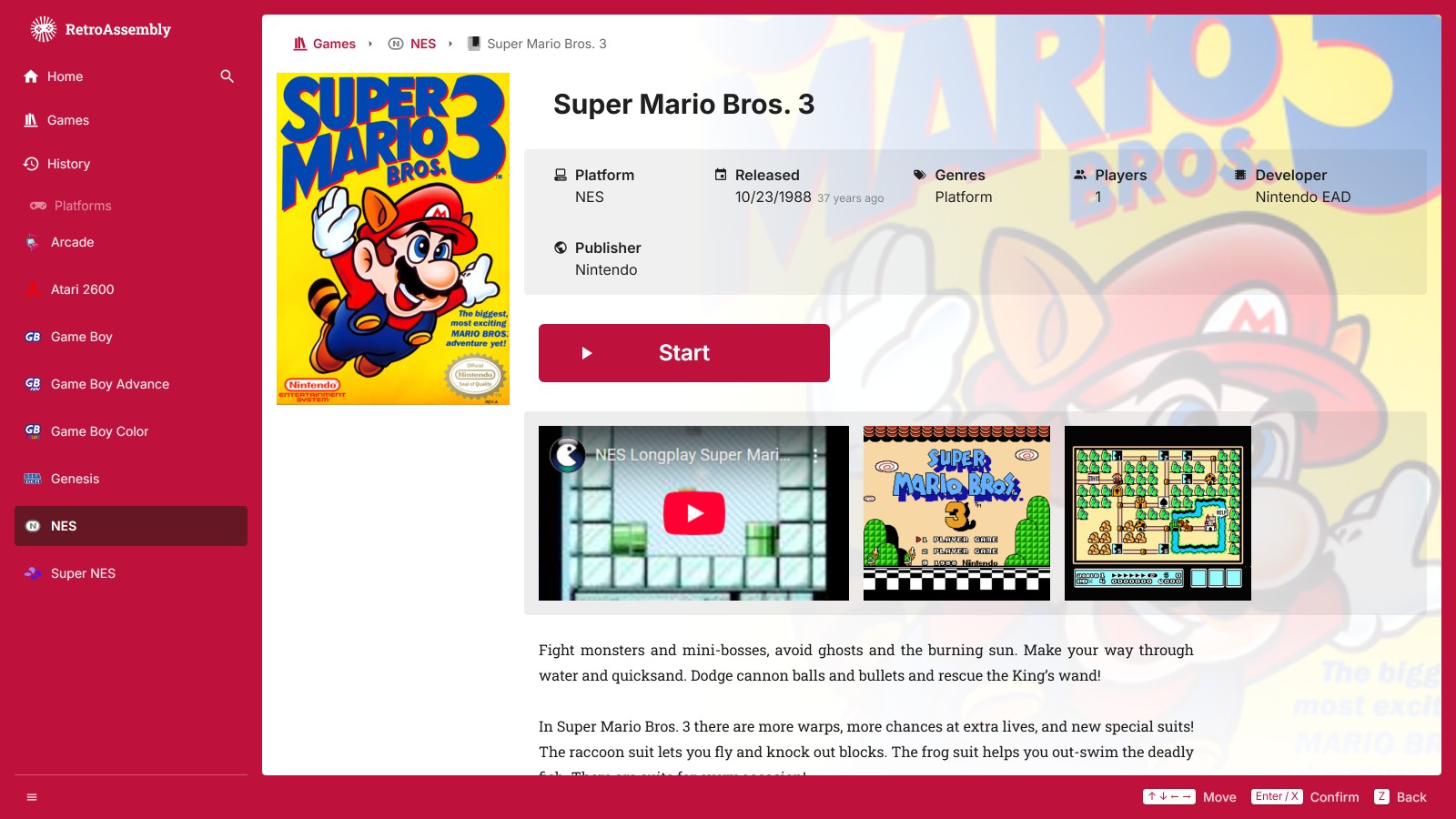
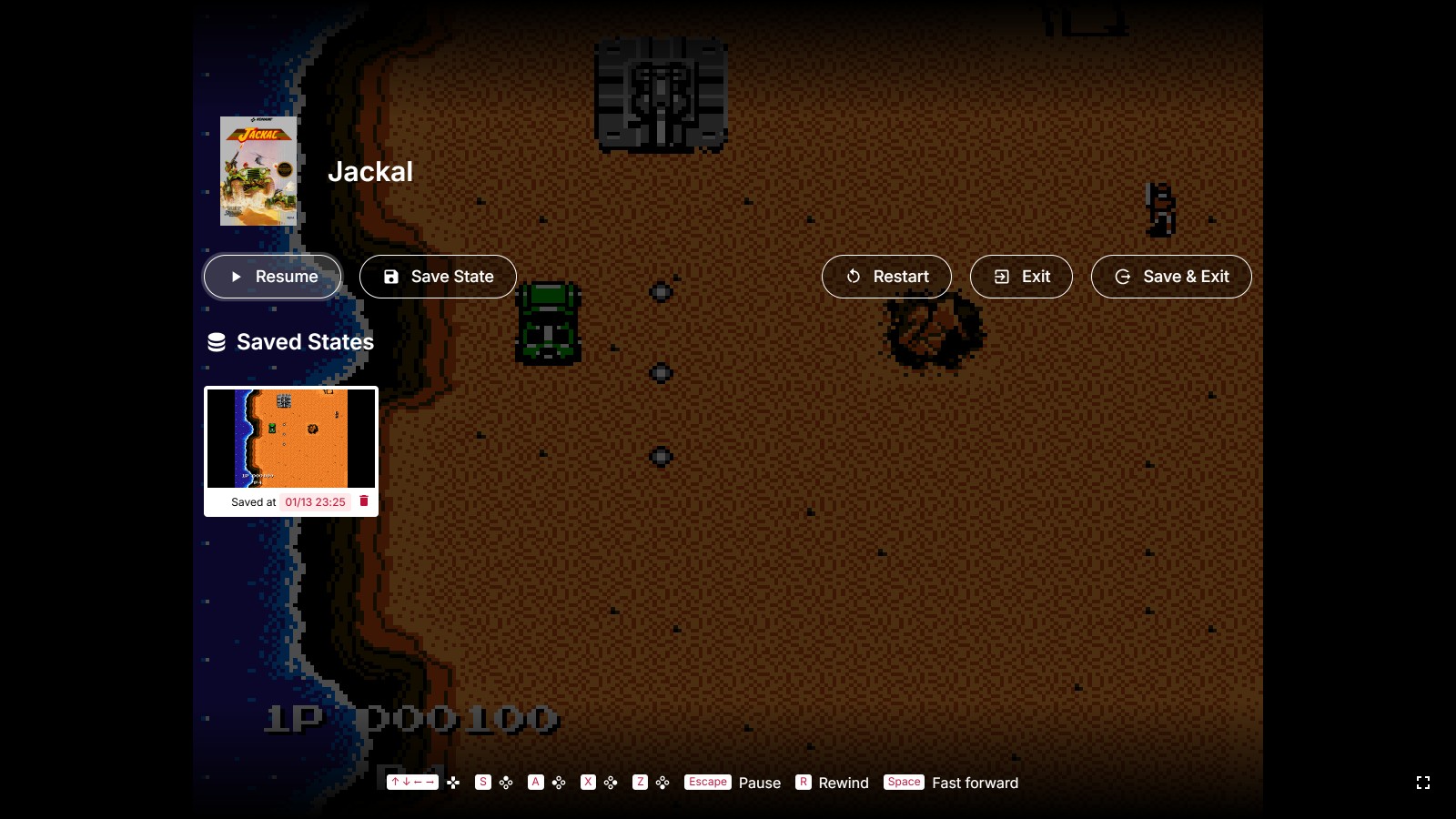
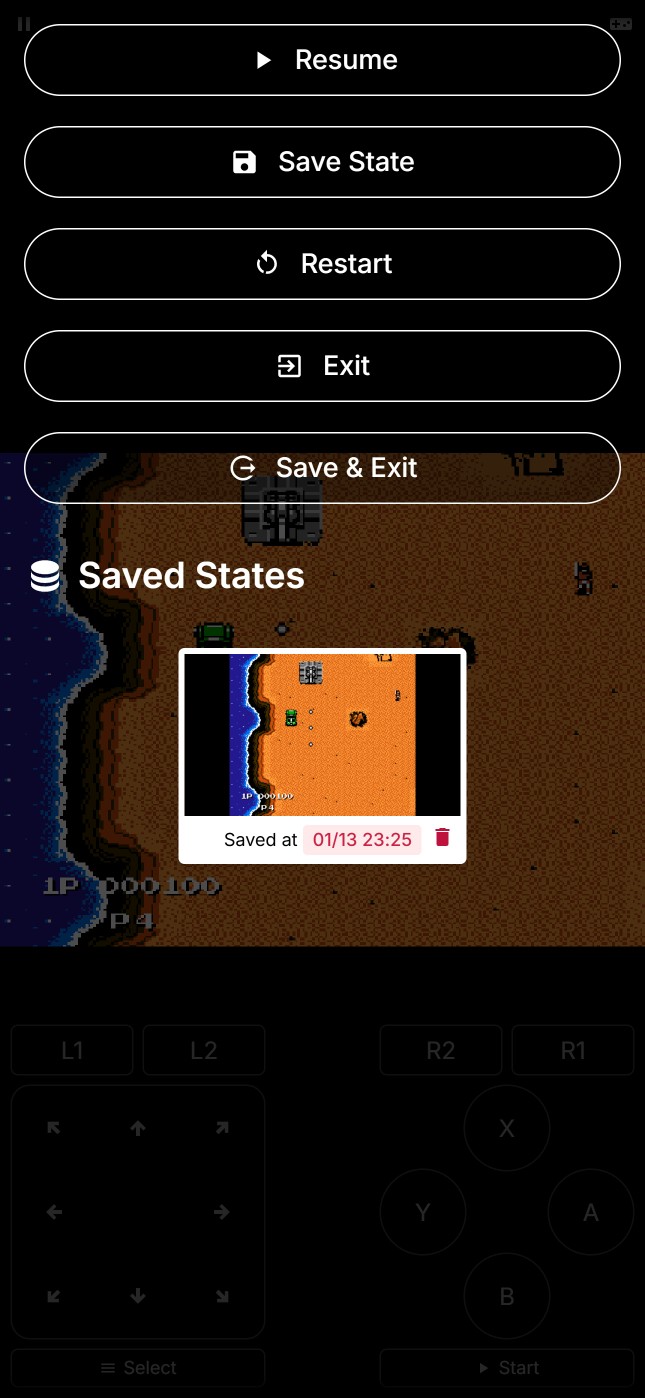
The personal retro game collection cabinet in your browser. Join us on Discord https://discord.gg/gwaKRAYG6t
1k
Stars
50
Forks
8
Open issues
5
Contributors


AI Analysis
RetroAssembly is a browser-based retro game emulator collection platform that lets users organize, play, and manage games from classic consoles (NES, SNES, Genesis, Game Boy, etc.) directly in the web browser with save synchronization and gamepad support. It is purpose-built for retro gaming enthusiasts who want a polished, web-accessible alternative to traditional emulator setups, and is not suitable for users seeking modern gaming or those without interest in classic platforms.
Inferred from signals mentioned in the README (tests, CI, type safety) — not a review of the actual code.
AI's overall editorial judgment — not an average of the bars above, can weigh other factors too.
Browser-based retro game collection manager with multi-platform emulation and cloud sync
RetroAssembly is a web frontend for organizing and playing retro games (NES, SNES, Genesis, GameBoy, Arcade) in the browser, with save synchronization, spatial navigation gamepad support, and shader filters. Built for casual retro enthusiasts who want a visual library interface rather than a pure emulator. The project has modest but active adoption—around 1,000 GitHub stars, Docker deployments, and a Discord community—and serves users seeking an accessible cabinet-like experience without heavy local setup.
Created April 2023 by arianrhodsandlot, RetroAssembly emerged in the mature web-based emulation space (EmulatorJS, webrcade existed prior). The project positions itself as a collection manager and social experience layer rather than an emulator engine builder, delegating core emulation to existing libraries.
14 stars in the last 7 days (relative to 2026-07-08) suggests modest ongoing adoption. The project has remained actively maintained with a push 2 days before the evaluation date. Growth appears driven by word-of-mouth in retro gaming communities rather than viral adoption. Docker Hub presence and Discord community indicate small but engaged user base, not explosive growth.
Docker Hub image availability with pull count tracking suggests some production deployment. Official hosted version at retroassembly.com indicates user-facing service. Discord community channel mentioned in README suggests active user communication. However, concrete metrics on user count, DAU, or enterprise deployment are not documented. Adoption appears limited to hobbyist/enthusiast segment.
TypeScript-based web application. Appears to wrap or integrate existing emulation engines (README mentions support for NES, SNES, Genesis, GameBoy, Arcade but does not detail emulator sources). Likely uses browser storage or cloud backend for save synchronization. Frontend emphasizes spatial navigation and gamepad UX. Architecture details beyond UI layer are not documented in the README.
Not documented in README.
Last push 2026-07-06, two days before evaluation date, indicates active maintenance. Repository created 2023-04-13, approximately 3 years old at evaluation time. Sustained activity over 3 years suggests the project is actively developed, not abandoned. No evidence of rapid iteration or major refactors from metadata alone.
ADOPT IF: you want a polished, accessible web-based frontend for managing and playing your existing ROM collection with cloud save sync, have a Discord community for peer support, and prefer cabinet-like UI over raw emulator interfaces. AVOID IF: you need bleeding-edge emulation accuracy, require offline-first architecture, or demand extensive technical customization and in-source documentation. MONITOR IF: you are evaluating whether to migrate from a desktop emulator setup to web-based gaming—RetroAssembly is mature enough to try but still a specialized tool, not a universal replacement.
Independent dimensions
Mainstream potential
3/10
Technical importance
5/10
Adoption evidence
4/10
- Adoption appears limited to enthusiast segment; mainstream awareness unknown. Growth trajectory is steady but modest, raising questions about long-term project momentum.
- Emulation quality and accuracy depend on underlying engine choice, which is not detailed in README. Unclear which emulators are used (BIOS requirements, accuracy tier, etc.).
- Cloud synchronization and save management architecture not documented. Security model, encryption, data retention, and privacy policy are not visible in README.
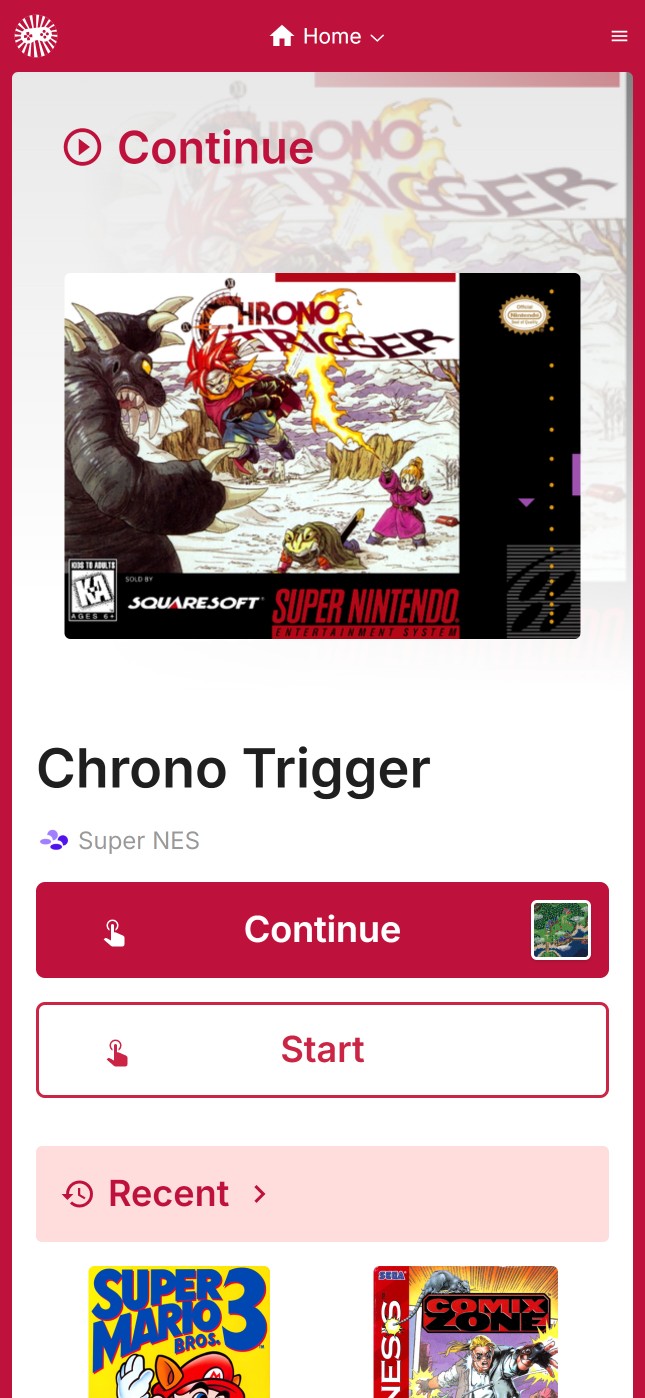
- Spatial navigation and gamepad UX are strengths but may alienate keyboard-only users on desktop. Mobile experience appears limited based on screenshot aspect ratios.
- Dependency on retroassembly.com hosted service for authentication/sync means self-hosting may require forking or running behind proxy. Lock-in risk to single provider unless Docker setup is transparent.
RetroAssembly will likely remain a niche but sustainable project for the retro gaming enthusiast community. Slow, steady growth is probable; mainstream breakout (competing with Nintendo Switch Online or official re-releases) is unlikely due to ROM legality concerns and positioning as a community tool rather than a commercial product. Active maintenance suggests it will not fade within 12–24 months.
Newsletter
Get analyses like this every Monday
Free weekly digest of the most interesting open-source discoveries.
Languages
Information
- Website
- https://retroassembly.com
- Language
- TypeScript
- License
- MIT
- Last updated
- 4d ago
- Created
- 39mo ago
- Analyzed with
- anthropic/claude-haiku-4-5
Stars over time
Contributors over time
Top 100 contributors only — repos with more will plateau at 100.
Open issues
Possibility to change menu keybindings (like pause)
[Feature Request] OIDC SSO Support
Sound Problem
Allow Picodrive to be used for genesis emulation on low end hardware.
feat: persist emulator speed setting per core/game
Open pull requests
No open pull requests.
Top contributors
Similar repos

EmulatorJS/EmulatorJS
EmulatorJS is a self-hosted JavaScript library for running legacy console and...
| Repository | Stars | Week Δ | Language | Score | Updated |
|---|---|---|---|---|---|
|
arianrhodsandlot/retroassembly
this
|
1k | +14 | TypeScript | 8/10 | 4d ago |
|
EmulatorJS/EmulatorJS
|
4k | — | JavaScript | 7/10 | 2w ago |
 JMBeresford/retrom JMBeresford/retrom
|
2k | — | TypeScript | 7/10 | 2d ago |
 aduros/wasm4 aduros/wasm4
|
1.5k | — | TypeScript | 7/10 | 1d ago |
 webrcade/webrcade webrcade/webrcade
|
1.3k | — | JavaScript | 7/10 | 6d ago |
 giongto35/cloud-game giongto35/cloud-game
|
2.5k | — | Go | 7/10 | 4d ago |
3,969 stars vs. 1,014; similar web-based approach. EmulatorJS appears to focus more on pure emulation library; RetroAssembly emphasizes collection management and social features. RetroAssembly likely easier for non-technical users to organize existing ROMs.
1,998 stars vs. 1,014; also TypeScript-based collection manager. RetroAssembly appears more UI-polished; retrom may offer more backend flexibility. Feature parity is likely high.
1,266 stars vs. 1,014; another web emulation frontend. webrcade emphasizes network play; RetroAssembly emphasizes single-player collection experience and visual cabinet aesthetics.
2,460 stars; focuses on cloud streaming architecture rather than client-side browser emulation. Different architectural approach and use case (streaming vs. local browser execution).
1,496 stars; fantasy console for game development, not a collection manager. Orthogonal to RetroAssembly's use case.