Node.js test runner that lets you develop with confidence 🚀
20.8k
Stars
1.5k
Forks
65
Open issues
30
Contributors



AI Analysis
AVA is a Node.js test runner designed for concurrent test execution with a minimal API, strong assertion messages, and ES module support. It serves developers building modern JavaScript applications who want atomic, isolated tests with fast parallel execution. It is NOT for teams requiring deep legacy test integration or those preferring traditional sequential testing paradigms.
Inferred from signals mentioned in the README (tests, CI, type safety) — not a review of the actual code.
AI's overall editorial judgment — not an average of the bars above, can weigh other factors too.
AVA: concurrent Node.js test runner built for speed and test isolation
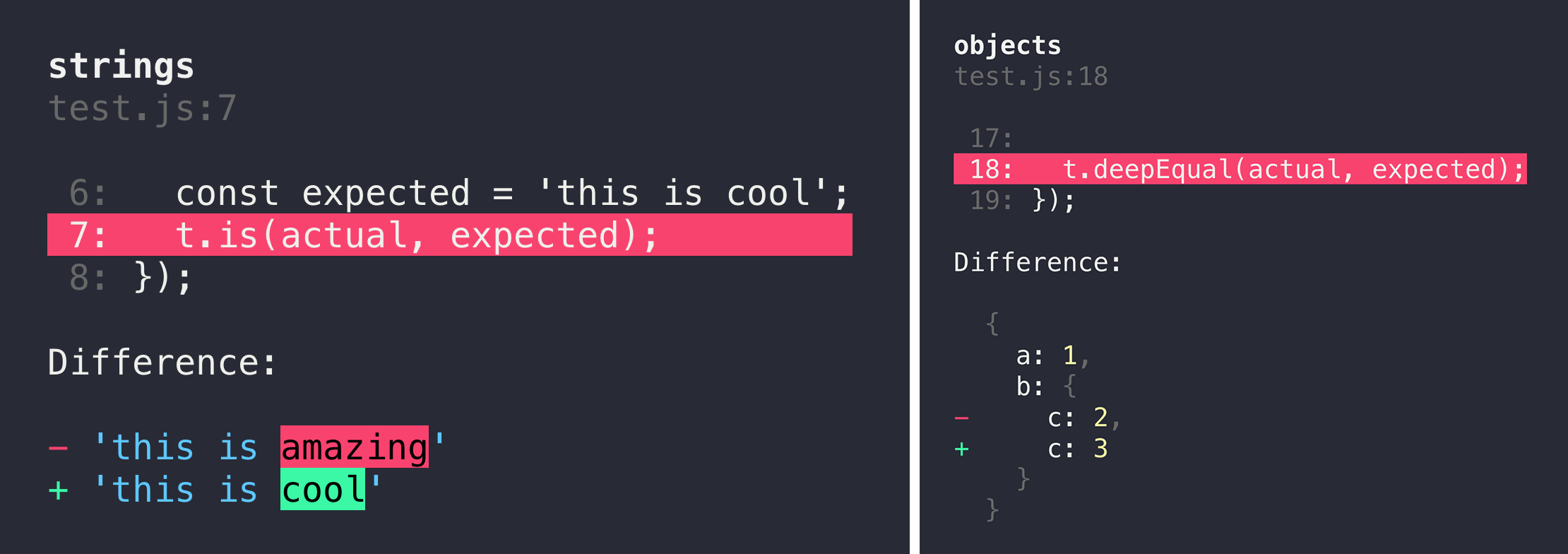
AVA is a Node.js test runner that executes test files concurrently in isolated worker threads, enforcing atomic, side-effect-free tests. It targets Node.js developers who want faster CI feedback and cleaner test discipline. Key differentiators include concurrency-first design, built-in TypeScript definitions, 'magic assert' diffs, and no implicit globals. With ~20.8k stars and ~11 years of history, it has genuine adoption in the Node.js open source community, particularly among ESM-forward projects and tool authors. It competes in a crowded field alongside Mocha, Jest, and Node's built-in test runner.
Created in late 2014 by Sindre Sorhus and collaborators, AVA was an early advocate for concurrent test execution and ES module adoption in the Node.js testing space, predating many modern runners.
AVA grew rapidly from 2015–2018 by riding the wave of the Sindre Sorhus ecosystem and offering something meaningfully different: concurrency and strict isolation by default. Growth has plateaued — 1 star gained in the last 7 days signals a mature, stable project rather than one in active expansion. The rise of Jest's dominance and, more recently, Node.js's built-in test runner have compressed AVA's addressable market.
AVA is listed as a devDependency in a large number of open source npm packages, particularly in the Sindre Sorhus and related ecosystems. NPM download counts are publicly available but not cited in the README. Adoption appears concentrated in open source Node.js packages and ESM-first projects rather than large enterprise application test suites.
Likely uses worker threads or child processes to run each test file in an isolated environment, enforcing concurrency at the file level. The API appears intentionally minimal — tests are registered with a single import, assertions are built-in, and there are no implicit globals. Appears to support ESM natively, with TypeScript definitions bundled. Shared workers recipe suggests some inter-process communication abstraction exists.
not documented in README
Last push was 2026-06-17, approximately 8 days before the evaluation date — actively maintained. The project has been sustained for over 11 years, which is strong evidence of long-term commitment. README references ongoing Discussions for updates, suggesting an engaged maintainer posture.
ADOPT IF: you are building a Node.js library or ESM-first package and want fast, isolated test execution with minimal configuration and good TypeScript support out of the box. AVOID IF: you need deep Jest ecosystem compatibility, React component testing, or mocking utilities without additional dependencies — or if zero-dependency setups (node:test) are a hard requirement. MONITOR IF: you are evaluating AVA for a new project and want to track whether the maintainer keeps pace with Node.js LTS changes and whether Vitest's server-side execution story further narrows AVA's use case.
Independent dimensions
Mainstream potential
3/10
Technical importance
7/10
Adoption evidence
6/10
- The Node.js built-in test runner continues to mature and may satisfy the needs of developers who currently adopt AVA for its simplicity, eroding the addressable audience over time.
- Vitest's growing adoption in non-browser Node.js contexts represents direct competitive pressure from a faster-growing project with broader ecosystem momentum.
- Growth has effectively flatlined (1 star/week), meaning community mindshare and new adopter discovery may decline gradually even if the project remains technically sound.
- Concurrency-by-default, while a strength for speed, can introduce hard-to-debug flakiness when tests share external resources (databases, files), creating friction for teams unfamiliar with isolation requirements.
- Sindre Sorhus ecosystem dependency: a significant portion of AVA's adoption is tied to packages in this specific orbit; broader enterprise or framework-driven adoption appears limited.
AVA is likely to remain a well-maintained, stable niche tool used primarily by ESM-forward Node.js library authors. It is unlikely to recapture broad growth but also unlikely to be abandoned given its active maintenance history.
Explore similar
Newsletter
Get analyses like this every Monday
Free weekly digest of the most interesting open-source discoveries.
Languages
Information
- Language
- JavaScript
- License
- MIT
- Last updated
- 3w ago
- Created
- 142mo ago
- Analyzed with
- anthropic/claude-haiku-4-5
Stars over time
Contributors over time
Top 100 contributors only — repos with more will plateau at 100.
Top contributors
Recent releases
Similar repos
| Repository | Stars | Week Δ | Language | Score | Updated |
|---|---|---|---|---|---|
|
avajs/ava
this
|
20.8k | +1 | JavaScript | 8/10 | 3w ago |
 mochajs/mocha mochajs/mocha
|
23k | — | JavaScript | 9/10 | 1d ago |
 ajv-validator/ajv ajv-validator/ajv
|
14.8k | — | TypeScript | 9/10 | 2mo ago |
 jasmine/jasmine jasmine/jasmine
|
15.8k | — | JavaScript | 8/10 | 6d ago |
 chaijs/chai chaijs/chai
|
8.3k | — | JavaScript | 8/10 | 1d ago |
 AvaloniaUI/Avalonia AvaloniaUI/Avalonia
|
31.1k | — | C# | 8/10 | 15h ago |
Jest is far more widely adopted, especially in React/frontend ecosystems. It ships with mocking, coverage, and a large plugin ecosystem. AVA's advantage is stricter isolation, simpler API, and better ESM support historically. Jest has been slower to adopt ESM natively.
The built-in runner, available since Node 18, requires zero dependencies and has narrowed AVA's installation-simplicity argument. However, AVA still offers better assertion ergonomics, magic diffs, and concurrency controls out of the box.
Mocha is older, more flexible, and more widely adopted in enterprise contexts. It requires external assertion and mocking libraries. AVA's concurrent-by-default model contrasts with Mocha's sequential default, offering faster test suites at the cost of some setup friction.
Vitest has rapidly become the dominant choice for Vite-based and modern frontend projects. It offers Jest-compatible APIs, ESM support, and fast execution. For Node.js-only projects, AVA remains a viable alternative, but Vitest is capturing much of the modern tooling momentum.
Jasmine is a BDD-style framework with a longer history and broad use in Angular ecosystems. It runs synchronously by default and lacks AVA's concurrency model. The two rarely compete directly for the same adopters.