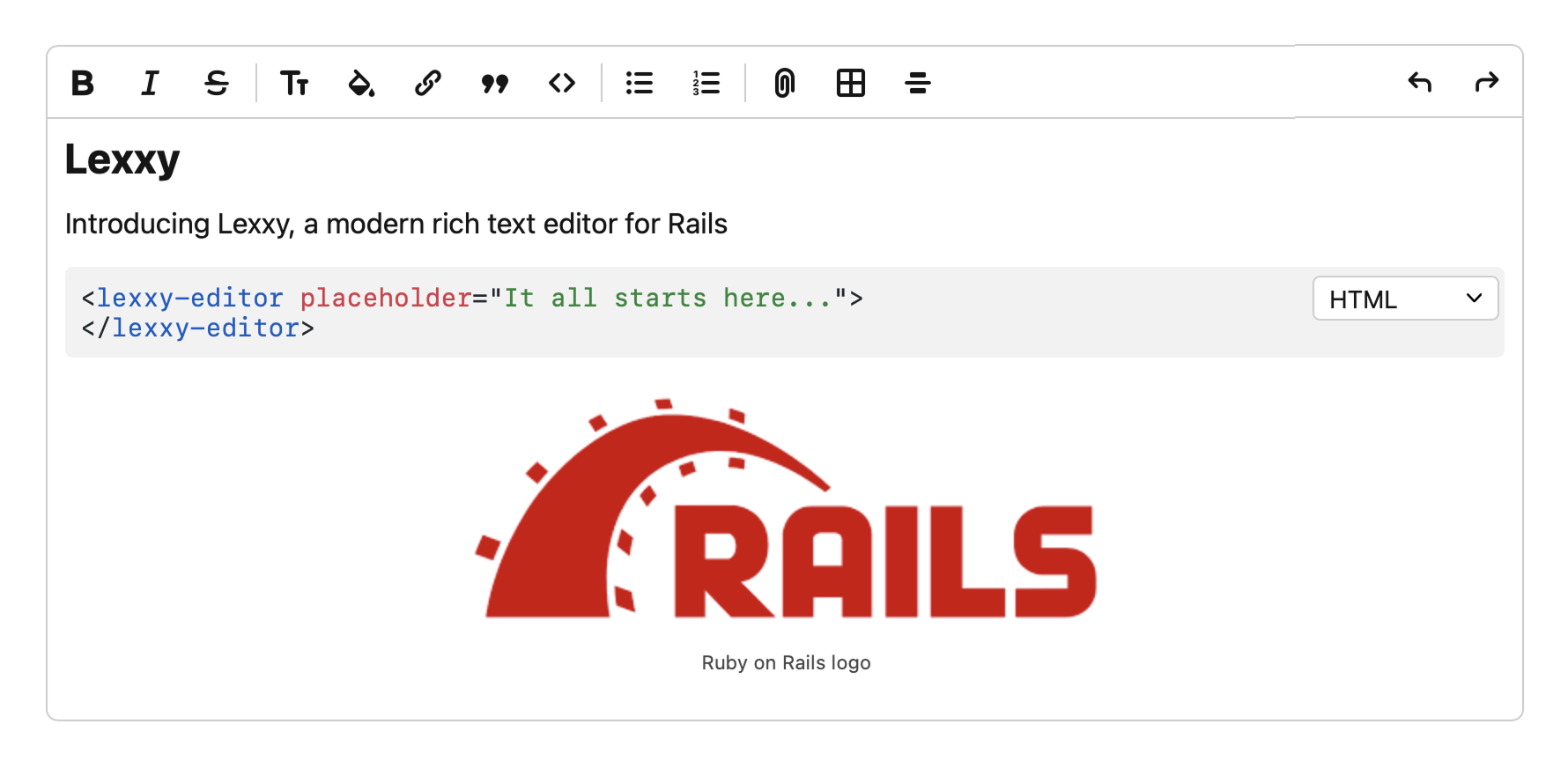
A modern rich text editor for Rails.
1.1k
Stars
106
Forks
75
Open issues
30
Contributors



AI Analysis
Lexxy is a modern rich text editor for Rails applications built on Meta's Lexical framework, offering features like Markdown support, syntax highlighting, and seamless Action Text integration. It serves Rails developers who need to embed sophisticated text editing capabilities directly into their web applications. It is not a general-purpose editor for end users—it is a developer library for building Rails-based applications with rich text input.
Inferred from signals mentioned in the README (tests, CI, type safety) — not a review of the actual code.
AI's overall editorial judgment — not an average of the bars above, can weigh other factors too.
Rails-native rich text editor built on Meta's Lexical, 14 months old with modest early adoption
Lexxy is a rich text editor designed specifically for Rails applications, built atop Meta's Lexical framework. It targets Rails developers seeking modern editor UX with semantic HTML and Action Text integration. The project is maintained by Basecamp and launched May 2025. Adoption appears limited to early adopters and Rails-focused organizations; real-world production usage is not documented. Active development continues, though the project remains pre-1.0.
Lexxy emerged in May 2025 as Basecamp's modern alternative to its own Trix editor (launched ~2015, 19,973 stars). Rather than replace Trix directly, Lexxy targets Rails developers wanting Lexical's architecture with Rails ecosystem integration. Basecamp has a track record shipping Rails-integrated tools, lending credibility to maintenance stability.
Lexxy gained ~1,144 stars over 14 months, averaging ~82 stars/month — modest but consistent. Recent weekly gain of 20 stars suggests stable, low-velocity interest rather than viral adoption. The project benefits from Basecamp's name recognition and explicit Rails positioning, attracting a defined audience rather than competing broadly. Growth appears correlated with Rails community awareness rather than external momentum.
Adoption not verified. No case studies, production deployments, or user testimonials are documented in README. Basecamp's own products likely use it internally, but external adoption is not publicly claimed or demonstrated. Sandbox environment available for trial, indicating effort to lower friction for evaluation.
Based on README: built as a JavaScript editor wrapping Meta's Lexical framework, designed for seamless Rails Action Text integration. Generates semantic HTML (real `<p>` tags) and supports Markdown shortcuts, syntax highlighting, configurable prompts, and media attachments. Likely implements as a Rails gem + JavaScript component, though implementation details are not visible in README.
Not documented in README. CI badge present (GitHub Actions workflow exists), suggesting automated testing is configured, but coverage metrics and test strategy are not described.
Last push 2026-07-09 (1 day before analysis date) indicates active ongoing work. GitHub Issues visible with 'Help Wanted' tags, suggesting maintainers engage with contributors. Project is 14 months old, pre-1.0 status implies ongoing API/feature stabilization. Maintenance appears consistent and responsive rather than dormant, though this is a young project.
ADOPT IF: you are building Rails applications with Action Text integration, value semantic HTML and modern UX, and are comfortable adopting a pre-1.0 tool with limited production validation. Early Basecamp backing suggests reasonable stability likelihood. AVOID IF: you require battle-tested editor with extensive production case studies, need multi-framework support, or operate under strict stability constraints with no appetite for API changes. MONITOR IF: you are tracking Rails editor landscape but can defer adoption 6–12 months until production usage patterns and stability are clearer.
Independent dimensions
Mainstream potential
4/10
Technical importance
6/10
Adoption evidence
2/10
- Pre-1.0 status means API and behavior may change; early adopters may face migration work.
- Adoption not verified outside Basecamp; production reliability and edge-case handling unknown.
- Dependency on Meta's Lexical framework — if Lexical changes direction or maintenance lapses, Lexxy is affected.
- Small contributor base (106 forks, modest issue activity visible) may limit community resilience if Basecamp deprioritizes the project.
- Rails ecosystem focus narrows addressable market; benefits scaling only within Rails community.
Lexxy will likely stabilize toward 1.0 release within 12–18 months, primarily adopted by Rails shops already using Action Text. Unlikely to challenge CKEditor or Lexical for dominant market share, but may become the de-facto Rails editor for new projects. Sustained Basecamp investment suggests it won't be abandoned, but mainstream adoption (outside Rails) is improbable.
Newsletter
Get analyses like this every Monday
Free weekly digest of the most interesting open-source discoveries.
Languages
Information
- Website
- https://lexxy.dev
- Language
- JavaScript
- License
- MIT
- Last updated
- 19h ago
- Created
- 14mo ago
- Analyzed with
- anthropic/claude-haiku-4-5
Stars over time
Contributors over time
Top 100 contributors only — repos with more will plateau at 100.
Open issues
Top contributors
Similar repos
| Repository | Stars | Week Δ | Language | Score | Updated |
|---|---|---|---|---|---|
|
basecamp/lexxy
this
|
1.1k | +20 | JavaScript | 7/10 | 19h ago |
|
basecamp/trix
|
20k | — | JavaScript | 9/10 | 1d ago |
 facebook/lexical facebook/lexical
|
23.6k | — | TypeScript | 8/10 | 9h ago |
 ckeditor/ckeditor5 ckeditor/ckeditor5
|
10.4k | — | JavaScript | 8/10 | 23h ago |
 JiHong88/suneditor JiHong88/suneditor
|
2k | — | JavaScript | 8/10 | 2w ago |
 owen2345/camaleon-cms owen2345/camaleon-cms
|
1.2k | — | Ruby | 7/10 | 4d ago |
Lexxy's predecessor within Basecamp. Trix has 19,973 stars and broader adoption history. Lexxy represents Basecamp's modernization effort, not replacement — Trix likely remains in maintenance mode. Lexxy targets developers wanting Lexical's feature set and architecture.
Meta's underlying framework (23,645 stars). Lexical is platform-agnostic; Lexxy wraps it for Rails. Lexxy provides Rails-specific integrations (Action Text, gem distribution) that Lexical does not. Lexical may appeal to non-Rails projects; Lexxy does not.
Established, broadly-adopted editor (10,446 stars). Serves many frameworks, not Rails-specific. CKEditor has mature ecosystem, commercial support option, and years of production deployment data. Lexxy is newer, narrower in scope, with unproven production track record.
Lightweight JavaScript editor (1,996 stars). Less feature-rich than Lexxy; serves lightweight use cases. Lexxy targets feature-rich editing with Rails integration and semantic HTML — different positioning.
Ruby-based CMS (1,237 stars). Includes editor but is a full CMS, not a standalone editor library. Lexxy is more focused and Rails-integrated, not a CMS.