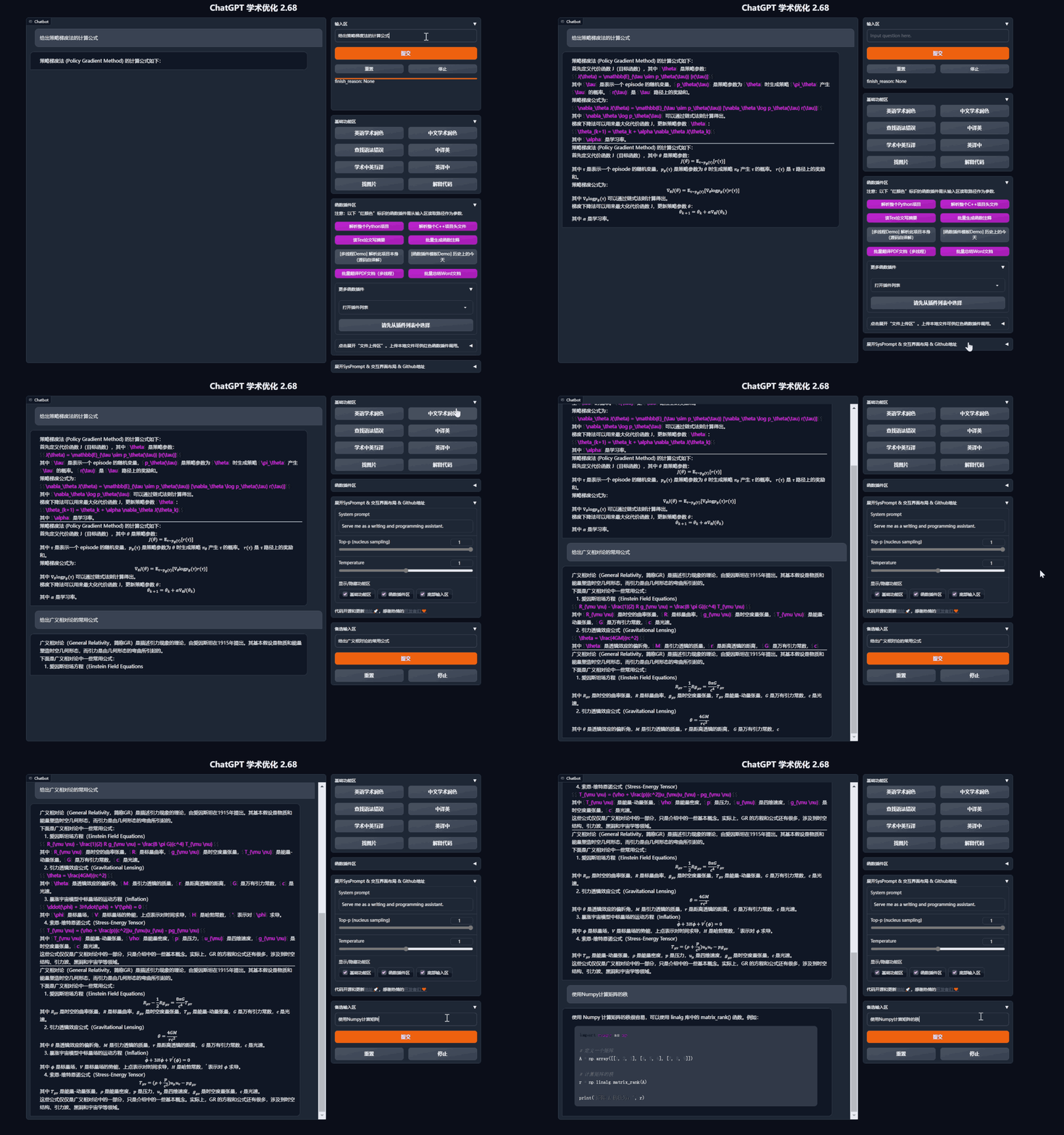
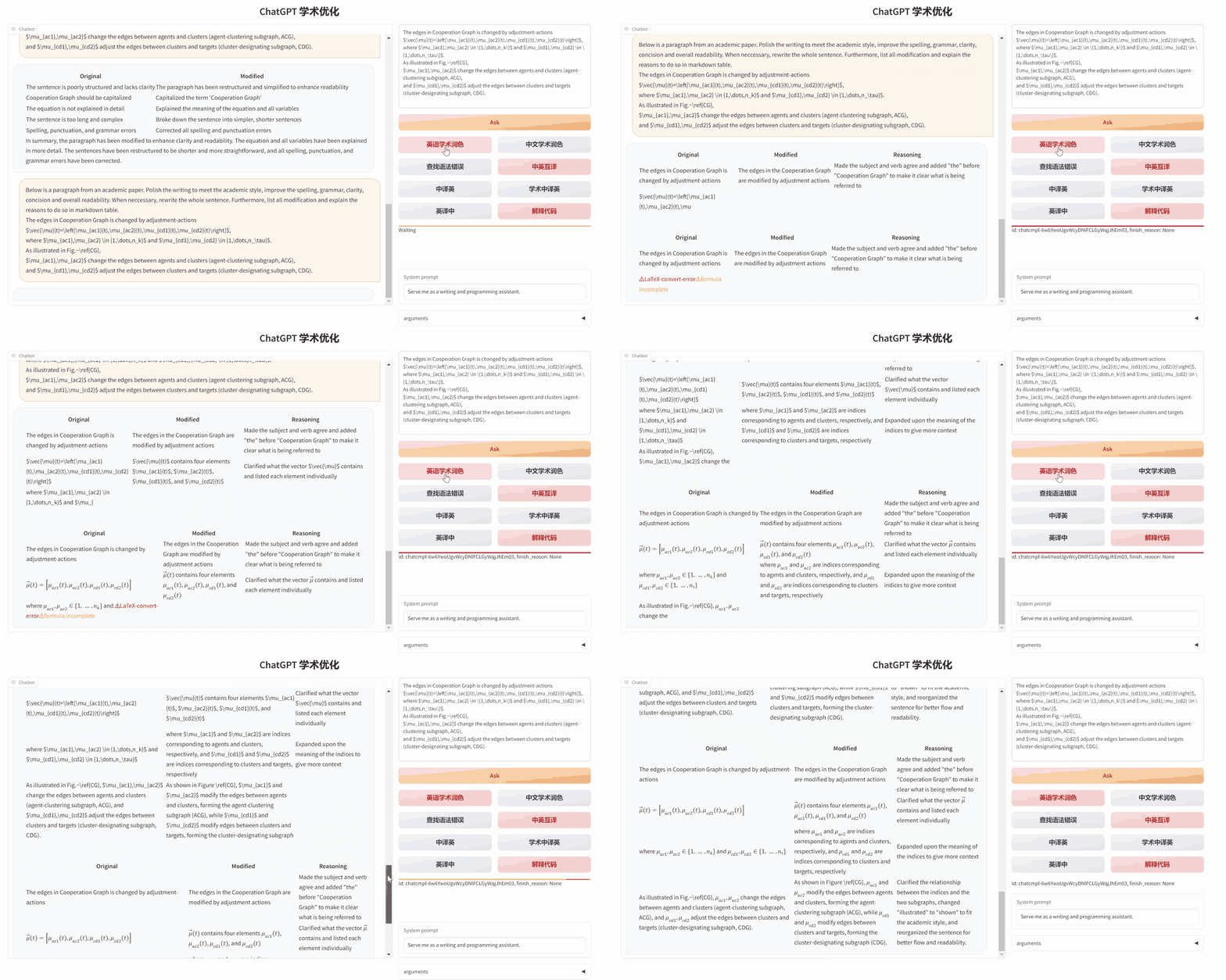
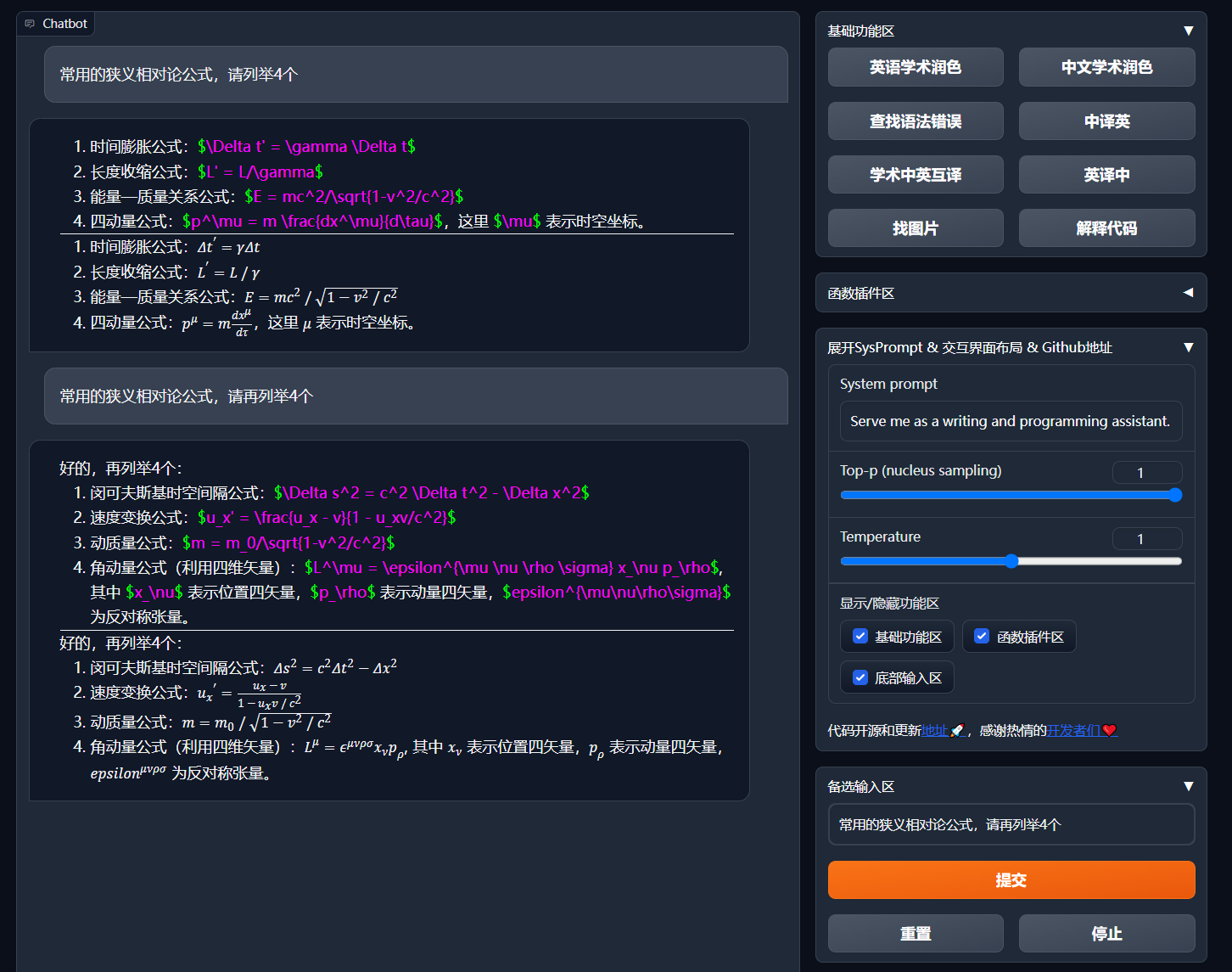
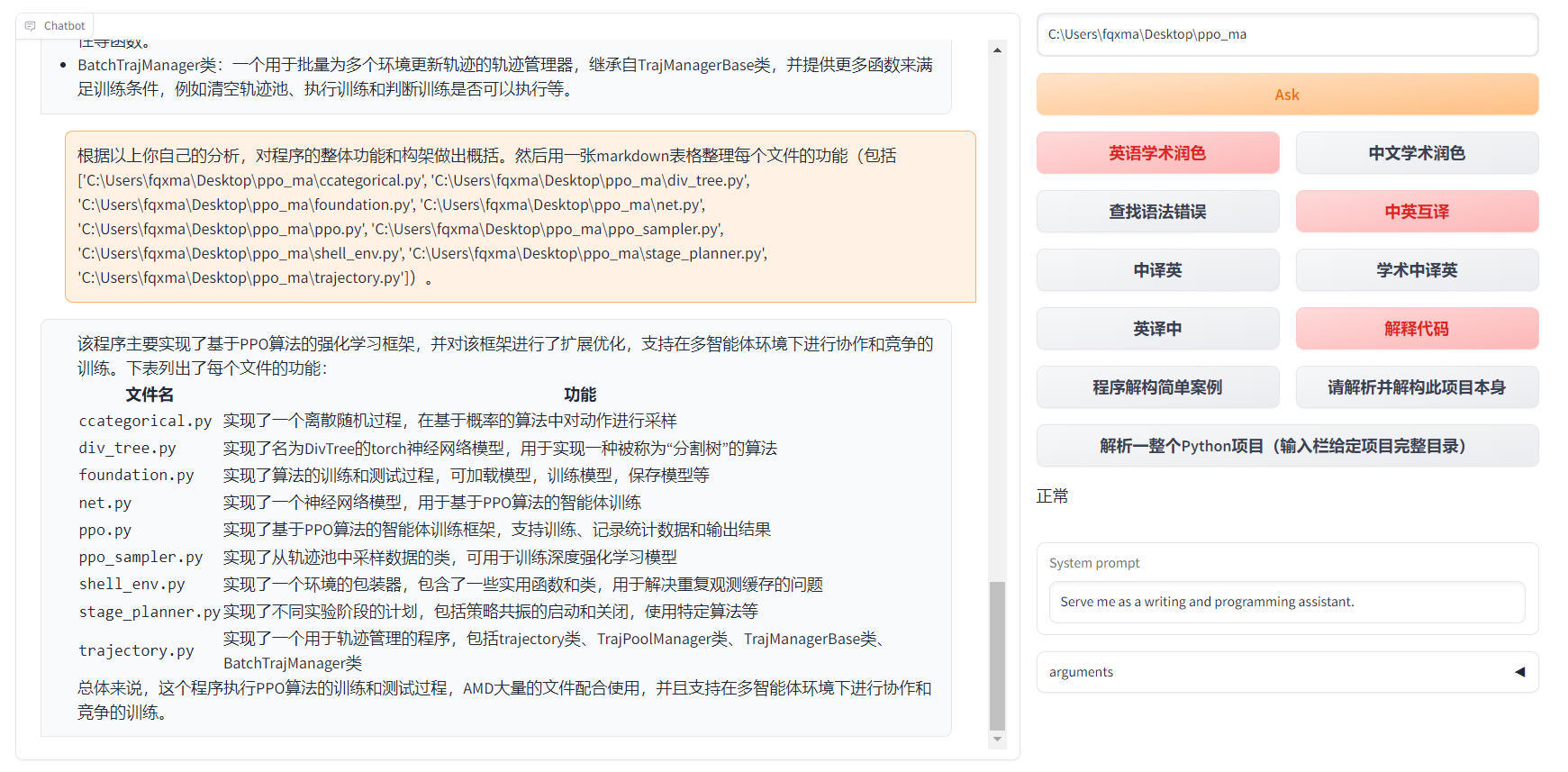
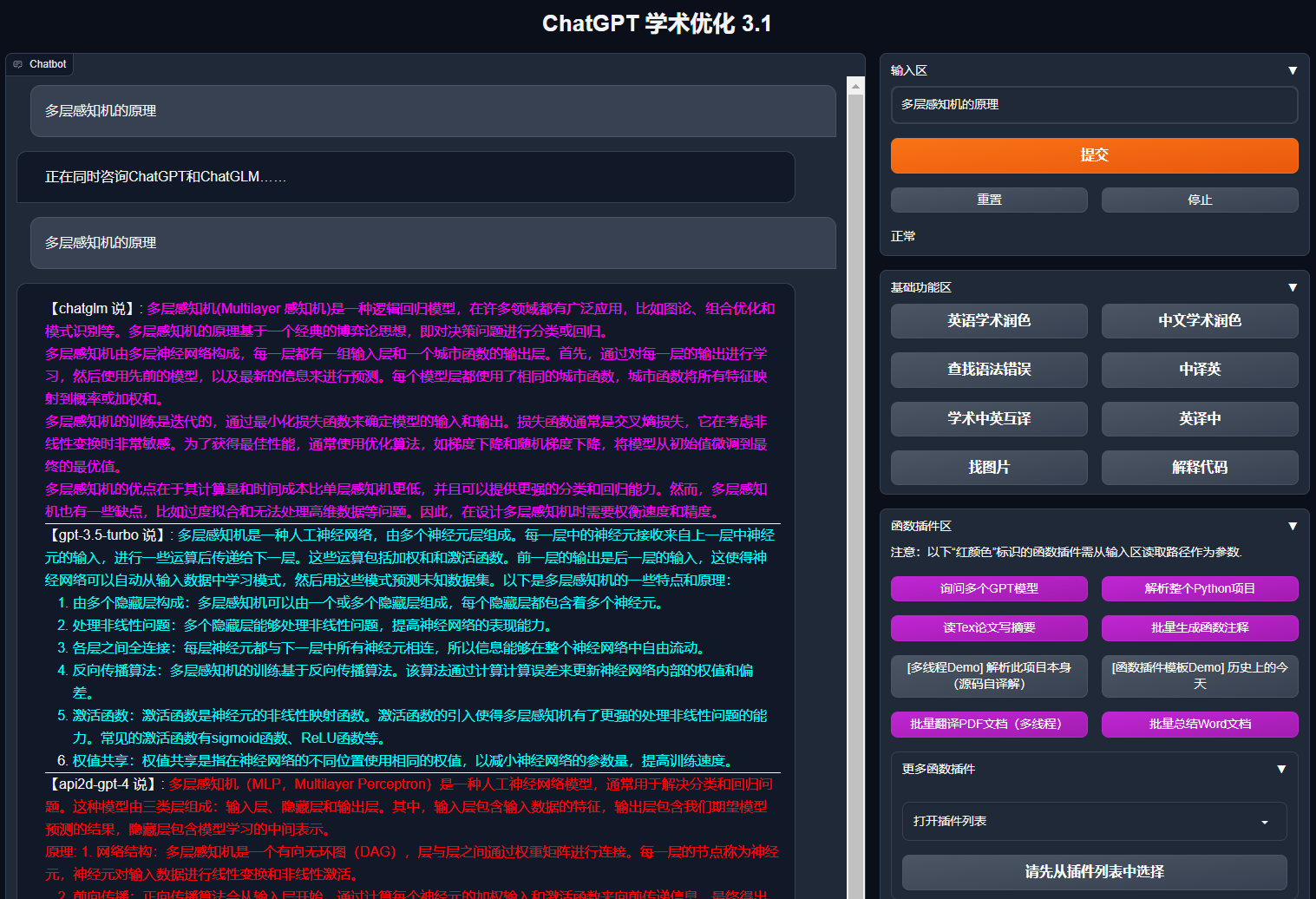
为GPT/GLM等LLM大语言模型提供实用化交互接口,特别优化论文阅读/润色/写作体验,模块化设计,支持自定义快捷按钮&函数插件,支持Python和C++等项目剖析&自译解功能,PDF/LaTex论文翻译&总结功能,支持并行问询多种LLM模型,支持chatglm3等本地模型。接入通义千问, deepseekcoder, 讯飞星火, 文心一言, llama2, rwkv, claude2, moss等。
71.1k
Stars
8.4k
Forks
329
Open issues
100+
Contributors


AI Analysis
GPT Academic is a specialized Gradio-based web UI designed to enhance LLM interactions for academic and research workflows, with particular focus on paper reading, proofreading, translation (PDF/LaTeX), and code analysis. It best serves Chinese-speaking researchers, students, and academics who work with scientific literature and need a multi-model interface supporting both commercial APIs (OpenAI, Claude, Qwen) and local models (ChatGLM, LLaMA). It is NOT a general-purpose chatbot UI or a dev...
Inferred from signals mentioned in the README (tests, CI, type safety) — not a review of the actual code.
AI's overall editorial judgment — not an average of the bars above, can weigh other factors too.
Chinese-first academic LLM interface with 71K stars targets researchers needing PDF translation, LaTeX editing, and multi-model access
GPT Academic is a Gradio-based web UI purpose-built for academic workflows: translating and summarizing arXiv/LaTeX papers, polishing research writing, analyzing codebases, and running batch LLM tasks. It targets Chinese-speaking researchers and developers who need seamless access to both international models (GPT-4, Claude) and domestic Chinese LLMs (Qwen, GLM, DeepSeek, Ernie). With 71K stars and a rich plugin ecosystem, it has become one of the most-starred Chinese LLM tooling projects on GitHub. Its modular plugin architecture allows community-contributed workflow extensions without touching core code.
Created in March 2023 shortly after GPT-3.5's API release, the project grew rapidly as Chinese researchers sought LLM tooling that worked with both OpenAI APIs and Chinese model providers, which general-purpose UIs like OpenAI's ChatGPT did not support.
The project exploded in early-to-mid 2023 as the first accessible, Chinese-friendly academic LLM interface. Growth was driven by strong word-of-mouth in Chinese academic and developer communities, Bilibili video tutorials, and continued feature additions like LaTeX translation, arXiv integration, and support for each new Chinese LLM as they launched. Growth has stabilized (87 stars in the last 7 days as of evaluation date), consistent with a maturing project rather than a viral one.
Widespread informal adoption is strongly implied by 71K stars, 8.3K forks, and extensive Bilibili video tutorials linked directly in the README — suggesting a large Chinese academic user base. However, no enterprise case studies, download counts, or deployment telemetry are publicly documented. Adoption appears concentrated among individual researchers and small academic groups rather than institutional deployments.
Appears to use Gradio as the frontend framework with a modular plugin system ('crazy_functions' directory). Likely follows a functional plugin pattern where each capability is a standalone Python module callable from the UI. Multi-model routing appears to be handled via a central dispatch layer supporting parallel queries. Docker deployment is supported, including a LaTeX-capable image variant.
Not documented in README
Last push was January 25, 2026 — approximately 5 months before evaluation date. The README changelog shows consistent updates through 2025 and into early 2026, including Dockerfile optimization, new model integrations, and a new GUI frontend in development. Maintenance appears active but slowed compared to the 2023–2024 pace. The project is not stagnant.
ADOPT IF: you are a Chinese-speaking researcher or developer needing a self-hosted tool to translate LaTeX/PDF papers, polish academic writing, and access multiple Chinese and international LLMs from a single interface. AVOID IF: you need a polished production deployment for non-technical end users, or your workflows are purely conversational without academic document handling. MONITOR IF: you are tracking the upcoming new GUI frontend mentioned in the January 2026 changelog, which may significantly improve usability.
Independent dimensions
Mainstream potential
4/10
Technical importance
7/10
Adoption evidence
6/10
- Maintenance pace has visibly slowed since late 2025; the announced new GUI frontend has been 'Coming Soon' since January 2026 with no confirmed release, creating uncertainty about future direction.
- Heavy dependency on Gradio means UI flexibility is constrained, and Gradio upgrades have historically caused breaking changes in similar projects.
- GPL-3.0 license restricts commercial embedding or SaaS productization, limiting adoption in enterprise or startup contexts.
- The project's value proposition depends on continued API compatibility with many third-party Chinese LLM providers whose APIs change frequently, creating ongoing maintenance burden.
- Documentation and setup complexity may deter non-technical academic users who would benefit most from the tool's capabilities.
Likely to remain a stable, well-regarded tool within Chinese academic communities. The new GUI frontend, if delivered, could trigger a secondary growth phase. Mainstream adoption outside Chinese-speaking academia appears unlikely given the specialized focus.
Newsletter
Get analyses like this every Monday
Free weekly digest of the most interesting open-source discoveries.
Languages
Information
- Language
- Python
- License
- GPL-3.0
- Last updated
- 6mo ago
- Created
- 40mo ago
- Analyzed with
- anthropic/claude-sonnet-4-6
Stars over time
Contributors over time
Top 100 contributors only — repos with more will plateau at 100.
Open issues
Dependency hardening: pin minimum safe dependency versions
Security: transformers cap leaves affected versions reachable in local model bridges
[Bug]: 网络错误
建议集成 FunASR/SenseVoice 替代实时语音对话的 ASR 模块
[Bug]: when I use minimax-2.7 model, it give me an error.
Top contributors
Similar repos

GaiZhenbiao/ChuanhuChatGPT
Chuanhu Chat is a web-based GUI for interacting with multiple LLMs (ChatGPT,...

AiHubCN/Awesome-Chinese-LLM
Awesome-Chinese-LLM is a curated collection of open-source Chinese language...

datawhalechina/self-llm
A comprehensive Chinese-language tutorial project for deploying, fine-tuning,...
| Repository | Stars | Week Δ | Language | Score | Updated |
|---|---|---|---|---|---|
|
binary-husky/gpt_academic
this
|
71.1k | +27 | Python | 7/10 | 6mo ago |
|
GaiZhenbiao/ChuanhuChatGPT
|
15.3k | — | Python | 7/10 | 2mo ago |
 xtekky/gpt4free xtekky/gpt4free
|
66.5k | — | Python | 7/10 | 8h ago |
|
AiHubCN/Awesome-Chinese-LLM
|
22.7k | — | — | 7/10 | 2mo ago |
|
datawhalechina/self-llm
|
31.2k | — | Jupyter Notebook | 8/10 | 3w ago |
 arc53/DocsGPT arc53/DocsGPT
|
18k | — | Python | 7/10 | 17h ago |
Similar Gradio-based Chinese LLM UI but more general-purpose. GPT Academic is more specialized for academic tasks (LaTeX, arXiv, paper polishing) while ChuanhuChatGPT covers broader conversational use cases. GPT Academic has ~4.6x more stars.
Polished, production-oriented UI for local LLM access. Open WebUI targets broader English-speaking deployment scenarios; GPT Academic targets Chinese academic workflows and multi-provider API access rather than local-only deployment.
A more visually polished, general-purpose LLM chat frontend also popular in China. LobeChat emphasizes UX and plugin marketplace; GPT Academic emphasizes research-specific batch operations like bulk PDF translation that LobeChat does not natively support.
Focuses on free/unofficial LLM API access rather than academic productivity. Comparable star count (~66K) but serves a completely different use case and user motivation.
Commercial AI research assistants with similar paper-reading goals but SaaS-only, no local model support, no LaTeX editing, and not accessible in China without VPN. GPT Academic is the self-hosted, open alternative for this workflow.
 GPT 学术优化 (GPT Academic)