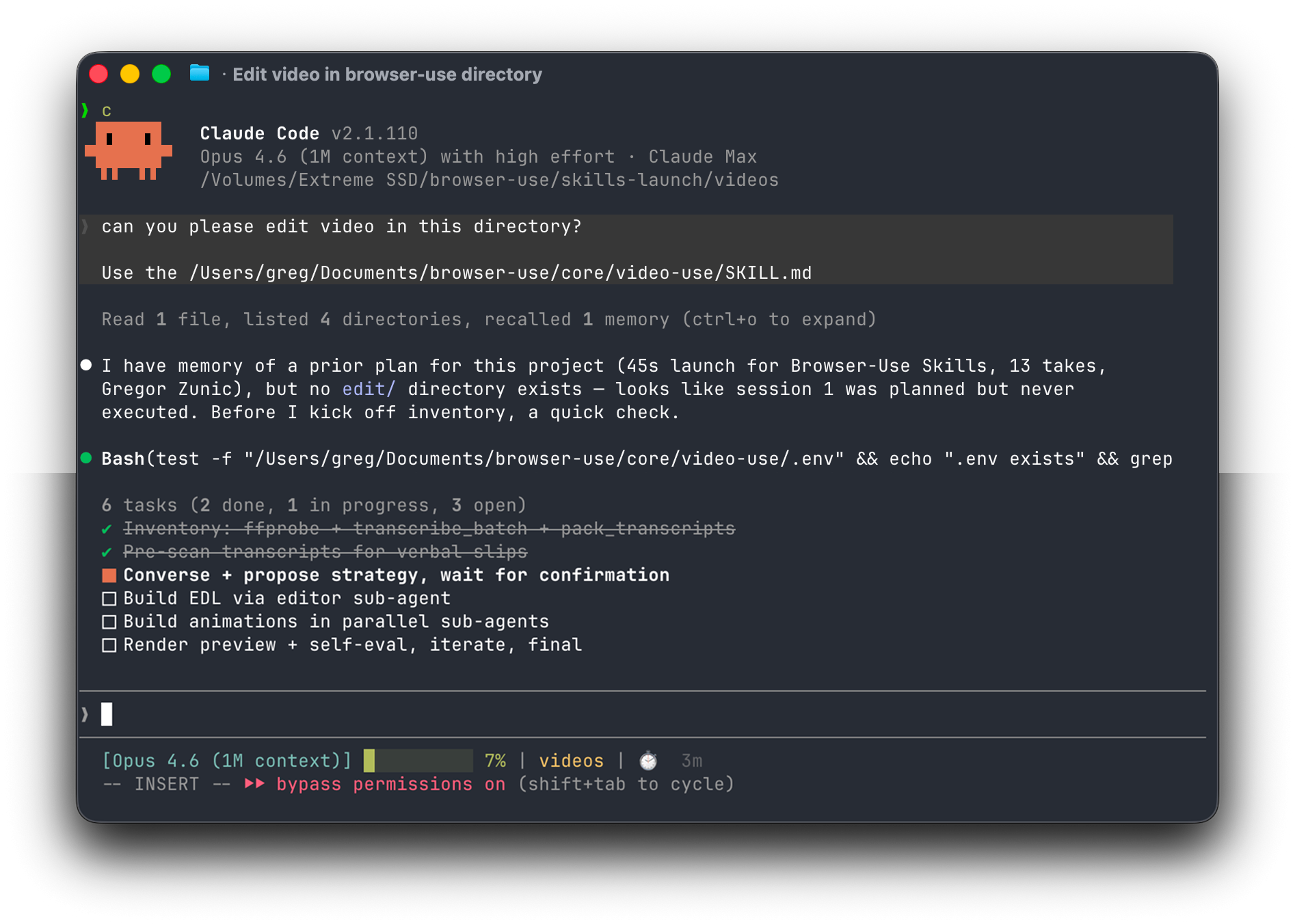
Edit videos with coding agents
16.3k
Stars
1.9k
Forks
52
Open issues
6
Contributors


AI Analysis
video-use is a specialized video editing tool that integrates with AI coding agents (Claude Code, Codex, Hermes) to automate the full post-production workflow—removing filler words, color grading segments, adding audio fades, burning subtitles, and generating animation overlays. It's purpose-built for creators, content producers, and teams who want hands-off video editing from raw footage through final export, best suited for talking-head content, tutorials, and montages rather than frame-by-...
Inferred from signals mentioned in the README (tests, CI, type safety) — not a review of the actual code.
AI's overall editorial judgment — not an average of the bars above, can weigh other factors too.
video-use brings LLM coding agents to video editing via transcript-first pipeline, skipping frame analysis entirely
video-use is a Python toolkit that lets AI coding agents (Claude Code, Codex, etc.) edit raw video footage using spoken transcripts rather than frame-by-frame visual analysis. It transcribes audio with ElevenLabs Scribe to get word-level timestamps, generates an EDL (edit decision list), renders via ffmpeg, and self-evaluates the output before presenting results. Built for solo creators, indie developers, and technical content makers who are already using AI coding agents and want automated post-production without learning a traditional NLE. The project originates from the browser-use organization, leveraging its established brand in the AI agent tooling space.
Created in April 2026 by the browser-use team, which already had significant visibility from its flagship browser-use project (~99K stars). This appears to be a deliberate extension of the 'agent-as-tool-operator' pattern into video editing, launched roughly 13 months after browser-use.
The repo accumulated ~9,946 stars in roughly 5 weeks since creation (April–May 2026), which is a strong initial burst almost certainly driven by browser-use's existing community and cross-promotion. The 121 stars in the last 7 days suggests the initial viral spike has subsided and growth is now organic and slower. The last push was May 15, 2026 — over 5 weeks before the current date — which is a notable pause in activity.
The README references a TikTok demo and mentions 'Browser Use Box' (a VPS/Telegram deployment product), suggesting some real usage. However, concrete production adoption evidence — user testimonials, case studies, download metrics, community forum activity — is not present in the README or available metadata. Adoption not verified beyond anecdotal demo-level usage.
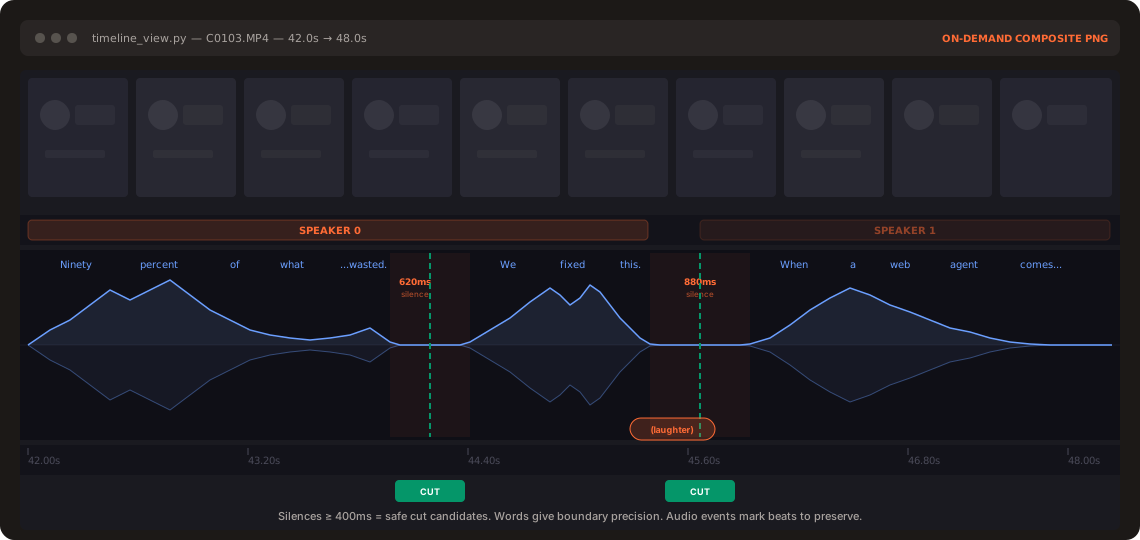
Appears to follow a pipeline pattern: transcribe → pack → LLM reasoning → EDL generation → ffmpeg render → self-evaluation loop. Likely structured as a set of Python helper scripts in a `helpers/` directory registered as an agent 'skill'. The LLM is kept stateless with respect to video frames — it reads structured text (packed markdown transcripts) and requests visual composites only on demand via a `timeline_view` utility. This text-first design is architecturally coherent and appears well thought-out based on the README. The self-eval loop (max 3 retries) adds a basic quality gate. Parallel sub-agent spawning for animation overlays suggests some async/subprocess orchestration, but implementation details are not verifiable.
Not documented in README
Last push was 2026-05-15, approximately 37 days before the current date of 2026-06-21. For a 10-week-old project that had rapid initial development, a 5-week gap without commits is worth monitoring but not yet alarming — early-stage projects often have burst-and-pause development cycles. However, combined with no documented issue tracker activity in the README, it is unclear whether the project is in active iteration or has slowed significantly post-launch. Confidence in continued active maintenance is medium-low.
ADOPT IF: you are a developer or technical creator already using Claude Code or a similar coding agent, comfortable with CLI workflows, and want automated rough-cut editing from raw talking-head or tutorial footage without a GUI editor. AVOID IF: you need a stable, production-hardened tool — the last commit was 5+ weeks ago on a <10-week-old project, and ElevenLabs API dependency adds cost and a single point of failure; also avoid if your workflow is non-technical or requires frame-accurate visual editing. MONITOR IF: you work in the AI-assisted video space and want to watch whether this matures into a maintained, community-backed standard or plateaus as a well-designed prototype.
Independent dimensions
Mainstream potential
4/10
Technical importance
7/10
Adoption evidence
2/10
- Project activity has stalled for 5+ weeks as of the evaluation date, with no public evidence of resumed development — may be an abandoned or deprioritized side project from the browser-use team.
- Hard dependency on ElevenLabs Scribe for transcription creates cost exposure and vendor lock-in; any pricing or API change would break the core pipeline.
- The agent-skill model (Claude Code, Codex) ties the tool to third-party agent platforms whose skill/plugin APIs may change or be deprecated without notice.
- Test coverage is undocumented, and the self-eval loop relies on the same LLM that made the cuts — this may not reliably catch errors the model is systematically prone to making.
- The initial star count likely reflects brand halo from browser-use rather than independent validation of the tool's utility, making growth projections uncertain.
Likely to remain a useful but niche proof-of-concept in the agent-driven media tooling space. May see a revival if the browser-use team resumes active development, but risks fading into low-maintenance status without a dedicated maintainer community forming around it.
Newsletter
Get analyses like this every Monday
Free weekly digest of the most interesting open-source discoveries.
Languages
Information
- Language
- Python
- License
- MIT
- Last updated
- 1w ago
- Created
- 3mo ago
- Analyzed with
- anthropic/claude-haiku-4-5
Stars over time
Contributors over time
Top 100 contributors only — repos with more will plateau at 100.
Open issues
Top contributors
Recent releases
No releases published yet.
Similar repos

bradautomates/claude-video
A Claude plugin that enables Claude to analyze video content by downloading,...

Agentchengfeng/chengfeng-videocut-skills
A specialized video editing skill package for Claude Code and Codex designed...
| Repository | Stars | Week Δ | Language | Score | Updated |
|---|---|---|---|---|---|
|
browser-use/video-use
this
|
16.3k | +2.5k | Python | 7/10 | 1w ago |
 nexu-io/html-video nexu-io/html-video
|
3.9k | — | HTML | 8/10 | 3w ago |
|
bradautomates/claude-video
|
6.8k | — | Python | 8/10 | 1w ago |
|
browser-use/web-ui
|
16.2k | — | Python | 7/10 | 2mo ago |
|
Agentchengfeng/chengfeng-videocut-skills
|
2.6k | — | HTML | 7/10 | 2w ago |
 digitalsamba/claude-code-video-toolkit digitalsamba/claude-code-video-toolkit
|
1.7k | — | Python | 8/10 | 4d ago |
Pixelle-Video (23K stars) appears to target similar AI-assisted video editing use cases and has substantially more community traction. It likely offers a more polished or broader feature set, though whether it uses a comparable transcript-first LLM approach is unclear from available data.
NarratoAI (~9.9K stars, similar scale) focuses on automated narrated video creation from scripts/articles. Overlaps in automated subtitle and editing workflows, but targets content generation rather than raw footage editing. The audiences partially overlap.
The dominant commercial tool for transcript-based video editing. Descript's core 'text-to-edit' concept is similar in spirit — edit video by editing text — but it is a closed, GUI-based SaaS product. video-use targets developers and agent-native workflows, not general consumers, making direct competition limited.
VectCutAPI (2K stars) appears to be a more narrowly scoped API for video cutting operations. video-use is more opinionated and full-stack (transcription through render), while VectCutAPI may offer lower-level primitives for integration.
The flagship sibling project demonstrates the same organization's ability to achieve massive adoption (~100K stars) with an agent-as-operator pattern. video-use attempts to replicate that template for video, but video editing is a narrower and more technically demanding domain with fewer potential users.