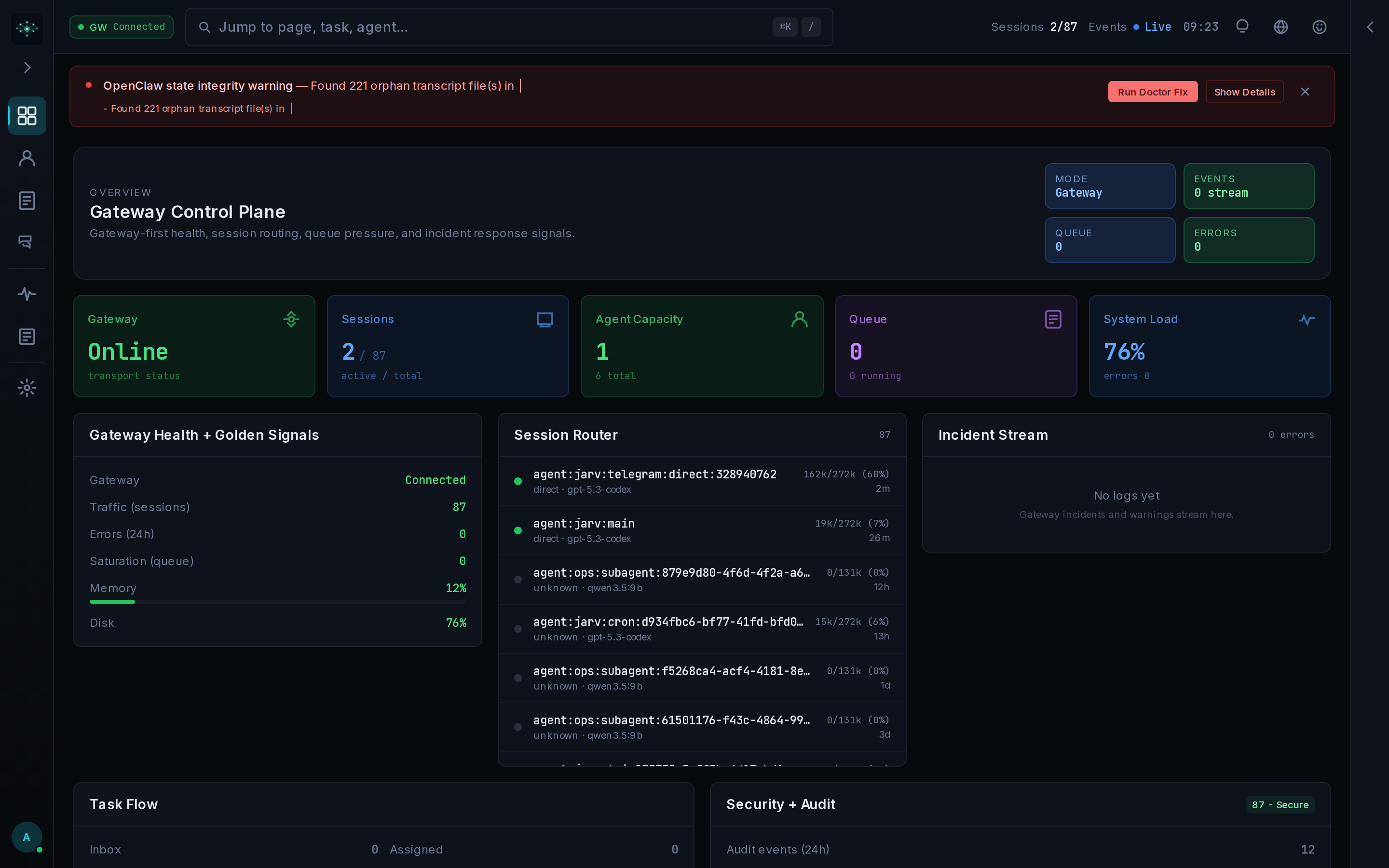
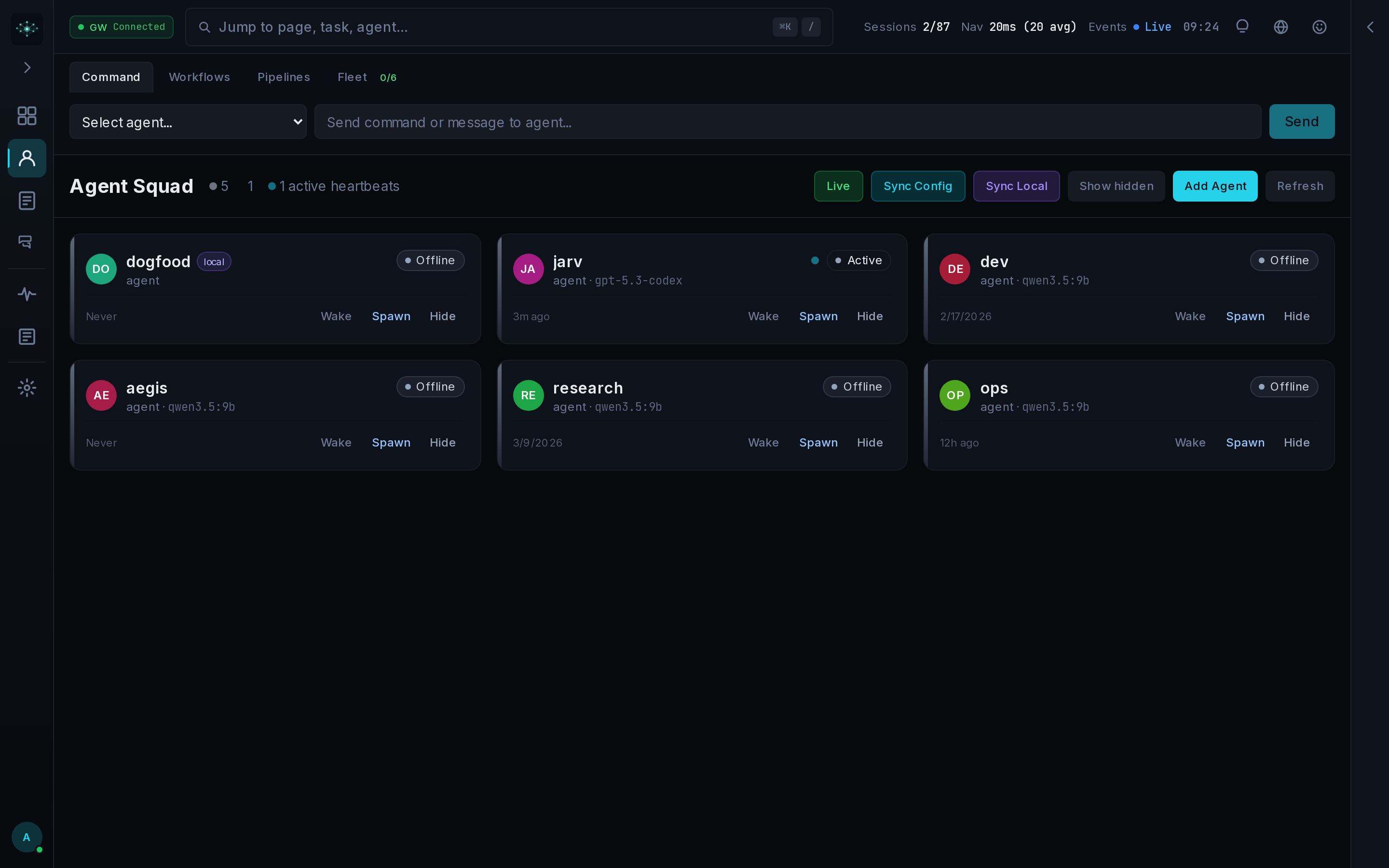
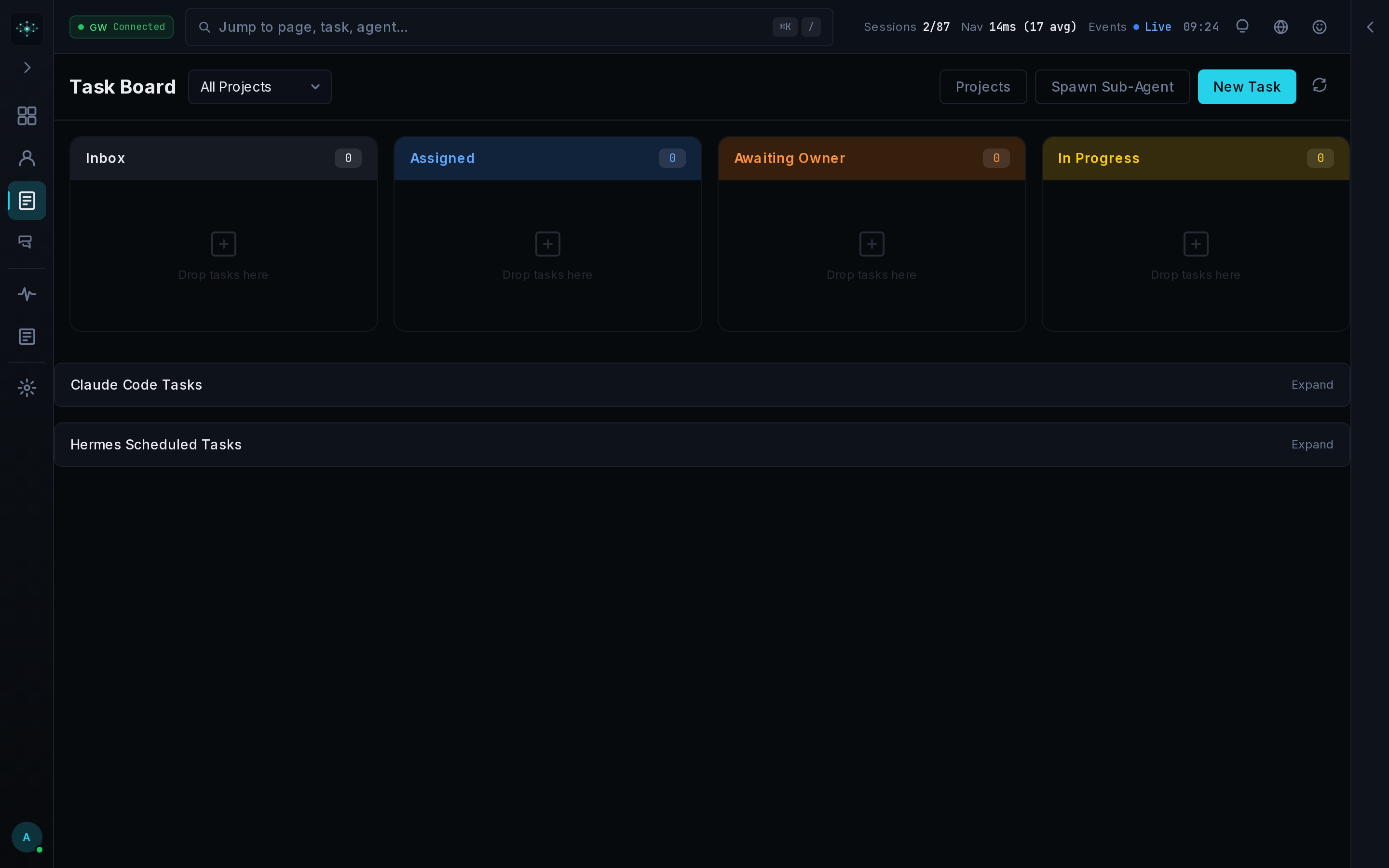
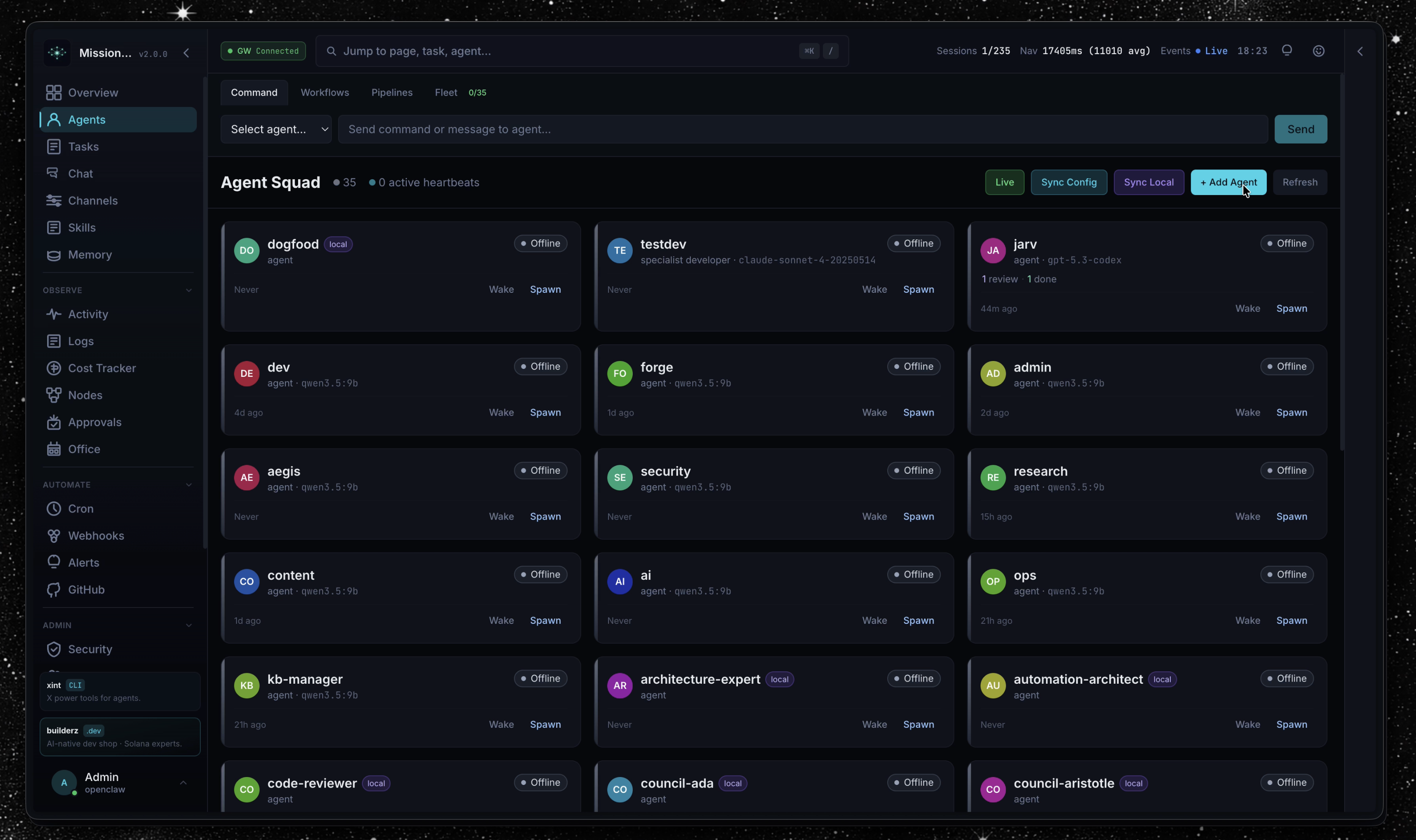
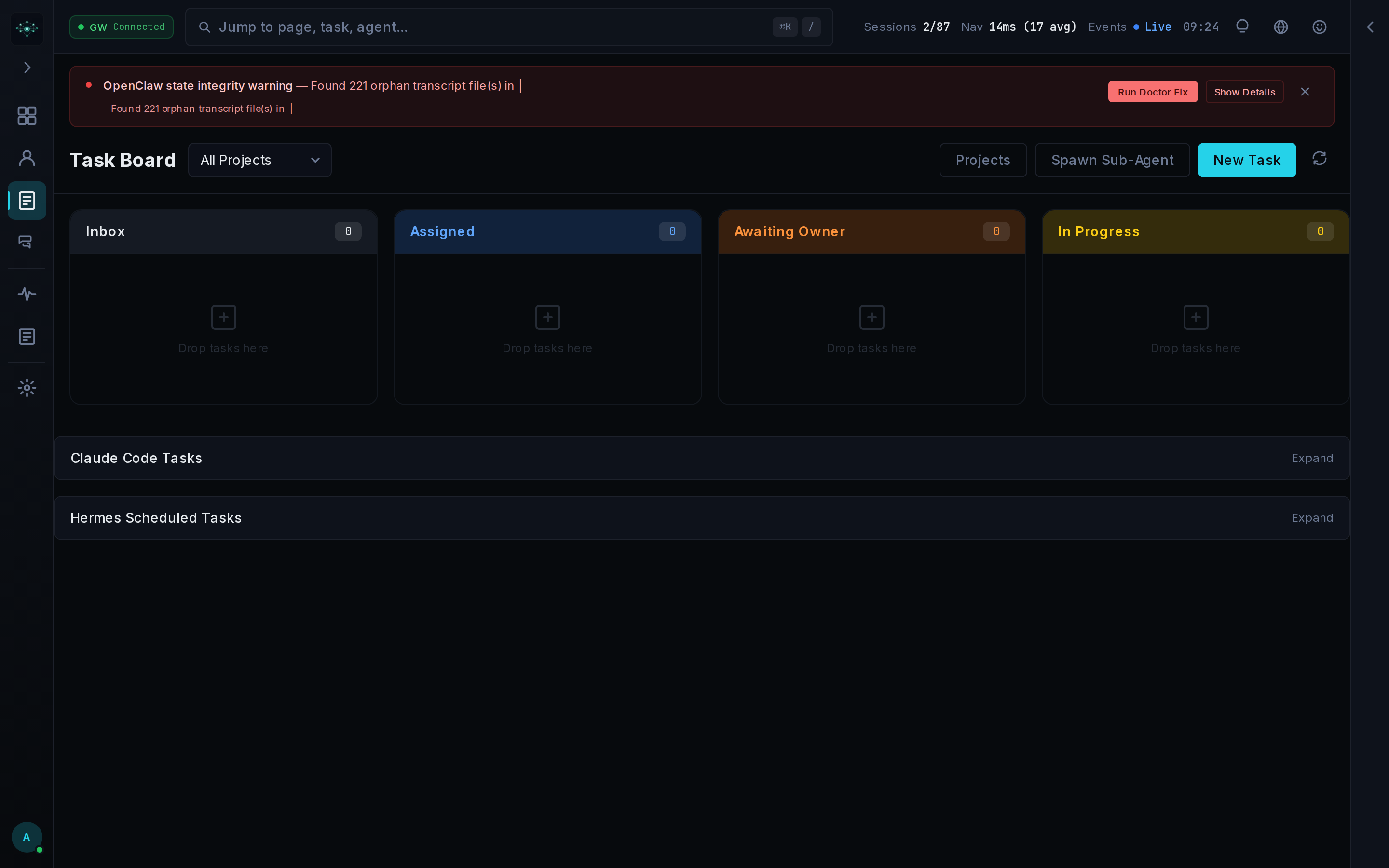
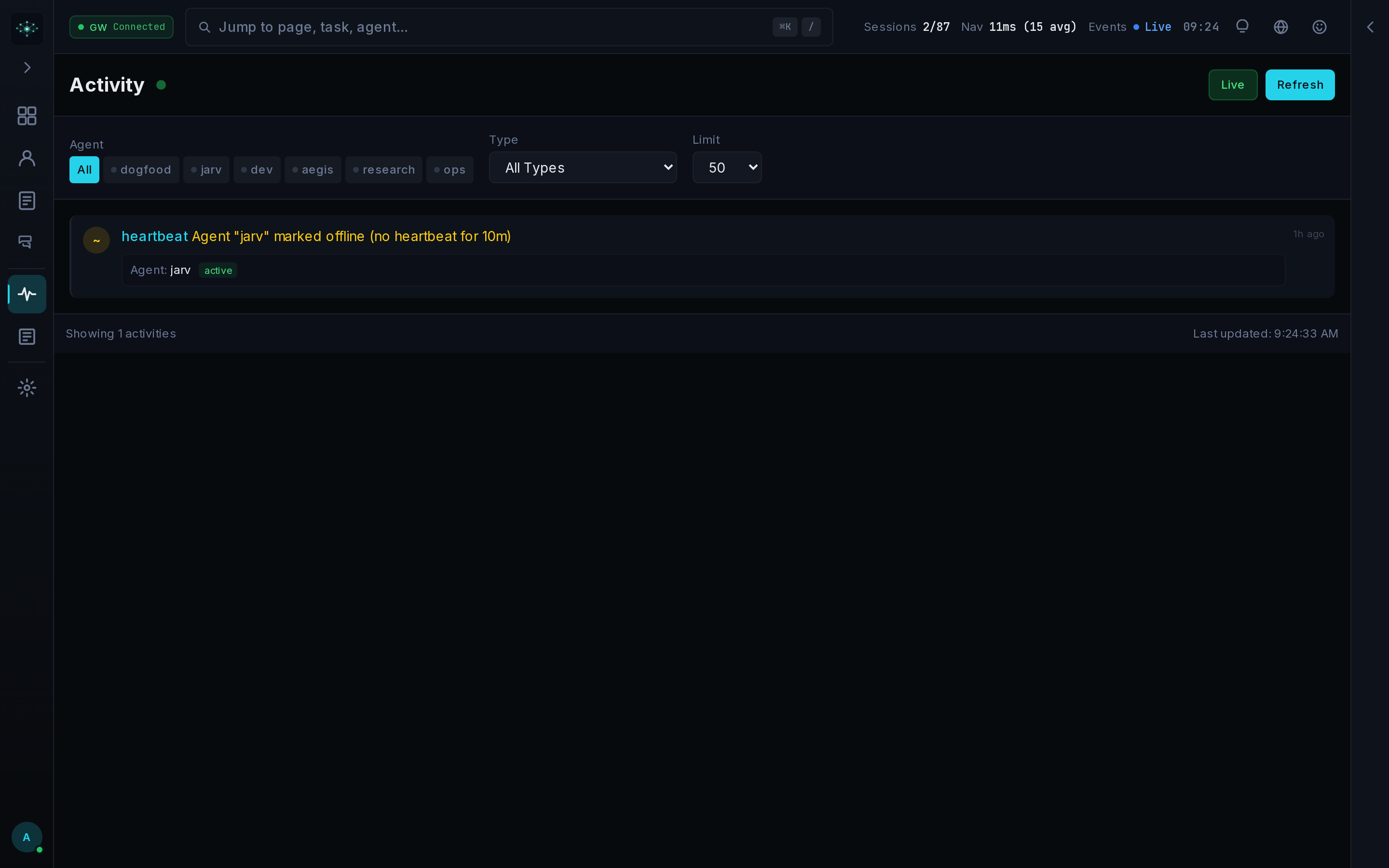
Self-hosted AI agent orchestration platform: dispatch tasks, run multi-agent workflows, monitor spend, and govern operations from one mission control dashboard.
5.7k
Stars
958
Forks
4
Open issues
30
Contributors


AI Analysis
Mission Control is a self-hosted, open-source dashboard for orchestrating AI agent fleets, dispatching tasks, tracking costs, and coordinating multi-agent workflows without external dependencies. It serves teams and developers who need centralized governance of AI agents across multiple frameworks (Claude, CrewAI, LangGraph, AutoGen) with role-based access control and real-time monitoring. It is not a general-purpose dashboard but a specialized platform for AI operations teams.
Inferred from signals mentioned in the README (tests, CI, type safety) — not a review of the actual code.
AI's overall editorial judgment — not an average of the bars above, can weigh other factors too.
Self-hosted AI agent orchestration dashboard: task dispatch, cost tracking, and multi-agent governance in one TypeScript app
Mission Control is an open-source, self-hosted dashboard for teams running AI agent fleets. It covers task dispatch, multi-agent workflow coordination, spend monitoring, role-based access, quality gates, and security auditing — all backed by SQLite with no external service dependencies. It targets developers and platform teams who want operational visibility over AI agents without vendor lock-in. The project is in alpha, under active development, and integrates with frameworks like OpenClaw, CrewAI, LangGraph, and AutoGen.
Created in February 2026, Mission Control is a recent entrant in the rapidly crowding AI agent tooling space. It appears to have been built by the builderz-labs organization in response to the fragmentation problem: teams running multiple agent frameworks had no unified observability or control layer.
Reached 5,615 stars in roughly five months, adding ~151 stars in the last 7 days — a moderate but consistent pace. Growth likely reflects genuine demand for self-hosted agent orchestration as teams grow uncomfortable with cloud-only solutions and as agent fleet complexity increases. The breadth of integrations (five framework adapters) and zero-dependency setup likely reduce friction for early adopters.
Adoption not verified from available metadata. The README includes a 'Built with Mission Control' section heading, suggesting user stories exist, but no named organizations or case studies are visible in the truncated README. Alpha status means production deployments, if any, are likely experimental or internal.
Appears to be a Next.js 16 single-page application with a TypeScript backend, SQLite as the sole datastore, WebSocket and SSE for real-time updates, and a modular panel system (32 panels documented). Likely uses a monorepo structure given the complexity. Role-based auth, API key management, and a 'Aegis' quality-gate subsystem are described. Multi-gateway architecture suggests an abstraction layer over agent framework APIs rather than native protocol integration.
README explicitly documents 577 tests: 282 unit tests and 295 E2E tests. This is a stronger signal of test discipline than most projects at this maturity stage, though actual coverage percentage and test quality cannot be verified from metadata alone.
Last push was 2026-07-06, the same day as evaluation — indicating active, ongoing development. The project is self-described as alpha, which is an honest signal. Commit recency and the 954 forks suggest an engaged contributor base. No evidence of abandoned PRs or stale issue queues from available metadata.
ADOPT IF: you need a self-hosted, low-infrastructure-overhead dashboard for managing multiple AI agents across frameworks, and your team can tolerate alpha-stage API instability. AVOID IF: you need production-hardened stability with guaranteed schema stability, or if your stack is already committed to a cloud-native observability platform with vendor support. MONITOR IF: you are evaluating agent orchestration tooling for a team that may scale to fleet operations — this project's trajectory over the next 6 months will clarify whether it reaches production-ready status.
Independent dimensions
Mainstream potential
5/10
Technical importance
7/10
Adoption evidence
2/10
- Alpha status means breaking changes to APIs, database schemas, and config formats are explicitly warned as likely — teams building on it now face migration costs.
- SQLite-only storage may become a practical bottleneck for high-throughput agent fleets or teams requiring multi-node deployments, despite simplifying initial setup.
- No verified production deployments in the public record make it difficult to assess real-world reliability at scale.
- The peer landscape is crowded and fast-moving; several similar TypeScript projects exist, and consolidation or a dominant tool emerging could reduce adoption pressure for Mission Control specifically.
- As a relatively new organization (builderz-labs), long-term maintenance commitment is unproven — sustainability beyond initial enthusiasm cannot be confirmed from available data.
Likely to stabilize into a useful self-hosted option for small-to-medium agent fleet operators within 12 months, assuming active development continues. Mainstream adoption will depend on whether it ships a stable v1 before competing tools consolidate the category.
Newsletter
Get analyses like this every Monday
Free weekly digest of the most interesting open-source discoveries.
Languages
Information
- Website
- https://mc.builderz.dev
- Language
- TypeScript
- License
- MIT
- Last updated
- 5d ago
- Created
- 5mo ago
- Analyzed with
- anthropic/claude-haiku-4-5
Stars over time
Contributors over time
Top 100 contributors only — repos with more will plateau at 100.
Open issues
Feature: Cross-session Trust Capital as external trust scoring input
v2.1+: native workspace fields (brand, isolation) + approval rules engine
[Feature] Per-agent Claude Code sessions for Pro-subscription task dispatch (no API key, no OpenClaw)
Top contributors
Similar repos

abhi1693/openclaw-mission-control
OpenClaw Mission Control is a centralized operations dashboard for managing AI...

777genius/agent-teams-ai
Agent Teams AI is a desktop application that orchestrates multiple AI agents to...
| Repository | Stars | Week Δ | Language | Score | Updated |
|---|---|---|---|---|---|
|
builderz-labs/mission-control
this
|
5.7k | +178 | TypeScript | 8/10 | 5d ago |
|
abhi1693/openclaw-mission-control
|
4.1k | — | TypeScript | 7/10 | 3mo ago |
 RunMaestro/Maestro RunMaestro/Maestro
|
3.1k | — | TypeScript | 7/10 | 8h ago |
|
777genius/agent-teams-ai
|
1.6k | — | TypeScript | 7/10 | 8h ago |
 zts212653/clowder-ai zts212653/clowder-ai
|
2.1k | — | TypeScript | 7/10 | 8h ago |
 craft-ai-agents/craft-agents-oss craft-ai-agents/craft-agents-oss
|
6.8k | — | TypeScript | 7/10 | 3d ago |
Higher star count and likely more mature, but scope overlap is unclear without deeper inspection. Mission Control's self-hosted, SQLite-first approach may differentiate it for teams wanting minimal infrastructure.
Name similarity suggests possible overlap in target use case. Mission Control explicitly lists OpenClaw as a supported framework adapter, so they may be complementary rather than direct rivals.
Mission Control has more stars and appears to offer a broader feature set (32 panels vs. unclear scope). Both target agent orchestration in TypeScript.
Lower star count; Mission Control appears more fully featured based on README breadth. Relative adoption and actual capability comparison cannot be confirmed without deeper inspection.
Smallest in the peer group. Mission Control's RBAC, quality gates, and multi-gateway support suggest a more operationally focused product by comparison.



-brightgreen)