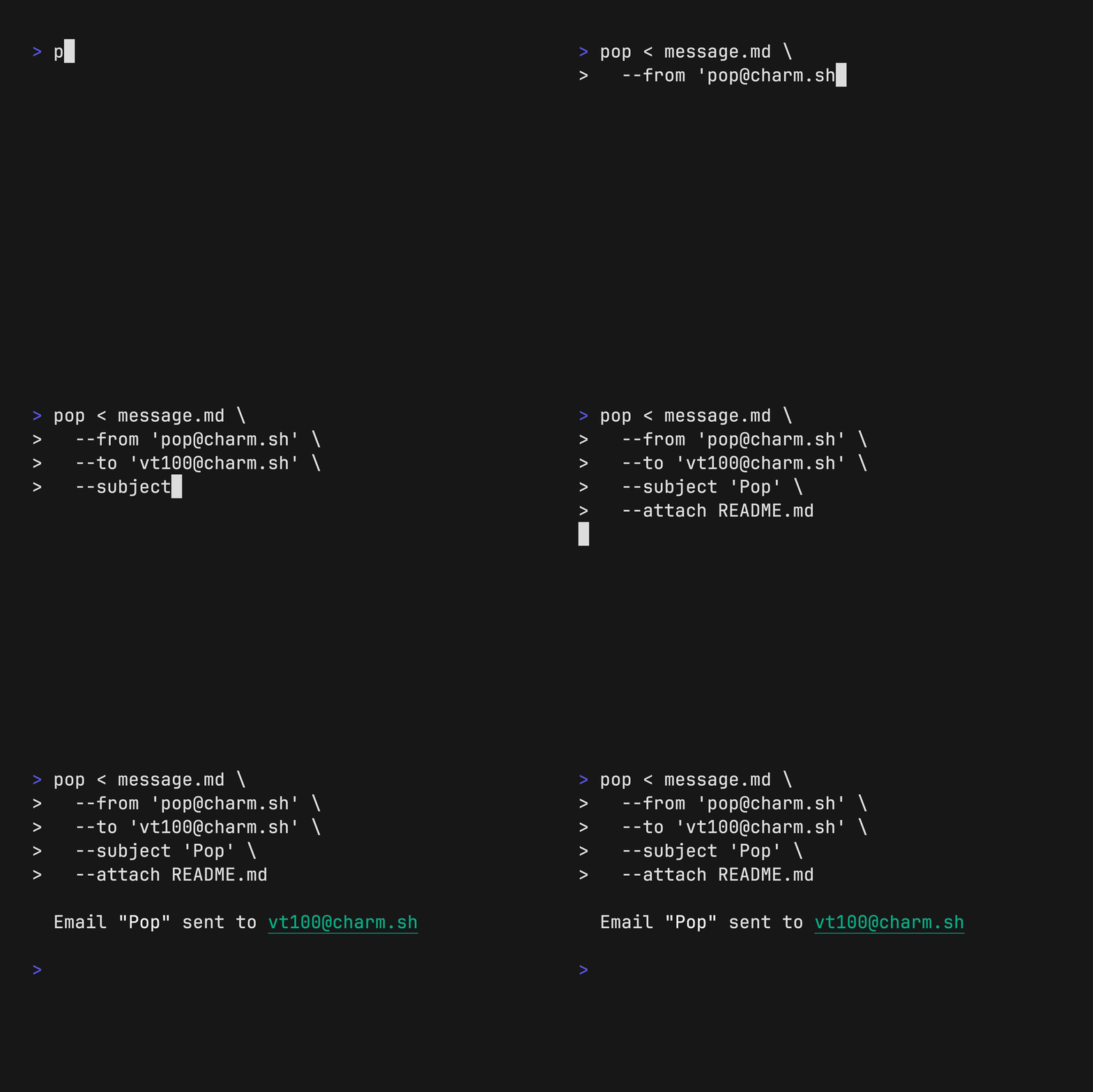
Send emails from your terminal 📬
2.9k
Stars
71
Forks
32
Open issues
14
Contributors


AI Analysis
Pop is a terminal-based email client that sends emails from the command line or via a text-based UI, with support for both Resend and SMTP backends. It serves developers and terminal-power-users who want email workflows integrated into their CLI pipelines, and includes AI agent integration features. This is a specialized productivity tool for a specific workflow, not a general-purpose email solution.
Inferred from signals mentioned in the README (tests, CI, type safety) — not a review of the actual code.
AI's overall editorial judgment — not an average of the bars above, can weigh other factors too.
Terminal email client with TUI and CLI modes, integrating Resend and SMTP
Pop is a Go-based command-line email tool built by Charm that provides both interactive TUI and CLI interfaces for composing and sending emails. It supports Resend (primary integration), SMTP, and file attachments, designed for terminal workflows and AI agent integration. Real-world adoption appears limited to CLI enthusiasts and Charm ecosystem users; adoption not verified in mainstream DevOps or infrastructure automation tooling.
Created June 2023 by Charm, a collective known for polished terminal UI libraries (Bubbletea, Lipgloss). Pop followed the same pattern: solving a specific terminal workflow gap with high production polish. Positioned as complementary to Charm's existing ecosystem rather than replacing existing email infrastructure.
2,862 stars accumulated over ~3 years represents modest, steady adoption within the terminal UI enthusiast community. 4 stars in last 7 days (2026-07-02 to 2026-07-08) indicates slow, plateau-like growth. No evidence of viral adoption or sudden enterprise demand. Growth appears driven by Charm ecosystem visibility and organic CLI community discovery rather than specific market pressure or killer use case.
Adoption not verified. README shows AI agent integration as a forward-looking feature ('AI agents work great with pop'), but no documented enterprise deployments, testimonials, or published case studies. Inclusion in Homebrew and Nix package managers indicates basic ecosystem recognition but not production scale adoption. No metrics on active installations, daily usage, or organizational deployments visible.
Likely based on Charm's Bubbletea framework for TUI mode (given author pattern). CLI mode appears to support inline piping and environment variable configuration. Appears to use adapter pattern to support multiple backends (Resend API, SMTP). README does not document internal architecture, dependency injection, or plugin extensibility.
Not documented in README. No mention of test suite, test framework, or coverage metrics.
Last push 2026-07-06 (2 days before analysis date) indicates active maintenance. Releases published regularly (evidenced by release badge in README). Build status badge visible suggests CI/CD in use. No evidence of stalled development, but no changelog or detailed commit history visible in excerpt. Appears to be receiving steady, ongoing care rather than intensive development or rapid feature expansion.
ADOPT IF: you regularly send emails from terminal scripts or AI pipelines and want a modern, polished CLI alternative to mail/sendmail; you prefer Resend or SMTP backends over vendor-specific APIs; you value tight Charm ecosystem integration. AVOID IF: you need full email read/manage/archive capabilities; you depend on esoteric SMTP extensions or legacy authentication; you require high production support and vendor backing. MONITOR IF: Charm expands Pop into a full mail client or if enterprise CLI tool adoption accelerates in 2026–2027; currently narrow but stable niche.
Independent dimensions
Mainstream potential
3/10
Technical importance
5/10
Adoption evidence
3/10
- Adoption limited to terminal-enthusiast subculture; may never reach mainstream DevOps / SRE toolkits
- Single-author (Charm) project dependency; if Charm shifts priorities, maintenance could slow despite current activity
- No documented test coverage; production reliability in large-scale email workflows unverified
- Resend partnership implies potential API lock-in if Resend changes terms or pricing; SMTP fallback mitigates but not all users will adopt
- Lack of commercial support or SLA; unsuitable for mission-critical email infrastructure
Pop likely remains a high-quality niche tool within the Charm ecosystem and CLI enthusiast communities through 2027. Possible acceleration if AI agent integration becomes standard in enterprise automation; more probable is continued slow, stable maintenance at current adoption plateau without major feature expansion.
Newsletter
Get analyses like this every Monday
Free weekly digest of the most interesting open-source discoveries.
Languages
Information
- Language
- Go
- License
- MIT
- Last updated
- 4d ago
- Created
- 37mo ago
- Analyzed with
- anthropic/claude-haiku-4-5
Stars over time
Contributors over time
Top 100 contributors only — repos with more will plateau at 100.
Open issues
Top contributors
Recent releases
Similar repos
charmbracelet/glow
Glow is a terminal-based markdown reader and renderer for the CLI, designed to...
charmbracelet/bubbles
Bubbles provides reusable TUI (terminal user interface) components for building...
| Repository | Stars | Week Δ | Language | Score | Updated |
|---|---|---|---|---|---|
|
charmbracelet/pop
this
|
2.9k | +5 | Go | 8/10 | 4d ago |
|
charmbracelet/gum
|
24k | — | Go | 8/10 | 4w ago |
|
charmbracelet/huh
|
7k | — | Go | 8/10 | 4d ago |
|
charmbracelet/glow
|
26.3k | — | Go | 8/10 | 3mo ago |
|
charmbracelet/bubbles
|
8.6k | — | Go | 8/10 | 4d ago |
|
charmbracelet/bubbletea
|
43.6k | — | Go | 9/10 | 4d ago |
Traditional Unix tooling focused on sysadmin pipelines; Pop adds modern TUI and higher-level abstractions for humans, not servers
Full email clients with read/archive capabilities; Pop is send-only, designed as a CLI primitive rather than a complete mail solution
Full-featured but heavier and less modern; Pop targets terminal-native scripting workflows and modern API backends
Cloud service CLIs tied to specific vendors; Pop is vendor-agnostic abstraction (Resend + SMTP) with emphasis on user interaction
Minimal, Unix-philosophy tools; Pop adds TUI, modern UI polish, and composition affordances at cost of higher memory footprint