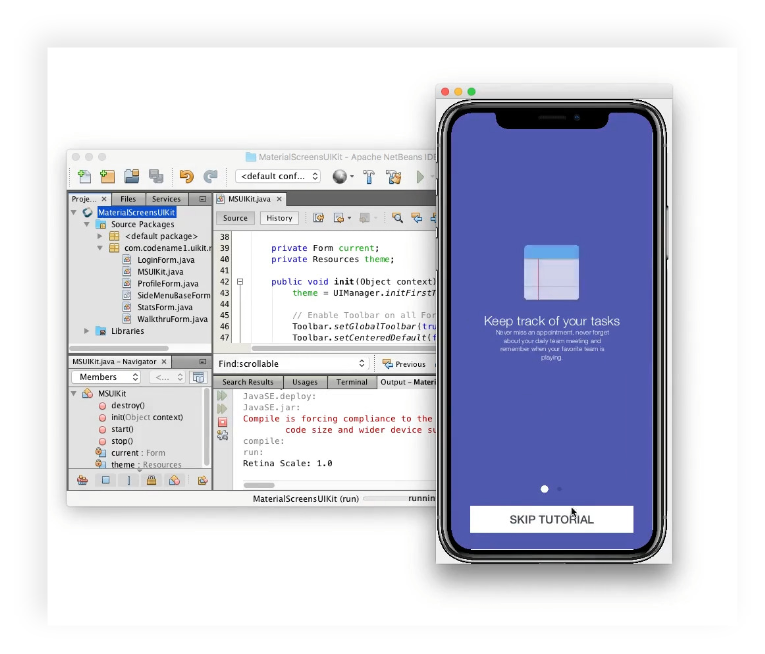
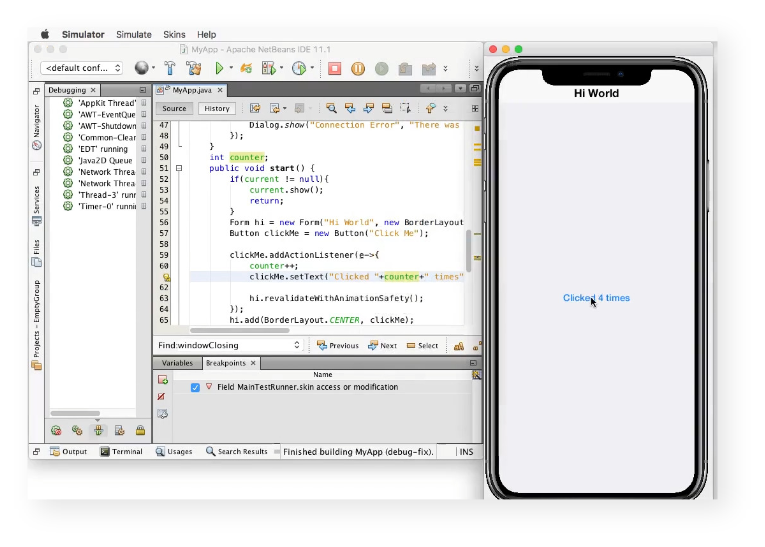
Cross-platform framework for building truly native mobile apps with Java or Kotlin. Write Once Run Anywhere support for iOS, Android, Desktop & Web.
1.9k
Stars
435
Forks
332
Open issues
30
Contributors




AI Analysis
Codename One is a cross-platform mobile development framework that compiles Java or Kotlin source code to native executables for iOS, Android, UWP, and web platforms with 100% code reuse. It serves Java/Kotlin developers who want to build truly native mobile applications without maintaining separate codebases per platform, and is best suited for teams already invested in the Java ecosystem who prioritize write-once-run-anywhere deployment.
Inferred from signals mentioned in the README (tests, CI, type safety) — not a review of the actual code.
AI's overall editorial judgment — not an average of the bars above, can weigh other factors too.
Java/Kotlin cross-platform framework targeting native compilation to iOS, Android, and web via bytecode-to-native approach
Codename One is a Write Once Run Anywhere (WORA) platform enabling Java and Kotlin developers to compile to native iOS, Android, UWP, and JavaScript/PWA targets with claimed 100% code reuse. It includes a simulator, visual GUI builder, CSS theming, and IDE integrations. Adoption appears concentrated in education and legacy Java shops; mainstream mobile developer adoption remains limited compared to React Native or Flutter. Project maintains active development (last commit July 2026) but slow star growth (3 in 7 days suggests limited growth momentum).
Founded 2015 as a Java-first alternative to Xamarin and early cross-platform frameworks. Evolved to support Kotlin and PWA/JavaScript compilation. Remains independently maintained with a commercial support tier but has not achieved widespread industry adoption despite 11 years in market.
Initial growth likely driven by Java ecosystem's demand for mobile solutions pre-2017. Growth appears to have plateaued; 1,851 stars accumulated over 11 years with minimal recent acquisition (3 stars/week) suggests the project has found a stable but narrow user base. No evidence of acceleration tied to language trends or platform shifts in recent years.
Adoption not verified. README does not cite production deployments, enterprise customers, or case studies. No public evidence of app store presence, developer surveys, or community size metrics. Comparison with similar platforms (Uno has 9,980 stars, OnsenUI 8,864) shows significantly lower visibility in open-source ecosystem. Cannot assess real-world usage from available metadata.
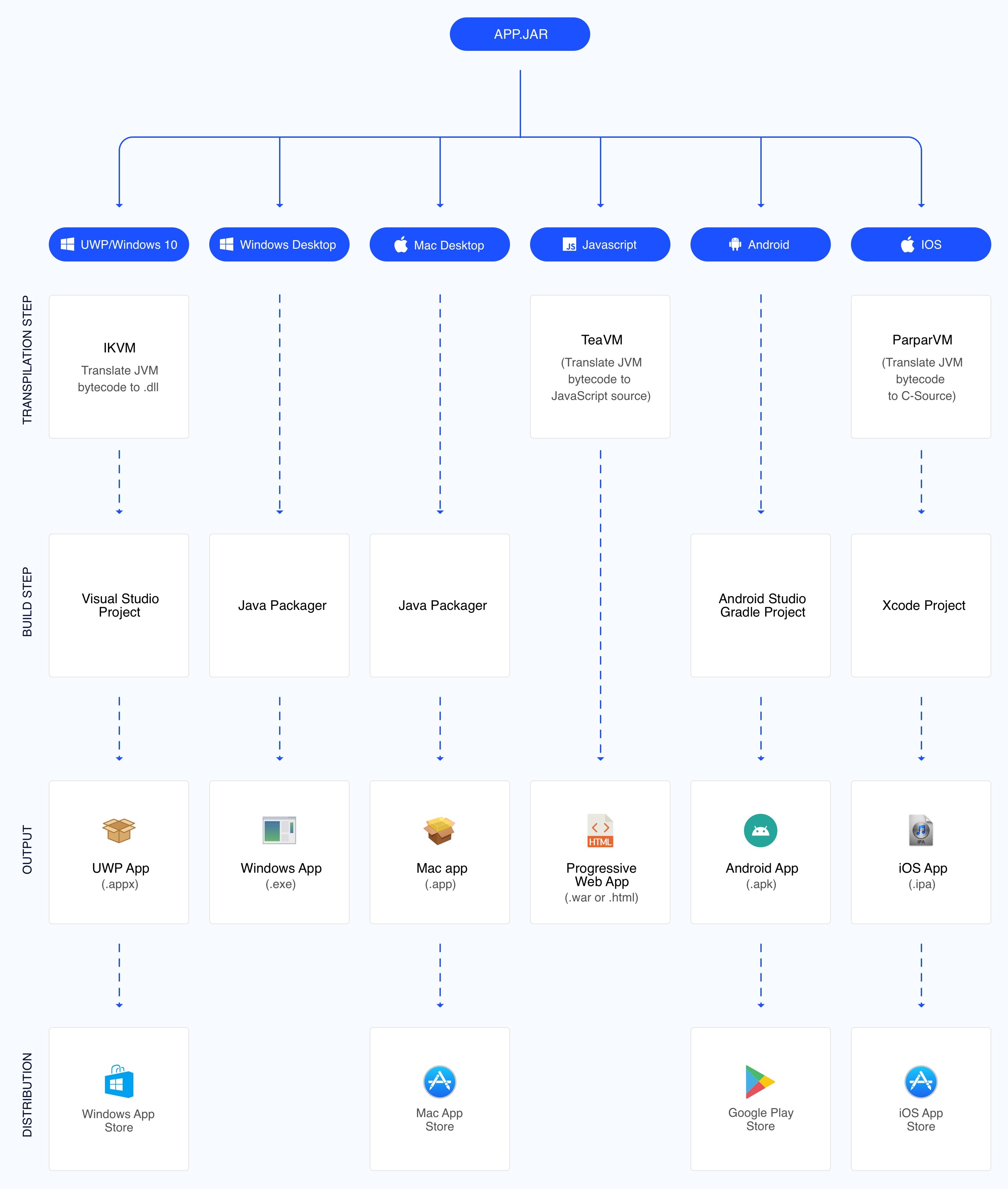
Based on README: compiles Java/Kotlin bytecode to native OS executables via platform-specific VMs and compiler chains. Appears to use abstraction layer for OS-level capabilities (Objective-C, C#, Dalvik/ART). Provides simulator, visual theme builder, CSS engine, and drag-and-drop GUI designer. Likely uses intermediate compilation or source-to-native transpilation, but specific compilation pipeline not detailed in README.
Not documented in README. No mention of automated testing infrastructure, test harness, or CI/CD tooling beyond claim of 'seamless CI out of the box.'
Last push 2026-07-08 (within 24 hours of analysis date) indicates active maintenance. Repository marked 'Hacktoberfest friendly' suggests welcoming contributor model. However, 3 stars in last 7 days and 1,851 total over 11 years indicates slow organic growth. Maintenance appears steady but not accelerating; consistent with a mature, stable project with niche adoption rather than one experiencing growth or decline.
ADOPT IF: you have a Java/Kotlin codebase requiring iOS and Android deployment with minimal code duplication, strong team familiarity with Java ecosystem, and acceptance of niche tooling and smaller community. AVOID IF: you are selecting a first cross-platform framework for a new project, expect large community resources and third-party libraries, require cutting-edge language features, or prioritize ecosystem size and hiring availability. MONITOR IF: you are evaluating for education use (Java boot camps, university projects) or have legacy Java mobile requirements; project appears stable but growth and market acceptance remain constrained.
Independent dimensions
Mainstream potential
2/10
Technical importance
5/10
Adoption evidence
2/10
- Ecosystem size and third-party library availability likely smaller than React Native, Flutter, or Xamarin—may require custom native integration for common use cases
- Adoption appears niche and declining relative to other WORA platforms; difficulty attracting new contributors or maintaining cutting-edge platform support (iOS version parity, Android API levels)
- Single organization maintains project; no evidence of corporate backing or multi-vendor support model; sustainability dependent on maintaining commercial tier revenue
- Bytecode-to-native compilation approach may result in larger app binaries or performance trade-offs compared to native or more streamlined cross-platform solutions
- Learning curve steeper than modern frameworks (Flutter, React Native); smaller body of tutorials, Stack Overflow activity, and community knowledge base
Codename One likely remains a stable, niche solution for Java shops with mobile requirements but will not capture significant market share from dominant platforms. May find sustained use in education and legacy enterprise settings but faces declining relevance as Kotlin adoption grows outside JVM ecosystem and developers shift toward modern WORA platforms.
Newsletter
Get analyses like this every Monday
Free weekly digest of the most interesting open-source discoveries.
Languages
Information
- Website
- https://www.codenameone.com/
- Language
- Java
- License
- NOASSERTION
- Last updated
- 10h ago
- Created
- 137mo ago
- Analyzed with
- anthropic/claude-haiku-4-5
Stars over time
Contributors over time
Top 100 contributors only — repos with more will plateau at 100.
Open issues
Top contributors
Similar repos
| Repository | Stars | Week Δ | Language | Score | Updated |
|---|---|---|---|---|---|
|
codenameone/CodenameOne
this
|
1.9k | +3 | Java | 7/10 | 10h ago |
 unoplatform/uno unoplatform/uno
|
10k | — | C# | 8/10 | 4h ago |
 onejs/one onejs/one
|
4.5k | — | TypeScript | 6/10 | 2d ago |
 cogentcore/core cogentcore/core
|
2.3k | — | Go | 7/10 | 1w ago |
 oinone/oinone-pamirs oinone/oinone-pamirs
|
2.5k | — | Java | 7/10 | 1mo ago |
 Acode-Foundation/Acode Acode-Foundation/Acode
|
5.9k | — | JavaScript | 7/10 | 9h ago |
5x higher GitHub stars; targets .NET ecosystem rather than Java/Kotlin; similar WORA positioning but serves different language community
Dominant market share in cross-platform mobile; vastly larger ecosystem and community; different language/paradigm; likely 100x+ larger industry adoption
Google-backed, larger community, faster compilation; compiles to native without bytecode intermediary; appears to have captured Java developers transitioning away from traditional frameworks
Microsoft-backed alternative targeting .NET; similar technical approach but with larger corporate backing and deeper VS integration
4.7x higher stars; web-first approach with mobile overlay; targets JavaScript ecosystem; different architectural philosophy