The only Kubernetes dashboard you need
5.5k
Stars
580
Forks
753
Open issues
30
Contributors


AI Analysis
Devtron is a Kubernetes dashboard and management platform that provides visibility into clusters and streamlines Helm app deployments through a unified interface with built-in RBAC. It is specifically designed for DevOps teams and platform engineers managing multi-cluster Kubernetes environments with GitOps tools like ArgoCD and FluxCD; it is not a general-purpose application platform but rather infrastructure-focused tooling for Kubernetes operations.
Inferred from signals mentioned in the README (tests, CI, type safety) — not a review of the actual code.
AI's overall editorial judgment — not an average of the bars above, can weigh other factors too.
Devtron: a self-hosted Kubernetes dashboard and CI/CD platform with RBAC, multi-cluster support, and Helm management
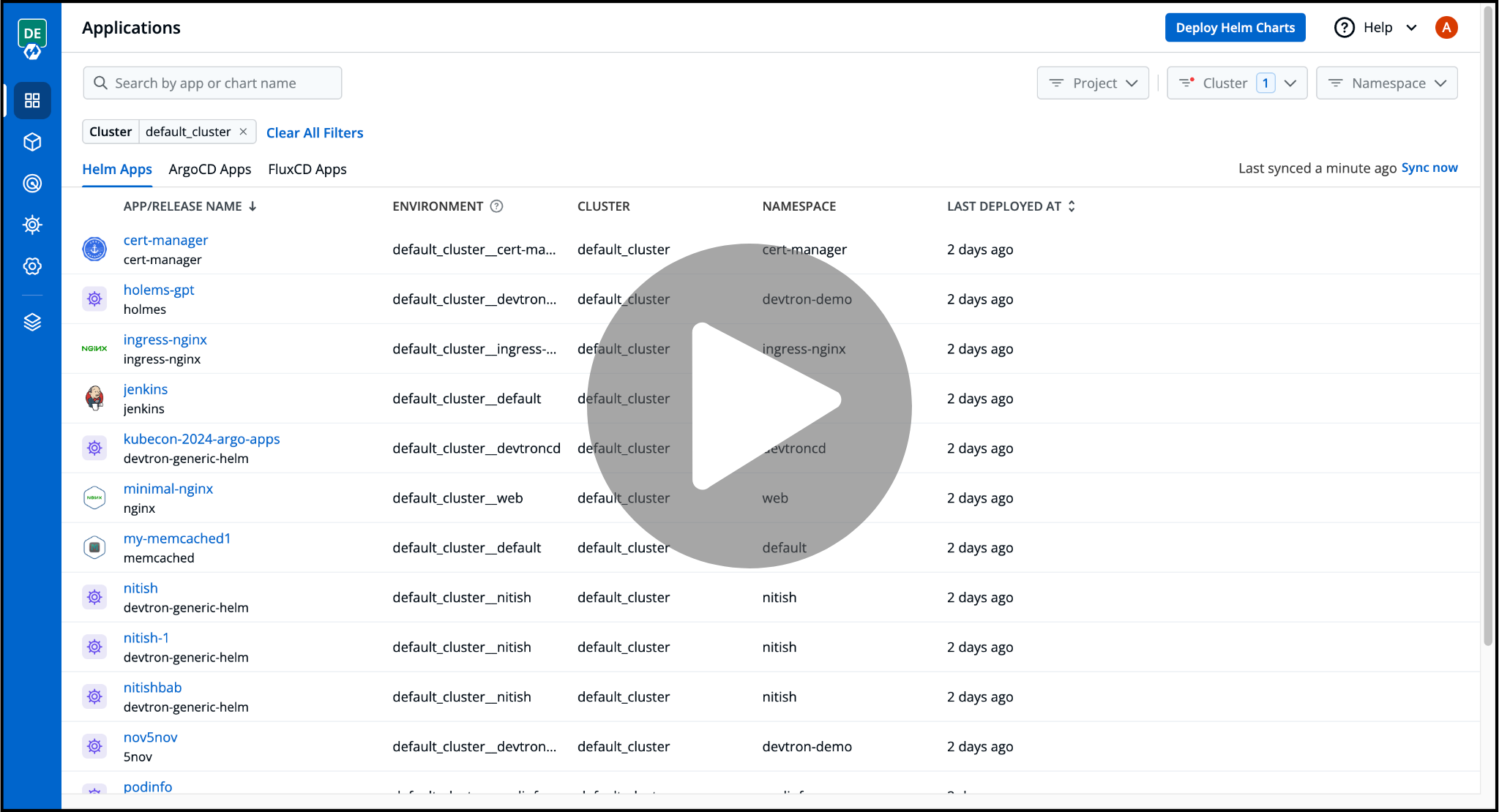
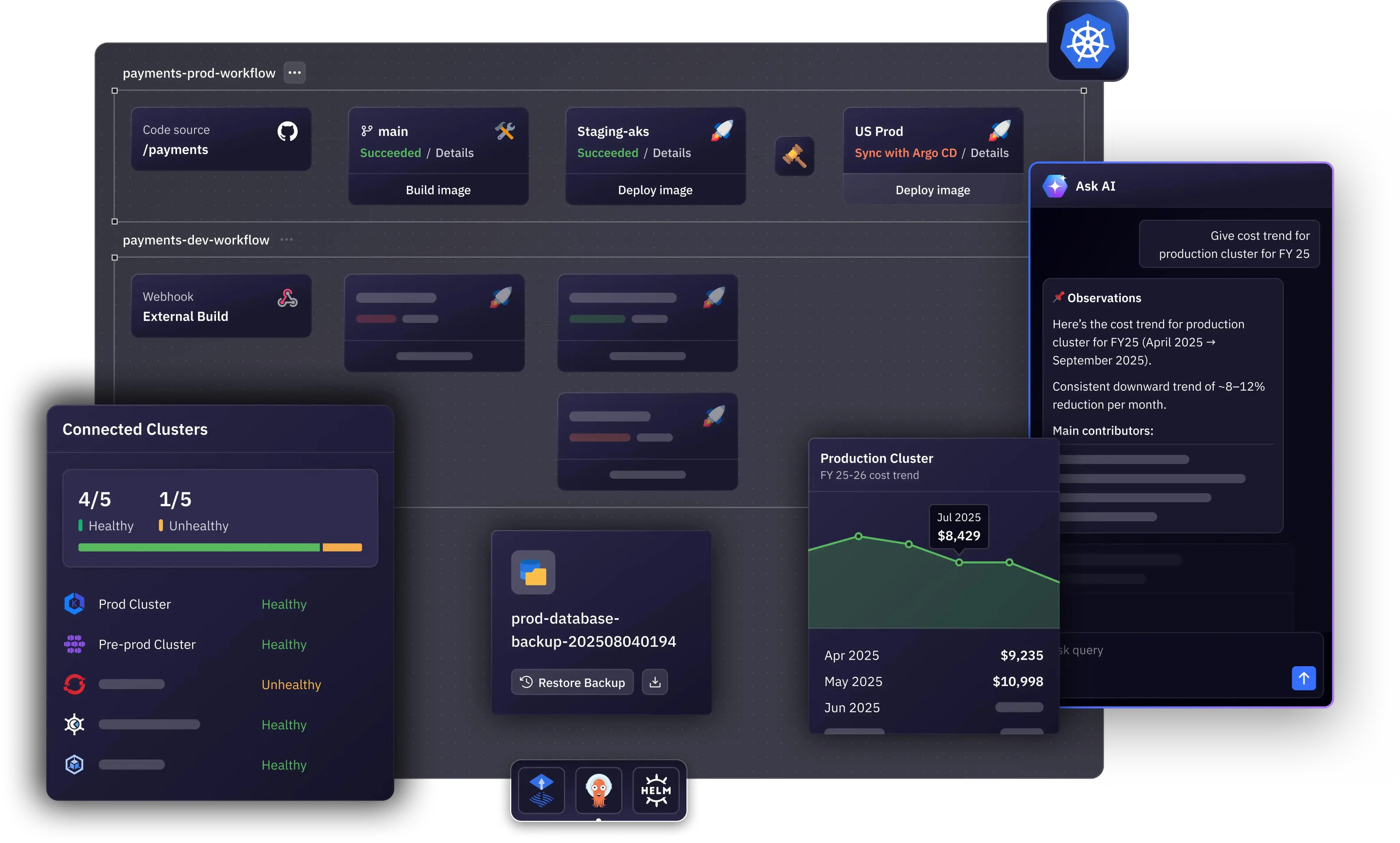
Devtron is an open-source Kubernetes management platform offering two overlapping products: a standalone dashboard for visualizing and managing Helm apps, ArgoCD, FluxCD, and cluster resources, and a fuller CI/CD pipeline system. It targets platform engineering and DevOps teams operating multiple Kubernetes clusters who want a unified, RBAC-controlled UI rather than assembling separate tools. The project is actively maintained, Helm-installable, and has a commercial SaaS offering alongside the OSS edition.
Created in October 2020 by Devtron Labs, the project began as a Kubernetes CI/CD platform. By 2024-2026 it had pivoted to also market a lighter standalone dashboard mode, reflecting industry demand for simpler cluster visibility without full pipeline adoption.
The project reached ~5,500 stars over roughly five years, a moderate pace suggesting steady organic interest rather than viral adoption. Recent star velocity (4 stars over 7 days as of late June 2026) indicates growth has plateaued or slowed significantly. The commercial SaaS offering and a Discord community (indicated in README) likely sustain engagement beyond pure GitHub metrics. The README restructuring and 'AI-Native' rebranding suggest an effort to reposition for 2025-2026 market trends.
Devtron Labs operates a commercial SaaS product (license.devtron.ai/dashboard) indicating real production deployments. The project lists enterprise-oriented features (SSO, fine-grained RBAC, multi-cluster) that suggest organizational adoption. A Discord community exists. However, independent third-party case studies or public production user lists are not documented in the README; verified scale of adoption cannot be confirmed from available metadata alone.
Likely a Go backend exposing REST/gRPC APIs with a separate frontend (not visible in this repo). Appears to be deployed via Helm chart into a dedicated 'devtroncd' namespace, suggesting a microservices or operator-based architecture. The README references an 'operator' Helm chart, implying a Kubernetes operator pattern for lifecycle management. Multi-cluster support likely uses kubeconfig or service-account-based federation.
Not documented in README
Last push was June 26, 2026 — two days before evaluation date — confirming very active development. GitHub badge shows monthly commit activity. The project holds a CII Best Practices badge, which requires documented processes around testing, security, and contribution standards. Maintenance posture appears strong.
ADOPT IF: your team manages multiple Kubernetes clusters and wants a single, self-hosted web UI covering Helm management, ArgoCD/FluxCD visibility, SSO, and RBAC without stitching multiple tools together. AVOID IF: you only need lightweight cluster inspection (Lens or kdash are simpler), you run a strictly GitOps-only workflow already covered by ArgoCD UI, or your organization cannot accept the operational overhead of running Devtron itself inside the cluster. MONITOR IF: you are evaluating internal developer platforms and want to see whether the 'AI-Native' repositioning and SaaS offering translate into a more polished managed experience before committing.
Independent dimensions
Mainstream potential
4/10
Technical importance
6/10
Adoption evidence
4/10
- Vendor-driven OSS: Devtron Labs controls the roadmap and offers a commercial SaaS tier; enterprise features may migrate behind a paywall over time.
- Self-hosting overhead: Devtron requires running its own operator and services inside the cluster, adding operational surface area that smaller teams may find disproportionate.
- Growth plateau risk: Very low recent star velocity (4/week) may indicate the project has saturated its initial audience without yet breaking into mainstream enterprise adoption.
- Broad scope creates complexity: Combining a dashboard, CI/CD pipelines, RBAC, and SSO in one tool increases upgrade risk and debugging surface compared to single-purpose tools.
- Competitive pressure: Well-funded platforms (Rancher, Backstage, ArgoCD ecosystem) continue to expand their UI capabilities, potentially narrowing Devtron's differentiation over time.
Devtron is likely to remain a viable, actively maintained option for teams that want a self-hosted, integrated Kubernetes management hub. It may grow modestly through its SaaS offering and 'AI-Native' rebranding, but breaking into mainstream adoption against entrenched incumbents will require sustained differentiation.
Newsletter
Get analyses like this every Monday
Free weekly digest of the most interesting open-source discoveries.
Languages
Information
- Website
- https://devtron.ai
- Language
- Go
- License
- Apache-2.0
- Last updated
- 1d ago
- Created
- 70mo ago
- Analyzed with
- anthropic/claude-haiku-4-5
Stars over time
Contributors over time
Top 100 contributors only — repos with more will plateau at 100.
Open issues
Feature: Pre/Post release for application groups
Feature: support scoped variables on project level also along with application and env level?
Backport workflow-hardening fix (excessive-permissions) to 5 release branches
Bug: Helm chart Unable to pass external database information when installing Devtron
Bug: Devtron Application Deployment Failure After Updating Bitbucket Tokens
Top contributors
Recent releases
Similar repos
| Repository | Stars | Week Δ | Language | Score | Updated |
|---|---|---|---|---|---|
|
devtron-labs/devtron
this
|
5.5k | +4 | Go | 7/10 | 1d ago |
 kite-org/kite kite-org/kite
|
2.9k | — | TypeScript | 7/10 | 2d ago |
 kdash-rs/kdash kdash-rs/kdash
|
2.5k | — | Rust | 8/10 | 13h ago |
 skyhook-io/radar skyhook-io/radar
|
2.5k | — | Go | 8/10 | 8h ago |
 devspace-sh/devspace devspace-sh/devspace
|
5.1k | — | Go | 8/10 | 6h ago |
 vladimirvivien/ktop vladimirvivien/ktop
|
1.1k | — | Go | 8/10 | 1w ago |
Helm Dashboard is narrowly focused on Helm release management and has slightly more stars (5,725). Devtron covers a much broader surface — multi-cluster resource browser, SSO, RBAC, CI/CD pipelines — making it heavier but more complete for teams that want a single platform.
Lens is the dominant desktop Kubernetes IDE. Devtron is web-hosted and self-served inside the cluster, making it more suitable for team-shared access and RBAC-controlled environments, while Lens excels as an individual developer tool.
DevSpace is a developer-workflow and inner-loop tool focused on local dev environments and deployment pipelines. Devtron targets operational visibility and production cluster management; the use cases overlap only partially.
Rancher is the enterprise-grade multi-cluster management incumbent. Devtron is lighter and more dev/DevOps-workflow-focused, while Rancher addresses broader infrastructure and lifecycle management at greater operational complexity.
Kdash is a fast terminal-based dashboard (TUI) for quick cluster inspection. Devtron is a full web UI with CI/CD and RBAC; they serve different personas — kdash for CLI-native developers, Devtron for teams needing shared, managed access.