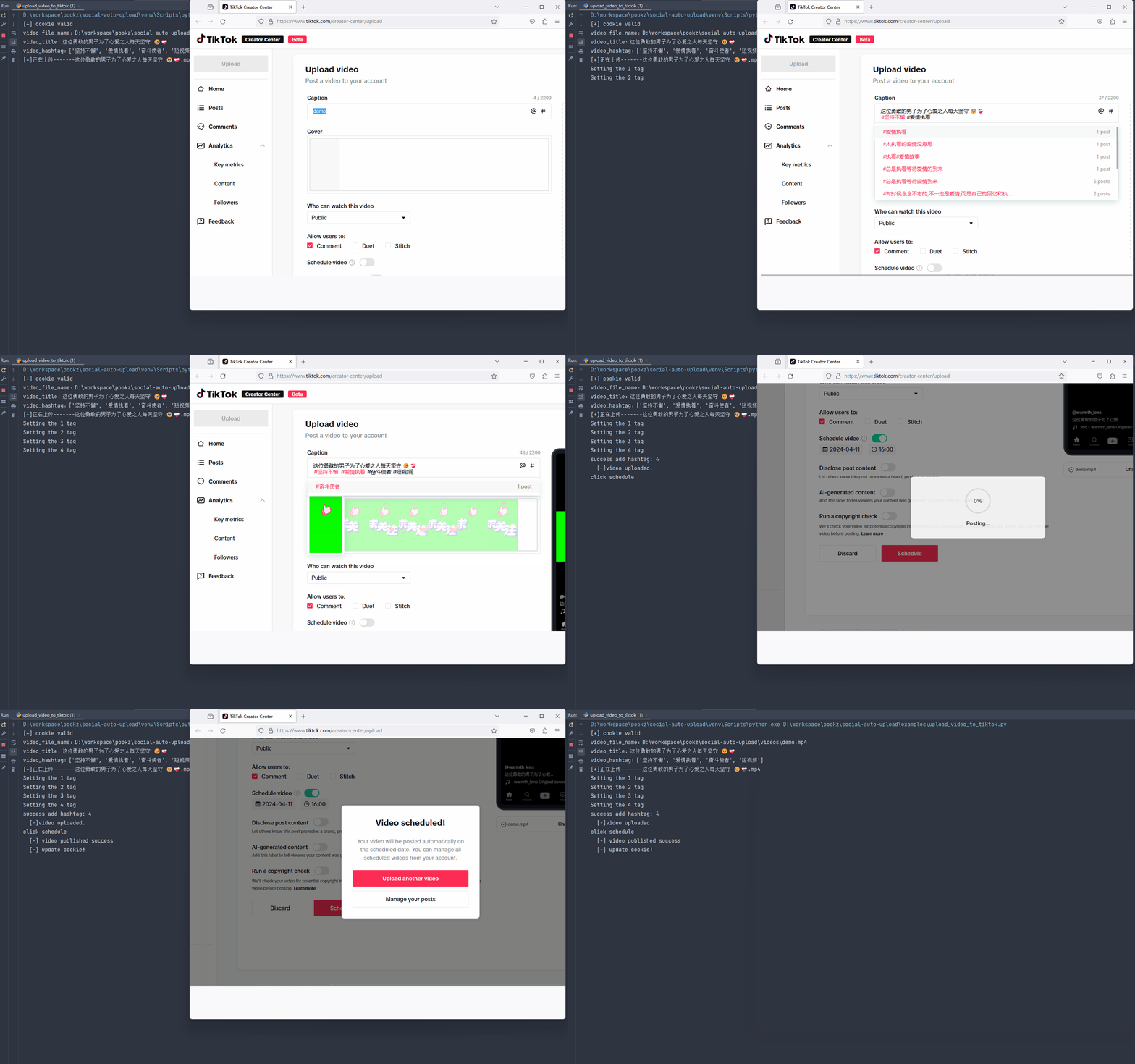
自动化上传视频到社交媒体:抖音、小红书、视频号、tiktok、youtube、bilibili
13.2k
Stars
2.3k
Forks
60
Open issues
24
Contributors


AI Analysis
A Python automation tool that uploads videos to multiple Chinese and international social media platforms (Douyin, Bilibili, Xiaohongshu, Kuaishou, WeChat Channels, Baijia, TikTok, YouTube) with scheduled posting support. Best suited for content creators and multi-platform distributors managing video matrices across multiple regions; not intended for general-purpose social media management.
Inferred from signals mentioned in the README (tests, CI, type safety) — not a review of the actual code.
AI's overall editorial judgment — not an average of the bars above, can weigh other factors too.
Python tool for automated multi-platform video publishing to Chinese and global social media
social-auto-upload automates video (and image-text) uploads to Douyin, Bilibili, Xiaohongshu, Kuaishou, WeChat Channels, Baidu Baijiahao, TikTok, and YouTube using browser automation (Playwright/patchright). It targets Chinese content creators, social media operators, and 'content matrix' builders who need to push the same video to many platforms without manual intervention. With 12,800+ stars, 2,200+ forks, and a stated community of 2,000+ members, it has real traction in the Chinese creator/operations tooling space. The project is now being refactored toward a unified CLI, headless mode, and AI-agent skill integration.
Created in December 2023, it grew steadily as short-video content monetization exploded in China. The project transitioned from a script-based approach to a CLI/skill architecture in 2025-2026, with the author pausing maintenance briefly in early 2025 before resuming active refactoring.
Growth appears driven by the surge in Chinese 'content matrix' operations — creators running many accounts across multiple platforms simultaneously. The 9k-to-12k+ star jump aligns with growing interest in automating repetitive publishing workflows and AI-agent integration for content ops. Sponsorships from AI tool vendors indicate commercial ecosystem relevance.
Author states a community of 2,000+ members (likely a WeChat/Discord group), 2,217 forks (suggesting practical deployment), and the presence of multiple paid sponsors focused on content creator tooling. These are indirect but credible signals of real-world use. No third-party case studies or public deployment metrics are documented in the README.
Likely a Playwright/patchright-based browser automation framework organized per-platform as uploader modules. README indicates a CLI layer ('sau' command), platform-specific 'skill' definitions for AI agent consumption, and a legacy web interface retained for backward compatibility but no longer the main development path. Appears to use uv for dependency management and supports headless browser operation.
not documented in README
Last push was 2026-06-21, just 2 days before evaluation date — clearly active. The author posted a transparency update in March 2026 acknowledging a slow period and committing to a refactoring sprint. Ongoing refactoring is visible in README (CLI unification, skill expansion, patchright migration). Maintenance appears genuine and accelerating rather than passive.
ADOPT IF: you are a Chinese content creator or operator running a multi-platform distribution workflow and can tolerate occasional breakage from platform UI changes. AVOID IF: you need production-grade reliability, have no tolerance for broken uploads after platform updates, or operate primarily on Western platforms not covered here. MONITOR IF: you are building AI-agent content pipelines and want a ready-made skill layer for social media publishing — the CLI/skill refactor may become genuinely useful for this use case in the near term.
Independent dimensions
Mainstream potential
5/10
Technical importance
6/10
Adoption evidence
5/10
- Browser automation against social media platforms is inherently fragile — any platform UI or anti-bot update can silently break uploads, requiring rapid maintainer response.
- The project depends heavily on a single maintainer who has acknowledged competing startup commitments, creating bus-factor and consistency risk.
- Platforms may detect and flag or ban accounts using automated browser-based uploads, which is a terms-of-service risk for users.
- The ongoing refactoring means documentation and example scripts may be out of sync with current code, increasing setup friction for new users.
- No formal license is listed, which creates ambiguity for commercial use or integration into proprietary tooling.
Likely to remain the go-to open-source tool for Chinese multi-platform video publishing automation, especially as AI-agent content workflows grow. Platform coverage and CLI maturity will improve, but structural fragility from browser automation is unlikely to disappear.
Newsletter
Get analyses like this every Monday
Free weekly digest of the most interesting open-source discoveries.
Languages
Information
- Website
- https://sap-doc.nasdaddy.com/
- Language
- Python
- Last updated
- 2w ago
- Created
- 32mo ago
- Analyzed with
- anthropic/claude-haiku-4-5
Stars over time
Contributors over time
Top 100 contributors only — repos with more will plateau at 100.
Open issues
易帷 ElasticView:集 AI 创作、素材管理、多平台自动发布、权限管理与团队协作于一体的一站式内容运营平台(支持docker部署以及api调用)。 官网:http://www.elastic-view.cn
[Debt] Backfill OpenSpec delta-format stubs (x57) / 回填 OpenSpec 存量 Stub
MIT License开源许可问题
`sau douyin login` fails end-to-end after the 2026 Q2 creator-center refactor
CLI 抖音/快手 headless 登录被平台识别为自动化,二维码扫码后被作废;同时 CLI 登录不会自动同步到 Web UI 账号表
Top contributors
Similar repos

CharlesPikachu/videodl
VideoDL is a lightweight Python-based video downloader supporting 30+ platforms...
| Repository | Stars | Week Δ | Language | Score | Updated |
|---|---|---|---|---|---|
|
dreammis/social-auto-upload
this
|
13.2k | +180 | Python | 7/10 | 2w ago |
 biliup/biliup biliup/biliup
|
5.3k | — | Rust | 7/10 | 5d ago |
 fqscfqj/Y2A-Auto fqscfqj/Y2A-Auto
|
1.5k | — | Python | 7/10 | 1d ago |
|
CharlesPikachu/videodl
|
2.4k | — | Python | 7/10 | 14h ago |
 difyz9/ytb2bili difyz9/ytb2bili
|
1.6k | — | Go | 7/10 | 2w ago |
 JoeanAmier/TikTokDownloader JoeanAmier/TikTokDownloader
|
15.1k | — | Python | 7/10 | 6d ago |
biliup focuses exclusively on Bilibili uploads and is implemented in Rust, suggesting a more performance-oriented and stable API integration. social-auto-upload wraps biliup for Bilibili support and covers a much broader platform set, but at the cost of maintaining fragile browser automations.
Solves the opposite problem — downloading content from TikTok/Douyin rather than uploading. Not a direct competitor, but often used alongside upload tools in content operations workflows.
Again focused on content extraction/download via API. Higher star count reflects broader appeal, but it does not address the upload/publishing use case that social-auto-upload targets.
General-purpose media downloader in Go. Overlaps only tangentially with social-auto-upload; serves a different workflow stage.
The actual baseline being replaced. Most platforms (Douyin, Xiaohongshu, etc.) have no official multi-platform upload API. Browser automation is currently the only automation path, making this tool's approach necessary rather than merely convenient for its target users.