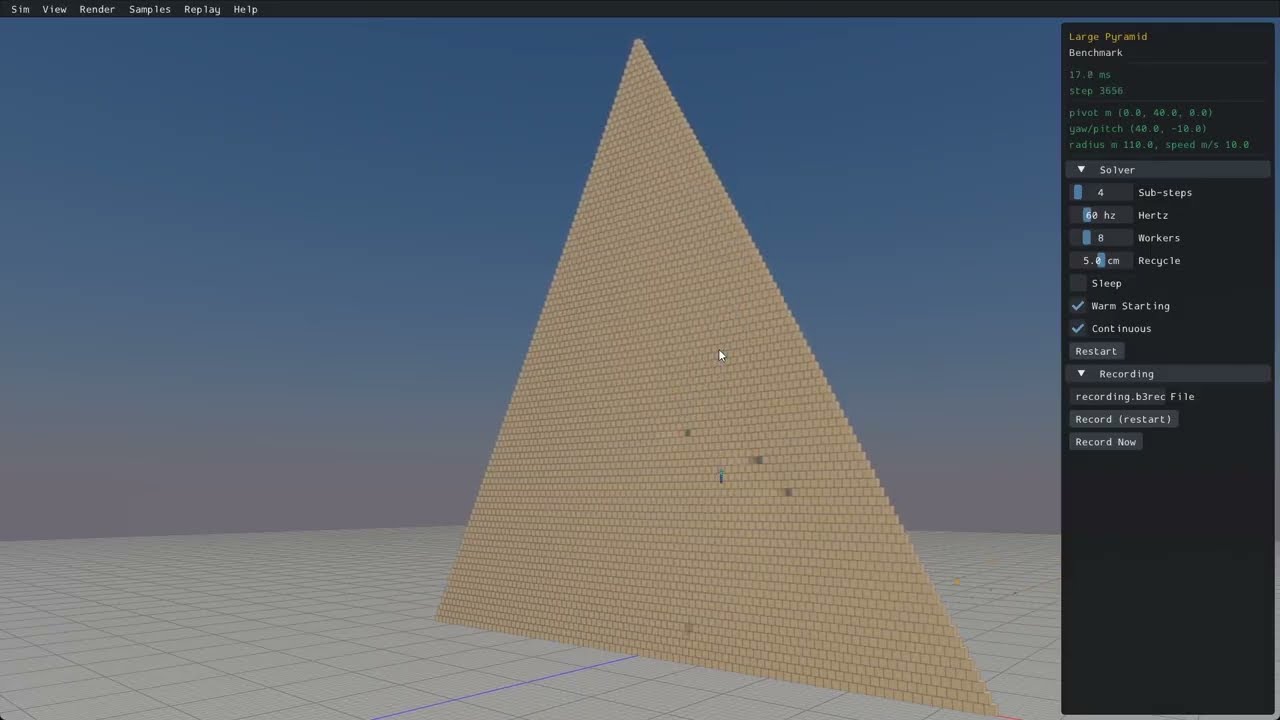
Box3D is a 3D physics engine for games
4.9k
Stars
213
Forks
11
Open issues
1
Contributors
AI Analysis
Box3D is a 3D rigid-body physics engine written in C, designed specifically for game development. It excels in scenarios requiring continuous collision detection, multi-body rigid dynamics, and deterministic cross-platform physics simulation. Best suited for game developers and graphics engineers building 3D games; not intended as a general-purpose physics library for scientific simulation or non-game applications.
Inferred from signals mentioned in the README (tests, CI, type safety) — not a review of the actual code.
AI's overall editorial judgment — not an average of the bars above, can weigh other factors too.
C-based 3D physics engine from Box2D creator, early release targeting game developers
Box3D is a 3D rigid-body physics engine written in C17, authored by Erin Catto (creator of the widely-adopted Box2D 2D physics engine). It emphasizes data-oriented design, multithreading, SIMD optimization, and deterministic simulation. Targeting game developers, it offers collision detection, joint systems, and character movement. Created May 2026 with 1,933 stars, it appears positioned as an open alternative in a space occupied by proprietary engines (PhysX, Havok) and other C/C++ solutions (Bullet, Jolt). Real-world adoption data is not yet available due to its nascent status.
Box3D is a 3D spiritual successor to Box2D, Catto's influential 2D physics engine first released in 2006 and widely adopted across indie and commercial games. The creator announced Box3D in mid-2026, leveraging his established reputation and community. The project entered public GitHub in May 2026 and has been actively updated since, suggesting a deliberate public launch rather than organic discovery.
The repository gained ~1,933 stars in approximately 2 months (May–July 2026), averaging roughly 30 stars per day in early growth phase. No stars were added in the last 7 days (as of 2026-07-03), which may reflect post-launch momentum settling or summer seasonal effects. The consistent commit activity (last push 2026-07-02, one day before analysis date) and YouTube launch video indicate active promotion and development. Growth trajectory appears healthy for a fresh release from an established creator, though still too early to distinguish temporary launch buzz from sustained adoption.
Adoption not verified. The project is approximately 2 months old as of analysis date. No case studies, published benchmarks, or documented game/studio usage are provided in README. Discord server mentioned but no membership/activity data available. YouTube introduction video released but viewership not stated. At this maturity stage, adoption would likely be experimental or internal to studios evaluating it, not yet public.
Based on README: data-oriented design with explicit SIMD support (SSE2, Neon) and multithreading optimizations for large body counts. Written in portable C17 with zero runtime dependencies beyond libc/libm. Appears to prioritize cache locality and determinism (stated 'cross platform determinism' and 'recording and replay'). Samples use sokol (graphics abstraction) and imgui (UI), indicating pragmatic decoupling of physics from rendering. No source code inspection performed; architecture claims rest on README statements.
Not documented in README. LLM use mentioned for 'unit tests' but no test framework, coverage metrics, or test suite details provided. Uncertainty remains about test comprehensiveness.
Very recent and actively maintained: repository created 2026-05-10, last commit 2026-07-02 (one day prior to analysis). Build CI status badge present. CLA assistant configured (indicating intent to accept community contributions, though pull requests currently disabled). Early-stage project lifecycle; not yet stagnant, but insufficient history to assess long-term maintenance patterns. Erin Catto's explicit statement of sole authorship responsibility suggests hands-on stewardship currently.
ADOPT IF: You are building games or simulations requiring 3D rigid-body physics, value open-source control and C portability, have tolerance for pre-v1.0 immaturity, and can contribute to early-stage library evolution. You distrust proprietary licensing or prefer integrating a focused physics solver rather than a monolithic engine. AVOID IF: You need production-hardened physics with extensive documented case studies, require comprehensive feature parity with commercial engines, depend on stable third-party plugin ecosystem, or need immediate community support for non-trivial physics scenarios. MONITOR IF: You are a mid-to-large studio evaluating physics solutions; watch for v1.0 release, adoption announcements from known studios, and community feedback over the next 12 months. If Catto sustains Bullet-like support cycles and adoption grows, Box3D could become the preferred open-source C solution.
Independent dimensions
Mainstream potential
4/10
Technical importance
7/10
Adoption evidence
1/10
- Early-stage immaturity: v0.1.0 tag suggests pre-release status; API and features may change significantly, risking integration rework in consuming projects.
- Single-author bottleneck: While Catto is highly credible, one primary maintainer creates concentration risk for long-term support, especially if priorities shift (e.g., back to Box2D maintenance or new projects).
- Adoption not yet validated: With zero documented production usage, edge cases and real-world physics scenarios may reveal design or performance limitations not caught by samples or internal testing.
- Pull request restrictions: PRs disabled in favor of issue-only feedback limits community code contribution, potentially slowing bug fixes and feature velocity compared to actively-merged alternatives.
- Unverified determinism claim: 'Cross platform determinism' is advertised but no determinism test suite or validation methodology is documented; critical for networked multiplayer or replay systems.
Box3D will likely reach v1.0 within 12–18 months and achieve modest production adoption in indie and small-to-mid indie studios, driven by Catto's reputation, open-source appeal, and C simplicity. Mainstream adoption to AAA parity unlikely; instead, it may establish itself as the preferred open C physics engine for developers avoiding C++ complexity and licensing costs. Jolt and PhysX will remain dominant; Box3D's niche is sustainable and valuable but not mainstream.
Newsletter
Get analyses like this every Monday
Free weekly digest of the most interesting open-source discoveries.
Languages
Information
- Language
- C
- License
- MIT
- Last updated
- 10h ago
- Created
- 2mo ago
- Analyzed with
- anthropic/claude-haiku-4-5
Stars over time
Contributors over time
Top 100 contributors only — repos with more will plateau at 100.
Open issues
Improvement of benchmark cli
Multi-convex bodies never sleep when stacked, solver-bound by redundant contacts
Hull SAT: compute the edge pair axis from the Gauss map arc intersection (~18% faster b3CollideHulls)
Feature Request: optional angular-only mode for the spherical joint
Sokol has no OpenGL on Win32, wants dlfcn.h and load .so libs with dlopen, instead of .dll and LoadLibrary.
Top contributors
Recent releases
Similar repos

bulletphysics/bullet3
Bullet Physics SDK is a mature, open-source real-time collision detection and...

GameFoundry/B3DFramework
B3D Framework is a modern C++17 library for building high-performance real-time...
| Repository | Stars | Week Δ | Language | Score | Updated |
|---|---|---|---|---|---|
|
erincatto/box3d
this
|
4.9k | +2.9k | C | 8/10 | 10h ago |
|
erincatto/box2d
|
10k | — | C | 9/10 | 2w ago |
|
bulletphysics/bullet3
|
14.6k | — | C++ | 7/10 | 9mo ago |
|
GameFoundry/B3DFramework
|
1.9k | — | C++ | 8/10 | 3d ago |
 ezEngine/ezEngine ezEngine/ezEngine
|
2k | — | C++ | 7/10 | 13h ago |
 piqnt/planck.js piqnt/planck.js
|
5.3k | — | TypeScript | 7/10 | 3mo ago |
PhysX is proprietary, closed-source, and GPU-accelerated; Box3D is open-source C and CPU-focused. PhysX has vast studio adoption; Box3D adoption is unverified. PhysX is mature; Box3D is ~2 months old. Box3D may appeal to developers preferring open-source control and C simplicity.
Bullet is C++ (not C), older (~20 years), and has established production usage. Both are open-source. Box3D emphasizes determinism and data-oriented design; Bullet is more feature-complete but less actively modernized. Box3D may offer better multithreading/SIMD on modern hardware.
Jolt is C++, newer than Bullet, open-source, actively developed, and gaining adoption. Both prioritize performance and modern CPU architecture. Jolt appears more feature-complete and has documented studio adoption (e.g., Horizon Forbidden West used physics-inspired techniques). Box3D's C focus and Catto's reputation may compete for developers valuing simplicity and legacy systems support.
Havok is proprietary, closed-source, widely used in AAA studios, and integrated into game engines. Box3D is open-source and independent. Box3D unlikely to displace Havok in enterprise; may appeal to indie and mid-tier studios avoiding licensing costs.
ODE is C/C++, open-source, older (~25 years), and minimally maintained. Box3D appears to supersede ODE in design philosophy and active development. ODE represents the legacy alternative; Box3D modernizes the open-source C physics engine category.