ESP8266 RFID (RC522, PN532, Wiegand, RDM6300) Access Control system featuring WebSocket, JSON, NTP Client, Javascript, SPIFFS
1.5k
Stars
438
Forks
74
Open issues
29
Contributors


AI Analysis
ESP-RFID is a complete, ready-to-use access control system built on the ESP8266 microcontroller, supporting multiple RFID reader types (RC522, PN532, Wiegand, RDM6300). It is purpose-built for maker spaces, labs, schools, and small organizations that need affordable RFID-based door access management with a web UI, WebSocket communication, and optional MQTT integration. This is a specialized tool for physical access control—not a general-purpose platform—best suited for technical users comfort...
Inferred from signals mentioned in the README (tests, CI, type safety) — not a review of the actual code.
AI's overall editorial judgment — not an average of the bars above, can weigh other factors too.
ESP8266 RFID access control system with web UI, serving maker spaces and small installations since 2017
ESP-RFID is an open-source access control solution built on the ESP8266 microcontroller, supporting multiple RFID reader types (RC522, PN532, RDM6300, Wiegand). It targets maker spaces, labs, and schools seeking low-cost, self-hosted door access systems. Users configure the system entirely through a web UI; the system manages up to 1,000+ user records, logs events with NTP timestamps, and supports MQTT integration. The project has maintained a stable community since 2017, with active development continuing as of June 2026.
Launched in May 2017, ESP-RFID emerged during the maker IoT boom when ESP8266 modules became ubiquitous and cheap. The project filled a gap for affordable, open-source access control without proprietary cloud dependencies. It evolved from a single-reader implementation to supporting multiple RFID protocols and offering both DIY assembly and official commercial boards via Tindie.
The project gained steady adoption within the maker community (1,473 stars, 438 forks) but shows slow recent growth (2 stars in last 7 days as of late June 2026). Growth was likely front-loaded during 2017–2020 when ESP8266 projects peaked in popularity. Current trajectory suggests stable maintenance rather than expansion—the README states 'still in development phase' but lacks recent feature announcements. The availability of official hardware boards on Tindie may have converted developer interest into deployed installations rather than continued GitHub activity.
README contains five testimonials from users praising the project ('works like a charm', 'impressive', 'brilliant'), but these are anecdotal quotes without timestamps or identifiable deployment scale. Tindie hardware sales suggest real-world installations exist, but sales volumes are not public. GitHub issues and discussions (not visible in provided metadata) would reveal production pain points; this cannot be assessed. Adoption not verified at quantifiable scale.
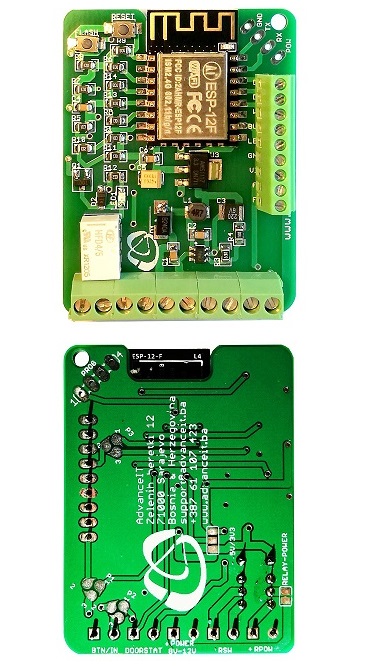
Based on README, the system uses ESP8266 with PlatformIO as build framework, ESPAsyncWebServer for real-time communication, WebSocket protocol for browser-hardware data exchange, and JSON encoding for messages. Likely uses SPIFFS for file storage. Appears to support multiple RFID reader types through abstracted driver interfaces, though README does not detail the abstraction layer. Official hardware includes relay control, door sensor input, and 12V power management.
Not documented in README. No mention of unit tests, CI/CD pipelines, or automated test suites. Testing approach appears manual or community-driven.
Last push 2026-06-17 (approximately 18 days before analysis date), indicating active repository maintenance. However, frequency of commits and PR review turnaround are not visible from metadata alone. README labels the project as 'still in development phase' with frequent changes and potential deprecations—this may indicate active iteration or may reflect documentation not updated since early versions. Gitter chat link and Open Collective funding suggest community engagement, but adoption level of those channels is unknown.
ADOPT IF: building a small-scale access control system (maker space, lab, school) with a single or few entry points, you want full local control without cloud dependency, and you are comfortable with DIY hardware assembly and web-based configuration. AVOID IF: you need enterprise-grade multi-building access management, real-time cloud integration, or high uptime guarantees (SLA). MONITOR IF: you depend on the ESP8266 platform—Espressif's shift toward ESP32 means ESP8266 support may eventually stall; evaluate ESP32 port viability before committing to large deployments.
Independent dimensions
Mainstream potential
3/10
Technical importance
6/10
Adoption evidence
4/10
- ESP8266 is aging hardware (Espressif focuses on ESP32); long-term vendor support uncertain. Firmware updates and security patches may eventually decline.
- Test coverage not documented; production reliability not independently verified. Community-driven testing may miss edge cases.
- README states project is 'still in development phase' with frequent changes and potential deprecations—stability for critical access control not guaranteed.
- Single-author or small-team maintenance apparent from GitHub metadata; bus factor risk if primary maintainers disengage.
- MQTT and NTP dependencies could fail silently if network connectivity drops; fallback behavior not documented in README excerpt.
Project likely remains a stable, niche solution for small installations. Mainstream adoption unlikely due to ESP8266 decline and fragmentation across multiple RFID protocols. May eventually see migration to ESP32-based fork or absorption into broader automation frameworks. Maintenance will probably slow unless institutional backing (e.g., hackerspaces adopting it as standard) emerges.
Newsletter
Get analyses like this every Monday
Free weekly digest of the most interesting open-source discoveries.
Languages
Information
- Language
- C++
- License
- MIT
- Last updated
- 3w ago
- Created
- 112mo ago
- Analyzed with
- anthropic/claude-haiku-4-5
Stars over time
Contributors over time
Top 100 contributors only — repos with more will plateau at 100.
Open issues
Top contributors
Recent releases
Similar repos

letscontrolit/ESPEasy
ESPEasy is a firmware framework for ESP8266/ESP32 microcontrollers that enables...

cifertech/ESP32-DIV
ESP32-DIV is a wireless offensive and defensive toolkit built on the ESP32-S3...
| Repository | Stars | Week Δ | Language | Score | Updated |
|---|---|---|---|---|---|
|
esprfid/esp-rfid
this
|
1.5k | — | C++ | 7/10 | 3w ago |
 miguelbalboa/rfid miguelbalboa/rfid
|
3k | — | C++ | 6/10 | 1w ago |
|
letscontrolit/ESPEasy
|
3.5k | — | C++ | 7/10 | 2w ago |
 esphome/esphome esphome/esphome
|
11.4k | — | C++ | 8/10 | 9h ago |
|
cifertech/ESP32-DIV
|
3.4k | — | C++ | 7/10 | 6d ago |
 cyberman54/ESP32-Paxcounter cyberman54/ESP32-Paxcounter
|
2k | — | C++ | 7/10 | 1mo ago |
Lower-level MFRC522 driver library (3,021 stars). Requires users to build access control logic themselves; ESP-RFID is a complete system. Different scope: library vs. application.
General-purpose ESP8266/ESP32 automation framework (3,502 stars). Covers RFID as one plugin among many; ESP-RFID is purpose-built for access control only. ESPEasy broader but less specialized.
Declarative smart home platform (11,342 stars). Supports RFID but requires Home Assistant integration; ESP-RFID standalone with built-in web UI. ESPHome more extensible but steeper learning curve for simple access control.
ESP32-based projects (3,318 and 2,034 stars respectively). ESP-RFID explicitly targets ESP8266 only. ESP32 projects offer more RAM/compute but require different hardware; not direct substitutes for cost-conscious setups.