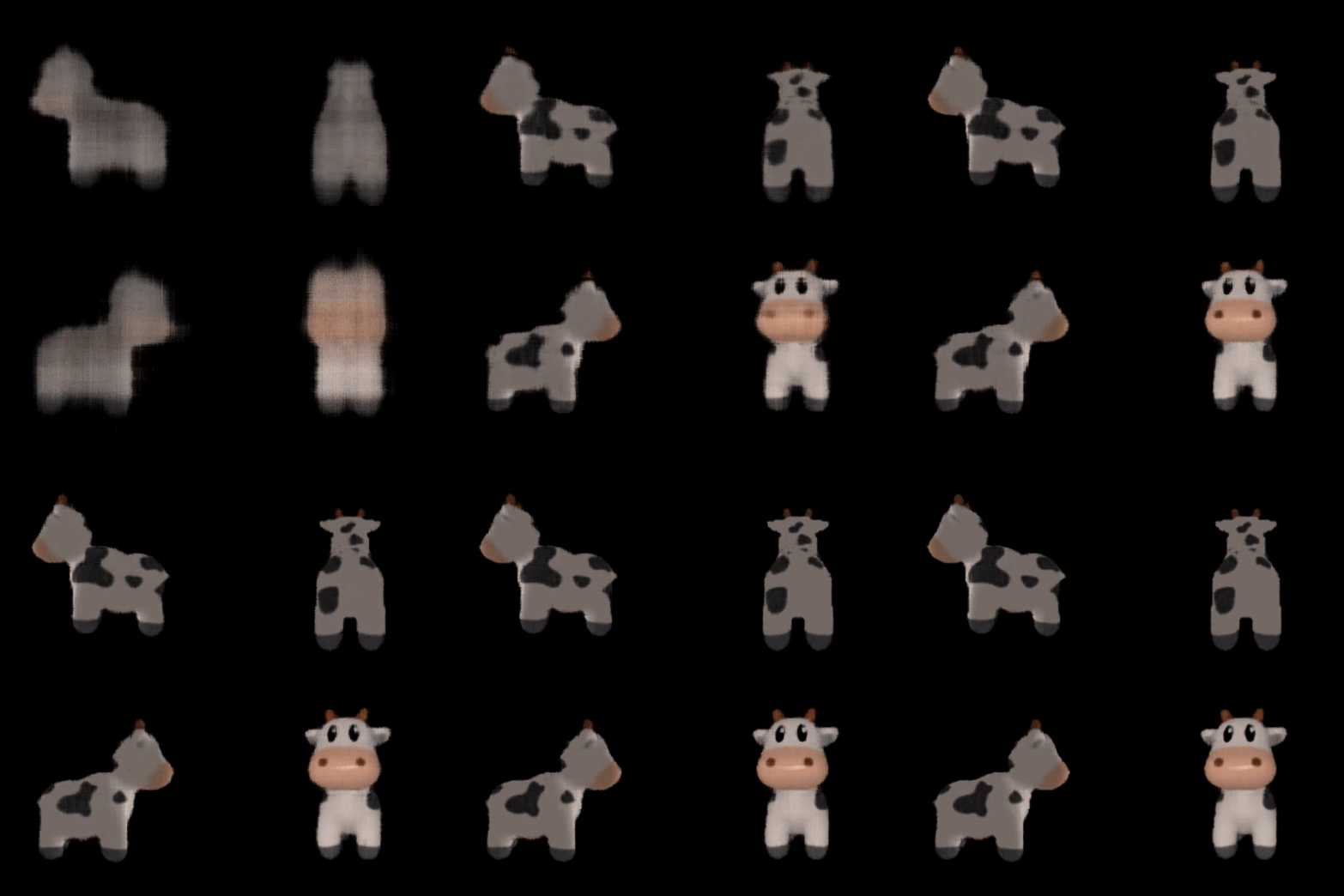
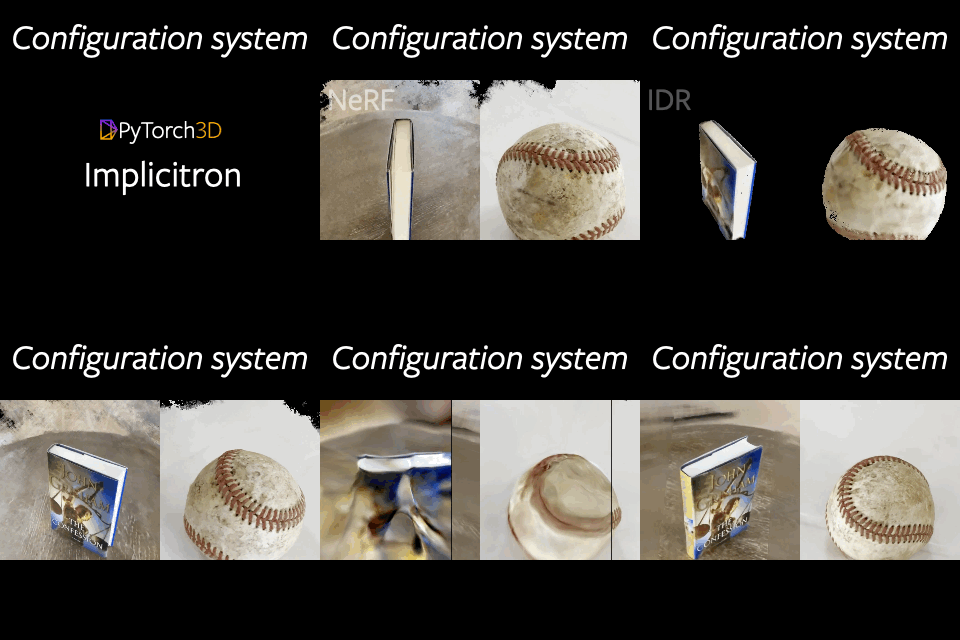
PyTorch3D is FAIR's library of reusable components for deep learning with 3D data
9.9k
Stars
1.5k
Forks
317
Open issues
30
Contributors


AI Analysis
PyTorch3D is FAIR's specialized library for 3D computer vision research, providing efficient PyTorch-native components for mesh manipulation, differentiable rendering, and implicit neural representations. It serves researchers and practitioners building deep learning models on 3D data—particularly those working on mesh reconstruction, novel view synthesis, and 3D geometry optimization—and is not suited for general-purpose 2D vision or non-research applications lacking 3D data workflows.
Inferred from signals mentioned in the README (tests, CI, type safety) — not a review of the actual code.
AI's overall editorial judgment — not an average of the bars above, can weigh other factors too.
FAIR's PyTorch3D brings differentiable 3D mesh and rendering ops to deep learning research
PyTorch3D is a research-grade library from Meta's FAIR group that provides GPU-accelerated, differentiable primitives for 3D computer vision: triangle mesh data structures, projective transforms, differentiable renderers, and implicit neural representation tools via Implicitron. Its primary audience is academic researchers and applied ML engineers working on 3D reconstruction, novel-view synthesis, and mesh-based deep learning. It has been used internally at FAIR to power publications like Mesh R-CNN, and has accumulated ~9,900 GitHub stars since 2019, indicating meaningful research community adoption.
Launched by FAIR in October 2019 to standardize 3D deep learning primitives across internal research. Has expanded progressively to include NeRF support and Implicitron for neural implicit representations.
Growth was strongest in 2020–2022, driven by the explosion of NeRF and differentiable rendering research. Star accumulation has plateaued at roughly 3 new stars per week as of mid-2026, consistent with a maturing specialized research library rather than a rapidly expanding general-purpose tool. The rise of Gaussian Splatting and newer scene representation methods may have shifted some researcher attention away.
Explicitly cited as powering internal FAIR research (Mesh R-CNN). 1,457 forks suggest meaningful reuse in derivative research codebases. Conda package availability indicates it has been used beyond just source installs. However, evidence of production deployment outside academic/research contexts is not documented in the README or available metadata.
Appears to be a modular Python/CUDA library built on top of PyTorch tensors. Likely implements custom CUDA kernels for performance-critical mesh operations alongside pure Python/PyTorch layers. Implicitron is a higher-level framework layered on top. All operators are designed to be batchable and differentiable by construction.
CI is active via CircleCI as shown in the README badge, indicating automated testing exists. Specific coverage metrics are not documented in the README.
Last push was June 13, 2026, approximately 10 days before evaluation date — the project is actively maintained. Anaconda package badge suggests maintained release artifacts. Given its age (since 2019) and continued pushes, it appears to be in slow but active maintenance rather than feature expansion mode.
ADOPT IF: you are doing research involving differentiable mesh processing, 3D reconstruction from images, or neural implicit representations in a PyTorch environment and need well-tested, GPU-accelerated primitives. AVOID IF: your workflow centers on Gaussian Splatting, real-time rendering, or production 3D pipelines where pure research-grade code may introduce operational risk. MONITOR IF: you are building NeRF-adjacent systems, as the field's tooling landscape is evolving rapidly and PyTorch3D's positioning relative to nerfstudio/threestudio may shift.
Independent dimensions
Mainstream potential
3/10
Technical importance
8/10
Adoption evidence
5/10
- Installation complexity is non-trivial due to custom CUDA extensions — documented in a separate INSTALL.md, which historically has been a friction point for new users.
- The research landscape has shifted toward Gaussian Splatting (3DGS) since 2023; PyTorch3D's mesh and implicit-rendering focus may see reduced relevance for the most active research directions.
- Maintenance appears sustained but growth has slowed significantly — future investment from Meta/FAIR may not keep pace with emerging paradigms.
- PyTorch version coupling means updates to PyTorch core can introduce compatibility breaks that require library updates to resolve.
- Limited evidence of adoption outside academic research settings means production hardening, long-term API stability guarantees, and enterprise support are uncertain.
Likely to remain a stable, respected reference library for mesh-based 3D deep learning research, but may gradually lose centrality as Gaussian Splatting and diffusion-based 3D generation tools define the next wave of research infrastructure.
Newsletter
Get analyses like this every Monday
Free weekly digest of the most interesting open-source discoveries.
Languages
Information
- Website
- https://pytorch3d.org/
- Language
- Python
- License
- NOASSERTION
- Last updated
- 2w ago
- Created
- 82mo ago
- Analyzed with
- anthropic/claude-haiku-4-5
Stars over time
Contributors over time
Top 100 contributors only — repos with more will plateau at 100.
Open issues
Top contributors
Similar repos
facebookresearch/dinov3
DINOv3 is a self-supervised vision foundation model from Meta AI Research that...
facebookresearch/detectron2
Detectron2 is Meta AI Research's modular library providing state-of-the-art...
facebookresearch/map-anything
MapAnything is a research framework for universal metric 3D reconstruction that...

1adrianb/face-alignment
A PyTorch-based library for detecting 2D and 3D facial landmarks using deep...
| Repository | Stars | Week Δ | Language | Score | Updated |
|---|---|---|---|---|---|
|
facebookresearch/pytorch3d
this
|
9.9k | +6 | Python | 8/10 | 2w ago |
|
facebookresearch/dinov3
|
10.9k | — | Jupyter Notebook | 8/10 | 4w ago |
|
facebookresearch/detectron2
|
34.6k | — | Python | 8/10 | 1mo ago |
|
facebookresearch/map-anything
|
3.5k | — | Python | 8/10 | 1mo ago |
|
1adrianb/face-alignment
|
7.5k | — | Python | 7/10 | 3mo ago |
 isl-org/Open3D isl-org/Open3D
|
13.8k | — | C++ | 8/10 | 7h ago |
Open3D is broader in scope (point clouds, visualization, SLAM) and has a C++ core with Python bindings. PyTorch3D is narrower but better integrated with PyTorch autograd for differentiable pipelines. They are more complementary than direct competitors.
Kaolin is NVIDIA's analogous library for 3D deep learning, also offering differentiable rendering. Kaolin may have better CUDA optimization on NVIDIA hardware; PyTorch3D has a stronger academic publication record and tutorial ecosystem.
nvdiffrast is a minimal, high-performance differentiable rasterizer from NVIDIA Research. It outperforms PyTorch3D's renderer in speed but is not a full-featured library — users needing only rasterization may prefer it.
trimesh handles mesh I/O and geometry operations well but is not differentiable and not GPU-accelerated. PyTorch3D is the right choice when gradients through mesh operations are required.
These newer frameworks target NeRF and 3DGS workflows specifically and have gained momentum in 2024–2026. They may be preferred for novel-view synthesis tasks, while PyTorch3D remains relevant for mesh-centric differentiable learning.