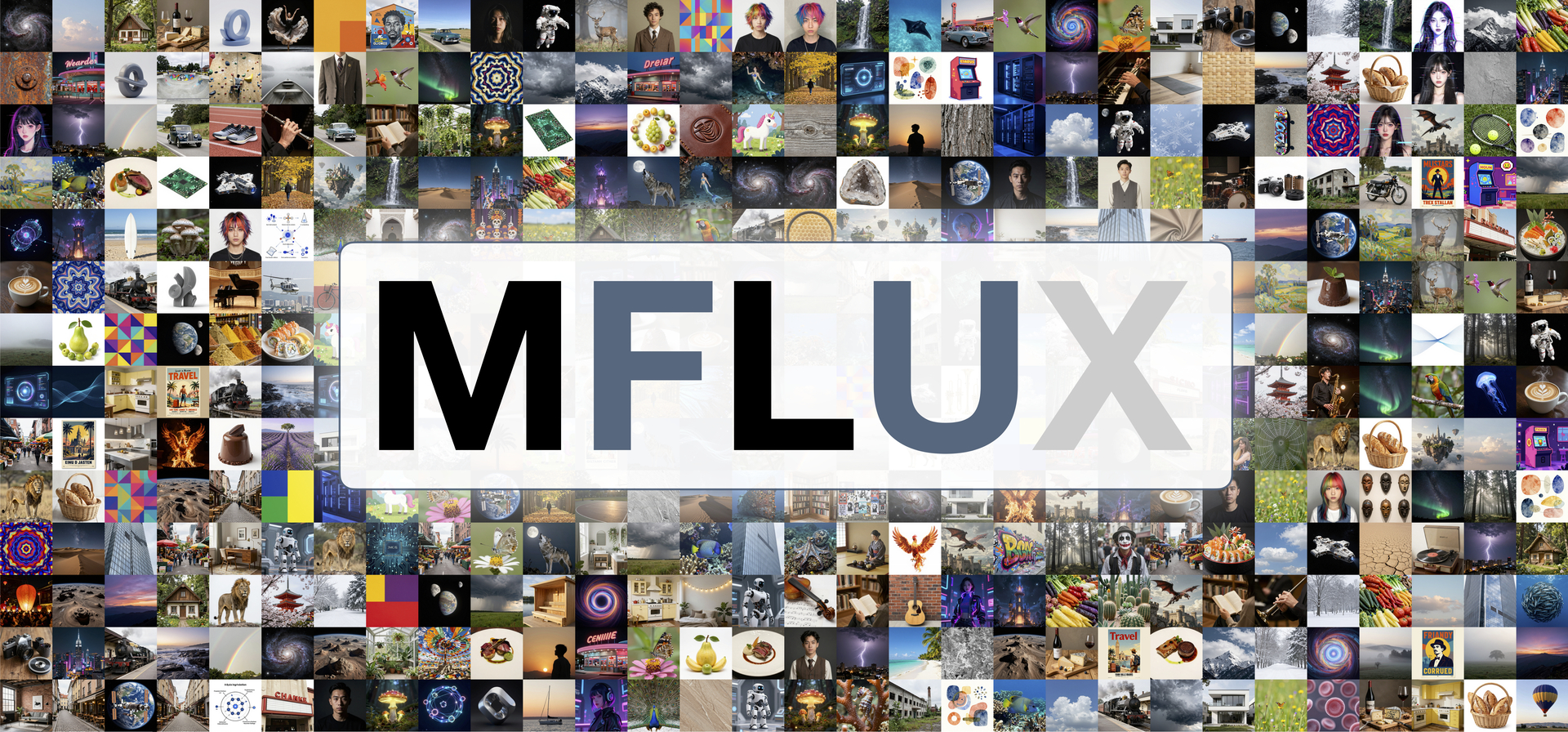
MLX native implementations of state-of-the-art generative image models
2.2k
Stars
157
Forks
110
Open issues
27
Contributors




AI Analysis
MFLUX is a specialized library for running state-of-the-art generative image models (Flux, Qwen, Z-Image) natively on Apple Silicon using MLX, with no GPU required. It is designed specifically for Mac users who want performant local image generation; it is not a general-purpose ML framework and is not intended for users on other platforms or those needing NVIDIA GPU support.
Inferred from signals mentioned in the README (tests, CI, type safety) — not a review of the actual code.
AI's overall editorial judgment — not an average of the bars above, can weigh other factors too.
MLX-native port of SOTA generative image models for local Mac inference
MFLUX is a Python library that reimplements state-of-the-art text-to-image and image editing models natively for MLX, Apple's machine learning framework. Built specifically for running on local Mac hardware without cloud dependencies, it supports models like FLUX.2, Z-Image, Krea2, and others. Adoption appears concentrated among Mac-based ML practitioners and developers seeking local inference; production adoption signals remain unverified, though the recent release cadence and model diversity suggest active use.
Project created August 2024, emerging as MLX adoption accelerated in the Apple silicon community. Built as a direct port of Hugging Face Diffusers/Transformers models, following minimalist, explicit coding principles. Positioned in the rapidly growing local generative AI ecosystem rather than as a centralized cloud service replacement.
Steady accumulation to ~2,200 stars over 22 months, with 156 forks suggesting developer interest. Gained 14 stars in last 7 days (modest weekly pace). Growth appears tied to SOTA model releases (Z-Image Nov 2025, FLUX.2 Jan 2026, Krea2/Ideogram4 Jun 2026) being rapidly ported to MLX, indicating reactive/opportunistic rather than organic demand-driven expansion. Recent activity concentrated post-January 2026.
Adoption not verified. No case studies, blog posts, or deployment examples documented in README. PyPI distribution available (mflux package noted in shields), suggesting some installation activity, but download metrics not disclosed. Community signals limited to GitHub stars/forks. Project describes itself as minimalist and developer-oriented, which may indicate early-adopter/enthusiast user base rather than production operations teams.
Appears to be a collection of model-specific implementations (Z-Image, FLUX.2, Krea2, Ideogram4, ERNIE-Image, FIBO, Qwen, Depth Pro, legacy FLUX.1) each with dedicated READMEs and CLI entry points. Based on README, architecture emphasizes explicit, line-by-line MLX reimplementation rather than abstraction layers. Quantization, LoRA support, and ControlNet appear to be cross-cutting features. Uses Hugging Face tokenizers as external dependency.
CI badge present in README (GitHub Actions tests.yml) but README does not detail test scope, coverage metrics, or test philosophy. Presence of CI suggests at least basic validation; extent unknown.
Last push 2026-06-30 (8 days before analysis date), indicating very recent activity. Repository created 2024-08-10, making it ~22 months old at analysis. Multiple model implementations added through 2025–2026 period, with releases tracked closely to upstream SOTA releases. No evidence of stagnation; maintenance appears active, though growth trajectory is measured rather than accelerating.
ADOPT IF: you develop on Mac, need local generative image inference without cloud cost, and can tolerate a younger codebase with narrower model support than Diffusers. AVOID IF: you need cross-platform hardware support, production uptime guarantees, or extensive third-party integrations. MONITOR IF: you're tracking local-inference trends; this is an indicator of demand for Mac-native ML but adoption signals remain inconclusive.
Independent dimensions
Mainstream potential
3/10
Technical importance
6/10
Adoption evidence
2/10
- Adoption unverified: no public case studies or production deployment reports; user base opaque.
- Maintainer bus factor: single-maintainer project (filipstrand); sustainability unclear if lead contributor steps back.
- Rapid model churn: porting new models frequently may spread maintenance effort thin; long-term quality/stability of older models unknown.
- MLX ecosystem lock-in: tightly coupled to MLX; changes to MLX upstream could require significant rework.
- Limited feature parity with Diffusers: README implies intentional minimalism but also implies some Diffusers features are absent or delayed in MFLUX ports.
Likely to remain a niche, specialized tool for Mac-based generative AI development. May grow incrementally as more developers adopt Apple silicon and demand local inference, but unlikely to achieve mainstream adoption beyond the Mac developer community. Success will be measured by active maintenance cadence and model currency rather than absolute star count.
Explore similar
Newsletter
Get analyses like this every Monday
Free weekly digest of the most interesting open-source discoveries.
Languages
Information
- Language
- Python
- License
- MIT
- Last updated
- 1w ago
- Created
- 23mo ago
- Analyzed with
- anthropic/claude-haiku-4-5
Stars over time
Contributors over time
Top 100 contributors only — repos with more will plateau at 100.
Open issues
Perf: `_hist_match` inverts a permutation via a second `np.argsort` (O(N log N) → O(N))
FIBO (base briaai/FIBO) txt2img produces pure noise — transformer velocity ~5–8× too small
Golden image comparator: atol is hardcoded to 0, so dark regions stay strict across hardware (low priority)
Request for inclusion in Related Projects
Stepwise images often don’t provide a useful preview of intermediate states
Open pull requests
Top contributors
Similar repos
| Repository | Stars | Week Δ | Language | Score | Updated |
|---|---|---|---|---|---|
|
filipstrand/mflux
this
|
2.2k | +19 | Python | 7/10 | 1w ago |
 Blaizzy/mlx-vlm Blaizzy/mlx-vlm
|
5.1k | — | Python | 7/10 | 18h ago |
 ml-explore/mlx ml-explore/mlx
|
27.5k | — | C++ | 8/10 | 12h ago |
 black-forest-labs/flux black-forest-labs/flux
|
25.7k | — | Python | 8/10 | 11mo ago |
Official FLUX reference implementation; supports multiple backends. MFLUX is a specialized, MLX-only port with no pretense of being the canonical implementation.
Larger MLX-focused sibling covering vision-language models. MFLUX narrower in scope (image generation only) but appears more actively maintained for generative models specifically.
Core MLX framework. MFLUX is a consumer library; depends on MLX ecosystem, not a competitor.
MFLUX is an opinionated, minimalist re-port of Diffusers models to MLX. Trade-off is Mac-local inference vs. broader hardware support and ecosystem maturity.
MFLUX is image-generation-specific; these are broader local ML platforms. Non-overlapping use cases unless extended.