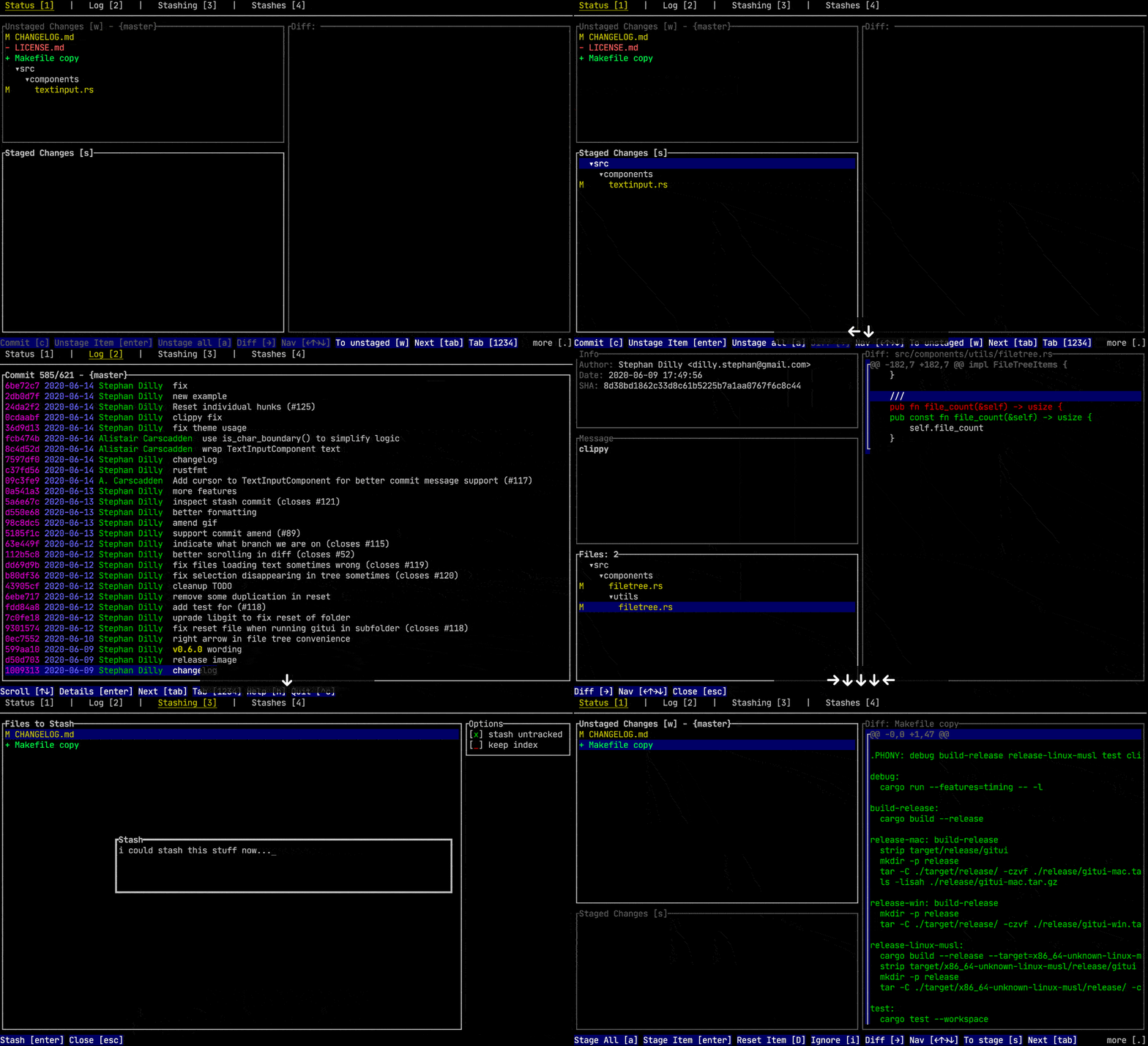
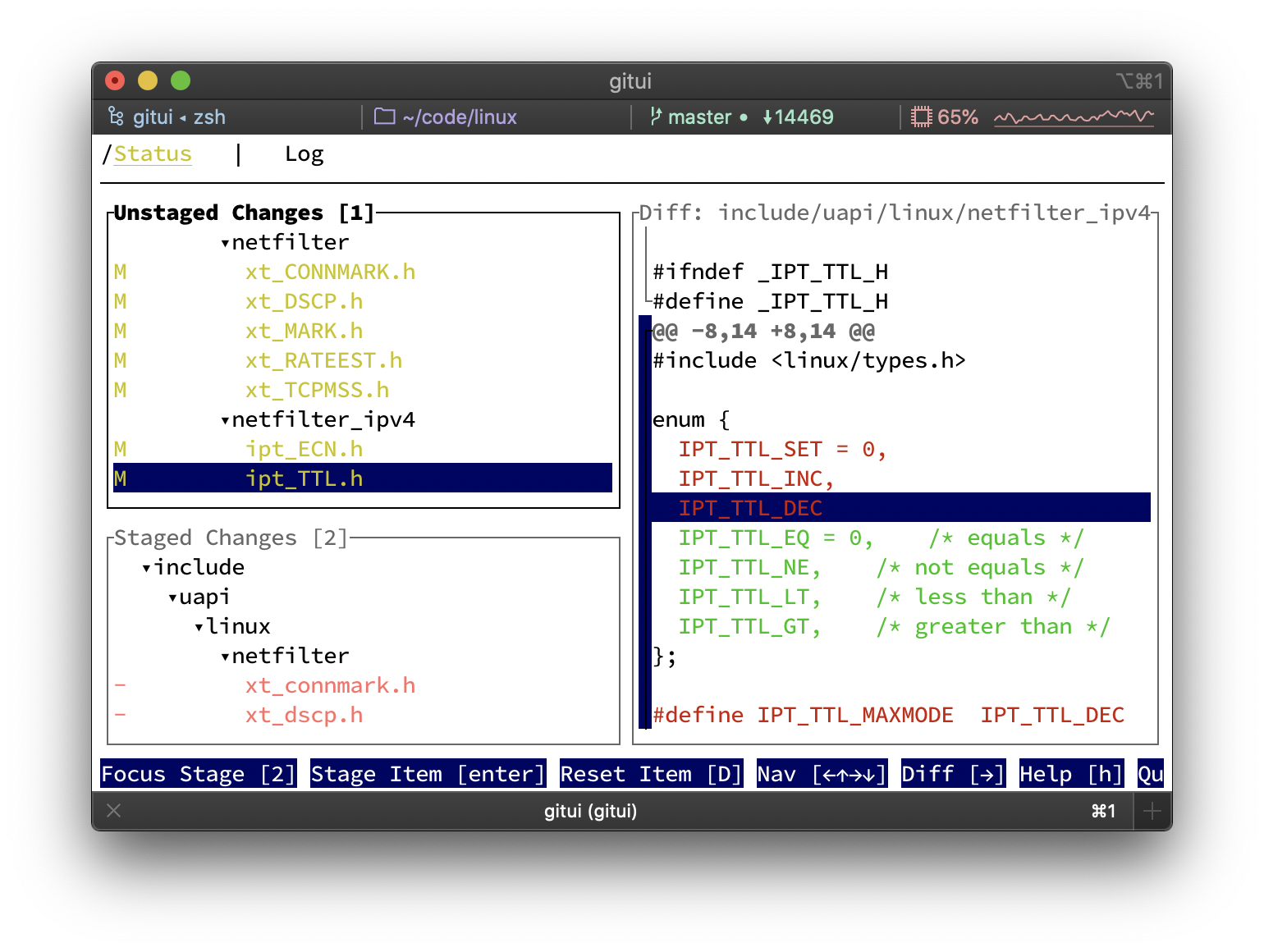
Blazing 💥 fast terminal-ui for git written in rust 🦀
22.2k
Stars
743
Forks
319
Open issues
30
Contributors


AI Analysis
GitUI is a fast, keyboard-driven terminal UI for Git operations written in Rust, designed to provide the comfort of a graphical Git client within the terminal. It excels for developers who spend most of their workflow in the terminal but need responsive, intuitive access to complex Git operations like staging, stashing, and interactive rebasing without sacrificing performance on large repositories. It is not a general-purpose tool for non-developers and not intended to replace command-line ex...
Inferred from signals mentioned in the README (tests, CI, type safety) — not a review of the actual code.
AI's overall editorial judgment — not an average of the bars above, can weigh other factors too.
Rust-powered terminal Git UI that handles massive repositories without freezing
GitUI is a keyboard-driven terminal user interface for Git, written in Rust, targeting developers who want the convenience of a graphical Git client without leaving their terminal. It specifically addresses performance degradation that affects other TUIs on large repositories — its own benchmarks show it outperforming lazygit and tig on the Linux kernel repo. The primary audience is terminal-first developers on Linux/macOS/Windows who regularly deal with staging hunks, reviewing diffs, or managing stashes and would rather not context-switch to a GUI.
Created in March 2020 by Stephan Dilly, initially as a personal productivity tool. Still primarily a spare-time project per the README. The org was renamed from extrawurst to gitui-org, signaling some formalization, but active development remains author-led.
Reached 22k stars organically, driven by Rust community interest and developer frustration with slow or GUI-dependent Git workflows. The RustBerlin meetup presentation with concrete benchmark data likely gave it a credibility boost. Growth has plateaued somewhat — 34 stars in 7 days is slow for a 22k-star project — suggesting it has found its core audience but is no longer rapidly expanding beyond it.
Available in Arch Linux official repos, Fedora, Homebrew, MacPorts, Winget, and Scoop — broad package manager coverage indicates real-world adoption beyond early adopters. Repology badge referenced suggests it is tracked across many distributions. The Discord community and 737 forks suggest active, engaged users, but no documented enterprise or team-scale adoption evidence is present in the README.
Likely built around an async Git API layer (README explicitly mentions 'Async git API for fluid control') with a terminal rendering frontend. Appears to use libgit2 bindings or a similar Rust Git library given the performance profile. The 'unsafe-forbidden' badge suggests deliberate memory safety discipline throughout the codebase.
Not documented in README. The presence of a CI badge suggests automated testing exists, but coverage extent cannot be determined from available metadata.
Last push was 2026-06-16, approximately 8 days before the evaluation date — the project is actively maintained. A Discord server exists for community support. The road-to-1.0 section lists specific open issues (interactive rebase, branch visualization, LFS) indicating planned, tracked development rather than ad-hoc maintenance.
ADOPT IF: you work frequently in the terminal, deal with large Git repositories where lazygit becomes sluggish or crashes, and value keyboard-driven hunk-level staging without leaving the terminal. AVOID IF: you need interactive rebase, Git LFS support, sparse repository workflows, or any feature still on the 1.0 roadmap as a daily requirement — these gaps are real. MONITOR IF: you are satisfied with lazygit today but want to watch whether GitUI's 1.0 milestones (interactive rebase, branch graph) close the feature gap.
Independent dimensions
Mainstream potential
4/10
Technical importance
7/10
Adoption evidence
6/10
- Still described as a spare-time project by its author, which limits the pace at which known feature gaps (interactive rebase, LFS, sparse repos) can be addressed.
- lazygit's significant adoption lead means community resources, plugins, and ecosystem integrations will likely remain skewed toward that tool for the foreseeable future.
- No explicit 1.0 release timeline is given; the project has been in 'beta' status for over 5 years, which may concern users seeking stability guarantees.
- GPG commit signing has documented shortcomings (issue #97 open since early history), which may be a blocker for users or teams with signing requirements.
- Growth signal is modest (34 stars/week) suggesting the project may have difficulty expanding its audience beyond current terminal-Rust enthusiast overlap.
GitUI will likely remain a well-maintained, respected niche tool. Reaching 1.0 with interactive rebase support could trigger a secondary growth wave, but it will probably not displace lazygit as the default recommendation in most developer communities.
Newsletter
Get analyses like this every Monday
Free weekly digest of the most interesting open-source discoveries.
Languages
Information
- Language
- Rust
- License
- MIT
- Last updated
- 23h ago
- Created
- 77mo ago
- Analyzed with
- anthropic/claude-haiku-4-5
Stars over time
Contributors over time
Top 100 contributors only — repos with more will plateau at 100.
Open issues
Top contributors
Similar repos

GitoxideLabs/gitoxide
Gitoxide is a pure Rust implementation of Git designed for building correct,...
| Repository | Stars | Week Δ | Language | Score | Updated |
|---|---|---|---|---|---|
|
gitui-org/gitui
this
|
22.2k | +17 | Rust | 8/10 | 23h ago |
 altsem/gitu altsem/gitu
|
2.8k | — | Rust | 8/10 | 1mo ago |
 jesseduffield/lazygit jesseduffield/lazygit
|
80.2k | — | Go | 9/10 | 31 min ago |
 kitlangton/ghui kitlangton/ghui
|
1k | — | TypeScript | 8/10 | 2w ago |
|
GitoxideLabs/gitoxide
|
11.7k | — | Rust | 8/10 | 11h ago |
 lusingander/serie lusingander/serie
|
2k | — | Rust | 8/10 | 1mo ago |
The dominant alternative with ~79k stars. More feature-complete (interactive rebase is stable, LFS support exists) and has a larger community. GitUI benchmarks faster and uses significantly less memory on large repositories. For most users lazygit is more capable today; GitUI is preferable specifically for very large repos or memory-constrained environments.
A long-established C-based terminal Git browser. Much smaller binary, but significantly slower than GitUI on large histories per the README benchmark. tig is primarily a viewer; GitUI covers more interactive operations like staging hunks and stashing.
A newer Rust-based TUI (2,815 stars) inspired by Magit. Appears to target a similar audience but with a different UX paradigm. Less mature and lower adoption than GitUI currently.
Similar star count (~21k) but a fundamentally different product — a graphical branch management tool with its own workflow model. Not a terminal tool. Targets a different segment of the developer spectrum despite being Rust-based.
A pure-Rust Git implementation library, not a user-facing TUI. Potentially relevant as a future backend dependency but serves a completely different purpose — library vs. end-user tool.