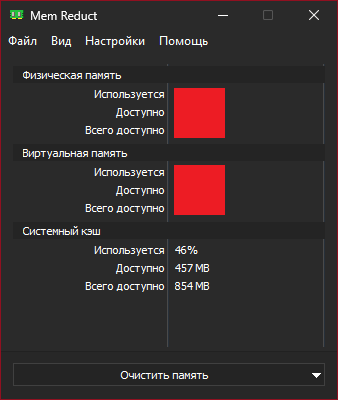
Lightweight real-time memory management application to monitor and clean system memory on your computer.
9.8k
Stars
574
Forks
26
Open issues
30
Contributors


AI Analysis
Mem Reduct is a lightweight Windows system utility that monitors and cleans system memory in real-time by managing cache, working sets, and page lists through low-level Native API calls. It targets power users and system administrators who want direct control over memory management on Windows 7 and later systems; it is not for macOS/Linux users or those seeking automatic, passive memory optimization.
Inferred from signals mentioned in the README (tests, CI, type safety) — not a review of the actual code.
AI's overall editorial judgment — not an average of the bars above, can weigh other factors too.
Windows memory cleaner uses undocumented Native API to free RAM and system cache
Mem Reduct is a lightweight Windows-only utility that monitors RAM usage in real-time and actively frees memory by flushing system working sets, standby page lists, and modified page lists via undocumented Windows Native API calls. It targets Windows desktop and power users — particularly those on older or memory-constrained hardware — who want manual or scheduled memory reclamation without third-party bloat. With nearly 10K stars and a decade of active maintenance, it has a clear, narrow purpose and a loyal user base in the Windows enthusiast and sysadmin communities.
Created in December 2014 by independent developer Henry++ (henrypp), the project has been maintained continuously for over 11 years, starting from Windows XP support and evolving to cover Windows 7 through 11, including ARM64.
Growth appears driven primarily by word-of-mouth in Windows power-user communities, forums like Reddit and Softpedia, and bundling in curated lists of free Windows utilities. The steady star accumulation (~41 stars/week as of mid-2026) suggests organic, sustained discovery rather than viral spikes. Its longevity and portability option likely contribute to persistent recommendations.
GitHub download badge is present in the README, suggesting total downloads are tracked, though the exact figure is not quoted here. The project appears on third-party software portals (Softpedia, MajorGeeks) based on its age and visibility, but specific download counts and enterprise usage are not verifiable from available metadata. Adoption is real but appears concentrated in individual Windows users rather than enterprise deployments.
Likely a single-process native Win32 application written in C, using undocumented Windows Native API (NtSetSystemInformation and related calls) to manipulate memory page lists. Appears to use a system tray icon with a small GUI. Supports both installer and portable deployment modes via an INI file. ARM64 support suggests the codebase has been updated for modern Windows architectures.
not documented in README
Last push was 2026-05-16, approximately 6 weeks before the evaluation date — indicating active maintenance. The project has been updated continuously for over a decade. GPG-signed binaries suggest attention to release hygiene. Given the narrow scope, infrequent releases are expected and do not indicate abandonment.
ADOPT IF: you are a Windows power user or sysadmin managing memory-constrained systems (older hardware, VMs, workstations with memory leaks in long-running apps) and want a free, open-source, portable tool for scheduled or manual memory cleanup. AVOID IF: you expect this to meaningfully accelerate a modern system with adequate RAM — forced memory freeing can cause performance regressions by evicting useful cache; also avoid if you need Linux/macOS support. MONITOR IF: you rely on undocumented Windows Native API calls that Microsoft could deprecate or break in future OS updates.
Independent dimensions
Mainstream potential
3/10
Technical importance
5/10
Adoption evidence
5/10
- Relies on undocumented Windows Native APIs that Microsoft could remove or break in future Windows releases without notice.
- Forced memory reclamation can hurt application performance by evicting beneficial file system cache, making the tool counterproductive on systems with sufficient RAM.
- Maintained by a single developer (henrypp); no organizational backing means bus-factor risk for long-term sustainability.
- ARM64 and newer Windows versions require ongoing testing that may lag behind OS releases given single-developer capacity.
- The effectiveness claim of '10-50% memory freed' depends heavily on usage pattern and system state; results may disappoint users on modern, well-managed systems.
Likely to remain a stable, slowly growing niche utility for Windows power users. Unlikely to expand scope significantly. Sustainability depends on the single maintainer's continued interest.
Newsletter
Get analyses like this every Monday
Free weekly digest of the most interesting open-source discoveries.
Languages
Information
- Language
- C
- License
- GPL-3.0
- Last updated
- 2mo ago
- Created
- 141mo ago
- Analyzed with
- anthropic/claude-haiku-4-5
Stars over time
Contributors over time
Top 100 contributors only — repos with more will plateau at 100.
Open issues
[Feature] 'Hide Tray Icon' Toggle
[Question] Is this website an official distribution channel?
[Bug] Spanish.ini
[Bug]The sinicization of Chinese is incomplete
[Feature] Exclusions
Top contributors
Similar repos

redis/memtier_benchmark
memtier_benchmark is a command-line load generation and benchmarking tool for...
| Repository | Stars | Week Δ | Language | Score | Updated |
|---|---|---|---|---|---|
|
henrypp/memreduct
this
|
9.8k | +71 | C | 7/10 | 2mo ago |
 bloomberg/memray bloomberg/memray
|
15.2k | — | Python | 8/10 | 13h ago |
 MemTensor/MemOS MemTensor/MemOS
|
10.2k | — | TypeScript | 8/10 | 1d ago |
 facebook/memlab facebook/memlab
|
5k | — | TypeScript | 8/10 | 2d ago |
|
redis/memtier_benchmark
|
1k | — | C++ | 8/10 | 1w ago |
 Diorser/LiteMonitor Diorser/LiteMonitor
|
5.7k | — | C# | 7/10 | 2mo ago |
RAMMap is a Microsoft-signed diagnostic tool that visualizes memory usage in detail but does not offer automated or scheduled cleaning. Mem Reduct fills the automation/cleanup gap RAMMap intentionally omits.
LiteMonitor (5.5K stars, C#) appears to focus on system monitoring broadly rather than active memory manipulation. Mem Reduct is more narrowly focused on memory cleaning specifically.
A commercial freeware alternative with a similar feature set. Mem Reduct differentiates itself by being fully open source under GPL-3.0, portable, and not bundled with adware or upsells.
Memray is a Python memory profiler for developers — a completely different use case. Listed as similar by stars but not functionally comparable; one profiles code, the other manages OS-level memory.
Task Manager shows memory usage but offers no mechanism to flush standby lists or system caches. Mem Reduct addresses the active reclamation gap that built-in tools do not provide.