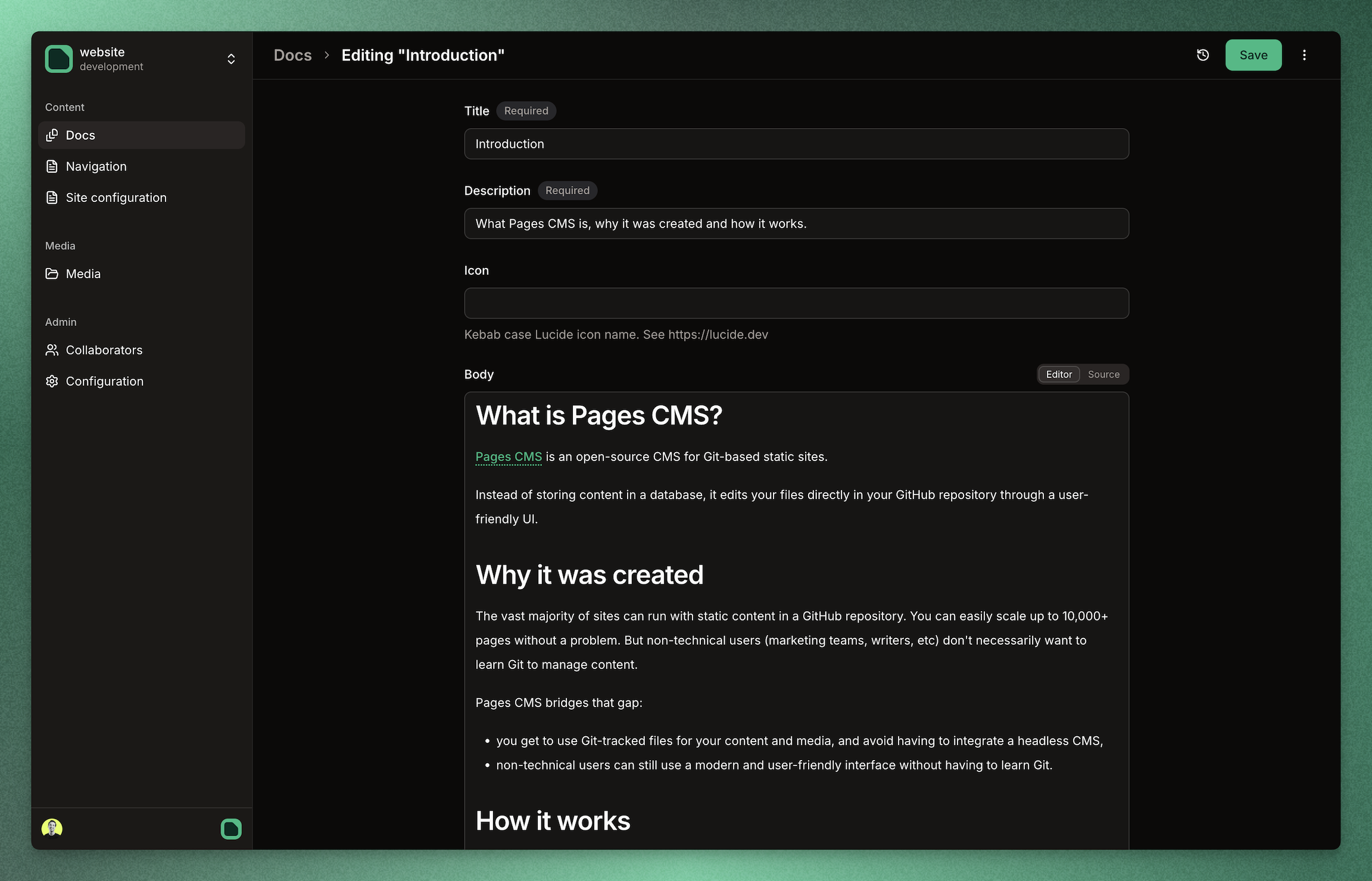
The simplest CMS you'll ever need. Manage content and media right in your GitHub repository.
3.8k
Stars
490
Forks
49
Open issues
8
Contributors


AI Analysis
Pages CMS is a GitHub-integrated content management system designed for static site generators and content-driven applications (Jekyll, Hugo, Next.js, Astro, VuePress, etc.). It enables non-technical users to manage content and media directly through a web interface without writing code, while storing everything in a GitHub repository. It serves teams building static sites who want editorial workflows without abandoning their existing toolchain.
Inferred from signals mentioned in the README (tests, CI, type safety) — not a review of the actual code.
AI's overall editorial judgment — not an average of the bars above, can weigh other factors too.
GitHub-native CMS for static sites; GitHub-repo-first workflow with hosted and self-hosted options
Pages CMS is a content management system designed for developers who host static sites or content-driven applications in GitHub repositories. It provides a web UI for editing markdown and media directly against GitHub repos, marketed as simpler than traditional headless CMS platforms. The project targets builders using Jekyll, Hugo, Next.js, Astro, and similar frameworks. Adoption appears concentrated in small-to-medium teams managing documentation and blogs; real-world adoption metrics are not publicly visible.
Project created December 2023; entered public visibility as an open-source alternative to hosted CMS platforms that abstract away the repository layer. Positioned in the emerging niche of 'GitHub-native' content tools, alongside Decap CMS and Outstatic, but with a narrower focus on simplicity over feature breadth.
Reached ~3,758 stars over ~18 months with steady, modest growth (4 stars in last 7 days as of 2026-06-27). Growth appears driven by targeted appeal to developers already using GitHub-based static site workflows rather than viral adoption. Recent activity (last push 2026-06-23) suggests active maintenance. No evidence of rapid acceleration or adoption cliff events.
Adoption not verified. No case studies, client logos, or deployment counts visible in README. Hosted version exists at app.pagescms.org but usage numbers not public. Community channel (Discord) mentioned but size unknown. GitHub stars and fork count suggest engagement but do not confirm production deployments at scale.
Based on README: TypeScript full-stack application with Next.js or similar framework layer, PostgreSQL backend, GitHub App OAuth integration, and browser-based UI for content editing. Likely uses server-side rendering and GitHub API webhooks for sync. Appears modular enough to run locally or hosted. Specific architectural details not documented in README.
Not documented in README. No CI/CD pipeline, testing framework, or coverage metrics mentioned.
Last push 2026-06-23 (4 days before analysis date) indicates active maintenance. Repository setup documentation is current and detailed. No evidence of abandoned issues or stalled PRs in visible metadata. Single primary maintainer (hunvreus) apparent from fork/star patterns. Appears actively maintained but possibly resource-constrained (one-person project signals).
ADOPT IF: your team uses GitHub for content, prefers editing markdown directly in pull requests with a UI layer, values simplicity and avoiding database-heavy CMS infrastructure, and is willing to self-host or trust a small maintained project. AVOID IF: you need enterprise-grade support, advanced content modeling, or large-scale team collaboration features; if you require SLA guarantees or commercial backing; or if you need audited security for regulated content. MONITOR IF: you are evaluating GitHub-native CMS options and want to see whether Pages CMS or Outstatic/Sveltia accumulate significantly more adoption and production evidence over the next 12 months.
Independent dimensions
Mainstream potential
3/10
Technical importance
5/10
Adoption evidence
2/10
- Single apparent maintainer creates sustainability risk; project could stall if maintainer loses interest or capacity.
- Production adoption not publicly documented; unclear how many live sites depend on this in production.
- No published SLA, security audit, or uptime metrics for hosted version; appropriate for open-source but limits enterprise adoption.
- Real-world feature limitations (content modeling, workflows, permissions) not evident from README; may constrain use cases after initial trial.
- Database requirement (PostgreSQL) for local deployment adds operational complexity versus purely static site builders; may deter smaller teams.
Pages CMS will likely remain a niche tool for developers comfortable with GitHub-native workflows and willing to self-manage infrastructure. Mainstream enterprise adoption unlikely without commercial backing or significant team expansion. Most probable outcome: stable, slow-growth project with dedicated user base in the 100–1,000 production deployment range (estimate unverified).
Newsletter
Get analyses like this every Monday
Free weekly digest of the most interesting open-source discoveries.
Languages
Information
- Website
- https://pagescms.org
- Language
- TypeScript
- License
- MIT
- Last updated
- 2w ago
- Created
- 31mo ago
- Analyzed with
- anthropic/claude-haiku-4-5
Stars over time
Contributors over time
Top 100 contributors only — repos with more will plateau at 100.
Open issues
Top contributors
Similar repos

decaporg/decap-cms
Decap CMS is a Git-backed headless CMS designed for static site generators and...

avitorio/outstatic
Outstatic is a static site CMS for Markdown and MDX content stored directly in...

sveltia/sveltia-cms
Sveltia CMS is a modern, open-source Git-based headless CMS designed as a full...
| Repository | Stars | Week Δ | Language | Score | Updated |
|---|---|---|---|---|---|
|
hunvreus/pagescms
this
|
3.8k | — | TypeScript | 7/10 | 2w ago |
 nuxt/content nuxt/content
|
3.6k | — | TypeScript | 8/10 | 1w ago |
|
decaporg/decap-cms
|
19.2k | — | JavaScript | 8/10 | 2d ago |
|
avitorio/outstatic
|
3.1k | — | TypeScript | 8/10 | 3d ago |
|
sveltia/sveltia-cms
|
2.6k | — | JavaScript | 8/10 | 10h ago |
 vuejs/vitepress vuejs/vitepress
|
18k | — | TypeScript | 9/10 | 1d ago |
Decap is significantly more established and feature-rich with broader framework support. Pages CMS positions itself as simpler and more GitHub-native. Decap has higher adoption but steeper learning curve; Pages CMS targets developers prioritizing simplicity over feature maximalism.
Similar positioning and star count. Both focus on GitHub-repo-first workflows. Outstatic emphasizes content modeling; Pages CMS emphasizes minimal setup. Direct competitors for the same niche; differentiation unclear from README alone.
Nuxt Content is a content layer for Nuxt apps; Pages CMS is an external editing UI. Different use cases: Nuxt Content for framework-integrated content; Pages CMS for non-developers editing repos. Not direct substitutes.
Lighter-weight, Svelte-based CMS. Similar star count and recency. Both position as simpler alternatives to Decap. Unclear which has better adoption or momentum without deployment data.