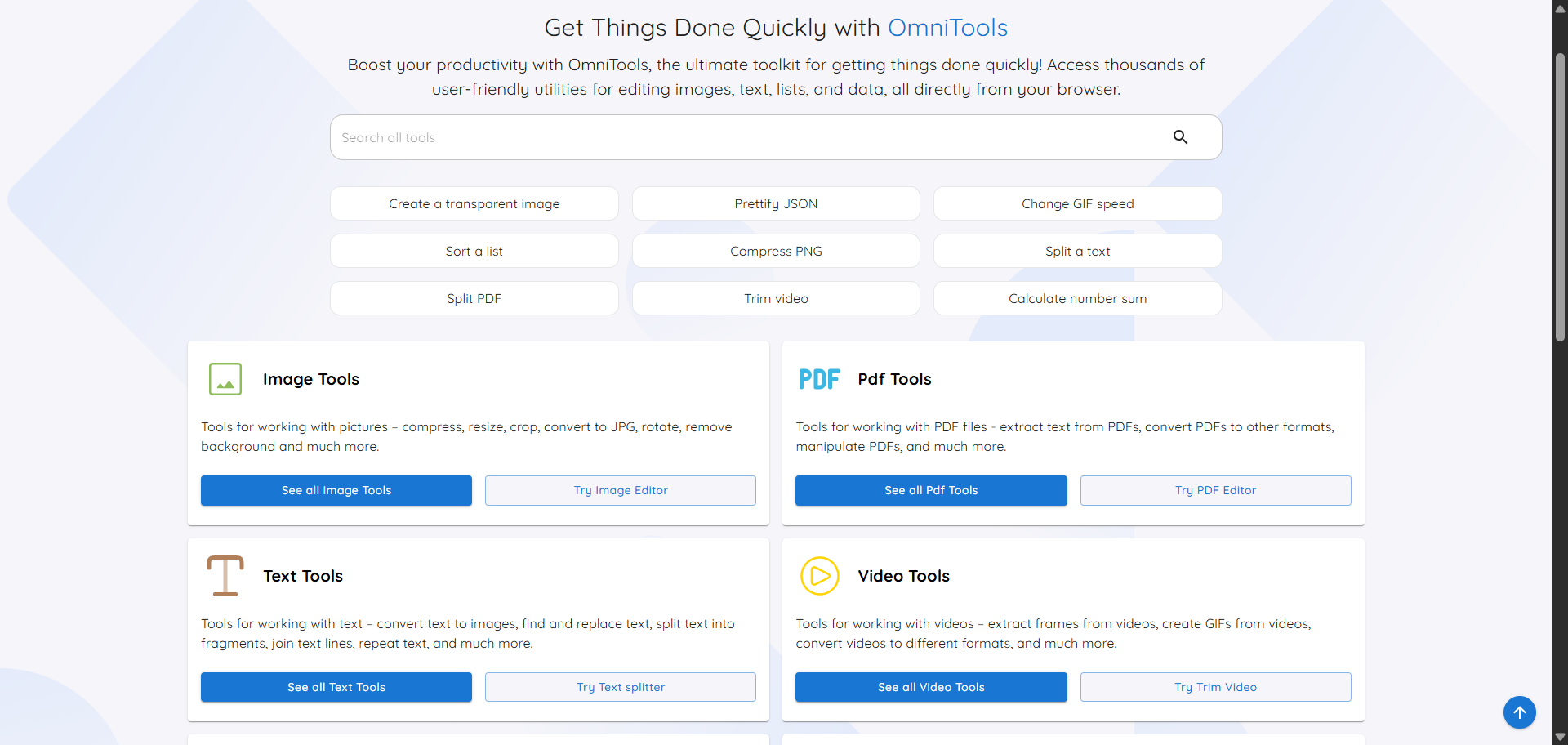
Self-hosted collection of powerful web-based tools for everyday tasks. No ads, no tracking, just fast, accessible utilities right from your browser!
9.8k
Stars
663
Forks
112
Open issues
30
Contributors


AI Analysis
OmniTools is a self-hosted web application providing a comprehensive collection of client-side utilities for image, video, PDF, text, date, math, and data manipulation. It serves developers, content creators, and everyday users who need privacy-respecting, ad-free tools without cloud dependencies. Best suited for individuals and small teams requiring local data processing; not intended as a cloud service replacement for enterprise-scale operations.
Inferred from signals mentioned in the README (tests, CI, type safety) — not a review of the actual code.
AI's overall editorial judgment — not an average of the bars above, can weigh other factors too.
Self-hosted, client-side utility toolkit for developers and privacy-minded users, packaged in a 28MB Docker image
OmniTools is a self-hosted web application offering a broad collection of browser-based utilities — image/video/audio processing, PDF manipulation, text formatting, date/math/data tools — all processed client-side with no server uploads. It targets developers, sysadmins, and privacy-conscious users who want an ad-free, tracking-free alternative to online converter sites, deployable on a home server or internal network via Docker. With ~9,758 stars acquired in roughly two years, it has gained meaningful community traction but remains well behind category leaders. The MIT license and contribution tooling (scaffolding scripts, i18n via Locize) suggest the project is designed for community growth.
Created in June 2024, OmniTools is a relatively young project (~2 years old as of mid-2026). It appears to have grown organically through developer communities and self-hosting enthusiast circles, with a Trendshift badge suggesting at least one notable trending episode on GitHub.
The project likely caught attention in self-hosting communities (Reddit r/selfhosted, Hacker News) where privacy-first, lightweight Docker tools are consistently popular. The 28MB image size and zero-server-processing pitch are effective differentiators for that audience. Star growth rate of ~29/week as of mid-2026 suggests the initial viral spike has passed and the project is settling into slower but steady organic growth — not stagnant, but past its peak momentum.
Docker Hub pull count is displayed as a badge but the exact number is not available in the provided metadata. The existence of a live demo at omnitools.app and a Discord community provides indirect evidence of real user engagement. A Trendshift badge confirms at least one measurable trending period. Concrete production deployment numbers are not verified from available data.
Appears to be a React + TypeScript single-page application using Material UI for the component layer and Iconify for icons. All processing is described as client-side (browser APIs, WebAssembly likely for media tasks). The Docker image serves static files via a lightweight web server (implied by 28MB image size). Likely a pure frontend build with no backend runtime.
README documents both unit tests (npm run test) and end-to-end tests (npm run test:e2e), indicating a testing infrastructure exists. Coverage levels and CI enforcement are not documented in the README.
Last push was May 4, 2026 — approximately 7 weeks before the evaluation date. For a utility toolkit, this is acceptable maintenance cadence, not stagnant. The project is at version 0.6.0, signaling it is still pre-1.0 and actively developed. A Discord server, Locize-based i18n, and contributor scaffolding scripts all point to an intentionally maintained community project.
ADOPT IF: you self-host services, want an all-in-one browser utility suite with zero data leaving the device, and value easy Docker deployment with a tiny footprint. AVOID IF: you need production-grade, deeply specialized tools (e.g., professional PDF editing or broadcast video processing) — breadth is the goal here, not depth. MONITOR IF: you are evaluating it for team or enterprise internal tooling; the pre-1.0 versioning and evolving tool set mean the API surface and feature list are still changing.
Independent dimensions
Mainstream potential
4/10
Technical importance
4/10
Adoption evidence
4/10
- Breadth-first approach means individual tools may have shallower functionality than dedicated single-purpose alternatives; quality consistency across tools cannot be verified without code inspection.
- Pre-1.0 versioning (0.6.0) indicates the project may still have breaking changes, incomplete tools, or unstable UX patterns between releases.
- Heavy dependence on a single primary maintainer (iib0011) is a bus-factor risk; contributor diversity appears limited based on typical early-stage open source patterns, though this cannot be confirmed without contributor graph analysis.
- Client-side media processing (video trimming, image conversion) in the browser can be significantly slower or memory-constrained compared to server-side or native tools, particularly for large files — the README does not document performance boundaries.
- The category is crowded and the dominant competitor (it-tools) has a 4x star advantage and longer track record, which may limit OmniTools' ability to attract contributors and retain mindshare over time.
OmniTools will likely stabilize as a respected second-tier option in the self-hosted utility space, growing steadily within homelab and privacy communities without displacing it-tools as the default recommendation.
Newsletter
Get analyses like this every Monday
Free weekly digest of the most interesting open-source discoveries.
Languages
Information
- Website
- https://omnitools.app
- Language
- TypeScript
- License
- MIT
- Last updated
- 2mo ago
- Created
- 25mo ago
- Analyzed with
- anthropic/claude-haiku-4-5
Stars over time
Contributors over time
Top 100 contributors only — repos with more will plateau at 100.
Open issues
Top contributors
Recent releases
Similar repos

snapotter-hq/SnapOtter
SnapOtter is a self-hosted file manipulation platform offering 200+ tools for...
| Repository | Stars | Week Δ | Language | Score | Updated |
|---|---|---|---|---|---|
|
iib0011/omni-tools
this
|
9.8k | +25 | TypeScript | 7/10 | 2mo ago |
 omni-media/omniclip omni-media/omniclip
|
1.4k | — | TypeScript | 7/10 | 20h ago |
 CorentinTh/it-tools CorentinTh/it-tools
|
39.7k | — | Vue | 8/10 | 4w ago |
|
snapotter-hq/SnapOtter
|
1.9k | — | TypeScript | 8/10 | 7h ago |
 tonhowtf/omniget tonhowtf/omniget
|
6.6k | — | Rust | 8/10 | 9h ago |
 DevToys-app/DevToys DevToys-app/DevToys
|
31.8k | — | C# | 8/10 | 5mo ago |
The most direct competitor with 39,499 stars and a Vue-based architecture. It-tools is more established, has a larger contributor base, and likely broader tool coverage. OmniTools differentiates on media/PDF tooling (video trimmer, PDF editor) which it-tools does not emphasize. Both are self-hosted and privacy-first.
DevToys targets desktop (Windows/Mac/Linux) rather than browser-based self-hosting. Overlaps in developer utility use cases (JSON, text tools) but serves a different deployment model. Not a direct substitute for users who want a web UI accessible across a LAN.
ConvertX focuses specifically on file conversion and has 17,056 stars. It is more specialized and server-side in its processing model, whereas OmniTools is broader and fully client-side. OmniTools may be preferred where data privacy from the server itself matters.
BentoPDF focuses narrowly on PDF operations with 13,840 stars. OmniTools overlaps on PDF tooling but is not specialized; users with heavy PDF workflows may prefer a dedicated tool.
Despite the similar name, omniget appears to be a different type of utility tool (Rust-based). Direct comparison is not meaningful based on available metadata.