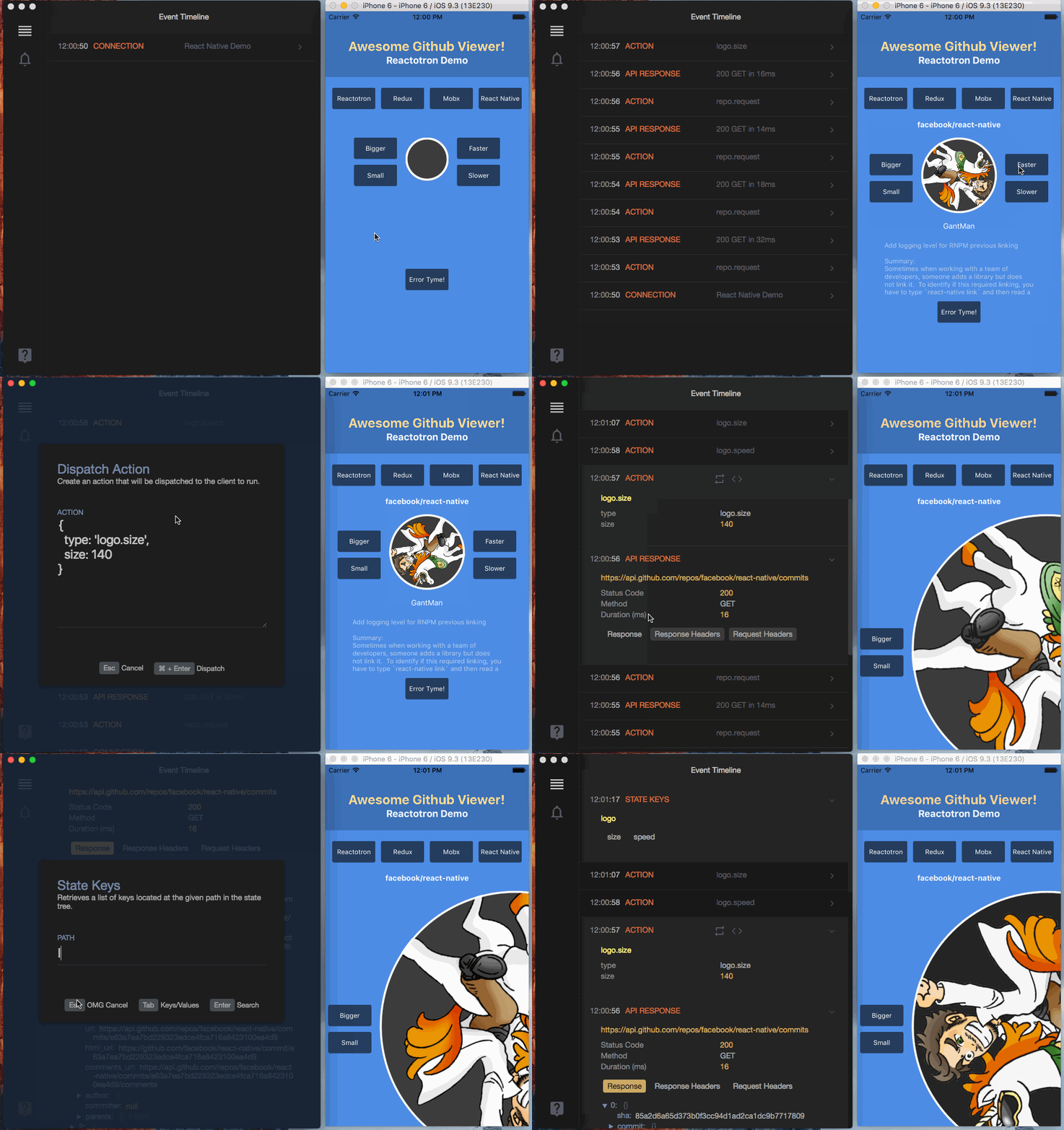
A desktop app for inspecting your React JS and React Native projects. macOS, Linux, and Windows.
15.6k
Stars
973
Forks
153
Open issues
30
Contributors



AI Analysis
Reactotron is a desktop debugging tool for React and React Native applications that enables developers to inspect application state, network requests, performance metrics, and manage Redux or mobx-state-tree state in real-time. It is a specialized developer tool best suited for React/React Native teams who need in-depth runtime inspection capabilities during development, and is less relevant for developers using other frameworks or those needing production-level monitoring. The tool is mainta...
Inferred from signals mentioned in the README (tests, CI, type safety) — not a review of the actual code.
AI's overall editorial judgment — not an average of the bars above, can weigh other factors too.
Reactotron: A dedicated desktop debugger for React and React Native with state, network, and performance inspection
Reactotron is a desktop debugging application built by Infinite Red that connects to React and React Native apps via a WebSocket bridge, exposing state (Redux, MobX-State-Tree), network traffic, logs, async storage, and custom commands in a unified GUI. It targets React Native developers especially, filling a gap that browser DevTools cannot cover — particularly for native mobile development workflows. With 15K+ stars, a decade of history, and active maintenance as of mid-2026, it is a recognized tool in the React Native consulting and indie dev community.
Created in April 2016 by Infinite Red's Steve Kellock, Reactotron predates many modern React Native debugging options. It evolved through major rewrites, gained plugin ecosystem depth, and became a default in Infinite Red's own project scaffolding (Ignite CLI), giving it organic embedded adoption.
Growth was driven primarily by the React Native boom (2016-2020), Infinite Red's consulting brand, integration with their popular Ignite boilerplate, and conference talks like Chain React 2018. Star growth has plateaued — only 2 stars gained in the last 7 days — suggesting the tool has found its stable audience rather than actively expanding. It is in mature maintenance mode rather than a growth phase.
Used internally by Infinite Red on client projects daily per the README. Integrated into Ignite CLI boilerplate, which has its own substantial adoption in the React Native community. NPM download counts for reactotron-react-native are publicly available and historically in the hundreds of thousands per month, suggesting meaningful real-world usage, though current figures cannot be confirmed from this metadata alone.
Appears to be a monorepo (README references monorepo docs) with a TypeScript codebase split across a desktop Electron app and multiple npm client libraries (reactotron-react-native, reactotron-react-js, plugin packages). Communication likely occurs via a local WebSocket server in the desktop app that client SDKs connect to. Plugin architecture appears modular based on the extensive plugin list documented.
Not documented in README
Last push was 2026-05-29, approximately 3.5 weeks before the evaluation date. This indicates active maintenance. The project has 70+ contributors and is backed by a professional company (Infinite Red) with commercial interest in keeping it functional. Maintenance appears steady rather than sporadic.
ADOPT IF: you are building React Native apps, especially with Redux or MobX-State-Tree, and want a unified external dashboard for state, network, and log inspection without cluttering the app UI — or if you use Infinite Red's Ignite boilerplate. AVOID IF: you are building browser-only React apps where browser DevTools and Redux DevTools browser extensions fully cover your needs, or if your team cannot tolerate the setup overhead of a running desktop app alongside a simulator/device. MONITOR IF: you are tracking the React Native debugging tooling landscape to see whether Flipper, Expo's built-in tooling, or other integrated solutions absorb Reactotron's niche over the next 1-2 years.
Independent dimensions
Mainstream potential
3/10
Technical importance
7/10
Adoption evidence
6/10
- Star growth has effectively plateaued, suggesting limited new developer discovery; the tool may gradually lose mindshare as platform-native debugging improves in Expo and Metro.
- Depends on Infinite Red's continued commercial investment; if their consulting focus shifts, maintenance pace could slow significantly despite community contributors.
- The desktop app + WebSocket bridge architecture introduces connection reliability issues (firewall, emulator networking) that can frustrate new users, as noted in troubleshooting docs.
- React Native's debugging ecosystem is in flux (Hermes, new architecture, Expo DevTools) — Reactotron must continuously adapt its integration layer or risk compatibility gaps.
- Relatively narrow adoption outside the React Native / Infinite Red ecosystem; usage in broader React JS web projects appears limited based on available signals.
Reactotron will likely remain a stable, well-maintained niche tool for the React Native consulting and mid-size app segment, sustaining its current user base without significant growth, unless a major ecosystem shift forces consolidation.
Newsletter
Get analyses like this every Monday
Free weekly digest of the most interesting open-source discoveries.
Languages
Information
- Language
- TypeScript
- License
- MIT
- Last updated
- 1mo ago
- Created
- 125mo ago
- Analyzed with
- anthropic/claude-haiku-4-5
Stars over time
Contributors over time
Top 100 contributors only — repos with more will plateau at 100.
Open issues
Network requests not captured on Expo SDK 56
Can the time format in the Timeline support custom adjustments?
Custom Commands page shows duplicates with multiple connections
Timeline command components crash on unexpected payload shapes
Redux plugin sends `undefined` instead of `[]` for state keys on non-object paths
Top contributors
Similar repos

reduxjs/redux-devtools
Redux DevTools is a developer-focused debugging and state inspection tool for...

aidenybai/react-scan
React Scan is a developer tool that automatically detects and highlights React...
| Repository | Stars | Week Δ | Language | Score | Updated |
|---|---|---|---|---|---|
|
infinitered/reactotron
this
|
15.6k | +4 | TypeScript | 8/10 | 1mo ago |
|
reduxjs/redux-devtools
|
14.4k | — | TypeScript | 8/10 | 2w ago |
|
aidenybai/react-scan
|
21.6k | — | TypeScript | 8/10 | 2w ago |
 responsively-org/responsively-app responsively-org/responsively-app
|
25k | — | TypeScript | 8/10 | 3d ago |
Redux DevTools is browser-extension-based and tightly scoped to Redux state inspection. Reactotron covers Redux but also network, logs, MST, and React Native-specific features like Async Storage. For browser-only React apps, Redux DevTools is more native to the workflow; for React Native, Reactotron has no direct browser-extension equivalent.
React Native Debugger is a standalone Chromium-based app wrapping Chrome DevTools with Redux DevTools integration. It offers JS debugging (breakpoints, profiling) that Reactotron does not. They are complementary rather than directly competing — Reactotron excels at runtime observability; React Native Debugger at JS execution debugging.
Flipper is Meta's official extensible desktop debugger for React Native with broader native plugin support (layout inspector, network, crash reporter). It has stronger institutional backing but has faced reliability complaints and dependency complexity. Reactotron is simpler to set up for its core use cases and more focused.
react-scan focuses narrowly on detecting unnecessary React re-renders with a visual overlay approach. It solves a specific performance visibility problem. Reactotron's scope is much broader (state, network, logs, custom commands), so these tools address largely different debugging needs and are not direct substitutes.
State-management-specific devtools integrations are becoming more common as ecosystems mature. These are in-browser overlays scoped to their library. Reactotron's external desktop window approach has the advantage of not cluttering the app UI but requires more setup and a running desktop app.