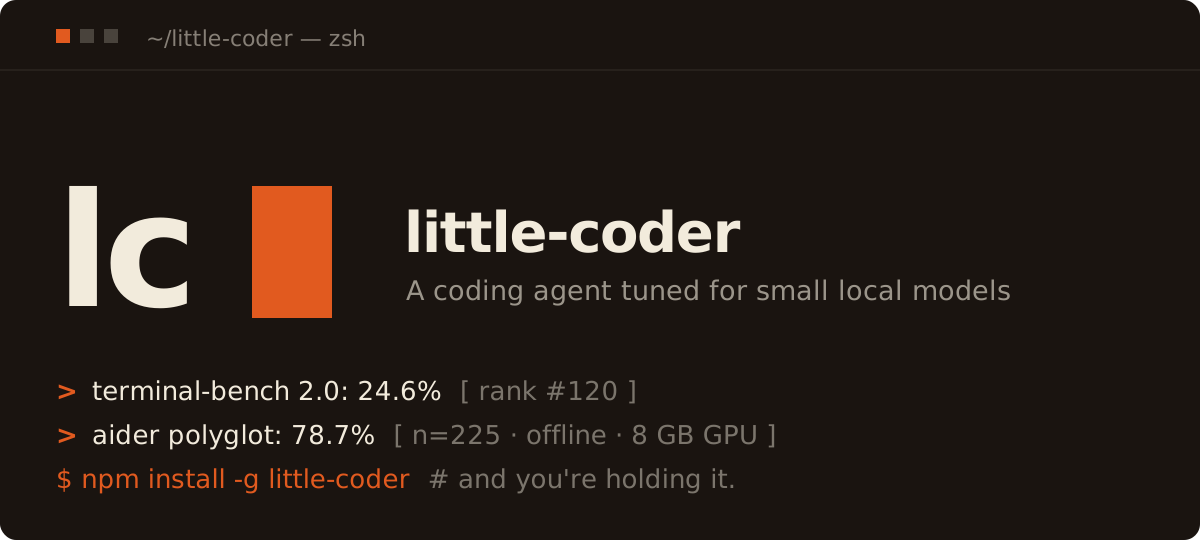
A harness optimized to smaller LLMs
1.7k
Stars
111
Forks
6
Open issues
6
Contributors


AI Analysis
little-coder is a coding agent harness optimized for smaller local language models (e.g., Qwen 3.6-35B), built on top of the pi agent framework. It targets developers who want to run coding agents on modest hardware without relying on frontier cloud models, combining 20 extensions, 30 skill files, and a Python benchmark suite. This tool is purpose-built for the small-model niche and is not a general-purpose coding assistant.
Inferred from signals mentioned in the README (tests, CI, type safety) — not a review of the actual code.
AI's overall editorial judgment — not an average of the bars above, can weigh other factors too.
Lightweight coding agent framework tuned for small local language models
little-coder is a TypeScript harness built on the pi agent framework, designed specifically to run coding tasks on smaller local LLMs (7B–35B parameter range). It bundles 20 extensions, 30 skill files, and a Python benchmark suite. The author claims a 9.7B Qwen model matched frontier model performance on Aider Polyglot. Adoption appears concentrated among developers running local models who want an alternative to cloud-dependent agents.
Created April 2026, little-coder emerged as a focused response to the observation that agent-architecture fit matters more than raw model capability. It wraps the minimal pi substrate (agent loop, multi-provider API, TUI) with domain-specific tuning for code generation and local execution.
Rapid early traction (1,636 stars in ~2.5 months, 77 gained in last 7 days) suggests strong initial interest among the local-model enthusiast segment. The accompanying Substack writeup explaining the research behind scaffold–model fit likely drove discovery. However, absolute star count remains modest compared to larger agent frameworks (llamacoder: 6,980; earendil-works/pi itself: 66,248), indicating the project remains in early adoption within a specific niche.
Adoption not verified. The README describes setup and usage but provides no case studies, deployment counts, or explicit user testimonials. The Substack post may contain adoption evidence but is outside the accessible metadata. Stars and forks are growing but do not constitute verified production usage.
Based on README, little-coder does not fork pi but layers on top: extensions live in `.pi/extensions/`, skills in `skills/`, benchmarks in a Python harness. Launcher runs pi with `--no-extensions` and injects only the bundled set. This design allows users to add/remove extensions by directory manipulation and to load custom extensions via environment variable or CLI flag. Appears to follow a modular, composition-based pattern rather than monolithic inheritance.
Not documented in README. A Python benchmark harness is mentioned but no details on scope, test suite structure, or CI/CD pipeline are provided.
Last push 2026-06-22 (7 days before evaluation date) indicates active maintenance. Project is 2.5 months old, so 'stagnation' is not applicable; the velocity is consistent with an early-stage, focused project. No indicators of abandonment or neglect.
ADOPT IF: you run local models (7B–35B range), want a pre-tuned agent harness with minimal cloud dependency, and are comfortable with TUI workflows. The composition-based extension model and read-before-edit discipline suggest thoughtful design. AVOID IF: you need a cloud-first solution, require production-grade observability/monitoring, or depend on extensive real-world deployment evidence before committing. MONITOR IF: you are evaluating local-model agent frameworks; this project's performance claims (9.7B Qwen parity with frontier models) are noteworthy but require independent validation beyond the benchmark harness.
Independent dimensions
Mainstream potential
3/10
Technical importance
6/10
Adoption evidence
2/10
- Adoption is not verified beyond GitHub metrics; no public deployments or user case studies are documented.
- Project is very new (2.5 months); long-term maintenance and feature stability are unknown.
- Performance claims rely on a custom Python benchmark; independent benchmarks against Aider and other frameworks are absent from README.
- Dependency on pi framework means changes to pi's API or direction could disrupt little-coder; this is architectural fragility, not technical quality.
- Test coverage is undocumented; code quality cannot be assessed from metadata alone.
little-coder will likely remain a specialized tool for local-model enthusiasts rather than mainstream adoption. Its value depends on sustained performance parity with larger models and continued interest in on-device LLM inference. If local models plateau or cloud inference becomes unavoidable, adoption may stagnate; if on-device AI grows, little-coder may evolve into a standard local-agent framework.
Newsletter
Get analyses like this every Monday
Free weekly digest of the most interesting open-source discoveries.
Languages
Information
- Language
- TypeScript
- License
- Apache-2.0
- Last updated
- 4d ago
- Created
- 3mo ago
- Analyzed with
- anthropic/claude-haiku-4-5
Stars over time
Contributors over time
Top 100 contributors only — repos with more will plateau at 100.
Open issues
little-coder does not use pi extensions and themes
[REQUEST] Update notification should relaunch upon install
[REQUEST] Enable default local model
My Local Coding Model Recommendations (After Testing 50+ Models)
[REQUEST] Per-phase model selection (plan model vs action model)
Open pull requests
Top contributors
Similar repos

Doorman11991/smallcode
SmallCode is a terminal-native AI coding agent optimized to run effectively on...
| Repository | Stars | Week Δ | Language | Score | Updated |
|---|---|---|---|---|---|
|
itayinbarr/little-coder
this
|
1.7k | +56 | TypeScript | 8/10 | 4d ago |
|
Doorman11991/smallcode
|
2k | — | JavaScript | 7/10 | 3w ago |
 QwenLM/qwen-code QwenLM/qwen-code
|
25.9k | — | TypeScript | 8/10 | 7h ago |
 1jehuang/jcode 1jehuang/jcode
|
8.3k | — | Rust | 8/10 | 9h ago |
 earendil-works/pi earendil-works/pi
|
69.4k | — | TypeScript | 8/10 | 2h ago |
 Nutlope/llamacoder Nutlope/llamacoder
|
7k | — | TypeScript | 7/10 | 19h ago |
little-coder is explicitly built *on* pi, not against it. pi is the minimal agent substrate; little-coder adds domain-specific tuning, extensions, and benchmarks. little-coder does not replace pi but demonstrates one opinionated configuration of it.
llamacoder is a full-stack web UI for code generation. little-coder is a TUI harness for local models. llamacoder appears optimized for ease-of-use and cloud models; little-coder for control and local execution. Different user profiles.
JavaScript-based, similar star count. README excerpt does not clarify its specific focus; insufficient evidence to characterize the comparison directly.
Aider is the benchmark against which little-coder claims performance parity (9.7B Qwen matching frontier performance on Aider Polyglot). Aider is a mature, widely-adopted CLI tool; little-coder is a newer framework claiming superior local-model efficiency.
Another pi-based project with higher star count (15,022). Suggests a growing ecosystem of pi extensions and configurations. little-coder's positioning within that ecosystem is not fully clarified in the README.